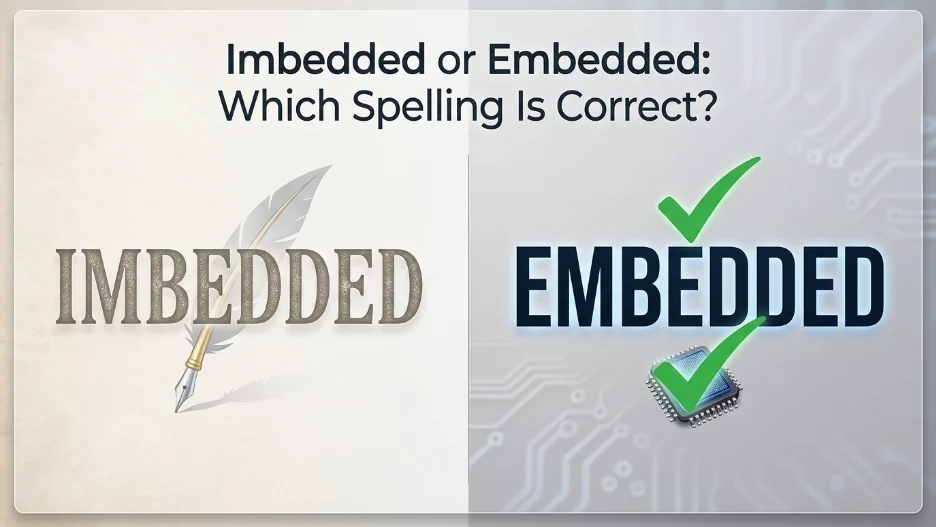
Embedded is the preferred and more commonly used spelling in modern English. It is the standard past tense and past participle of embed, meaning to fix firmly within something (e.g., “The journalist was embedded with the military.”).Imbedded is an older variant spelling that is still recognized but is rarely used today. For most academic, professional, and everyday writing, embedded is the recommended choice
Many English writers wonder whether imbedded or embedded is the correct spelling. Both words refer to something that is firmly fixed, inserted, or enclosed within something else. Because both forms appear in dictionaries and older texts, it’s easy to assume they are used equally in modern English.
Today, embedded is the standard and overwhelmingly preferred spelling in both American and British English. Although imbedded is still recognized as a variant, it is considered less common and is rarely used in contemporary writing. This guide explains the differences, usage, examples, and why embedded is the better choice for most situations.
Quick Answer Table
| Feature | Embedded | Imbedded |
| Correct Spelling | Yes | Yes |
| Preferred Spelling | Yes | No |
| Meaning | Fixed firmly in a surrounding mass; made an integral part of a larger whole | Same as “embedded” |
| Usage | Standard in modern English; recommended in all style guides | Rare, alternative spelling; considered archaic by some |
| Example Sentence | The video was embedded in the webpage. | The video was imbedded in the webpage. |
Which One Is Correct?
Both “embedded” and “imbedded” are correct spellings of the same word. They share identical meanings and can be used interchangeably in any context. However, “embedded” is the clear winner in terms of frequency and acceptance in modern English.
The distinction between “imbedded or embedded” is primarily a matter of spelling preference rather than meaning. If you’re writing for a general audience, “embedded” is your safest choice .
Think of it this way: “imbedded” is like a vintage car—it runs fine and looks interesting, but you wouldn’t take it to a modern racetrack expecting to compete. “Embedded” is the reliable vehicle that dominates today’s roads.
Meaning of the Correct Word: Embedded
Definition
“Embedded” functions as both the past tense and past participle of the verb “embed.” It can also serve as an adjective. The word has several related meanings, all centered around the concept of being firmly fixed or integrated within something else .
Explanation
When we say something is embedded, we typically mean it is:
- Physically fixed within a surrounding substance
- Digitally inserted into a file, document, or webpage
- Figuratively integrated as an essential part of a larger whole
The term carries connotations of permanence and integration. Something embedded isn’t just placed on the surface; it’s worked into the very fabric of whatever contains it.
Usage in Various Contexts
Physical Context: “The fossils were embedded in layers of sedimentary rock.”
Digital Context: “Click the link to watch the embedded video.”
Figurative Context: “The values of honesty and integrity are deeply embedded in the company culture.”
Journalistic Context: “The embedded reporter sent dispatches from the front lines.”
Linguistic Context: “The sentence contains an embedded clause that adds complexity.”
Meaning of the Incorrect or Alternative Word: Imbedded
Is It Incorrect?
“Imbedded” is not incorrect. It is a valid alternative spelling of “embedded” .
A Rare Valid Usage
While both spellings are acceptable, “imbedded” is much less common in modern usage. Some writers might choose it to achieve a specific stylistic effect or to evoke an older, more literary tone. In technical contexts, such as statistics, “imbedded” has occasionally been used to describe specific processes, but this usage is highly specialized .
Why It’s Less Common
The primary reason “imbedded” has fallen out of favor is the overwhelming preference for “embedded” in contemporary English. Many style guides explicitly recommend “embedded” as the standard spelling.
Key Differences Between Imbedded and Embedded
Spelling
The only difference is the first letter—”e” versus “i.” “Embedded” uses the prefix “em ,” while “imbedded” uses “im .”
Meaning
There is no difference in meaning between these spellings. Both refer to the same concepts of fixation, integration, and enclosure .
Pronunciation
Both spellings are pronounced identically: /ɛmˈbɛdɪd/ (em BED id) . You would never guess the spelling difference from hearing someone say the word.
Grammar
Both function as adjectives and as past tense verb forms. They are used in identical grammatical structures.
Usage
This is where the real difference lies. “Embedded” is far more common, especially in formal writing, digital contexts, and journalism. Style guides consistently recommend “embedded” as the preferred spelling .
| Usage Context | Preferred Spelling | Example |
| Academic writing | Embedded | “The findings are embedded in a broader theoretical framework.” |
| Journalism | Embedded | “The reporter was embedded with the battalion.” |
| Digital/Technology | Embedded | “The system uses embedded processors.” |
| Creative Writing | Either, but usually “embedded” | “Memories are embedded in the landscape.” |
Recognition
“Embedded” is universally recognized and understood. “Imbedded” might be considered a minor spelling error in some contexts, particularly where editors or automated systems flag it as nonstandard.
Common Mistakes People Make
1. Assuming One Is Wrong
The most common mistake is believing that “imbedded” is incorrect. Many people automatically correct “imbedded” to “embedded,” not realizing both are valid.
2. Overusing “Imbedded” for Effect
While “imbedded” is acceptable, overusing it can make your writing seem dated or quirky. It’s best reserved for specific stylistic purposes.
3. Mixing Spellings Inconsistently
Using “imbedded” in one paragraph and “embedded” in the next is inconsistent and can confuse readers. Choose one and stick with it.
4. Using “Imbedded” in Formal or Technical Writing
Although not technically wrong, “imbedded” is discouraged in most formal contexts. Stick with “embedded” for academic papers, business reports, and technical documentation.
Correct Usage Examples
Casual Examples
- “I embedded the link in my Instagram bio so people can find my website.”
- “The chocolate chips were embedded throughout the cookie.”
- “There’s an embedded video in the blog post that explains everything.”
Professional Examples
- “The new software will be embedded in our existing infrastructure.”
- “Ethical considerations should be embedded in every stage of product development.”
- “We are looking for an embedded systems engineer to join our team.”
- “The journalist was embedded with the unit for six months.”
Educational Examples
- “The teacher embedded vocabulary lessons into the reading assignments.”
- “Students learned about embedded clauses in grammar class.”
- “The university offers a certificate program in embedded systems design.”
Literary/Metaphorical Examples
- “Sorrow was embedded in the old house’s walls, a permanent resident.”
- “The truth, once embedded in her heart, could not be shaken.”
- “His childhood memories were embedded in the landscape of the small town.”
Word Origin / Etymology
The history of “embedded” and “imbedded” is a fascinating journey through the development of the English language.
Early Roots
The root of both words lies in the Old English word bedd, meaning “bed.” This evolved into the Middle English bedden, meaning “to make a bed.” The prefix “en ” (or “em “) was added to create “embeden,” which meant to place something in a bed or layer .
First Appearance
The spelling “imbed” first appeared in print in 1778, while “embed” followed in 1794 . This shows that both spellings have coexisted for over two centuries.
The Prefix Confusion
The variation stems from two different prefixes:
- “Em ” comes from Old French and is a variant of the prefix “en “
- “Im ” is a variant of the prefix “in “
Both prefixes mean “in” or “into.” Over time, spellings with both prefixes arose and sometimes diverged in meaning. In this case, the meaning remained the same while the spelling diverged .
Linguistic Relatives
Similar prefix variations exist in other English words:
- “Enquire” and “inquire” (essentially the same meaning)
- “Ensure” and “insure” (now have different meanings)
- “Emigrate” and “immigrate” (now have distinct meanings)
Why the Incorrect Version Became Popular
“Imbedded” became popular through a combination of historical factors and linguistic patterns.
Historical Precedence
The prefix “im ” was commonly used with words starting with “b” (like imbibe), “m” (like immerse), and “p” (like impress). This pattern made “imbed” seem natural .
Variation Without Consequence
For much of the 18th and 19th centuries, spelling was less standardized than it is today. Writers often chose spellings based on personal preference or regional convention, and “imbed” was a recognized choice .
Continued Usage
“Imbedded” continued to appear in published works by respected authors. For example, Sylvia Plath wrote about something being “imbedded in the network of one’s individuality” .
The Power of Habit
Once a spelling becomes established, it can persist for generations. Some writers continue to use “imbedded” simply because it’s what they learned.
Easy Memory Tricks
“E” for Everyday
Remember that “E” stands for everyday—and “embedded” is the spelling you’ll see most often in everyday writing.
“I” for I’d Rather Not
When deciding between “imbedded or embedded,” think of the “I” as standing for “I’d rather not”—because using “imbedded” is generally not recommended in modern writing.
The Embedder
Picture the word “embed” and remember that the “e” is for “electronic”—a reminder that digital contexts almost always use “embedded.”
Visualize It
Imagine a video embedded in a webpage. The code uses an “e,” and that’s the spelling you should use too.
Pronunciation Clue
Both words sound the same when spoken. If you’re unsure which spelling to use, choose “embedded” as the default.
Frequently Asked Questions
What is the difference between imbedded and embedded?
There is no difference in meaning between “imbedded” and “embedded.” They are alternative spellings of the same word, with “embedded” being the far more common and preferred choice in modern English .
Is imbedded a word?
Yes, “imbedded” is a word. It is a valid but less common spelling variant of “embedded .
Which is correct: imbedded or embedded?
Both spellings are technically correct. However, “embedded” is recommended in all major style guides and is the standard spelling in modern English .
How do you spell embedded in the UK?
Embedded” is the standard spelling in both British and American English. “Imbedded” is less common in both varieties but can occasionally be found in British texts .
What does “imbedded” mean?
“Imbedded” means the same as “embedded”: fixed firmly in a surrounding mass or made an integral part of a larger whole .
Is “imbedded” a misspelling of “embedded”?
No, “imbedded” is not a misspelling. It is an alternative spelling, though it is less common. However, some editors and spell checkers may flag it as an error because “embedded” is strongly preferred .
Why is “embedded” more common than “imbedded”?
The spelling “embedded” has become more common due to its adoption in technology contexts (like embedded systems), its prevalence in journalism (embedded reporters), and recommendations from major style guides .
Can I use “imbedded” in academic writing?
It is best to use “embedded” in academic writing. Most style guides and academic journals recommend “embedded” as the standard spelling .
Conclusion
The “imbedded or embedded” question is one of the English language’s less contentious debates. Both spellings are correct, but “embedded” has clearly emerged as the standard in modern usage. It appears more frequently in everything from casual blog posts to academic papers and technical documentation.
When in doubt, choose “embedded.” It’s the spelling recognized by dictionaries, recommended by style guides, and expected in most professional contexts. Its dominance is particularly pronounced in digital and technological contexts, where “embedded” has become the standard term for everything from online videos.