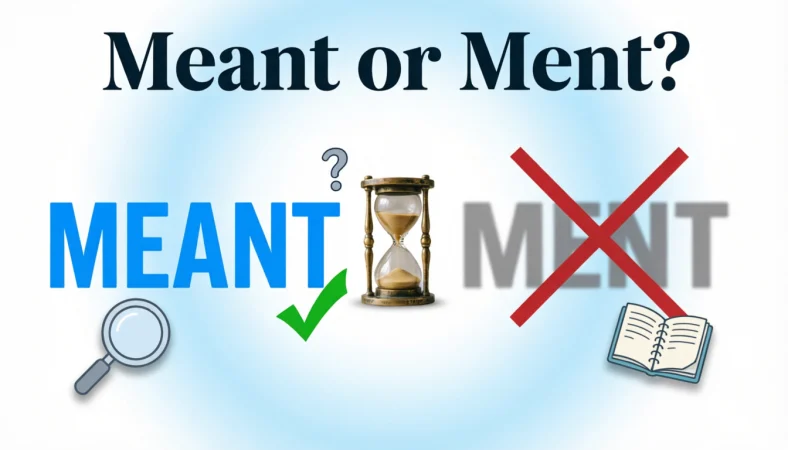
Quick answer:Meant is the correct spelling.
Ment is not a correct English word and is usually just a spelling mistake.Meant is the past tense and past participle of mean, meaning intended, signified, or had a purpose
Meant or Ment is a common spelling confusion because these words look very similar, but only one is correct in standard English. Meant is the proper spelling and is the past tense of the verb mean, while ment is simply an incorrect spelling that does not have a recognized meaning in English.
Understanding the difference between meant and ment helps you avoid a common writing mistake. Since meant is used to express intention, purpose, or meaning from the past, using the correct form improves clarity and makes your communication more accurate
Quick Answer Table
| Feature | Meant | Ment |
| Correct Spelling | Yes | No |
| Status | Standard English word | Common misspelling/typo |
| Part of Speech | Verb (past tense of “mean”) | Not a standard word |
| Meaning | Intended, signified, or implied | No recognized meaning |
| Pronunciation | /mɛnt/ (rhymes with “bent”) | /mɛnt/ (identical pronunciation) |
| Example | “I meant to call you yesterday.” | “I ment to call you yesterday.” |
Which One Is Correct?
Let’s address the elephant in the room immediately: meant is the correct spelling. “Ment” is not a standard English word and is universally considered a spelling error.
The confusion arises because “meant” and “ment” are pronounced identically in most English dialects. When words sound the same but one is incorrect, it creates a perfect storm for spelling mistakes. This phenomenon, known as a spelling pronunciation error, is incredibly common in English due to our language’s complicated relationship between how words are spelled and how they sound.
“Meant” functions as the past tense and past participle of the verb “mean.” Whenever you’re expressing that someone intended something, signified something, or referred to something in the past, “meant” is your word. “Ment,” on the other hand, doesn’t exist as a standalone word in standard English dictionaries.
It’s worth noting that “ment” does appear as a suffix in words like “payment,” “enjoyment,” and “government,” but that’s a completely different usage. This suffix is added to verbs to create nouns, which is entirely unrelated to the past tense of “mean.” This linguistic coincidence likely contributes to the confusion, as writers might subconsciously remember seeing “ment” at the end of other words.
Meaning of the Correct Word: Meant
Definition
“Meant” is the past tense and past participle of the verb “mean.” It’s used to indicate that something was intended, signified, or implied in the past.
Detailed Explanation
When you use “meant,” you’re referring to a completed action of intending, signifying, or indicating something. It’s one of those irregular verbs in English that doesn’t follow the standard ” ed” pattern for past tense formation. Instead of “meaned,” we use “meant.”
The word carries several nuanced meanings depending on context:
- Intention: Expressing that someone had a specific purpose or plan
- Signification: Indicating what something represented or referred to
- Implication: Suggesting something indirectly
- Designation: Referring to a particular person or thing
Usage in Context
Understanding the meaning of “meant” is essential for clear communication. Here’s how it functions in different contexts:
Expressing intention: When you want to communicate that an action was purposeful, “meant” is your word. For example, “I meant to finish my homework before dinner” clearly expresses intention.
Clarifying misunderstanding: If there’s been a miscommunication, “meant” helps explain the actual intention. For instance, “I meant the blue folder, not the red one.”
Discussing significance: When something had importance or conveyed a message, “meant” expresses that meaning. “Her words meant more than she realized.”
Referring to the past: Any time you’re talking about what someone intended or signified in the past, “meant” is the correct choice.
Real World Examples
Let’s explore “meant” in various real life scenarios:
Casual conversation: “I meant to text you back, but my phone died.” This common scenario shows how “meant” expresses intention in everyday communication.
Professional context: “The CEO meant to convey confidence in our team’s abilities.” Here, “meant” indicates what someone intended to communicate in a business setting.
Academic writing: “The author meant to critique societal norms through her protagonist’s journey.” Literary analysis frequently uses “meant” to discuss authorial intent.
Personal reflection: “I’ve never meant to hurt anyone, but sometimes I still do.” This demonstrates “meant” in a more emotional, introspective context.
Interpreting actions: “His silence meant he wasn’t ready to talk.” Here, “meant” connects an action to its implied meaning.
Expressing significance: “That opportunity meant everything to my career.” This shows how “meant” can express value or importance.
Correcting misunderstandings: “When I said you were late, I meant you missed the meeting, not that you were irresponsible.” This illustrates how “meant” clarifies previous statements.
Expressing purpose: “These tools are meant for professional use only.” “Meant” indicates designated purpose in this context.
Meaning of the Incorrect Word: Ment
Why “Ment” Is Incorrect
“Ment” is not a recognized word in standard English. It’s a common misspelling that occurs when writers confuse the spelling of “meant” with the ” ment” suffix found in nouns like “treatment” or “payment.
How the Mistake Happens
The error typically occurs for several reasons:
- Phonetic spelling: Since “meant” and “ment” sound identical, writers sometimes spell the word based on how it sounds rather than its actual spelling.
- Suffix confusion: The ” ment” suffix is so common in English that writers might mistakenly apply it to “mean” to create “ment,” forgetting that “mean” is an irregular verb.
- Autocorrect fails: Sometimes autocorrect doesn’t catch this error because “ment” might be recognized as a partial word or a name.
- Typing speed: When typing quickly, it’s easy to misspell “meant” by omitting the “a.”
- Regional variations: In some dialects, the vowel sound is so short that it’s nearly imperceptible, making the “a” seem unnecessary.
Is “Ment” Ever Correct?
The short answer is no, not as a standalone word in standard English. However, there are a few exceptions:
- Computer programming: In some programming languages, “ment” might appear as an abbreviation or variable name.
- Text messaging slang: Occasionally, “ment” appears in extremely casual digital communication as shorthand.
- Typing errors: In informal contexts, typos are sometimes intentionally left uncorrected.
- Names or brands: Occasionally, “Ment” appears as a proper noun or brand name.
- Obsolete usage: In very rare historical texts, you might encounter “ment” as an archaic form, but this is not relevant to modern English.
In all standard contexts, you should avoid using “ment” and instead use “meant.”
The Role of the ” ment” Suffix
To further clarify, let’s look at the legitimate ” ment” suffix. This suffix turns verbs into nouns, indicating an action, process, or result. Here are some examples:
- Enjoy → Enjoyment (the state of enjoying)
- Pay → Payment (the act of paying)
- Govern → Government (the system of governing)
- Treat → Treatment (the process of treating)
This suffix is entirely different from the past tense marker and should never be confused with “meant.”
Key Differences Between Meant and Ment
Spelling
The most obvious difference is the presence of the letter “a” in “meant.” “Meant” contains five letters, while “ment” contains four.
Meaning
“Meant” carries significant meaning related to intention, significance, and implication. “Ment” has no independent meaning as a standalone word.
Pronunciation
Interestingly, “meant” and “ment” are pronounced identically in almost all English dialects. Both sound like “ment” (rhyming with “bent” or “went”). This identical pronunciation is the primary source of confusion.
Grammar and Function
“Meant” functions as a verb, specifically the past tense form of “mean.” It can stand alone in sentences or combine with helping verbs.
“Ment” doesn’t function as a standard verb and can’t be used grammatically in sentences.
Recognition and Acceptance
“Meant” appears in every standard English dictionary. “Ment” appears only as a suffix in dictionaries, never as a standalone entry.
Frequency
Meant” is a common word appearing frequently in both spoken and written English. “Ment” appears only as a spelling error or in the context of linguistic discussions about the error.
Etymology
“Meant” has a long history in English, with roots stretching back to Old English. “Ment” as a standalone word has no etymological history.
Common Mistakes People Make
Mistake 1: Spelling It “Ment” in Past Tense
This is the most common error. Writers correctly understand they need the past tense of “mean” but mistakenly spell it as “ment” instead of “meant.”
Incorrect: “I ment to call you.”
Correct: “I meant to call you.”
Mistake 2: Confusing It with the ” ment” Suffix
Some writers confuse “meant” with words that end in ” ment.” This leads to errors like:
Incorrect: “I had good intenions ment for the project.”
Correct: “I had good intentions meant for the project.”
Mistake 3: Misusing “Meant” as a Noun
Occasionally, writers try to use “meant” as a noun, which is incorrect.
Incorrect: “The meant of his message was unclear.”
Correct: “The meaning of his message was unclear.”
Mistake 4: Forgetting the “A” in Past Participle Forms
The error also appears in perfect tenses and passive constructions:
Incorrect: “It has always ment a lot to me.”
Correct: “It has always meant a lot to me.”
Mistake 5: Using “Ment” in Formal Writing
This is particularly problematic because it undermines credibility. In professional, academic, or official contexts, such spelling errors can significantly damage your authority.
Correct Usage Examples
Casual Examples
- “I meant to tell you earlier, but I completely forgot.”
- “She meant to ask about the party, but the conversation shifted.”
- “We meant to leave at noon, but we got delayed.”
- “He meant what he said about helping with the move.”
- “They meant to stop by on their way home.”
Professional Examples
- “The quarterly report meant we needed to adjust our strategy.”
- “The client meant to request the revisions by Wednesday.”
- “Her promotion meant additional responsibilities.”
- “The deadline meant working overtime this week.”
- “The partnership meant expanded opportunities for both companies.”
- “The budget cuts meant we had to prioritize essential projects.”
- “The CEO’s statement meant a shift in company direction.”
- “These changes meant retraining the entire department.”
Educational Examples
- “The historian meant to challenge conventional interpretations.”
- “The experiment’s results meant new avenues for research.”
- “The textbook meant to provide a comprehensive overview.”
- “The professor meant to emphasize critical thinking skills.”
- “The assignment meant hours of independent research.”
- “The equation meant solving for multiple variables.”
- “The literary device meant to create dramatic irony.”
- “The case study meant applying theoretical frameworks.”
Literary and Metaphorical Examples
- “Her silence meant more than any words could express.”
- “The sunset meant the end of another chapter.”
- “His departure meant the closing of an era.”
- “The storm meant nature’s fury unleashed.”
- “The broken mirror meant years of bad luck.”
- “The letter meant reconciliation and forgiveness.”
- “The empty house meant loneliness and reflection.”
- “The blooming flowers meant spring’s triumphant return.”
Word Origin / Etymology
Understanding the etymology of “meant” helps explain why it’s spelled the way it is.
Old English Roots
“Meant” derives from the Old English verb “mænan,” which meant “to intend, signify, or lament.” This word appears in written records dating back to the early Anglo Saxon period, around the 9th century.
Evolution Through Middle English
During the Middle English period (roughly 1100 1500), the word evolved into “menen,” with spelling variations including “mene,” “mennen,” and “meynen.” During this period, the past tense forms also varied, with “mende,” “mente,” and eventually “ment” appearing in some texts.
The Silent “A” Mystery
The “a” in “meant” is a fascinating linguistic feature. It’s present in the spelling but silent in pronunciation, which is why “meant” and “ment” sound identical. This silent “a” is a remnant of earlier pronunciation. When English underwent the Great Vowel Shift between the 15th and 17th centuries, pronunciation changed dramatically, but spelling often remained conservative.
The “Mean” Connection
“Mean” itself has a complex etymology. It comes from the Old English “gemæne,” meaning “common” or “general.” This root eventually split into two different words: “mean” (as in unkind) and “mean” (as in to signify). The past tense form “meant” serves both meanings.
Cognates in Other Languages
If you look at related languages, you’ll see similar forms:
- German: “meinte” (past tense of “meinen”)
- Dutch: “meende” (past tense of “menen”)
- Swedish: “menade” (past tense of “mena”)
These cognates all share the same root and follow similar patterns of irregular conjugation.
The Influence of the ” ment” Suffix
The ” ment” suffix came into English from French, which had inherited it from Latin ” mentum.” It entered English during the Middle Ages and became increasingly common. This suffix eventually created a secondary association with “ment,” making the confusion even more likely.
Why the Incorrect Version Became Popular
The Homophone Effect
The primary reason “ment” has become such a common misspelling is the homophone effect. Words that sound alike but are spelled differently (homophones) naturally lead to confusion. “Meant” and “ment” sound identical, so people who haven’t internalized the spelling are likely to guess incorrectly.
The Impact of Digital Communication
The rise of digital communication has accelerated spelling errors. When people type quickly, they rely on phonetic spelling. Autocorrect often fails to catch errors when the misspelling creates another valid word or isn’t recognized as an error.
The Suffix Confusion Factor
Because English has so many words ending in ” ment” (like “assessment,” “management,” “momentum,” “prejudgment,” and “amusement”), the brain can develop a pattern where “ment” feels like a natural ending for words. This pattern recognition can sometimes override correct spelling.
The Silent Vowel Phenomenon
The silent “a” in “meant” creates a situation where the spelling doesn’t match the pronunciation. This type of discrepancy often leads to spelling errors. English is full of such examples:
- “Cough” and “through” don’t rhyme despite similar spelling
- “Knight” has a silent “k”
- “Rhythm” has no vowel in its first syllable
These inconsistencies make English spelling challenging for both native and non native speakers.
Regional Dialects
In some regional dialects, the vowel in “meant” is pronounced so briefly that it’s nearly imperceptible. This can make the “a” seem completely absent, reinforcing the incorrect “ment” spelling.
Social Media and Informal Writing
In very casual contexts like text messaging, social media, and gaming, correct spelling often takes a backseat to speed. Errors can become normalized in these environments and then creep into more formal writing.
Easy Memory Tricks
Trick 1: Think About Other “EA” Verbs
Consider other verbs with “ea” in the present tense that change to “ea” in the past tense:
- “Mean” → “meant”
- “Lean” → “leant” (or “leaned”)
- “Dream” → “dreamt” (or “dreamed”)
- “Deal” → “dealt”
- “Feel” → “felt”
If you know one, you can remember the pattern.
Trick 2: “MEANT” Has an “A” for “Action”
Think of “meant” as past action. The “a” in “meant” stands for “action” or “already done.” This helps you remember it’s the past tense form.
Trick 3: “Ment” Is Missing Something Important
If you write “ment,” you’re missing the crucial “a.” Ask yourself: “Am I missing the A?” The answer should always be no.
Trick 4: Look at the Base Word
“Mean” has an “a.” When you form the past tense, you keep the “a.” This is a straightforward way to remember.
Trick 5: Use a Mnemonic Sentence
Create a memorable sentence: “My Exciting Adventure Needed Thinking” doesn’t work directly, but “My Exciting Adventure Needs Thinking” can help you remember the letters.
Trick 6: Visual Association
Picture the word “mean” with an arrow pointing backward in time. The “a” stays because it’s the same word, just in the past.
Trick 7: Think of Other Silent Letters
English has many words with silent letters:
- “Sign” has a silent “g”
- “Knight” has a silent “k”
- “Bomb” has a silent “b”
- “Meant” has a silent “a”
The “a” is there for historical reasons, even if you can’t hear it.
Trick 8: Sound It Out Carefully
Pronounce “meant” very deliberately: “mee ant.” This exaggerated pronunciation makes the “a” more noticeable and can help you remember.
Trick 9: Use the “Mint” Comparison
Note that “mint” (the herb) has a short “i” sound. “Meant” has a short “e” sound. This distinction can help you differentiate them.
Trick 10: Check Your Writing
Develop a habit of double checking “meant” whenever you write it. Over time, this becomes automatic.
FAQs
Q1. Is “ment” a word in English?
No, ment is not a standalone English word. It is only used as a suffix in words like payment and treatment.
Q2. Which is correct: meant or ment?
Meant is the correct spelling. Ment is a spelling mistake when you mean the past tense of mean.
Q3. What is the difference between mean and meant?
Mean is present tense, while meant is the past tense and past participle.
Example: I mean this now. / I meant that yesterday.
Q4. Can ment ever be used correctly?
Yes, but only as part of another word (suffix), not as an independent word.
Q5. How do you pronounce meant?
Meant is pronounced like ment (/ment/), which causes the spelling confusion.
Q6. Is ment correct in British English?
No. British English also uses meant as the correct spelling.
Q7. Why do people write ment instead of meant?
Because both words sound identical, making it easy to confuse the spelling.
Q8. What does meant mean?
It means intended, signified, or had a particular purpose.
Q9. Can spelling ment affect professional writing?
Yes. Using ment instead of meant can look like a spelling error in formal writing.
Q10. Is meant required in English exams?
Yes. Tests like IELTS and TOEFL expect meant as the only correct form
Conclusion
We’ve thoroughly explored the meant or ment debate, and the answer is clear: meant is always the correct choice when you need the past tense of “mean.” This little word carries significant meaning in our language, expressing everything from simple intentions to profound significance.
Remember that while “meant” and “ment” sound identical, they couldn’t be more different in terms of correctness. The “a” in “meant” is your clue to the word’s legitimacy and its connection to “mean.” Keep the memory tricks we’ve discussed in mind, and proofread carefully, especially in professional contexts.