Ringworm is a contagious fungal infection that causes a ring-shaped, itchy rash, while eczema is a non-contagious inflammatory skin condition that leads to dry, itchy, and irritated skin. Although they can look similar, their causes, treatments, and symptoms are different.
You notice an itchy, red patch of skin, and you’re not sure what it is. It could be ringworm. It could be eczema. But which one is it, and why does it matter? Because choosing between a tube of antifungal cream and a tub of moisturizing ointment makes all the difference in the world. Mixing them up could mean weeks of wasted time, worsening symptoms, or even spreading an infection to family and friends.
This guide is your definitive resource. We’ll clearly compare ringworm or eczema, demystifying their distinct causes, symptoms, and treatments. By the end, you’ll know exactly how to spot the difference and the right steps to take.
Quick Answer Table
For those seeking immediate clarity, here is a snapshot of the key distinctions.
| Feature | Ringworm | Eczema |
| What It Is | A contagious fungal infection (tinea corporis) | A chronic inflammatory skin condition (often atopic dermatitis) |
| Primary Cause | Fungal organisms called dermatophytes | Overactive immune response, genetic factors, and skin barrier defects |
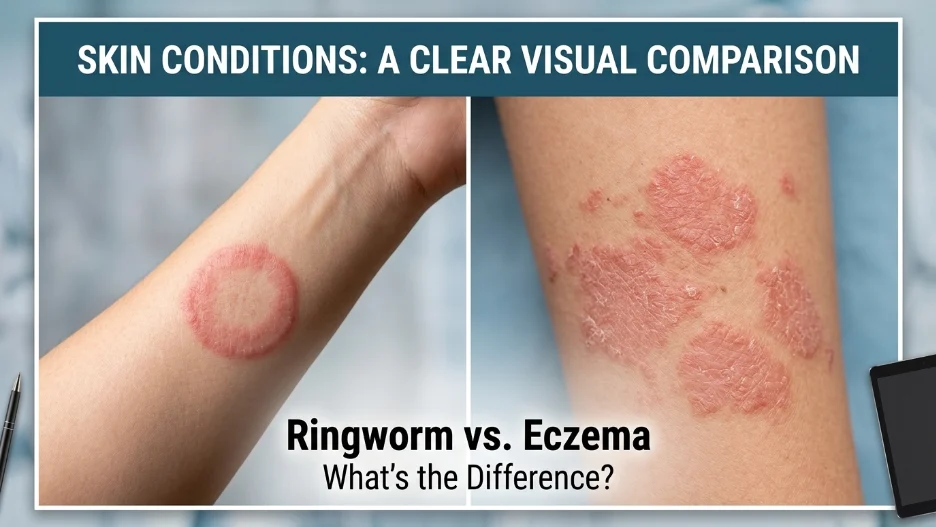
| Typical Appearance | Circular, ring shaped rash with a scaly, raised border and clearer center | Dry, scaly patches with poorly defined borders; can be round or irregular |
| Contagious | Highly contagious | Not contagious at all |
| Treatment | Over the counter antifungal creams (e.g., terbinafine, clotrimazole) | Lifestyle changes, moisturizers, and corticosteroid creams |
Which One Is Correct?
When we talk about “ringworm or eczema,” we are not debating which word is grammatically correct. Both terms are valid medical conditions. Instead, we are determining which diagnosis is correct for a specific skin rash. The confusion arises because their symptoms can overlap significantly. For instance, a type of eczema known as nummular eczema can create coin shaped, or discoid, lesions that strongly resemble ringworm. This is why medical professionals often rely on microscopic examinations or biopsies to confirm a diagnosis when the visual appearance is ambiguous. Understanding the differences between the two is the key to distinguishing which condition is correct for you.
Meaning of Ringworm
Ringworm is a common fungal skin infection. Despite its name, it is not caused by a worm. The term “ringworm” comes from the characteristic ring shaped rash it produces on the skin.
Definition and Explanation
Ringworm is caused by a group of fungi called dermatophytes. These fungi infect the outer layer of the skin, as well as hair and nails. The fungus thrives in warm, moist environments and is highly contagious. It can be spread through direct skin to skin contact with an infected person or animal, or by touching contaminated surfaces like towels, clothing, or gym equipment.
Usage and Real world Examples
You might encounter ringworm in various forms depending on the location of the infection. For example:
- Tinea corporis: Ringworm on the body, appearing as a red, scaly ring.
- Tinea pedis: Athlete’s foot, affecting the soles and between the toes.
- Tinea cruris: Jock itch, affecting the groin area.
- Tinea capitis: Ringworm of the scalp, which can cause hair loss.
If you have a pet, especially a cat, it’s possible for them to pass the infection to you.
Meaning of Eczema
Eczema, also known as atopic dermatitis, is a chronic and non contagious inflammatory skin condition. Unlike ringworm, eczema is not an infection but a dysfunction of the skin barrier.
Definition and Explanation
Eczema is believed to be caused by a combination of genetic predisposition and environmental triggers, leading to an overactive immune response in the skin. This causes the skin to become dry, itchy, and inflamed. It’s important to note that “eczema” is an umbrella term that includes several specific types, with atopic dermatitis being the most common.
Usage and Real world Examples
Eczema can appear anywhere on the body but is most common in skin folds, such as the inside of the elbows and behind the knees. It can also affect the hands, neck, and face. Because it is a chronic condition, it is often characterized by periods of flare ups and remission. Symptoms can be triggered by a wide range of factors, including:
- Dry skin
- Irritants like soaps and fragrances
- Stress
- Allergens like dust mites or pet dander
Key Differences: Ringworm vs. Eczema
To properly address your concern about ringworm or eczema, it’s crucial to understand the core differences across several categories. This table provides a clear breakdown.
| Feature | Ringworm | Eczema |
| Spelling | Ringworm | Eczema |
| Meaning | Fungal infection | Chronic skin inflammation |
| Cause | Fungus (Dermatophytes) | Genetics & environmental triggers |
| Shape of Rash | Usually circular, well defined borders | Often irregular, poorly defined borders |
| Center of Rash | Typically clearer and less scaly | Usually the same color and texture as the rest |
| Itchiness | Intense, sometimes described as burning | Intense, often described as unbearable; can worsen at night |
| Contagiousness | Highly contagious | Not contagious |
| Treatment | Antifungal creams | Moisturizers, steroid creams, avoidance of triggers |
Deeper Dive into Distinctions
The appearance of the rash is a primary method for distinguishing ringworm or eczema. Ringworm typically presents as one or a few distinct, expanding circular patches with a raised, red, scaly border and a clearer center, which creates the “ring” appearance. You can often see the infection actively spreading outwards.
Eczema, on the other hand, can be more diffuse. A specific type, nummular eczema, does produce coin shaped (or “round”) patches, which is why the confusion is so common. However, the color and texture of these patches are usually uniform throughout the circle, and the skin around the patch is often extremely dry and scaly.
Furthermore, the location of the rash can be a clue. While both can appear on the trunk and limbs, eczema is classically found in the flexural areas (e.g., elbows, knees), while ringworm is more often found on exposed skin.
Common Mistakes People Make
- Treating Eczema with Antifungal Creams: This is one of the most common errors. If you have a chronic skin condition like eczema, antifungal creams are ineffective and will not relieve symptoms. This can lead to frustration and delay proper treatment.
- Dismissing Ringworm as a Minor Rash: Because ringworm is highly contagious, treating it quickly is essential to prevent its spread to others, including family members and pets.
- Assuming a “Round Rash” is Always Ringworm: As noted, nummular eczema is a prime example of a condition that mimics the appearance of ringworm. A diagnosis from a doctor, which may involve a skin scraping to check for fungus, is often the safest route.
- Overlooking Secondary Infections: Scratching both ringworm and eczema can lead to bacterial infections like staph, which require a different treatment approach, such as antibiotics.
Correct Usage Examples
For Ringworm
- Casual: “My new kitten gave me ringworm, so I’ve been putting anti fungal cream on the itchy spot.”
- Professional: “The patient presented with a classic case of tinea corporis, exhibiting a well defined, annular lesion on the forearm.”
- Educational: “Ringworm is a common dermatophytosis that thrives in moist environments, making gym goers and swimmers particularly susceptible to infection.”
- Metaphorical/Literary: “The fungus spread through the garden like a slow, creeping ringworm, decimating the rose bushes.”
For Eczema
- Casual: “My eczema always flares up when it gets really cold and dry outside.”
- Professional: “Atopic dermatitis can be managed effectively with a regimen of high quality emollients and topical corticosteroids.”
- Educational: “The genetic component of eczema means it often runs in families alongside other atopic conditions like asthma and hay fever.”
- Metaphorical/Literary: “Stress was a poison that seeped into his system, breaking out as an emotional eczema he couldn’t scratch.”
Word Origin / Etymology
Ringworm
The term “ringworm” has a straightforward, descriptive origin. “Ring” refers to the circular shape of the rash, and “worm” is a holdover from ancient times. Before the true fungal nature of the condition was understood, people believed the rash was caused by an actual worm burrowing under the skin. Even though we now know it’s a fungal infection, the name has stuck.
Eczema
The term “eczema” comes from the Greek word “ekzein,” which means “to boil out” or “to boil over.” This is a highly apt description for the condition, as it refers to the tiny, fluid filled blisters (vesicles) that form on the skin during an acute flare up and “ooze” fluid[citation:15?].
Why the Incorrect Version Became Popular (Confusion)
People confuse ringworm and eczema because the symptoms can be deceptively similar. Both conditions are notorious for causing a red, scaly, and intensely itchy rash. This can appear in similar locations on the body, making it difficult to distinguish for someone without medical training. The term “ringworm” itself is misleading; people often don’t realize it’s a fungus, and the concept of an “eczema” that looks like a ringworm (nummular eczema) is not widely known. This visual and symptomatic crossover is the primary driver of the confusion.
Easy Memory Tricks
- “Ringworm is a Ring”: This is the most helpful trick. If the rash has a distinct, raised, circular border with a clearer, healthier looking center, it strongly points to ringworm. Eczema may be round, but the center will not be clearer.
- “Eczema is Everywhere”: Eczema is often a systemic issue. If you have dry skin all over your body or have a personal or family history of allergies or asthma, the rash is more likely to be eczema. Ringworm is more localized, appearing as one or a few specific spots.
- “Check the Spread”: Ringworm is highly contagious. If you notice other family members or pets developing similar rashes, it is likely ringworm. Eczema is not contagious.
FAQs
1. Is ringworm or eczema contagious?
Ringworm is contagious and can spread through direct contact or shared items. Eczema is not contagious and cannot be passed from person to person.
2. Can eczema turn into ringworm?
No. Eczema cannot become ringworm, although damaged skin from eczema may be more vulnerable to fungal infections.
3. What does eczema look like compared to ringworm?
Eczema usually appears as dry, itchy patches with uneven edges, while ringworm forms a circular rash with a raised, scaly border and a clearer center.
4. How can you tell the difference between a fungal rash and eczema?
Ringworm often improves with antifungal medication, while eczema does not. A doctor can confirm the diagnosis with a skin examination or a simple fungal test.
5. Can ringworm or eczema be cured?
Ringworm is usually cured with antifungal treatment. Eczema has no permanent cure, but its symptoms can be effectively managed.
6. What are the common symptoms of ringworm and eczema?
Both can cause itching, redness, and dry skin. However, ringworm typically has a ring-shaped rash, while eczema appears as irregular patches.
7. Is ringworm a type of eczema?
No. Ringworm is a fungal infection, whereas eczema is an inflammatory skin condition. They are different disorders with different treatments.
8. Can a doctor tell the difference between ringworm and eczema?
Yes. A healthcare provider can usually diagnose the condition through a physical examination and, if needed, a skin scraping or other tests.
Conclusion
Understanding the difference between ringworm or eczema is the first step to finding relief. While they both cause uncomfortable, itchy skin, they are fundamentally different conditions. One is a treatable fungal infection; the other is a chronic condition that requires ongoing management.
Remember the key visual clue: the distinct ring of ringworm versus the often irregular patches of eczema. If you are unsure, a simple test by a doctor can provide a definitive answer and guide you to the correct treatment, ensuring your skin gets the care it needs.