Quick Answer:
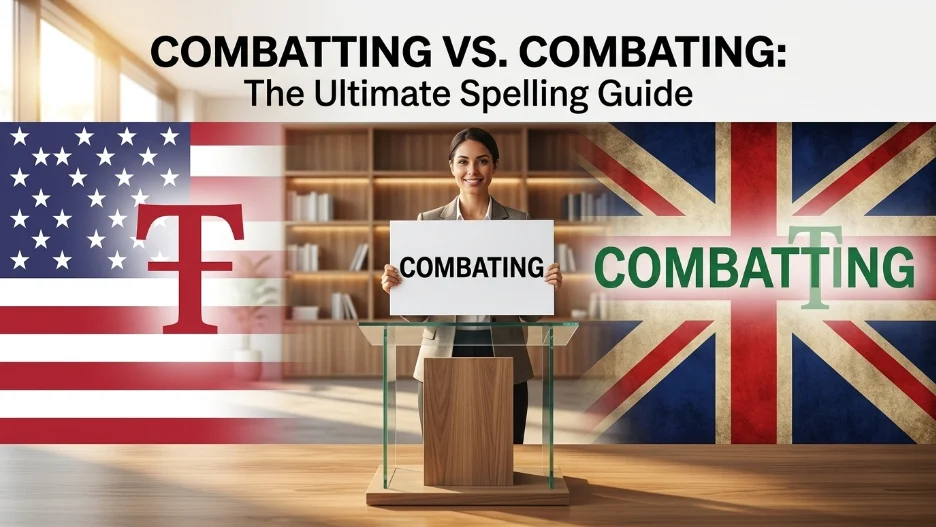
Combating is the preferred and more widely accepted spelling in modern English. It is the present participle of combat, meaning to fight against or take action to stop something (e.g., “The organization is combating climate change.”).Combatting is also considered correct but is much less common and appears mainly in some British English publications or older style guides. For most writing, combating is the recommended choice
Many English writers wonder whether combatting or combating is the correct spelling. Both forms come from the verb combat, which means to fight against, resist, or work to stop something. The confusion arises because English sometimes doubles the final consonant before adding -ing, while other verbs do not follow the same pattern.
In modern English, combating is the preferred and more widely accepted spelling in both American and British usage. Although combatting is also considered correct, it is much less common and is mainly found in older publications or certain style preferences. This guide explains the difference, correct usage, examples, and why combating is usually the better choice.
Quick Answer Table
To get straight to the point, here is a quick overview of the two spellings:
| Feature | Combating | Combatting |
| Correct Spelling? | Yes (Standard) | Yes (Variant) |
| Primary Usage | American and International English | British English (Less Common) |
| Meaning | To fight or struggle against something | To fight or struggle against something |
| Example Sentence | The government is combating poverty. | The government is combatting poverty. |
Conclusion: Both “combating” and “combatting” are considered correct spellings. However, if you’re writing for an international, professional, or American audience, “combating” is the recommended and more widely accepted choice .
Which One Is Correct?
If you’ve been wondering whether “combatting” or “combating” is the correct spelling, the answer is both! The word “combat,” meaning to fight or oppose, is the root, and when adding the suffix ” ing,” the rules for doubling the final consonant can lead to two different spellings .
A common misconception is that one is simply wrong and the other is right. This isn’t the case. Both forms are grammatically sound and appear in reputable dictionaries. The difference primarily lies in regional spelling conventions: American English typically uses “combating” with one ‘t’, while British English often uses “combatting” with a double ‘t’ . This makes it a matter of style and audience rather than a strict right or wrong grammar rule.
Meaning of the Correct Word
Since both spellings share the same definition, we’ll focus on the meaning of the root word “combat.”
Definition and Explanation
“Combating” is the present participle or gerund form of the verb “combat,” which means to take action to stop, reduce, or oppose something undesirable, harmful, or dangerous . It implies an active and intentional struggle against a problem, adversary, or negative force.
- Present Participle: Used to describe an ongoing action.
- Gerund: Used as a noun to refer to the act of fighting something.
Real World Usage Examples
Here’s how you might see or use “combating” in everyday English:
- Official Context: “The new policy is aimed at combating climate change by reducing carbon emissions.”
- Health: “Scientists are working on innovative methods for combating the spread of infectious diseases.”
- Social Issues: “The charity is dedicated to combating homelessness in urban areas.”
- Everyday Life: “I’m combating my sweet tooth by replacing sugary snacks with fruit.”
Meaning of the Alternative Word
“Combatting” holds the exact same meaning as “combating.” It is the present participle or gerund form of “combat” . The only difference is the spelling. It is not a mistake but rather a less common variant, particularly outside of the UK . You might see “combatting” more frequently in historical British texts, some UK publications, or in the writing of those who use British English spelling conventions.
Key Differences Between the Two Words
The table below breaks down the distinctions more clearly. Both spellings are accepted, but knowing their nuances is key to using them effectively and correctly.
| Feature | Combating | Combatting |
| Spelling | Single “t” | Double “t” |
| Primary Meaning | Present participle/gerund of “combat” | Present participle/gerund of “combat” |
| Pronunciation | Typically /kəmˈbæt.ɪŋ/ with stress on the second syllable . | Typically /kəmˈbæt.ɪŋ/ with stress on the second syllable . |
| Grammatical Function | Verb (present participle) or noun (gerund) | Verb (present participle) or noun (gerund) |
| Regional Preference | Standard in American English. Preferred by international style guides . | A variant occasionally used in British English, but much less common in modern usage . |
| Dictionary Recognition | Listed as the primary or preferred spelling in Merriam Webster and other US dictionaries . | Listed as an alternate or British variant in dictionaries like Collins. Often omitted in US dictionaries . |
| Formal Writing Guidance | Highly recommended for professional, academic, and SEO writing . | Generally discouraged in formal writing for global audiences to maintain clarity and consistency. |
Pronunciation Differences
Intriguingly, the word “combat” itself can be pronounced in two ways, which adds another layer to the discussion. When used as a noun (meaning a fight or battle), the stress is on the first syllable: COM bat. When used as a verb (meaning to fight against), the stress is on the second syllable: com BAT .
This pronunciation difference is the key to understanding the spelling rule. For a verb like “combat,” where the final syllable is stressed (com BAT), American English typically doubles the final consonant before adding ” ing” (e.g., “bat” becomes “batting,” “defer” becomes “deferring”). However, “combat” is an exception to this general rule in American English . British English, on the other hand, often allows for the doubling to remain, even with the stress pattern, leading to “combatting.”
Common Mistakes People Make
The main mistake isn’t necessarily using one spelling over the other, but rather a lack of consistency. Here are common pitfalls to avoid:
- Inconsistent Spelling: Switching between “combating” and “combatting” in the same document. This looks unprofessional and confuses the reader. Pick one and stick with it.
- Assuming One is Wrong: Believing that “combatting” is a typo. While “combating” is more common globally, “combatting” is a valid British variant .
- Misapplication of the Doubling Rule: Forgetting the stress pattern and doubling the consonant in all cases. The rule is nuanced, so relying solely on analogy (like “bat” to “batting”) can be misleading .
- Confusing the Adjective Form: Accidentally writing “combatative” instead of “combative.” The adjective form describing someone who is eager to fight is always “combative,” spelled with just one ‘t’ .
Correct Usage Examples
To help you visualize the correct usage in different contexts, here are some examples using the recommended standard spelling, “combating.
Casual Examples
- “She’s been combating her fear of public speaking by taking an online course.”
- “We’re always combating the clutter in our house—it feels like a never ending battle!”
Professional/Formal Examples
- “Our marketing team is dedicated to combating the spread of misinformation about our brand.”
- “The cybersecurity firm specializes in combating ransomware attacks for Fortune 500 companies.”
Educational Examples
- “The course aims to equip students with critical thinking skills for combating logical fallacies in arguments.”
- “Researchers are pioneering new technologies for combating the effects of climate change.”
Literary/Metaphorical Examples
- “The old man spent his twilight years combating his deepest regrets through acts of kindness.”
- “The protagonist spent the novel combating the powerful forces of tyranny and oppression.”
Word Origin / Etymology
The word “combat” has a rich history. It originated in the Middle English period, derived from the Old French verb “combattre” . The Old French term itself comes from the Late Latin “combattere,” a combination of the Latin prefix “com ” (meaning “together” or “with”) and “battere” (meaning “to beat” or “to strike”) . Thus, the literal meaning is “to strike together” or “to fight with.” This etymology highlights the word’s inherent sense of active opposition and struggle, which remains central to its meaning today .
Why the Incorrect Version Became Popular
In this case, the “incorrect” version (“combatting”) hasn’t necessarily become popular, but it has maintained a presence, largely due to British English spelling rules.
British English tends to double a final consonant in words where the stress falls on the last syllable, which is the case for the verb “combat” (com BAT) . Therefore, some British sources and writers consider the double ‘t’ to be the most logical spelling.
However, American English often simplifies such spellings, favoring “combating . The dominance of American English in global media and technology has led to “combating” becoming the more recognizable and widely accepted spelling worldwide. Major style guides and most SEO focused content recommend “combating” to ensure consistency and clarity for the broadest possible audience .
Easy Memory Tricks
Need a quick hack to remember which spelling to use?
- Think of Your Audience: If you’re writing for a US audience, use one ‘t’ (combating). Just remember, Americans use A single ‘t’ !
- Think of “Defeat”: When you’re combating a problem, you want to be efficient and effective. Think of a single ‘t’ as being more concise and streamlined, just like the American spelling.
- The Adjective Clue: Remember that the adjective is always combative (with one ‘t’). If you know that, you’re less likely to add an extra ‘t’ to the verb form. It’s a great anchor to keep your spelling consistent!
FAQs
Is “combatting” a typo?
No, “combatting” is not technically a typo. It is a recognized spelling variant used in British English, although it is less common than “combating .
Should I use “combating” or “combatting” ?
For SEO, it’s generally best to use “combating.” This is the most common spelling and will align your content with the majority of searches and American English conventions .
Are there any other differences between the two spellings?
No, aside from the spelling itself, there are no differences. Both words have the exact same meaning, pronunciation, and grammatical function .
What is the adjective form of “combat”? Is it “combative” or “combatative”?
The correct adjective form is “combative,” meaning eager to fight or confront. “Combatative” is a common misspelling and is not correct .
What is the past tense of “combat”?
The past tense of “combat” follows the same regional pattern. In American English, it’s often “combated” (one ‘t’), while British English sometimes uses “combatted” (double ‘t’) .
Does the pronunciation change the spelling?
The pronunciation of “combat” as a verb (com BAT) explains the rule, but in practice, the standard American spelling (“combating”) is an exception to the doubling rule. Regional convention is the primary factor in determining spelling, not pronunciation .
Is “combating” or “combatting” more professional?
“Combating” is generally considered more professional for global and North American audiences. It is recommended by major style guides like AP Style, making it the safer choice for business and formal writing .
Can I use “combatting” in a US university essay?
While you could, it’s generally not recommended. US institutions and professors will expect you to use American English conventions, making “combating” the correct choice for your essay.
Conclusion
So, is it “combatting” or “combating”? The definitive answer is that both spellings are correct, but their usage depends on the context. “Combating” with a single ‘t’ is the standard spelling in American English and is recommended for international, professional, and SEO focused writing due to its widespread acceptance. “Combatting” with a double ‘t’ is a valid British variant that you might encounter in historical texts or some UK publications.
The key takeaway is to be consistent. Choose the spelling that best suits your audience and stick with it throughout your document. By keeping the memory tricks in mind and understanding the simple rule of regional preference, you can now write with confidence, ensuring your message about fighting for or against something is both grammatically sound and professionally polished.