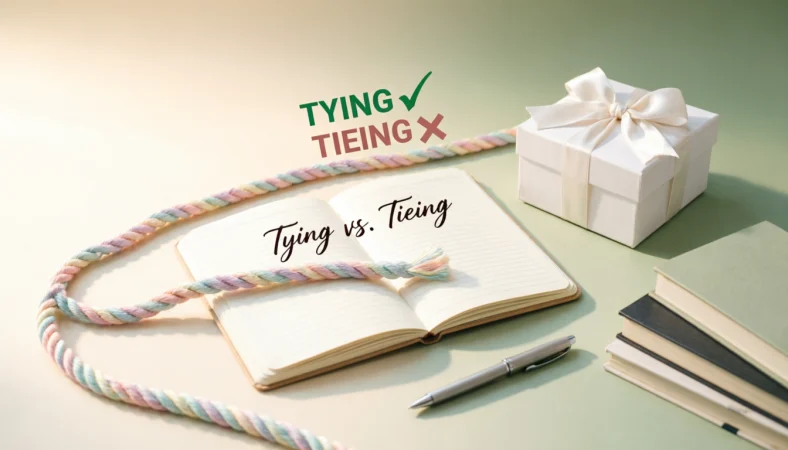
Tying (correct spelling):
Tying means fastening, connecting, or securing something by using a knot, string, rope, or similar method. It is the present participle/gerund form of tie.
Example: She is tying her shoelaces.
Tieing (incorrect spelling):
Tieing is a misspelling of tying in standard modern English. It does not have a separate accepted meaning
The confusion between “tying” and “tieing” stems from a fundamental rule of English spelling that often leaves people scratching their heads. Some believe both forms are acceptable, while others insist only one is correct. This article unpacks everything you need to know about this pair of words, including their meanings, usage guidelines, common mistakes, and the surprising reasons why people get them wrong.
By the end of this comprehensive guide, you will have complete confidence in your spelling of this word and understand its proper use in various contexts. Whether you’re writing a professional email, crafting an essay, or simply curious about English grammar, this article gives you the tools and knowledge to use “tying” correctly every single time.
Quick Answer Table
| Aspect | Details |
| Correct Spelling | Tying |
| Incorrect/Alternative Spelling | Tieing (considered a misspelling) |
| Word Type | Verb (present participle) |
| Meaning | Fastening, securing, or binding something with a rope, string, or similar material |
| Part of Speech | Present participle of the verb “tie” |
| Example Sentence | She is tying her shoelaces before the race begins. |
Which One Is Correct?
The simple answer is that “tying” is the correct spelling, while “tieing” is a common misspelling. Modern English dictionaries, style guides, and grammar authorities universally accept “tying” as the standard present participle form of the verb “tie.
The rule follows a standard English spelling pattern: when a verb ends in ” ie,” you change the ” ie” to ” y” before adding ” ing.” This rule applies to several other verbs like “die” (dying), “lie” (lying), and “vie” (vying). Therefore, “tie” becomes “tying” rather than “tieing.”
Despite being grammatically incorrect, you may encounter “tieing” in casual writing, social media posts, or even occasionally in published works. This persistence of the incorrect form can be attributed to a combination of factors, including unfamiliarity with the spelling rule, the influence of digital autocorrect features that might not flag it, and the natural tendency to simply add ” ing” to the base word without modification.
If you’re writing for professional, academic, or formal purposes, using “tying” is the only acceptable choice. The incorrect version can undermine your credibility and make your writing appear unpolished or careless.
Meaning of the Correct Word: Tying
“Tying” is the present participle form of the verb “tie,” and it carries several related but distinct meanings depending on the context. At its core, “tying” refers to the action of fastening, securing, or binding objects together using a rope, string, cord, ribbon, or similar flexible material. Understanding these nuanced meanings helps you use the word with precision and confidence.
Primary Definition: “Tying” describes the physical act of creating a knot or bow to join two or more items together or to secure something in place. This is the most common and straightforward usage people encounter in everyday situations.
Extended Usage: Beyond the literal meaning, “tying” can also refer to:
- Creating connections or relationships between things
- Equaling or matching in a competition
- Restricting or binding someone or something
- Linking or associating concepts together
Common Examples:
- She is tying her hair back with a scrunchie before heading to the gym.
- The carpenter is tying the wooden planks together with strong rope.
- They are tying up loose ends before finalizing the business deal.
- The two teams are tied for first place in the tournament standings.
In professional and formal writing, using “tying” correctly demonstrates your attention to detail and command of English conventions. Whether you’re describing physical actions or metaphorical connections, “tying” remains the consistently correct choice across all contexts.
Meaning of the Incorrect Spelling: Tieing
“Tieing” is considered an incorrect spelling in standard English usage, though it’s important to understand why people use it and how it functions in the language. Recognizing this common error helps you avoid it and understand why some writers might be confused.
Is It Ever Correct? The short answer is no. “Tieing” is not accepted as a valid spelling in any major dictionary, style guide, or grammar reference. It is simply a misspelling that has gained some traction due to human error and the prevalence of informal writing.
Why Does It Appear? Several factors contribute to the continued appearance of “tieing” in writing:
- Overgeneralization: Writers apply the standard rule of adding ” ing” directly to the base verb without considering the ” ie” to ” y” modification requirement.
- Autocorrect Oversights: Some digital devices and software might not flag “tieing” as an error, especially if the user has previously added it to their custom dictionary.
- Unfamiliarity: Many English learners and even native speakers are simply unaware of the spelling rule governing verbs ending in ” ie.”
- Visual Similarity: “Tieing” looks like it should be correct because “tie” plus ” ing” seems logical to those unfamiliar with the rule.
While you might see “tieing” in informal settings like text messages, social media comments, or personal blogs, using it in professional or academic writing would be considered a grammatical error that could harm your credibility.
Key Differences Between Tying and Tieing
Understanding the distinctions between these two spellings goes beyond simply knowing which is correct. Let’s explore the key differences to ensure you never confuse them again.
Spelling Differences
The spelling difference is straightforward but significant. “Tying” drops the “e” from “tie” and changes the “i” before adding ” ing,” while “tieing” simply appends ” ing” to the base word without modification. This might seem like a minor distinction, but it represents a fundamental rule of English spelling that applies to numerous verbs.
Pronunciation Differences
Despite the spelling difference, “tying” and “tieing” are pronounced identically. Both are pronounced as “TYE ing” (rhyming with “dying” or “frying”). The pronunciation remains consistent because the underlying root word “tie” determines how the word sounds. This pronunciation similarity actually contributes to the confusion, as the two versions sound the same when spoken, making the spelling error harder to catch in conversation.
Grammar Differences
From a grammatical standpoint, there is no difference between how these words function in a sentence. Both would be treated as the present participle of “tie,” used in continuous tenses or as gerunds. However, because “tieing” is considered incorrect, using it would be viewed as a spelling error rather than a grammatical one.
| Aspect | Tying (Correct) | Tieing (Incorrect) |
| Spelling Rule | Follows ” ie” to ” y” rule | Violates standard rule |
| Dictionary Status | Recognized | Not recognized |
| Professional Use | Accepted | Rejected |
| Academic Use | Required | Inappropriate |
Usage Differences
The usage difference is clear: “tying” should be used in all formal and informal contexts where the present participle of “tie” is needed. “Tieing” should be avoided entirely. While you might occasionally encounter “tieing” in informal writing, it’s always better to use the correct form to maintain credibility and clarity.
Recognition in Formal Writing
Professional editors, teachers, and grammar checkers universally flag “tieing” as an error. In contrast, “tying” passes all standard spelling and grammar checks. This difference in recognition can significantly impact how your writing is perceived by others.
Common Mistakes People Make
The “tying versus tieing” dilemma is just one example of a broader pattern of spelling errors in English. Let’s explore the most common mistakes people make with these words and, more importantly, how to avoid them.
Mistake 1: Adding ” ing” Without Modifying the Base Word
This is the most frequent error. Writers simply add ” ing” to “tie” and produce “tieing.” This mistake stems from applying a general rule without considering the specific exception for words ending in ” ie.”
How to Avoid: Remember the rule for verbs ending in ” ie”: change the ” ie” to ” y” before adding ” ing.” Practice with related words to reinforce this pattern.
Mistake 2: Confusing With Other Verb Patterns
Some writers confuse the pattern for “tie” with other verbs where you simply add ” ing.” For example, you add ” ing” to “play” to get “playing,” and to “sing” to get “singing.” “Tie” doesn’t follow this pattern.
How to Avoid: Create a mental list of verbs that follow the ” ie” to ” y” rule, including “die,” “lie,” “vie,” and “tie.” Reviewing these words together can help cement the correct pattern.
Mistake 3: Relying on Autocorrect Without Verification
Many writers trust their devices’ autocorrect features to catch spelling errors. However, not all systems flag “tieing” as incorrect, leading to perpetuation of the error.
How to Avoid: Don’t rely solely on technology. Develop your understanding of the rule so you can catch errors that automated systems might miss.
Mistake 4: Assuming Both Forms Are Acceptable
Some writers believe “tying” and “tieing” are both valid alternatives, perhaps influenced by seeing both in various contexts. This assumption leads to inconsistent usage and potential errors.
How to Avoid: Understand that only “tying” is correct. Even if you see “tieing” somewhere, it doesn’t make it acceptable in standard English.
Mistake 5: Applying the Rule Incorrectly in Different Tenses
While “tying” is the present participle, some writers also struggle with other forms of the verb. For example, “tied” and “ties” are straightforward, but the “tying” form trips people up.
How to Avoid: Practice all forms of the verb to build confidence: “tie,” “ties,” “tied,” and “tying.”
Correct Usage Examples Across Various Contexts
To truly master the use of “tying,” it’s helpful to see how the word functions across different contexts and situations. The following examples illustrate proper usage in various settings.
Casual and Everyday Examples
- I’m tying my shoes before we leave for the party.
- She is tying a ribbon around the gift box.
- He keeps tying his jacket around his waist whenever it gets warm.
- Are you tying your hair up for the swimming session?
- The kids are tying knots in their jump ropes.
- My grandmother is tying a quilt together with colorful threads.
Professional and Business Examples
- The project manager is tying together various department initiatives.
- We are tying up the final details of the merger agreement.
- The legal team is tying the contract to specific performance metrics.
- She is tying her professional development goals to the company’s strategic objectives.
- The marketing department is tying the campaign to seasonal trends.
- Our IT team is tying the new software to existing systems.
Educational and Academic Examples
- The teacher is tying the lesson to real world applications.
- Students are tying their research findings to established theories.
- The professor is tying historical events to contemporary issues.
- Researchers are tying their data to specific demographic factors.
- The study is tying nutritional habits to cognitive performance.
- She is tying her thesis argument to multiple scholarly sources.
Literary and Metaphorical Examples
- The author is tying various plot threads together in the final chapter.
- Destiny is tying their fates together in unexpected ways.
- The narrative is tying themes of love and loss throughout the story.
- His poetry is tying natural imagery to human emotions.
- The film is tying humor to social commentary effectively.
- Her speech was tying hope and determination in a powerful message.
Sporting and Competitive Examples
- The two teams are tied for the championship lead.
- She is tying her personal best time in the race.
- They are tying the score in the final minute of the game.
- He is tying the world record for the long jump.
- The competitors are tied in the preliminary rounds.
- Our team is tying the series at two games each.
Technical and Specialized Examples
- The software is tying user accounts to specific devices.
- The network administrator is tying multiple servers together.
- The programmer is tying different code modules efficiently.
- The system is tying authentication protocols to user permissions.
- Engineers are tying safety features to performance metrics.
Word Origin and Etymology
Understanding the etymology of “tie” and “tying” provides fascinating insights into the word’s development and helps explain why the spelling rule exists in its current form.
Ancient Roots
The word “tie” traces its origins to Old English “tēag,” meaning “rope” or “cord,” and “tīegan,” meaning “to bind, fasten, or join.” These words evolved from Proto Germanic “taugijō” and ultimately from the Proto Indo European root “deuk ,” meaning “to lead, pull, or draw.” This ancient root also gave rise to words like “duke” (leader) and “conduct” (leading together).
Evolution Through Middle English
During the Middle English period (roughly 1100 1500), the spelling varied considerably. Writers used forms like “tien,” “teye,” and “tie” interchangeably. The modern spelling began to standardize around the 16th century as printing presses increased the demand for consistent spelling.
The Spelling Rule’s Development
The ” ie” to ” y” rule before ” ing” developed as a practical solution to avoid an awkward “ieie” sequence. In older English, when ” ing” was added directly to words ending in ” ie,” you would get forms like “tieing” or “dieing.” These forms were visually awkward and sometimes difficult to parse. Eventually, the ” ie” to ” y” transformation became the accepted standard for certain verbs.
Similar Words That Follow the Same Pattern
Several common verbs follow the same ” ie” to ” y” pattern:
- Die → Dying
- Lie → Lying
- Vie → Vying
- Tie → Tying
- (Occasionally) Hie → Hying (though “hieing” is also accepted)
Historical Usage of “Tieing”
Interestingly, “tieing” wasn’t always considered incorrect. In the 17th and 18th centuries, both “tying” and “tieing” appeared in published works, with “tying” gradually gaining dominance. By the 19th century, most style guides and dictionaries had firmly established “tying” as the standard spelling. Today, dictionaries sometimes list “tieing” as an old, rare, or nonstandard variant, but they overwhelmingly recommend “tying.”
Why the Incorrect Version Became Popular
Despite being technically incorrect, “tieing” persists in modern writing. Understanding the reasons behind this persistence helps you recognize why the error occurs and why it’s so common.
The Power of Analogy
English speakers often rely on analogies to create new words or spellings. Because many verbs simply add ” ing” to their base form (like “writing,” “reading,” “playing”), people naturally apply this pattern to “tie.” This analogical thinking is a normal part of language processing but leads to errors when exceptions exist.
Digital Communication Influence
The rise of digital communication has contributed to the spread of “tieing.” In fast paced environments like texting or social media, people prioritize speed over accuracy. Autocorrect systems sometimes fail to flag “tieing” as an error, particularly if the user has previously added it to their dictionary or if the system’s word database isn’t comprehensive.
Language Evolution
Language is always evolving, and some grammar experts have argued that “tieing” might eventually become accepted through common usage. However, standard English dictionaries and style guides remain resolute in rejecting this spelling. While language evolves, the transition from “incorrect” to “acceptable” typically takes decades or centuries of consistent usage.
Regional Variations
Some regional English varieties might show more tolerance for “tieing,” particularly in informal contexts. However, even in these regions, “tying” remains the preferred spelling in formal writing.
The Role of Education
Interestingly, many native English speakers learn the ” ie” to ” y” rule in school but forget it over time. Others might not have been taught the rule explicitly, leading to uncertainty. This educational gap contributes to the persistence of common errors like “tieing.”
Easy Memory Tricks
Remembering the correct spelling of “tying” doesn’t have to be difficult. These memory tricks can help you instantly recall the correct form whenever you need it.
The “Y” Replacement Trick
The easiest way to remember “tying” is to think about what happens to the word “tie” when you add ” ing.” The “e” is replaced by a “y,” so you’re effectively “tying” things together. Create a mental image of tying a knot with the letter “y” replacing the “e.”
Rhyme With Common Words
“Tying” rhymes with “dying” and “lying.” All three words follow the same spelling rule. Remember this rhyme to reinforce the connection: “Tying, dying, lying all with ‘y’ are flying.” This simple rhyme helps you recall that these words drop the “e” and add “y.”
Visualize the Rule
Think of the ” ie” ending as a pair of shoes. When you add ” ing,” you’re removing one shoe (the “e”) and replacing it with a “y.” This visual analogy makes the transformation memorable.
The Famous Rule Reminder
Some grammar experts suggest this memorable phrase: “When ‘tie’ wants to ‘ing,’ it drops the ‘e’ and adds a ‘y.'” This simple rule covers all cases and is easy to remember.
Practice With Sentences
The best way to internalize spelling rules is through practice. Write sentences using “tying” repeatedly until the correct spelling becomes automatic. For example:
- “I am tying my shoes.”
- “She is tying the bow.”
- “They are tying the boat to the dock.”
Create a Cheat Sheet
Keep a small list of words that follow the ” ie” to ” y” rule where you’ll see it frequently, like on your desk or as a phone wallpaper. Include “tie,” “die,” “lie,” and “vie” to reinforce the pattern.
FAQs
Is “tieing” ever acceptable in modern English?
No, tieing is considered incorrect; the correct spelling is tying.
Does “tying” have the same pronunciation as “tieing”?
Yes, both sound like “TYE-ing”, but only tying is standard.
Can I use “tieing” in creative writing?
You can, but it may be seen as a spelling mistake. Tying is recommended.
Is “tying” the only correct form of the word?
Yes, tying is the accepted modern English spelling.
What are the other forms of “tie”?
The forms are tie, ties, tied, and tying.
Do other verbs follow the same spelling rule?
Yes, examples include die → dying and lie → lying.
Why does “tie” become “tying”?
The final -ie changes to -y before adding -ing.
Can I use both tying and tieing?
No, use tying in all standard English writing.
Is tying a verb or noun?
“Tying” can be a verb form or a gerund (noun form).
Will tieing become correct in the future?
Language can change, but currently tying remains the only accepted form.
Conclusions.
After exploring the difference between “tying” and “tieing,” it is clear that “tying” is the correct spelling, while “tieing” is a common misspelling. This rule follows the pattern of changing -ie to -y before adding -ing, as seen in words like dying, lying, and vying.
Understanding this simple spelling rule helps you write more accurately and avoid common English mistakes. Whether you are writing formally or casually, choosing “tying” shows attention to detail and a better command of English spelling.