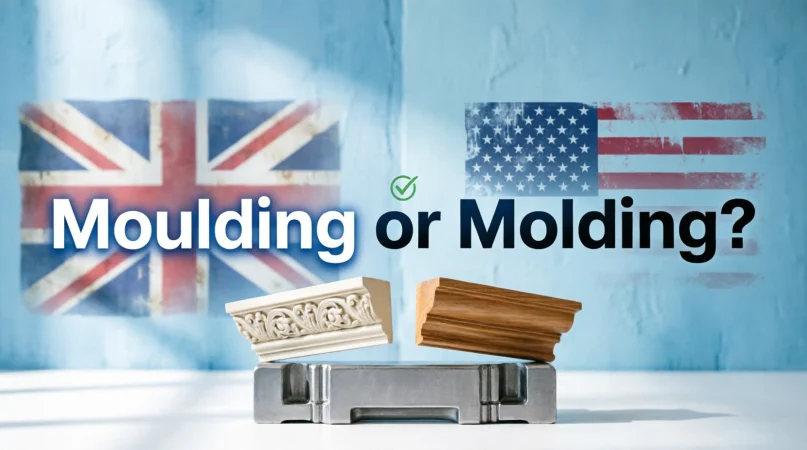
Quick Answer: Moulding and molding mean the same thing. Molding is the American English spelling, while moulding is the British English spelling. Use the version that matches your audience and writing style.
The terms moulding and molding refer to the same process of shaping materials into a specific form or creating decorative trim used in construction, furniture, and interior design. The difference lies primarily in regional spelling conventions rather than meaning. Molding is the preferred spelling in American English, while moulding is commonly used in British English, Canadian English, Australian English, and other countries that follow British spelling standards.
Whether discussing decorative architectural features, manufacturing processes, or woodworking applications, both terms refer to the same concepts. Understanding the distinction is important for writers, students, professionals, and businesses that communicate with international audiences. Choosing the correct spelling depends on your target audience and the style guide you follow.
In professional writing, consistency matters more than the spelling itself. By recognizing the regional differences, readers can avoid confusion and ensure clear communication in both technical and everyday contexts.
Quick Answer Table
| Feature | Moulding | Molding |
| Correct Spelling | Yes | Yes |
| English Variety | British English | American English |
| Meaning | Decorative trim or the process of shaping material | Decorative trim or the process of shaping material |
| Pronunciation | Same as molding | Same as moulding |
| Common Usage | UK, Australia, New Zealand, South Africa | United States, Canada (often) |
| Example Sentence | The room featured elegant wooden moulding. | The room featured elegant wooden molding. |
Which One Is Correct?
The answer depends on the version of English you’re using.
Use moulding if:
- You follow British English spelling conventions.
- Your audience is in the UK.
- You’re writing for British publications, schools, or businesses.
Use molding if:
- You follow American English spelling conventions.
- Your audience is in the United States.
- You’re writing for American companies, schools, or websites.
Neither spelling is wrong.
This is similar to other British-American spelling differences, such as:
| British English | American English |
| Colour | Color |
| Favourite | Favorite |
| Behaviour | Behavior |
| Labour | Labor |
| Mould | Mold |
| Moulding | Molding |
Meaning of the Correct Word
Because both spellings are correct, it’s important to understand the meanings they share.
Definition of Moulding/Molding
Moulding (UK) and molding (US) can refer to:
- Decorative trim used in architecture and interior design.
- The process of shaping a material into a specific form.
- Influencing or shaping a person’s character, behavior, or development.
Meaning in Construction and Architecture
In homes and buildings, moulding or molding refers to decorative strips of material placed around:
- Ceilings
- Doors
- Windows
- Walls
- Cabinets
Examples include:
- Crown molding
- Baseboard molding
- Door molding
- Decorative wall molding
Example
The designer installed beautiful crown molding throughout the house.
or
The designer installed beautiful crown moulding throughout the house.
The meaning remains identical.
Meaning in Manufacturing
The word also describes a process used to shape materials.
Materials commonly molded include:
- Plastic
- Metal
- Clay
- Rubber
- Glass
Example:
The company specializes in plastic molding for automotive parts.
British version:
The company specializes in plastic moulding for automotive parts.
Meaning in Personal Development
The word can also be used figuratively.
Example:
Her teachers played a significant role in molding her future.
British version:
Her teachers played a significant role in moulding her future.
In this context, it means shaping someone’s character, skills, or personality.
Meaning of the Alternative Word
Unlike many word-comparison articles where one term is incorrect, moulding and molding are both valid spellings.
Is Moulding Incorrect?
No.
Moulding is the standard spelling in:
- The United Kingdom
- Australia
- New Zealand
- Ireland
- South Africa
Is Molding Incorrect?
No.
Molding is the standard spelling in:
- The United States
- Most American publications
- American educational systems
Are They Regional Variations?
Yes.
This is a classic example of a regional spelling variation rather than a grammatical error.
Key Differences Between the Two Words
Although the meanings are identical, there are a few distinctions worth noting.
1. Spelling Difference
| British English | American English |
| Moulding | Molding |
The extra “u” appears in British spelling.
2. Meaning Difference
There is no difference in meaning.
Both words refer to:
- Decorative trim
- Manufacturing processes
- Shaping something physically
- Shaping someone metaphorically
3. Pronunciation Difference
There is no pronunciation difference.
Both are generally pronounced:
MOHL-ding
Phonetic transcription:
/ˈmoʊldɪŋ/
The silent spelling difference does not affect pronunciation.
4. Grammar Difference
There is no grammatical difference.
Both function as:
- Nouns
- Gerunds
- Present participles
Examples:
Noun:
The molding was damaged.
Verb form:
The workers are molding plastic parts.
British version:
The workers are moulding plastic parts.
5. Regional Recognition
| Region | Preferred Form |
| United Kingdom | Moulding |
| Australia | Moulding |
| New Zealand | Moulding |
| Ireland | Moulding |
| United States | Molding |
| Canada | Molding (often preferred) |
Common Mistakes People Make
Many writers make avoidable mistakes when using these spellings.
Mixing English Styles
Incorrect:
The colour of the room matched the decorative molding.
This mixes British and American spellings.
Better:
British English:
The colour of the room matched the decorative moulding.
American English:
The color of the room matched the decorative molding.
Assuming One Spelling Is Wrong
Many learners believe molding is a typo.
It isn’t.
Likewise, moulding is not outdated or incorrect.
Both are accepted spellings.
Using Different Spellings in the Same Document
Consistency matters.
Choose one style and stick with it throughout your writing.
Ignoring Audience Expectations
A British audience expects “moulding.”
An American audience expects “molding.”
Using the wrong regional spelling may look unprofessional.
Correct Usage Examples
Let’s explore how the word appears in different contexts.
Casual Examples
- We added decorative molding to the living room.
- The old moulding needs repainting.
- That wooden molding looks expensive.
- The moulding around the fireplace is beautiful.
Professional Examples
- The contractor replaced the damaged crown molding.
- Injection molding remains a key manufacturing process.
- Decorative moulding enhances architectural detail.
- The moulding was custom-made for the restoration project.
Educational Examples
- Students studied the molding process in engineering class.
- The museum displayed examples of Victorian moulding.
- Plastic molding is widely used in industrial production.
- Historic moulding styles reflect architectural trends.
Literary and Metaphorical Examples
- Experience is constantly molding our character.
- Challenges are moulding her into a stronger leader.
- Time acts as an invisible force molding society.
- Education plays a critical role in moulding young minds.
Moulding vs Molding in Architecture
One of the most common search intents involves home design and construction.
What Is Decorative Moulding or Molding?
Decorative molding refers to ornamental trim installed in buildings.
Popular types include:
| Type | Purpose |
| Crown Molding | Connects walls and ceilings |
| Baseboard Molding | Covers wall-floor joints |
| Chair Rail Molding | Protects walls |
| Picture Frame Molding | Decorative wall design |
| Door Molding | Frames doorways |
| Window Molding | Frames windows |
Example
American English:
Crown molding increases a home’s visual appeal.
British English:
Crown moulding increases a home’s visual appeal.
Moulding vs Molding in Manufacturing
Another common usage appears in industrial and engineering fields.
What Is Molding?
Molding is a production process where material is shaped using a mold.
Common methods include:
- Injection molding
- Blow molding
- Compression molding
- Rotational molding
- Vacuum molding
British English uses:
- Injection moulding
- Blow moulding
- Compression moulding
The process remains the same.
Only the spelling changes.
Word Origin / Etymology
Understanding the history helps explain the spelling difference.
Origin of “Mould”
The word comes from:
- Old French: modle
- Latin: modulus meaning “measure” or “small standard”
Over centuries, British English preserved the spelling mould.
Emergence of “Mold”
During spelling reforms in the United States, many words were simplified.
The extra “u” was removed from words such as:
- Colour → Color
- Honour → Honor
- Labour → Labor
- Mould → Mold
As a result:
- Moulding became moulding in British English.
- Molding became molding in American English.
Why the Alternative Version Became Popular
The rise of molding is closely connected to American spelling standardization.
American lexicographers promoted simplified spellings to create a distinct written standard.
Over time:
- American schools adopted “molding.”
- Publishers preferred simplified forms.
- Businesses standardized American spelling.
Meanwhile, British English retained traditional spellings.
Today, both versions are firmly established.
Moulding or Molding in Digital Writing
Modern writers often wonder which spelling works best online.
For International Audiences
Choose one style and stay consistent.
For UK SEO
Target keywords such as:
- decorative moulding
- crown moulding
- timber moulding
- architectural moulding
For US SEO
Target keywords such as:
- decorative molding
- crown molding
- wall molding
- molding installation
Many websites even optimize for both spellings to capture broader search traffic.
Easy Memory Tricks
Remembering the difference is simple.
Trick 1: The “U” Stands for UK
MoUlding = UK
The extra U signals British English.
Trick 2: America Likes Simpler Spellings
American English often removes silent letters.
Examples:
- Colour → Color
- Honour → Honor
- Moulding → Molding
Trick 3: Match Your Audience
Ask yourself:
Am I writing for Britain or America?
That answer usually determines the correct spelling.
Moulding or Molding: Which Should You Use?
Use this quick guide:
| Audience | Recommended Spelling |
| British readers | Moulding |
| American readers | Molding |
| Australian readers | Moulding |
| Academic UK writing | Moulding |
| US business writing | Molding |
| US construction industry | Molding |
| UK construction industry | Moulding |
The most important rule is consistency.
FAQs
1. Is moulding or molding correct?
Both are correct. Moulding is British English, while molding is American English.
2. Which spelling is more common worldwide?
Molding is often more common online because of the global influence of American English, but moulding remains standard across many English-speaking countries.
3. Is moulding a typo?
No. Moulding is the accepted British English spelling.
4. Is molding an American spelling?
Yes. Molding is the standard American English form.
5. Do moulding and molding mean the same thing?
Yes. They share identical meanings and usage.
6. Is there a pronunciation difference?
No. Both words are pronounced the same way.
7. Which spelling should I use in academic writing?
Use the spelling style required by your institution or publication. British institutions generally prefer moulding, while American institutions prefer molding.
8. Is crown molding different from crown moulding?
No. The term describes the same architectural feature. Only the spelling changes.
9. Why does British English use “ou” spellings?
British English often preserves historical spellings inherited from French and Latin influences.
10. Can I use both spellings in one article?
It’s best not to. Consistency improves readability and professionalism.
Conclusion
In conclusion, there is no difference in meaning between moulding and molding. The choice depends entirely on the version of English being used. Use molding when writing for American audiences and moulding when following British English conventions.”Moulding and Molding” are simply different spellings of the same word.
The correct choice depends on whether you are using British or American English. Understanding this distinction helps ensure accuracy, consistency, and professionalism in writing, construction documents, design discussions, and everyday communication.