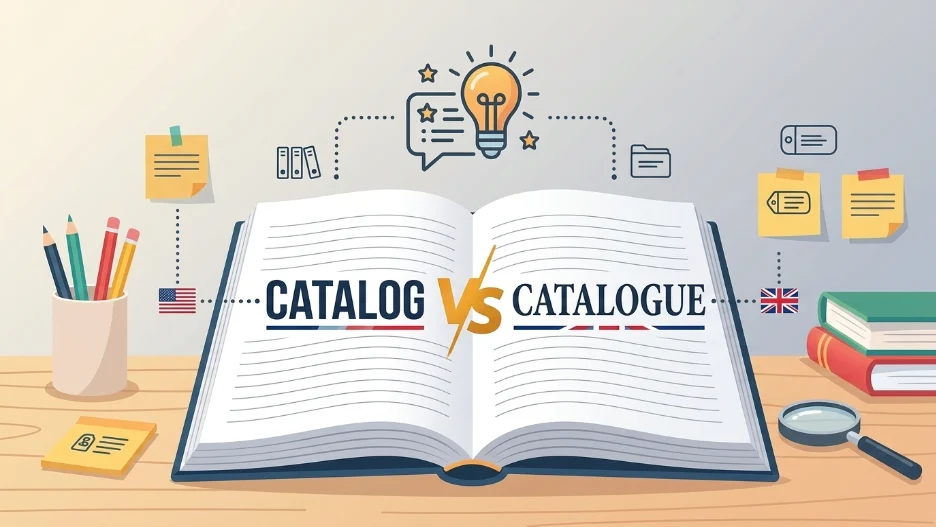
Quick Answer: Catalog and catalogue have the same meaning and are both correct spellings. The difference is regional usage. Catalog is the preferred spelling in American English, while catalogue is the standard spelling in British English and many other English-speaking countries. Choose the version that matches your audience, but use it consistently throughout your writing.
Have you ever wondered whether catalog or catalogue is the correct spelling? If you’ve seen both versions in books, online stores, or business documents, you’re not alone. These two words have the same meaning, referring to a list of items, products, books, or information. The only real difference is the variety of English being used.
In this guide, we’ll explain the differences between catalog and catalogue, when to use each spelling, and why both are considered correct. You’ll also find clear examples, common mistakes to avoid, and simple tips to help you choose the right spelling for American, British, or international audiences
Quick Answer Table
| Feature | Catalog | Catalogue |
| Correct Spelling | ✅ Yes (American English) | ✅ Yes (British/Commonwealth English) |
| Region | United States, Canada | UK, Australia, New Zealand, South Africa |
| Meaning | A list, register, or systematic arrangement of items | Same meaning |
| Usage | Noun and verb | Noun and verb |
| Pronunciation | KA tuh log | KA tuh log (identical) |
| Example | “I need to catalog my book collection.” | “I need to catalogue my book collection.” |
Which One Is Correct?
The short answer is that both “catalog” and “catalogue” are correct. The choice between them depends entirely on where your audience lives and which variety of English they use.
Think of it like this: “catalog” is the American English version, while “catalogue” is the British English version. Neither is more correct than the other—they simply serve different regional audiences. This is similar to other spelling differences like color/colour, theater/theatre, and center/centre.
Meaning of “Catalog”
Definition
A catalog (American spelling) is a systematic, organized list or register of items, often with descriptive details. It can function as both a noun and a verb:
- As a noun: A collection of items arranged in a specific order with descriptions
- As a verb: The act of creating such a list or systematically organizing items
Usage in American English
In the United States, “catalog” is the standard spelling for both the noun and verb forms. It’s used across all professional, academic, and casual contexts:
- Retail: “I received the holiday catalog in the mail today.”
- Libraries: “The library’s catalog contains over 100,000 titles.”
- Academics: “Students can catalog their research sources using reference management software.”
- Business: “Our product catalog is available for download on our website.”
- Technology: “The software helps users catalog their digital assets efficiently.”
Real World Examples
- “The museum published a comprehensive catalog of its 19th century art collection.”
- “Before the internet, companies would mail glossy catalogs to potential customers.”
- “I need to catalog all my grandmother’s recipes before they’re lost.”
- “The database catalog allows users to search for items by multiple criteria.”
- “As a collector, I’ve learned to catalog my stamps by country and year.”
Meaning of “Catalogue”
Definition
Catalogue carries the identical meaning as its American counterpart—it’s a systematic list or register of items with descriptions. The only difference lies in its spelling, which follows British English conventions.
Usage in British and Commonwealth English
“Catalogue” is the preferred spelling in:
- United Kingdom
- Australia
- New Zealand
- South Africa
- India (in many contexts)
- Other Commonwealth nations
Like its American variant, it can function as both a noun and verb:
- As a noun: “The university’s library catalogue is accessible online.”
- As a verb: “The curator will catalogue the new acquisitions.”
Real World Examples
- “The British Museum published a comprehensive catalogue of its Egyptian artifacts.”
- “Our company’s latest catalogue features sustainable fashion items.”
- “Researchers are working to catalogue the region’s biodiversity.”
- “The collector carefully catalogued his vintage stamps in a leather bound album.”
- “Oxford University’s Bodleian Library has an extensive digital catalogue.”
Key Differences Between the Two Words
Spelling
The most obvious difference is the presence of “ue” at the end of “catalogue.” The American “catalog” drops these letters, following the pattern of other words like “dialog” (American) vs. “dialogue” (British), though note that some American publications still use “dialogue” in specific contexts.
Meaning
There is no difference in meaning. Both words refer to exactly the same concept: an organized list or register of items with accompanying descriptions.
Pronunciation
There is no difference in pronunciation. Both are pronounced as [KA tuh log] with the stress on the first syllable. The “ue” at the end is silent, making the pronunciation identical regardless of which spelling you choose.
Grammar
Both words function identically grammatically:
- Noun: Singular (catalog/catalogue) and plural (catalogs/catalogues)
- Verb: Regular verb forms (cataloged/catalogued; cataloging/cataloguing)
- Usage: Same grammatical patterns and sentence structures
Usage
The primary difference lies in regional usage:
- United States: Standard spelling is “catalog”
- United Kingdom: Standard spelling is “catalogue”
- Canada: Often follows British spelling but American influence is growing
- Australia: Follows British spelling
- India: Mixed usage, with British spelling being more traditional
Recognition
Both spellings are widely recognized by dictionaries, spell checkers, and readers around the world. However, there are important considerations:
- American spell checkers will flag “catalogue” as incorrect
- British spell checkers will flag “catalog” as incorrect
- Most international readers understand both variations
- Some style guides have specific preferences
Common Mistakes People Make
1. Inconsistent Usage Within the Same Document
Mistake: Switching between “catalog” and “catalogue” in the same document without a clear reason.
Solution: Choose one spelling (based on your target audience or style guide) and stick with it throughout your document.
2. Assuming One Spelling Is “Wrong”
Mistake: Declaring that “catalog” is a misspelling or “catalogue” is outdated.
Solution: Recognize that both are correct—they just serve different regional audiences.
3. Ignoring Target Audience
Mistake: Using American spelling for a British audience or British spelling for an American audience in formal contexts.
Solution: Always consider your primary audience and use the spelling they expect.
4. Misapplying Verb Conjugations
Mistake: “I cataloged the items” (American) or “I catalogued the items” (British) are correct, but mixing the base spelling with the other conjugation pattern is incorrect.
Solution: Maintain consistency in all forms.
5. Overlooking Style Guide Requirements
Mistake: Ignoring the specific requirements of style guides like APA, MLA, or Chicago Manual of Style.
Solution: Check your required style guide for specific preferences.
6. Assuming Spelling Determines Pronunciation
Mistake: Thinking “catalogue” might be pronounced differently due to its longer spelling.
Solution: Remember that pronunciation is identical—the “ue” is silent.
7. Using Both Spellings in Professional Writing
Mistake: Mixing spellings in professional documents, business communications, or academic papers.
Solution: Maintain consistency throughout your writing.
Correct Usage Examples
Casual Examples
- “I love flipping through the furniture catalog for design inspiration.”
- “My grandmother keeps a handwritten catalog of all her rose varieties.”
- “The online course catalog has hundreds of interesting classes to choose from.”
- “Can you catalog all the books we’ve collected over the years?”
- “The garage sale catalog listed all the vintage treasures.”
Professional Examples
- “Our marketing team is finalizing the annual product catalog for distribution.”
- “The procurement department requires a detailed catalog of office supplies.”
- “The database administrator needs to catalog all database schemas for compliance.”
- “We’ve updated our digital catalog with the latest inventory items.”
- “The company’s catalog of services includes consulting, implementation, and support.”
Educational Examples
- “Students must learn to catalog their academic research sources properly.”
- “The school library’s catalog system uses the Dewey Decimal Classification.”
- “Researchers can catalog their field notes using specialized software.”
- “The course catalog provides detailed descriptions of all available subjects.”
- “Undergraduates should catalog their professional experiences for future job applications.”
Literary/Metaphorical Examples
- “Her memory serves as an emotional catalog of all the loves and losses she’s experienced.”
- “The poet’s work provides a catalog of human emotions.”
- “He could catalog the city’s history through its architectural changes.”
- “The artist’s sketchbook served as a visual catalog of his travels.”
- “Her daily journal became a catalog of small joys and quiet sorrows.”
Word Origin / Etymology
Understanding the historical journey of “catalog” helps explain why we have two spellings today.
Ancient Roots
The word traces back to ancient Greek:
- Greek: “katalogos” (κατάλογος) meaning “a list, register, or enrollment”
- Greek components: “kata” (down) + “legein” (to count, tell, or speak)
Latin Transition
The Greek word was adopted into Late Latin as “catalogus,” maintaining the same meaning of an itemized list.
French Influence
The word entered Middle English via Old French “catalogue,” which explains why the British spelling retained the French influenced “ue” ending.
The American Shortening
By the mid 19th century, American English began simplifying spellings, following the influence of Noah Webster, who advocated for more phonetic spelling. Webster’s dictionaries promoted “catalog” without the “ue” ending, similar to other simplified spellings like:
- “color” instead of “colour”
- “center” instead of “centre”
- “dialog” instead of “dialogue” (though note that “dialogue” remains more common in some contexts)
Contemporary Usage
Today, the split between American and British spellings is firmly established, though digital communication and globalization are blurring these lines.
Why the Incorrect Version Became Popular
Neither version is truly incorrect, but it’s worth understanding how the variant became so prevalent.
The Rise of American English
The shorter “catalog” gained dominance in the United States through:
Noah Webster’s Influence: His spelling reforms in the early 1800s sought to simplify and Americanize English spellings, removing what he considered unnecessary letters.
Printing and Publishing: American publishers and newspapers standardized “catalog” in their style guides, which reinforced its usage.
Cultural and Economic Impact: As American influence grew globally, the simplified spelling spread through trade, media, and technology.
The Persistence of British English
The longer “catalogue” remained standard in the UK and Commonwealth due to:
Historical Tradition: British English maintained traditional spellings, including French influenced endings.
Educational Systems: British schools taught the traditional spelling as correct, perpetuating it across generations.
Publishing Standards: Major British publishers, including Oxford University Press, maintained “catalogue” as their standard.
Modern Cross Pollination
Today, the internet and globalization have led to increased exposure to both spellings. Most readers understand both variants, though they may have a preference based on their background.
Easy Memory Tricks
The “American Savings” Trick
Remember: Americans like to save letters. Just like they save the “u” in “color” and the “re” in “center,” they save the “ue” in “catalog.”
The “British Elegance” Trick
Remember: British English often preserves the original spellings. The extra “ue” makes the word look more traditional, just like other British spellings.
The “Double Check” Trick
Remember: Think of “catalogue” as having the “ue” (you and me) ending, which reminds you that it’s the version used outside America.
The “Audience” Check
Remember: Ask yourself: “Who’s reading this?” If it’s Americans, use “catalog.” If it’s British, Commonwealth, or international readers, use “catalogue.”
The “Style Guide” Check
Remember: If you’re unsure, check your style guide. APA, MLA, and Chicago typically recommend the American spelling unless you’re specifically writing for British audiences.
Frequently Asked Questions
Is catalogue correct?
Yes. Catalogue is the standard spelling in British English, while catalog is the American English spelling. Both words have the same meaning, pronunciation, and grammatical use.
Is catalog or catalogue correct?
Both are correct. Use catalog for American audiences and catalogue for British, Australian, and most Commonwealth audiences.
Is catalog a real word?
Absolutely. Catalog is the accepted American English spelling and appears in all major dictionaries.
Why are there two spellings?
The difference comes from regional spelling conventions. American English simplified the word to catalog, while British English retained the traditional catalogue spelling.
Is catalogue still used today?
Yes. Catalogue remains the standard spelling in the UK, Australia, New Zealand, South Africa, and many other English-speaking countries.
Is catalog American or British English?
Catalog is the American English spelling. Catalogue is the British English equivalent.
Is cataloging or cataloguing correct?
Both are correct. American English uses cataloging, while British English uses cataloguing.
Can I use catalog and catalogue interchangeably?
Yes, since they have the same meaning. However, you should use one spelling consistently throughout your document.
Which countries use catalog and which use catalogue?
The United States primarily uses catalog, while the United Kingdom, Australia, New Zealand, South Africa, and many Commonwealth countries generally use catalogue.
How do you pronounce catalog and catalogue?
Both words are pronounced exactly the same. The “ue” in catalogue is silent.
What is the plural of catalogue?
In British English, the plural is catalogues. In American English, the plural is catalogs.
What is the past tense of catalog?
The American English past tense is cataloged, while British English uses catalogued.
Can catalog be used as a verb?
Yes. Both catalog and catalogue can be used as verbs meaning to organize or create a systematic list of items.
Does the spelling matter in academic writing?
Yes. Follow the spelling conventions required by your institution or style guide, and remain consistent throughout your work.
Does the spelling affect SEO?
It can. Use catalog when targeting an American audience and catalogue when targeting British or international audiences to better match search intent.
Is there any difference in meaning between catalog and catalogue?
No. The two words are complete synonyms and differ only in spelling.
Which spelling should I use in Canada?
Both spellings appear in Canadian English. Catalogue is traditionally more common, but catalog is becoming increasingly popular due to American influence.
Are there other words with the same spelling pattern?
Yes. Similar American and British spelling variations include dialog/dialogue, analog/analogue, monolog/monologue, and epilog/epilogue.
Which spelling should I use for my business name?
Choose the spelling that matches your primary audience. Catalog is best for American customers, while catalogue is more appropriate for British and international markets.
Will one spelling replace the other in the future?
Both spellings are well established and are likely to remain in use. Although globalization has increased exposure to both forms, regional spelling preferences continue to be widely recognized.
Conclusion
Catalog and catalogue are both correct spellings of the same word. The only difference is regional usage: catalog is the preferred form in American English, while catalogue is the standard spelling in British English and many other English-speaking countries. They share the same meaning, pronunciation, and grammatical function, so neither spelling is more correct than the other.
The best choice depends on your audience. If you’re writing for readers in the United States, use catalog. For audiences in the United Kingdom, Australia, or other Commonwealth countries, catalogue is the better option. Whatever spelling you choose, use it consistently throughout your writing to maintain clarity, professionalism, and a polished reading experience.