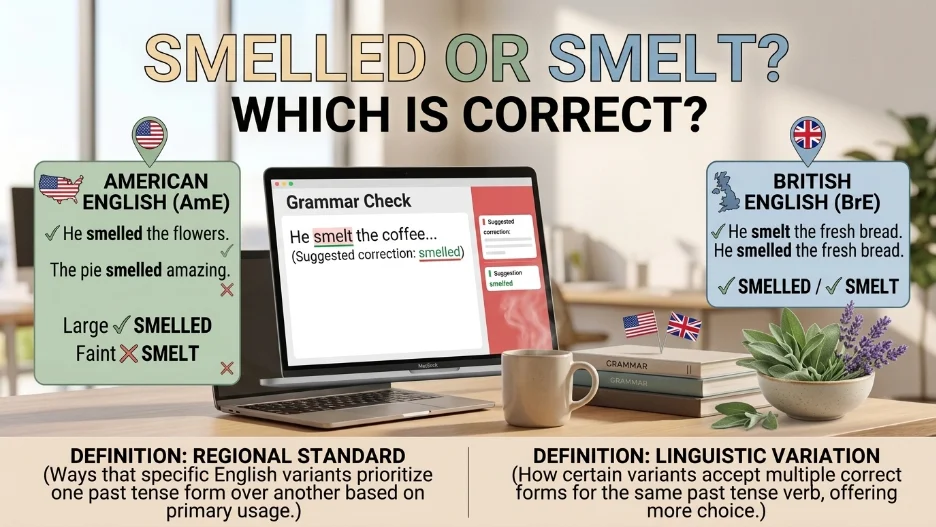
Quick Answer: Both “smelled” and “smelt” are correct past tense and past participle forms of smell. Smelled is more common in American English, while smelt is preferred in British English. They have the same meaning and can usually be used interchangeably.
The difference between smelled and smelt both are correct past forms of the verb smell. While they have the same meaning, the preferred choice depends largely on whether you are writing in American or British English.
In American English, smelled is the standard and more commonly used form. In British English, both smelled and smelt are acceptable, although smelt is often preferred in everyday writing and speech. Understanding this regional difference will help you choose the form that best suits your audience and writing style.
Quick Answer Table
| Feature | Smelled | Smelt |
| Correct in American English | ✅ Yes (preferred) | ❌ Rare |
| Correct in British English | ✅ Yes | ✅ Yes (common) |
| Meaning (as past tense of smell) | To have perceived an odor | To have perceived an odor |
| Part of Speech | Verb (past tense/past participle) | Verb (past tense/past participle) |
| Example Sentence | “I smelled fresh coffee when I woke up.” | “I smelt fresh coffee when I woke up.” |
| Other Meanings | None | A fish; to extract metal from ore |
| Pronunciation | /smɛld/ | /smɛlt/ |
Which One Is Correct?
Here’s the good news: both smelled and smelt are grammatically correct past tense forms of the verb to smell . The difference is primarily regional.
Smelled is the standard past tense and past participle form in American English . If you’re writing for a U.S. or Canadian audience, smelled is your go to choice. It’s also widely accepted and understood in British English.
Smelt is a common alternative in British English and other Commonwealth varieties (Australian, New Zealand, etc.) . Brits use smelled and smelt interchangeably, with neither form being significantly more common than the other .
Think of it like the learned vs. learnt or burned vs. burnt debate—same verb, different regional preferences .
Quick Rule of Thumb
- American audience? Use smelled
- British audience? Use either, but be consistent
- International audience? Smelled is safest—it’s understood everywhere
Meaning of Smelled
Smelled is the regular past tense and past participle form of the verb smell. It means to have perceived, detected, or become aware of an odor through the nose .
Smell is a sensory verb—it connects us to the world through scent. When you use smelled, you’re describing a completed action of detecting or experiencing an aroma.
Common Uses of Smelled
1. Perceiving an odor:
- “I smelled something burning in the kitchen.”
- “She smelled the flowers in the garden.”
2. Having a particular scent:
- “The room smelled like fresh paint.”
- “His jacket smelled of woodsmoke.”
3. Figurative detection:
- “I smelled trouble the moment he walked in.”
- “We smelled a rat when she gave such a vague answer.”
Real World Examples
“Residents had begun reporting that their water smelled of petroleum, signaling possible contamination.” —The Washington Post
“Arson is suspected because investigators said they smelled an accelerant at the scene.” —The New York Times
Meaning of Smelt (Beyond the Past Tense)
Here’s where it gets interesting. Smelt has three distinct meanings, and only one of them relates to the sense of smell.
1. Smelt as a Past Tense of Smell (British English)
In British English, smelt functions the same way as smelled :
“The officers pulled over the vehicle, which was being driven by Stewart who smelt of liquor.” —The Belfast Telegraph
“Coming from Milton Keynes, where there weren’t a great deal of old things, to walk in somewhere that smelt of coffee and vinyl was odd.” —The Guardian
2. Smelt as a Noun (A Fish)
A smelt is a small, silvery fish found in cold northern waters, belonging to the family Osmeridae . These fish are common in the Great Lakes and Northern European waters .
Example: “We caught several smelts during our fishing trip.”
3. Smelt as a Verb (Metal Extraction)
To smelt means to extract metal from its ore by heating and melting .
Important: The past tense of this meaning is smelted, not smelt .
Example: “They smelted the iron ore to produce steel.”
Key Differences Between Smelled and Smelt
| Aspect | Smelled | Smelt |
| Primary Region | North America (U.S., Canada) | British English (UK, Australia, NZ) |
| Form | Regular ( ed ending) | Irregular ( t ending) |
| Pronunciation | /smɛld/ (one syllable) | /smɛlt/ (one syllable) |
| Other Meanings | None | Fish; metal extraction |
| Past Tense of Smelt (metal) | N/A | Smelted |
| Level of Formality | Standard everywhere | Common in UK, rare in US |
| Recognition | Universal | Recognized globally but less common in US |
Common Mistakes People Make
Mistake 1: Thinking Smelt Is Incorrect
Many American English speakers mistakenly believe smelt is a misspelling. It’s not—it’s simply the British variant . Think of it as a regional preference rather than an error.
Mistake 2: Using Smelt for Metal Extraction in Past Tense
Incorrect: “They smelt the ore yesterday.”
Correct: “They smelted the ore yesterday.”
Remember: when smelt means “to extract metal,” its past tense is smelted .
Mistake 3: Mixing Regional Conventions
If you’re writing for an American audience, using smelt might look outdated or foreign. Similarly, if you’re writing for a British audience, smelled is perfectly fine but smelt often feels more natural .
Mistake 4: Inconsistent Usage
Inconsistent: “She smelled the roses, and then she smelt the coffee.”
Consistent: “She smelled the roses, and then she smelled the coffee.” (American English)
Consistent: “She smelt the roses, and then she smelt the coffee.” (British English)
Correct Usage Examples
Casual / Everyday Examples
- “I smelled (or smelt) the cookies as soon as I walked in.”
- “That milk smelled (or smelt) sour—I tossed it out.”
- “Have you smelled (or smelt) this cheese? It’s incredible!”
- “My dog smelled (or smelt) something interesting in the grass.”
Professional / Business Examples
- “The quality control team smelled (or smelt) a chemical odor in the manufacturing facility.”
- “After the fire, the building smelled (or smelt) of smoke for weeks.”
- “The inspectors smelled (or smelt) something unusual and requested further testing.”
- “Her proposal smelled (or smelt) of desperation—we need to help her refine it.”
Educational / Academic Examples
- “The experiment produced a gas that smelled (or smelt) like rotten eggs.”
- “Historically, early chemists smelled substances to identify them—a dangerous practice.”
- “The organic compound smelled (or smelt) of vinegar, indicating the presence of acetic acid.”
- “Indigenous peoples smelled the earth after rain to predict weather patterns.”
Literary / Metaphorical Examples
- “The night air smelled (or smelt) of jasmine and possibility.”
- “He smelled (or smelt) betrayal in her hesitation.”
- “The old library smelled (or smelt) of parchment and forgotten stories.”
- “She smelled (or smelt) success in every step he took.”
Using the Verb Smell Correctly
A quick grammar note: smell can be used as a copular verb (linking verb), which means it’s followed by an adjective, not an adverb .
Correct: “The soup smells delicious.” (adjective)
Incorrect: “The soup smells deliciously.” (adverb)
Correct: “Roses smell beautiful.”
Incorrect: “Roses smell beautifully.”
Correct: “The room smelled damp.”
Incorrect: “The room smelled damply.”
Word Origin / Etymology
The verb smell has a fascinating history. It emerged in Middle English (circa 1125–1175) as smellen or smullen . Its exact origin is uncertain, but it likely came from Old English or early Germanic influences .
The past tense variant smelt follows an older pattern where verbs ended in t rather than ed—similar to felt (from feel) and slept (from sleep) . This pattern was more common in older forms of English.
The noun smelt (the fish) comes from Old English smyld or smelt and is related to words meaning “to melt” or “soft” (referring to the fish’s texture) . The metal extraction smelt comes from Middle Dutch or Middle Low German smelten, related to the modern German schmelzen (to melt) .
Why the Incorrect Version Became Popular
Smelt isn’t incorrect—but it has become less common in American English for several reasons.
The Regularization of English Verbs
English has a natural tendency to regularize irregular verbs over time. Just as help changed from holp to helped, many t verbs have gradually shifted to ed forms . Smelled represents this trend toward regularity.
Noah Webster’s Influence
In the early 19th century, American lexicographer Noah Webster intentionally promoted simplified spellings to distinguish American English from British English. His dictionaries favored ed endings over t endings, which influenced generations of American writers and educators .
The Rise of American English
As American culture, media, and business spread globally, American English conventions (including smelled) gained wider acceptance. Today, smelled is the more common form worldwide .
The Smelt Confusion
Because smelt has other meanings (fish and metal extraction), some writers avoid it to prevent ambiguity. Why risk confusion when smelled is clear and universally understood?
One Exception: The Meme
If you’ve ever heard the phrase “He who smelt it, dealt it,” you’ve encountered a rare case where smelt is used in American English . This rhyming expression has become a cultural meme and keeps smelt alive in American pop culture.
Easy Memory Tricks
For American English Speakers
“In America, we smelled—with an E.”
Think of the E in American and the E in smelled. They go together naturally.
For British English Speakers
“Brits use smelt—just like spelt and learnt.”
The pattern of using t endings in British English extends to several verbs: learned/learnt, burned/burnt, spelled/spelt, and smelled/smelt .
If You’re Still Unsure
When in doubt, use smelled. It’s correct in every variety of English and never causes confusion. No one will ever mark smelled as wrong—while smelt might raise eyebrows in American contexts .
For the Fish vs. Verb Confusion
“Fish have fins; metals are mined—only smells are smelt (in British English).”
Remember: if you’re talking about a fish or extracting metal, the past tense is smelted, not smelt.
Frequently Asked Questions
1. Is smelt a real word?
Yes! Smelt is a real word with three meanings: (1) British past tense of smell, (2) a type of small silvery fish, and (3) the act of extracting metal from ore. All three are legitimate dictionary entries .
2. Is smelt the past tense of smell?
Yes, in British English. In American English, smelled is the preferred past tense. Both are grammatically correct, but smelled is more common in North America .
3. Is it smelled or smelt in the UK?
Both are acceptable in the UK. British English speakers use smelled and smelt interchangeably, and neither form is significantly more common than the other .
4. Is smelled American or British?
Smelled is the standard form in American English, but it’s also perfectly acceptable in British English. It’s the most widely understood and universally accepted past tense form of smell .
5. Can I use smelt in American English?
Yes, but it’s rare. Americans will understand you, but smelt may look outdated or foreign to them. The exception is in the phrase “He who smelt it, dealt it,” which is widely recognized .
6. What is the past participle of smell?
The past participle of smell can be either smelled or smelt . For example:
- Present perfect: “I have smelled (or smelt) that perfume before.”
- Past perfect: “She had smelled (or smelt) something strange all day.”
7. Is smell a regular or irregular verb?
Smell is considered a semi irregular or weak irregular verb because it has both regular ( ed) and irregular ( t) past tense forms . Both are acceptable, though regional preferences vary.
8. What’s the difference between smelled and smelt as words?
The difference is primarily regional. Smelled is standard in American English; smelt is common in British English. However, smelt also has two unrelated meanings (fish and metal extraction), while smelled has only the olfactory meaning .
9. How do you pronounce smelt and smelled?
- Smelled is pronounced /smɛld/ (rhymes with “held”)
- Smelt is pronounced /smɛlt/ (rhymes with “felt”)
10. Is it “I smelled a rat” or “I smelt a rat”?
Both are correct! “Smell a rat” is an idiom meaning to suspect something is wrong. In American English: “I smelled a rat.” In British English: “I smelt a rat.”
Conclusion
So, which is correct: smelled or smelt? The answer depends on your audience and location.
For American English speakers (and most Canadian speakers), smelled is the clear winner. It’s the standard, preferred, and most widely accepted form. Use it confidently in all your writing.
For British English speakers, both forms are equally correct. You can choose smelled or smelt based on person.