Quick answer:Center and Centre both are correct spellings.
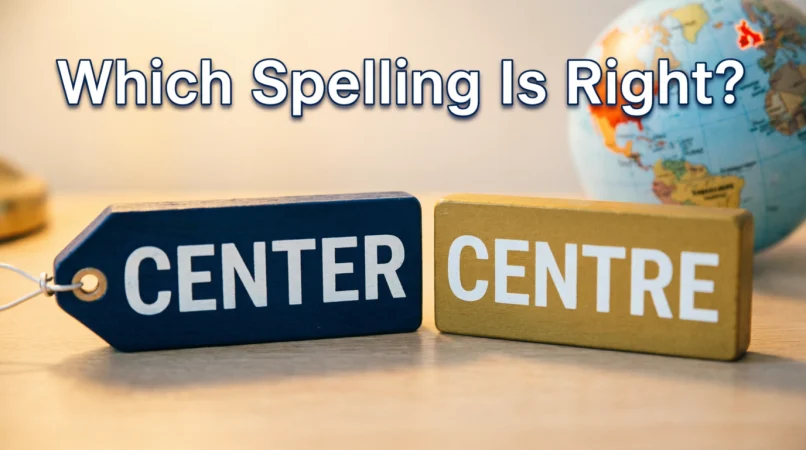
Center is the standard American English spelling, while Centre is used in British English and many Commonwealth countries. They have the same meaning.
Center and Centre are both correct spellings with the same meaning. They refer to the middle point, central place, or main part of something. The only difference is regional spelling preference.
Center is preferred in American English, while Centre is preferred in British English, Australian English, and other Commonwealth varieties. Choose the spelling that matches your audience and stay consistent.
Quick Answer Table
| Feature | Center | Centre |
| Primary Usage | American English | British English |
| Correctness | Correct | Correct |
| Meaning | Middle point, place, or focus | Middle point, place, or focus |
| Pronunciation | SEN ter | SEN tuh |
| Example Sentence | The medical center is located downtown. | The medical centre is located in the city centre. |
| Global Recognition | Widely used in USA, Philippines | Used in UK, Australia, Canada, New Zealand, and many Commonwealth countries |
Which One Is Correct: Center or Centre?
The honest truth is that both spellings are grammatically correct, but they serve different audiences. Neither version is incorrect; rather, they represent regional spelling variations that have developed over centuries.
Center is the preferred spelling in American English. If you live in the United States or write primarily for American audiences, this is the version you should use. It appears in American publications, educational materials, and official documents.
Centre is the standard spelling in British English. This version is used throughout the United Kingdom, Australia, Canada (though with some exceptions), New Zealand, South Africa, and other Commonwealth nations. If your readers are primarily British or international, this spelling is typically the better choice.
The choice between center or centre isn’t about right or wrong, but about understanding your audience and maintaining consistency in your writing. Many global organizations adopt one spelling standard and stick with it throughout their communications.
Meaning of Center
Definition and Core Meaning
Center (American spelling) functions as both a noun and a verb in English. As a noun, it refers to the middle point of something, a place where activities are concentrated, or a facility dedicated to specific services. As a verb, it means to place something in the middle or to focus on something.
Detailed Explanation
The word “center” carries multiple meanings across different contexts:
Geometric Center: This is the exact middle point of a circle, sphere, or other geometric shape. For example, “The center of the circle is marked with a dot.”
Location or Place: A center can be a building or area where particular activities occur. Examples include shopping centers, community centers, medical centers, and conference centers.
Focus or Core: The center can represent the most important part of something. For instance, “The center of the argument was about budget allocation.”
Political Meaning: In politics, the center refers to moderate views that are neither extremely left nor right wing. “The party moved toward the center to attract more voters.”
Sports Usage: In basketball, the center is a position played by a tall player near the basket. In soccer or football, the center refers to the middle area of the field.
Usage Examples
Casual Context:
- “Let’s meet at the center of the mall.”
- “The town center was crowded with holiday shoppers.”
- “I need to find the center of this target.”
Professional Context:
- “Our research center focuses on sustainable energy solutions.”
- “The medical center provides comprehensive healthcare services.”
- “Please center the text on the page before printing.”
Educational Context:
- “The students learned to find the center of various geometric shapes.”
- “The university established a new center for environmental studies.”
Literary Context:
- “She remained the calm center of the storm.”
- “His entire world centered around his family.”
Meaning of Centre
Definition and Usage
Centre is the British English spelling of the same word we discussed above. It carries exactly the same meanings and functions identically in sentences. The only difference is the spelling convention based on regional preferences.
Regional Usage
British Context:
- “The city centre is closed to traffic on weekends.”
- “She works at a sports centre near her home.”
Australian Context:
- “The shopping centre has over 200 stores.”
- “We visited the cultural centre during our trip.”
Canadian Context:
- Canadian English typically uses “centre” in most contexts, though some government and official documents may use “center” in certain situations.
International Context:
- Many international organizations, particularly those with British English influence, use “centre.”
- “The UN centre for peacekeeping operations is located in New York.”
Correct Usage Examples
Everyday Conversation:
- “The hotel is right in the centre of town.”
- “Could you sit in the centre of the row?”
- “The shopping centre closes at 9 PM.”
Business Communication:
- “Our regional head office serves as the administrative centre.”
- “The new conference centre will host major events.”
Academic Writing:
- “The research findings centre on the impact of climate change.”
- “This discussion centres around three main themes.”
Key Differences Between Center and Centre
Spelling Differences
The most obvious difference is the arrangement of the final three letters. “Center” follows the American pattern of ending with ” er,” while “centre” follows the British pattern of ending with ” re.” This distinction is part of a broader pattern in English spelling. Similar pairs include “theater/theatre,” “meter/metre,” “liter/litre,” and “fiber/fibre.”
Geographical Recognition
The choice between center or centre signals to readers which English convention you’re following. Americans immediately recognize “center” as standard, while Brits and Commonwealth readers view “centre” as the natural choice. Some readers may perceive using the “wrong” spelling as a minor error, but it rarely causes confusion in meaning.
International Business Context
In global business environments, companies often choose one spelling standard for all official communications. Many international organizations with American roots use “center,” while those based in the UK or Europe typically use “centre.” Consistency is more important than which version you choose.
Pronunciation Variations
Both spellings share the same pronunciation in standard English. However, British speakers may pronounce “centre” with a slightly softer ending sound, while American speakers might pronounce “center” with a more distinct “r” sound. These differences are subtle and relate more to accent than to the spelling itself.
Dictionary Recognition
Both “center” and “centre” appear in major dictionaries worldwide. American dictionaries list “center” as the primary spelling and “centre” as a variant. British dictionaries do the opposite, listing “centre” as primary and “center” as an American variant. Both are recognized as valid English words.
Common Mistakes People Make When Using Center or Centre
Mixing Spellings Inconsistently
One of the most common mistakes is using both spellings within the same document. This creates confusion and looks unprofessional. If you choose “center,” use it throughout your entire piece of writing. If you prefer “centre,” maintain that spelling consistently.
Using the Wrong Spelling for Your Audience
Many writers automatically use the spelling they learned growing up, even when writing for an international audience. Consider your readers carefully. If you’re writing for an American publication, use “center.” If you’re submitting to a British journal, use “centre.”
Forgetting Place Names
Place names that include “center” or “centre” should be spelled exactly as they appear in official sources. For example, Rockefeller Center in New York uses “Center,” while the Royal Albert Hall’s official address uses “Centre.” Always check the official spelling of proper nouns.
Word Stress and Pronunciation Confusion
Some writers mistakenly think the different spellings indicate different pronunciations or meanings. Both words are pronounced identically and share all meanings. The spelling difference is purely visual and regional.
Using Center as a Verb Incorrectly
When using center or centre as a verb, ensure you’re using the correct preposition. In American English, you typically say “center on” or “center around.” In British English, “centre on” or “centre around” are equally acceptable. For example:
- “The discussion centered on economic policy.”
- “The debate centred around environmental issues.”
Incorrect Noun Usage
Another common error involves using “center” as a noun but treating it as a singular when it should be plural. Remember that “center” refers to one middle point, so use it appropriately.
- Correct: “There are several community centers in this district.”
- Incorrect: “There are several community center in this district.”
Correct Usage Examples
Personal and Casual Examples
American Style:
- “Let’s grab coffee at the new shopping center.”
- “The kid made a centerpiece for the Thanksgiving table.”
- “I feel like the center of attention whenever I wear this dress.”
- “The center of the pizza was perfectly cooked.”
British Style:
- “Let’s meet in the town centre for lunch.”
- “The children made a table centrepiece for Christmas.”
- “She loves being the centre of attention at parties.”
- “The theatre is located in the city centre.”
Professional and Business Examples
American Professional Context:
- “Our call center operates 24 hours a day.”
- “The business development center has relocated to a larger facility.”
- “Please center the logo on the company letterhead.”
- “We need to center our marketing strategy on customer needs.”
British Professional Context:
- “The head office serves as the administrative centre.”
- “Our research centre has been operational since 1995.”
- “The conference centre can accommodate up to 500 delegates.”
- “We plan to centre our growth strategy on emerging markets.”
Educational and Academic Examples
American Academic Context:
- “The students calculated the center of mass in physics class.”
- “The Writing Center provides free tutoring sessions.”
- “This theory centers on the concept of social justice.”
British Academic Context:
- “The mathematics department has a dedicated study centre.”
- “The university’s research centre for neuroscience is world renowned.”
- “The essay centres around three key arguments.”
Literary and Metaphorical Examples
American Literature:
- “The small town was the emotional center of the novel.”
- “Justice remains the center of the democratic experiment.”
- “His world centered around his art.”
- “The mother was the center of family life.”
British Literature:
- “The garden was the visual centre of the estate.”
- “The moral centre of the story is forgiveness.”
- “Her life centred around her work and family.”
- “The village green served as the social centre of the community.”
Word Origin and Etymology
Understanding the etymology of center or centre provides fascinating context for why we have two spellings today.
Ancient Roots
Both spellings trace back to the Latin word “centrum,” which means the fixed point of a circle’s compass. The Romans borrowed this from Greek “kéntron,” which means a sharp point or prick, and later came to mean the point around which a circle is drawn. This Greek term itself comes from “kentein,” meaning to prick or stitch.
Journey Through Languages
Latin Influence: The Latin “centrum” was used in classical Latin to describe the middle point of a circle.
French Connection: The word entered Old French as “centre,” and from French, it made its way into Middle English.
Old English Adoption: By the 14th century, the word had been adopted into English, carrying the French spelling “centre.” This remained the dominant spelling in all English speaking regions for centuries.
The American Spelling Shift
The “center” spelling emerged in American English in the late 18th and early 19th centuries. This change coincided with broader spelling reforms championed by figures like Noah Webster, who sought to create a distinctly American version of English. Webster and other reformers believed English spelling should be more phonetic and logical.
Noah Webster’s Influence: Webster’s 1828 dictionary promoted simplified American spellings. He reasoned that “center” better represented the word’s pronunciation than “centre.” His reforms became widely adopted in American education and publishing.
British Resistance: While American spelling evolved, British English largely maintained traditional spellings, preserving the French influenced spelling of many words. This created the spelling divide we still see today.
Why the Incorrect Version Became Popular
Neither “center” nor “centre” is actually incorrect. However, historical circumstances made each spelling dominant in different regions.
The American Version’s Rise
The “center” spelling gained popularity because of intentional educational and publishing reforms in the United States. As American schools adopted Webster’s spelling books, children learned the standardized “center” spelling. This created generational consistency and made it the default spelling in American English.
Digital Age Influence
The internet and global communication have blurred regional spelling lines. Many people now see both spellings regularly, leading to some confusion. American software defaults, keyboard layouts, and spell check preferences often reinforce the “center” spelling, even for users outside the United States.
Globalization Impact
As American media and technology dominate global markets, “center” has become more visible worldwide. Many non native English speakers learn American English spellings because of this exposure. However, the British spelling remains strong in many regions, particularly in former British colonies.
Why Writers Sometimes Mistakenly Believe One Is Wrong
Many people grow up learning only one spelling and naturally assume the other is incorrect. This is a matter of perspective, not grammar fact. Teachers in America often correct students who write “centre,” while British teachers do the opposite. This reinforces regional biases and perpetuates the confusion.
Easy Memory Tricks to Remember the Right Spelling
Here are simple ways to remember which spelling to use:
Visual Association
- American “center”: Think of the Empire State Building in New York City. Its location is the center of Manhattan. Remember that “center” ends with “er,” just like “New York.”
- British “centre”: Imagine a photo of London. The “centre” has the “re” ending, which you can remember by thinking of “the royal” spelling.
Pronunciation Memory Aid
- “Center” ends with “er” like “her,” which is the American way.
- “Centre” ends with “re” like the beginning of “republic,” reminding you of the British Commonwealth.
Context Clue
- When writing for an American audience, think “American = er” (like “computer” or “water”).
- When writing for a British audience, think “British = re” (like “theatre” or “metre”).
Keyboard Memory
- If your keyboard is set to American English, spell check will suggest “center.”
- If your keyboard is set to British English, the suggestion will be “centre.”
Sentence Association
- Write a sentence that includes your preferred spelling naturally. For example, “The shopping center is in the center of town.” Repeat this until it feels natural.
- Or for British English, “The shopping centre is in the centre of town.”
Use Technology
- Set your spell checker to your preferred English variant.
- Notice how software defaults when you type.
- Pay attention to autocorrect suggestions.
FAQs
1. Is it center or centre in Canada?
Canada mostly uses centre, following British English style.
2. Is center or centre used in Australia?
Centre is the standard spelling in Australian English.
3. Which spelling is correct in academic writing?
Use the spelling required by your institution’s style guide.
4. How do you pronounce center and centre?
Both are pronounced the same: SEN-ter.
5. Is it centering or centring?
Centering is American English; centring is British English.
6. Is it medical center or medical centre?
Both are correct depending on region: US uses center, UK/Australia use centre.
7. Do center and centre have different meanings?
No, both have the same meaning.
8. Are center and centre both English words?
Yes, both are accepted English spellings.
9. Should businesses use center or centre?
Use the official spelling chosen by the business.
10. Is center used in British English?
Rarely; centre is the preferred British spelling.
Conclusion
The difference between center and centre is not about right or wrong—it is about regional spelling preferences. Both words are correct, have the same meaning, and are pronounced the same. The main rule is to choose the spelling that matches your audience and maintain consistency throughout your writing.
Whether you use center for American English or centre for British and Commonwealth English, your message will remain clear. Understanding this small spelling difference helps you write more accurately, communicate confidently, and avoid unnecessary confusion in different English-speaking region