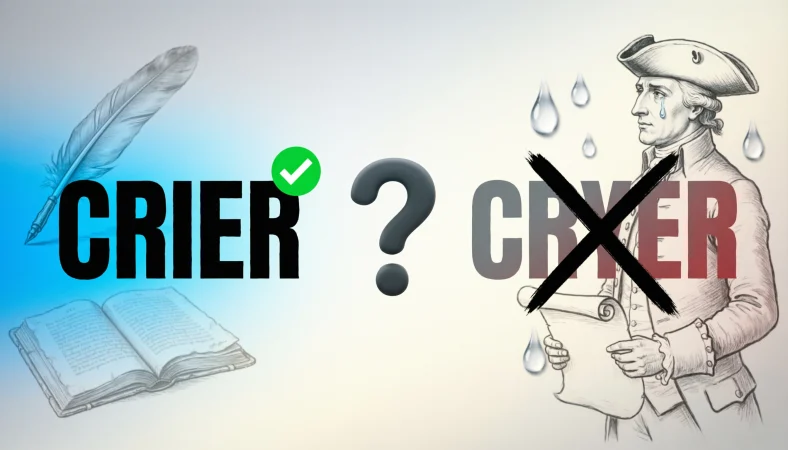
Quick answer:Crier and Cryer are both correct words, but they have different meanings.
Crier usually means someone who announces or calls out (like a town crier), while cryer means someone who cries or weeps. Their usage depends on the context.
Crier or Cryer both words look and sound similar. Although they share the same root word cry, they have different meanings and uses. Crier usually refers to a person who makes announcements or calls out publicly, while cryer refers to someone who cries or weeps.
Understanding the difference between crier and cryer helps you choose the right word based on context. Whether you are writing about a traditional town crier or describing someone who cries often, using the correct spelling makes your writing clearer and more accurate.
Quick Answer Table
| Aspect | Details |
| Correct Spelling | Crier |
| InCorrect Spelling | Cryer (generally considered a misspelling or rare surname) |
| Meaning | A person who cries, weeps, or makes announcements publicly |
| Primary Usage | Town crier (historical announcer), someone who weeps frequently, or one who shouts out |
| Example Sentence | “The town crier announced the news in the village square.” |
Which One Is Correct?
The straightforward answer is that “crier” is the correct spelling in standard English. This spelling follows the conventional rule for forming nouns from verbs ending in “y.” When you add the suffix ” er” to a verb that ends with “y,” you typically change the “y” to “i” before adding the suffix. Therefore, from the verb “cry,” we get “crier.”
The spelling “cryer” is largely considered incorrect in modern English usage. However, the situation has a few nuances. “Cryer” does exist but primarily as a surname or a rare alternative spelling that has largely fallen out of favor. In contemporary writing, whether you are working on a blog post, academic paper, or creative work, “crier” is the form recognized by major dictionaries and style guides.
Meaning of the Correct Word
Definition
A “crier” is fundamentally a person who cries. However, this simple definition branches into two distinct meanings that have evolved over time.
Explanation and Usage
First Meaning – One Who Weeps
The most common understanding of a crier is someone who weeps or sheds tears frequently. This usage applies to both literal crying and metaphorical expressions of emotion. For instance, a person who cries easily at sad movies or emotional events might be described as a crier. This meaning is widely used in everyday conversation.
Second Meaning – One Who Makes Public Announcements
Historically and in more formal contexts, a crier refers to an official who makes public announcements. The most famous example is the “town crier,” a person employed by a town or city to make public proclamations in the streets. Before modern communication methods like newspapers and television, town criers were essential for spreading news and official announcements.
Real world Examples
Here are examples of how “crier” appears in various contexts:
Everyday Usage
- “She is such a crier that even commercials make her emotional.”
- “I am not usually a crier, but that movie had me in tears.”
- “He admitted he was a crier during his teenage years.”
Historical and Formal Usage
- “The town crier rang his bell and shouted the latest news.”
- “Local authorities hired a crier to announce the new regulations.”
- “The royal crier delivered the proclamation with a booming voice.”
Professional and Metaphorical Usage
- “The company’s bankruptcy became a crier for corporate reform.”
- “The protest leader was a crier for social justice.”
- “In the courtroom, the crier called the session to order.”
Meaning of the Incorrect or Alternative Word
Is It Incorrect?
“Cryer” is generally considered a misspelling of “crier” in modern English. However, the situation is more complex than simply labeling it wrong.
Primary Recognition
The spelling “cryer” is most commonly recognized as a surname. Families with the last name Cryer exist in various English speaking countries. When used as a proper noun, it is entirely correct because names do not follow standard spelling rules.
Rare Valid Usage
In some historical contexts, “cryer” appears as an alternative spelling. This is particularly true in older English texts from the 16th and 17th centuries when spelling standards were less rigid. However, contemporary usage has firmly established “crier” as the standard spelling.
Common Misconceptions
Some people mistakenly believe that “cryer” refers specifically to someone who cries tears, while “crier” refers to someone who makes announcements. This distinction is incorrect. Both meanings belong to “crier,” and “cryer” remains a spelling error, not a word with a distinct definition.
Key Differences Between the Two Words
Understanding the differences between “crier” and “cryer” helps clarify why one is preferred.
Spelling
The most obvious difference is the letter after “r.” “Crier” uses an “i,” while “cryer” uses a “y.” This spelling variation stems from the standard English rule of changing “y” to “i” before adding suffixes. “Crier” follows this rule correctly, while “cryer” does not.
Meaning
“Crier” has established meanings in the English language. It refers to a person who cries or a public announcer. “Cryer,” on the other hand, lacks its own distinct meaning. When it appears outside of surnames, it is simply an alternative spelling that is considered outdated and incorrect.
Pronunciation
Both spellings are pronounced the same way: KRIGH er. The pronunciation does not change regardless of the spelling. This phonetic similarity is why many people do not notice the spelling difference in spoken language and often make errors in writing.
Grammar
Grammatically, “crier” functions as a noun formed from the verb “cry” by adding the agent noun suffix ” er.” The spelling change follows standard English morphological rules. Cryer” violates these rules, which is why grammar guides reject it.
Usage
In modern writing, “crier” appears in:
- News articles and journalism
- Academic writing
- Creative literature
- Legal documents
- Everyday conversation
“Cryer” appears primarily as:
- A surname in official records
- An occasional typo in informal writing
- A deliberate alternative spelling in historical fiction
Recognition
Major dictionaries including Merriam Webster, Oxford English Dictionary, and Cambridge Dictionary all recognize “crier” as the standard spelling. “Cryer” either does not appear or is listed as a variant that is no longer current.
Common Mistakes People Make
Writers frequently make errors when choosing between “crier or cryer.” Understanding these common mistakes can help you avoid them.
Mistake 1: Assuming Both Are Correct
Many people believe that “crier” and “cryer” are both acceptable alternatives. This is incorrect. “Crier” is the only standard spelling for the noun meaning a person who cries or announces.
Mistake 2: Confusing the Meanings
Some writers think “crier” refers to public announcers while “cryer” refers to people who weep. This is a false distinction. Both meanings belong to “crier,” and “cryer” is simply a misspelling.
Mistake 3: Forgetting the Spelling Rule
The rule that verbs ending in “y” change to “i” before adding ” er” is often forgotten. Examples include:
- Carry becomes carrier
- Tarry becomes tarrier
- Marry becomes marriage
Applying this rule to “cry” naturally produces “crier.”
Mistake 4: Overlooking Proper Nouns
When “Cryer” appears as a surname, it is correct. However, people sometimes mistake a proper noun for a common noun and use “cryer” incorrectly in general contexts.
Mistake 5: Relying on Auto correct
Auto correct tools sometimes fail to flag “cryer” as an error, especially if the user has previously used it. This leads to perpetuation of the mistake.
Correct Usage Examples
To help you use “crier” correctly, here are examples from various contexts.
Casual Examples
These examples reflect everyday usage in informal contexts.
- My sister is a big crier during weddings.
- I became a crier after having children.
- Are you a crier when you watch sad movies?
- He is not a crier, but that song made him emotional.
- The baby is a happy crier who stops as soon as you pick him up.
Professional Examples
These examples show how “crier” appears in formal and workplace contexts.
- The court crier announced the judge’s entrance with a solemn voice.
- Our new policy was delivered by the office crier to ensure everyone heard it.
- The marketing campaign used a virtual crier to announce daily deals.
- As the designated crier, she announced every team member’s achievement.
- The conference organizers hired a crier to guide attendees between sessions.
Educational Examples
These examples demonstrate proper usage in academic settings.
- Students learned about the historical role of the town crier in medieval England.
- The English teacher explained that “crier” follows the standard spelling rule.
- In her essay, she described herself as a crier during literary tragedies.
- The history lesson covered how the cruiser was essential before mass media.
- Linguistic students studied the evolution of “crier” from Old English origins.
Literary and Metaphorical Examples
These examples show creative and figurative uses of the word.
- The novelist described the protagonist as a silent crier who wept without sound.
- Her voice was a crier in the wilderness of indifference.
- The poem portrayed the wind as a celestial crier announcing seasonal change.
- In the dystopian novel, the crier symbolized resistance against oppression.
- The memoir revealed her transformation from a shy crier to a confident speaker.
Word Origin / Etymology
Understanding the etymology of “crier” provides insight into why it is spelled the way it is.
Old English Origins
The word “crier” traces its roots back to the Old English verb “cry” which came from the Old French word “crier.” The French term meant to shout or proclaim and was adopted into English following the Norman Conquest of 1066.
Latin Connection
The Old French “crier” itself derived from the Latin word “quiritare,” which meant to cry out or wail. This Latin root connected to the concept of making loud vocal sounds, whether in pain, announcement, or celebration.
Evolution of Spelling
During the Middle English period, the spelling varied considerably. Writers used forms like “criour,” “cryer,” “crier,” and others. The standardization of English spelling in the 16th and 17th centuries eventually settled on “crier” as the preferred form, following the “y” to “i” rule when adding suffixes.
Historical Usage
The earliest recorded uses of “crier” in English date back to the 13th century. It initially meant both someone who shouted out and someone who wept. The distinction between these meanings was contextual rather than spelling based.
Why the Incorrect Version Became Popular
Despite “crier” being the correct spelling, “cryer” persists in modern usage. Several factors contribute to this continued confusion.
The Surname Effect
Cryer” is a relatively common surname in English speaking countries. People frequently encounter it as a family name, creating familiarity with this spelling. When they later need to write the common noun, they mistakenly use the spelling they have seen.
Auto correct and Spell check Limitations
Many spell check tools accept “cryer” because it appears in their dictionaries as a proper noun. When users type “cryer,” their software does not flag it as an error, reinforcing the incorrect spelling.
Internet Influence
The internet has accelerated language change and sometimes perpetuates errors. Blog posts, social media updates, and casual writing frequently contain “cryer,” and readers absorb this without realizing it is incorrect.
Reanalysis of the Spelling Rule
Some people think the “y” to “i” rule does not apply because “cry” is a short word. They assume that keeping the “y” is acceptable, similar to how “flyer” is a valid spelling variation. However, “crier” is the correct form, unlike “flyer,” which is acceptable.
Historical Precedent
Since “cryer” appears in older texts, some writers believe it is a legitimate alternative. While it was used historically, modern standards have rejected it in favor of “crier.”
Easy Memory Tricks
Remembering the correct spelling becomes easy with these simple tricks.
Trick 1: The Rule Reminder
Remember that verbs ending in “y” change to “i” before adding ” er.” Carry becomes carrier, tarry becomes tarrier, and cry becomes crier. If you can remember “carrier,” you can remember “crier.”
Trick 2: The Announcer Connection
Think of a town crier with an “i.” Town criers are historical figures, and “i” stands for “important information.” The “i” in crier reminds you that they announced important news.
Trick 3: The “I” in Tear
When someone cries tears, they produce “i” sounds. Connect the letter “i” in crier to the idea of tears. Criers have tears, and criers has an “i.”
Trick 4: Contrast with Flyer
Contrast “flyer” and “crier.” Flyer is a common word where keeping the “y” is acceptable. However, crier follows the standard rule. If you are unsure, ask whether the word follows the “y” to “i” rule. Crier does.
Trick 5: Visual Mnemonic
Visualize a town crier holding a sign that says, “I am a crier with an I.” The visual association of the letter “I” in the word helps cement the correct spelling.
Trick 6: The Surname Distinction
Remember that “Cryer” is a last name, not a common noun. If you are referring to a specific person named Cryer, use that spelling. For anything else, use “crier.”
FAQs
1. Is it crier or cryer in British English?
Crier is the standard spelling in British English.
2. What is a town crier?
A town crier is someone who makes public announcements.
3. Is cryer a real word?
Yes, but it is mainly used as a surname or rare variant.
4. Why do people confuse crier and cryer?
Because both sound the same and look similar.
5. Can cryer be used as a name?
Yes, Cryer can be a proper surname.
6. How do you pronounce crier?
Crier is pronounced KRY-er.
7. What is the difference between crier and cryer?
Crier is the standard word; cryer is mostly a name or uncommon variant.
8. Is crier used in formal writing?
Yes, crier is acceptable in formal writing.
Conclusion
The confusion between “crier or cryer” is understandable, but the answer is clear. Crier” is the correct spelling for the noun meaning a person who cries or a public announcer. This spelling follows standard English rules, is recognized by all major dictionaries, and has stood the test of time.
“Cryer,” while occasionally seen, is not a standard spelling for common usage. It persists primarily as a surname and in older texts. Using “crier” in your writing demonstrates linguistic competence and adherence to grammatical standards. The memory tricks we have shared will help you remember this distinction forever.