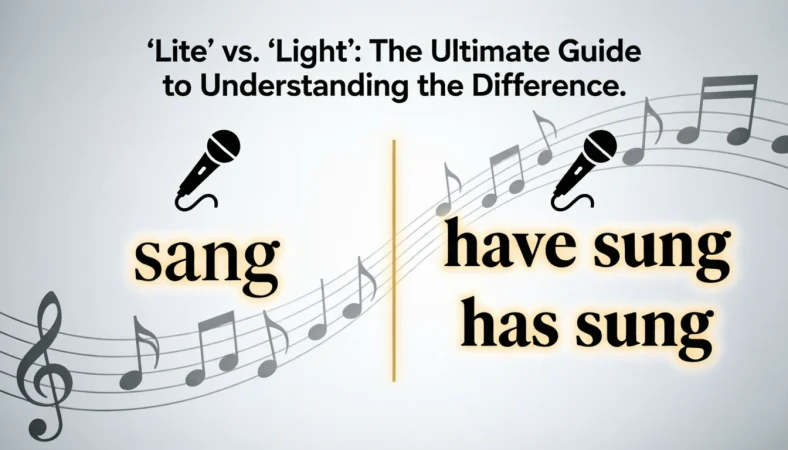
Quick Answer: “Sang” is the simple past tense of sing, while “sung” is the past participle and must be used with a helping verb such as has, have, had, or was.
Examples:
- ✅ She sang beautifully at the concert.
- ✅ She has sung in many concerts.
Sang or Sung is a common English grammar confusion because both words come from the verb “sing” but are used in different situations. Sang is the simple past form, used when talking about an action that happened and finished in the past. Sung is the past participle form, which is used with helping verbs like has, have, or had.
Understanding the difference between sang and sung helps you use verb forms correctly in speaking and writing. While both describe the act of making music with your voice, choosing the right form depends on the sentence structure and tense. Learning this small grammar rule makes your English clearer and more accurate.
Quick Answer Table
| Aspect | Sang | Sung |
| Correct Spelling | Yes | Yes |
| Part of Speech | Verb (past tense) | Verb (past participle) |
| Meaning | Past action of singing | Completed action of singing |
| Usage | Alone with a subject | Requires auxiliary verb |
| Example | She sang beautifully. | She has sung that song before. |
| Common Mistake | Using with auxiliary verbs | Using without auxiliary verbs |
Which One Is Correct: Sang or Sung?
The short answer is that both “sang” and “sung” are correct, but they are used in different grammatical contexts. Neither is inherently wrong, and both serve distinct purposes in English grammar. The confusion arises because many people do not fully understand the difference between the simple past tense and the past participle form of irregular verbs.
“Sang” is the simple past tense form of the verb “to sing.” It is used when referring to an action that happened in the past and is now complete. You use “sang” when you want to describe a specific instance of singing that occurred at a definite time in the past.
On the other hand, “sung” is the past participle form of “to sing.” It is never used alone as the main verb in a sentence. Instead, it requires an auxiliary verb such as “have,” “has,” or “had.” The past participle is used in perfect tenses to describe actions that have been completed or that have relevance to the present moment.
The key to using these forms correctly lies in understanding whether you need the simple past or the past participle. Once you grasp this distinction, choosing between “sang” and “sung” becomes straightforward and intuitive.
Meaning of Sang
“Sang” is the simple past tense of the irregular verb “sing.” It describes an action that occurred at a specific time in the past. When you use “sang,” you are narrating an event that started and ended in the past, with no connection to the present.
Definition and Explanation
The definition of “sang” is straightforward: it is the past tense form used to indicate that someone performed the act of singing. This action is complete and happened before the current moment. The simple past tense works independently and does not require any other verbs to convey its meaning.
Usage of Sang
Use “sang” when you are telling a story about a past event or describing something that happened at a specific time. The sentence structure is simple: subject + sang + any additional information.
Real World Examples of Sang
Here are practical examples of how to use “sang” correctly in various contexts:
- The choir sang beautifully during the Sunday service.
- My grandmother sang lullabies to me when I was a child.
- The lead singer sang all the high notes perfectly at the concert.
- We sang happy birthday to our colleague yesterday.
- The birds sang outside my window every morning last spring.
- He sang his favorite song at the talent show and won first place.
- The entire stadium sang along to the national anthem.
In each of these examples, “sang” stands alone as the main verb, and the action is clearly situated in the past with a definite time reference.
Meaning of Sung
“Sung” is the past participle form of “sing.” Unlike “sang,” it cannot function as the sole verb in a sentence. Instead, it must be paired with an auxiliary verb to create perfect tenses or passive voice constructions.
Definition and Explanation
The definition of “sung” relates to completed singing actions that have significance to the present or that occurred before another past action. The past participle form is essential for constructing various perfect tenses that add layers of meaning to your sentences.
Usage of Sung
Use “sung” when you need to express that singing has been completed at some point, whether in the recent past or more distant past. The auxiliary verb you choose determines the specific tense and meaning.
Here are the different ways “sung” is used with auxiliary verbs:
Present Perfect: Have/has + sung
- Indicates an action that happened at an unspecified time before now
- Shows relevance to the present moment
- Often used with “ever,” “never,” “already,” or “yet”
Past Perfect: Had + sung
- Indicates an action completed before another past action
- Establishes sequence of events in the past
Future Perfect: Will have + sung
- Indicates an action that will be completed before a specific future time
Passive Voice: Be + sung
- Focuses on the action rather than who performed it
Real World Examples of Sung
Here are practical examples showing the correct usage of “sung” in various contexts:
- The national anthem has been sung at every sporting event this season.
- She has sung in three different choirs throughout her career.
- By the time the concert ended, the band had sung all their greatest hits.
- That song has been sung by countless artists over the decades.
- The opera singer had sung the role of Carmen more than fifty times.
- Have you ever sung a solo in front of a large audience?
- The students have sung that folk song in their music class for years.
Notice how each example uses an auxiliary verb alongside “sung” to create a complete and meaningful sentence.
Key Differences Between Sang and Sung
Understanding the distinctions between “sang” and “sung” is crucial for proper grammar usage. Here are the primary differences explained in detail.
Spelling
Both “sang” and “sung” are correctly spelled words. The difference lies not in spelling but in their grammatical functions. “Sang” contains an “a” and represents the simple past, while “sung” contains a “u” and represents the past participle.
Meaning
The meaning difference is subtle but important. “Sang” simply describes a past action of singing. “Sung” describes a completed action of singing that has some connection to the present or to another past action through the use of auxiliary verbs.
Pronunciation
Both words are pronounced similarly but with distinct vowel sounds. “Sang” is pronounced with a short “a” sound, similar to “bank” or “rang.” “Sung” is pronounced with a short “u” sound, similar to “bunk” or “rung.” This pronunciation difference can help you remember which form you are using.
Grammar
The grammatical difference is the most significant factor distinguishing these two forms. “Sang” functions as a main verb that can stand alone in a sentence. “Sung” functions as a past participle that must always accompany an auxiliary verb.
Sang Grammar Rules:
- Appears in simple past tense sentences
- Does not require any helping verbs
- Indicates a completed action at a definite past time
- Often used with specific time markers
Sung Grammar Rules:
- Appears in perfect tenses and passive voice
- Requires auxiliary verbs (have, has, had, be)
- Indicates completed action with present relevance
- Used with time markers that are unspecified or span periods
Usage
The usage patterns for these two words differ significantly. “Sang” appears in narrative past tense storytelling, while “sung” appears in perfect tense constructions that connect past actions to other times.
Recognition
“Sang” is more common in everyday speech and simple past narratives. “Sung” is equally common but appears more frequently in perfect tense constructions, which are prevalent in both spoken and written English.
Common Mistakes People Make with Sang or Sung
Even native English speakers frequently misuse these verb forms. Understanding these common errors will help you avoid them.
Using “sung” without an auxiliary verb
- Incorrect: She sang the song.
- Correct: She sang the song. (simple past)
- Also correct: She has sung the song. (present perfect)
Mistake 2:
- Incorrect: She has sung the song.
- Correct: She has sung the song.
Confusing the simple past with the past participle in questions
- Incorrect: Have you sung that before?
- Correct: Have you sung that before?
Using “sung” in simple past narratives
- Incorrect: Yesterday, I sang at the party.
- Correct: Yesterday, I sang at the party.
Overusing “sang” in all past contexts
- Incorrect: I have sung many songs in my life.
- Correct: I have sung many songs in my life.
Mistake 6: Not recognizing the auxiliary verb in contractions
- Incorrect: She’s sung that song already.
- Correct: She’s sung that song already.
These mistakes often happen because speakers rely on what sounds natural rather than understanding the grammatical rules. The good news is that with practice, correct usage becomes second nature.
Correct Usage Examples of Sang and Sung
To solidify your understanding, here are numerous examples showing both forms in various contexts. Pay attention to the sentence structure and the presence or absence of auxiliary verbs.
Casual Examples
Using Sang:
- I sang at karaoke last night.
- My sister sang a beautiful song at her wedding.
- The children sang nursery rhymes all afternoon.
- He sang his heart out at the concert.
Using Sung:
- I have sung that song at karaoke before.
- My sister has sung at many weddings.
- The children have sung those nursery rhymes since preschool.
- He has sung at that concert hall several times.
Professional Examples
Using Sang:
- The guest artist sang the challenging aria flawlessly.
- Our choir sang the national anthem at the opening ceremony.
- The soloist sang the jazz standard with remarkable skill.
Using Sung:
- The guest artist has sung that aria in venues worldwide.
- Our choir has sung the national anthem at major sporting events.
- The soloist has sung that jazz standard over two hundred times.
Educational Examples
Using Sang:
- The students sang the folk song during their cultural exchange.
- The opera major sang the entire piece from memory.
Using Sung:
- The students have sung various folk songs from different cultures.
- The opera major has sung that piece in several competitions.
Literary and Metaphorical Examples
Using Sang:
- Her voice sang through the concert hall like a gentle breeze.
- The poet sang of love and loss in his verses.
- The wind sang a mournful tune through the trees.
Using Sung:
- Her voice has sung through countless concert halls around the world.
- The poet has sung universal themes throughout his career.
- The wind has sung through these trees for centuries.
Word Origin and Etymology
The history of these verb forms helps explain their irregular nature and why they differ from regular English verbs.
Origins of Sing
The verb “sing” comes from Old English “singan,” which had strong Germanic roots. This word is related to similar verbs in other Germanic languages, such as German “singen” and Dutch “zingen.” The irregular conjugation pattern of “sing” has existed since the earliest forms of English and has changed relatively little over time.
Historical Development
The Old English conjugations were:
- Infinitive: singan
- Past singular: sang
- Past plural: sungon
- Past participle: sungen
Notice how the past plural “sungon” and the past participle “sungen” both contained the “u” sound. Over time, the past plural form “sungon” fell out of use, and the past singular “sang” became the standard simple past form for all subjects. The past participle simplified to “sung” and retained the “u” vowel.
Linguistic Significance
This pattern of vowel changes in irregular verbs is called ablaut. The sequence of vowels in “sing sang sung” follows a pattern that appears in many other English irregular verbs, including “ring rang rung” and “swim swam swum.” Understanding this pattern can help you remember that “sang” is for simple past and “sung” is for past participle.
Why the Incorrect Version Became Popular
Several factors contribute to the confusion between “sang” and “sung” and the common misuse of these forms.
Dialectal Variations
In some dialects and regional varieties of English, speakers regularly use “sung” in place of “sang” in simple past contexts. For example, in certain parts of the United States and the United Kingdom, you might hear “I sung a song” or “He sung the national anthem.” While this usage is common in informal speech, it is considered nonstandard in formal writing and educated speech.
The Influence of Other Irregular Verbs
The confusion may also stem from other irregular verbs where the past tense and past participle are identical. For example:
- “Set” is the same in all forms
- “Cut” is the same in all forms
- “Hit” is the same in all forms
Because these verbs do not change form, speakers might incorrectly assume that all irregular verbs follow this pattern and that “sang” and “sung” are interchangeable.
Lack of Grammar Education
Many English speakers learn grammar primarily through exposure rather than formal instruction. Without understanding the distinction between simple past and past participle, speakers might rely on what sounds natural to them. This can lead to inconsistent or incorrect usage patterns.
The Influence of Music and Song Lyrics
Songwriters and poets sometimes choose to use nonstandard grammar for rhythmic, aesthetic, or poetic effect. When people hear these nonstandard usages in popular music, they might assume they are correct or acceptable in everyday speech.
Easy Memory Tricks for Sang or Sung
Here are some mnemonic devices and memory tricks to help you remember the correct usage of “sang” and “sung.”
The “A” for Alone Trick
Remember that “sang” has an “a” and can stand alone as the main verb in a sentence. Think of “A” as representing “Alone” or “Action.” When the verb stands alone, use “sang.”
- She sang = Alone and complete
- He sang = Alone and complete
- They sang = Alone and complete
The “U” for Helper Trick
Remember that “sung” has a “u” and needs a helper verb to complete its meaning. Think of “U” as representing “Used with helper” or “Unfinished without helper.”
- She has sung = Needs “has” helper
- He had sung = Needs “had” helper
- They have sung = Needs “have” helper
The Helper Verbs Checklist
When deciding which form to use, ask yourself whether your sentence contains any of these helper verbs:
- Have, has, or had
- Is, am, or are
- Was or were
If yes, use “sung.” If not, use “sang.”
The Time Marker Test
Ask yourself whether your sentence includes a specific time marker:
- Specific time (yesterday, last week, in 2020) = use “sang”
- Unspecified time (ever, never, before) = use “sung”
The Completion Question
Ask yourself whether the singing action is:
- Simply described as a past event = use “sang”
- Described as completed with present relevance = use “sung”
FAQS
Is “sung” the past tense of sing?
No, sang is the simple past tense. Sung is the past participle.
Is “I have sang” correct?
No, the correct form is “I have sung.”
Can “sung” be used without a helper verb?
No, standard English uses sung with helping verbs like has, have, or had.
What is the difference between sang and sung?
Sang is past tense; sung is used in perfect tenses.
Is “she sung” correct?
No, use “she sang” for simple past and “she has sung” for perfect tense.
What is the present tense of sing?
The present forms are sing and sings.
How are sang and sung pronounced?
Sang sounds like sang (/sæŋ/), while sung sounds like sung (/sʌŋ/).
Why does English have sang/sung?
They are irregular verb forms inherited from older English patterns.
Which is more common: sang or sung?
Sang is more common in everyday speech.
Can sung be an adjective?
Yes, in some contexts sung can describe a performed song or response.
What is the past participle of sing?
The past participle is sung
Conclusion
The difference between sang and sung becomes easy once you understand their grammatical roles. Sang is the simple past tense of sing, used for completed actions in the past, while sung is the past participle used with helping verbs like has, have, or had to form perfect tenses.
Using the correct form improves your grammar and makes your sentences more accurate. Remember the pattern: sing → sang → sung. Choose sang for a past event and sung when you need a perfect tense structure. This simple rule will help you avoid one of the most common verb mistakes in English.