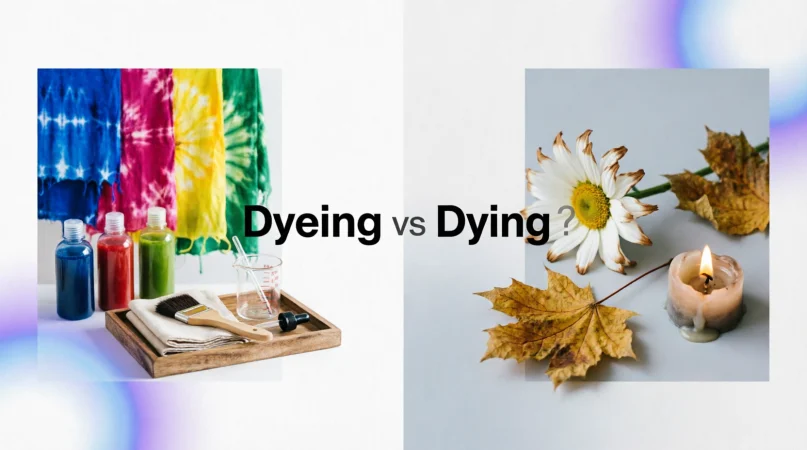
Quick Answer: Dyeing means coloring something, such as fabric, hair, or clothing with dye. Dying means approaching death or coming to an end.
Example:
- She is dyeing her hair blonde.
- The old tree is dying because it isn’t getting enough water.
The words dyeing and dying are among the most commonly confused terms in English because they differ by only one letter while carrying completely different meanings. Although they sound alike, their definitions, usage, and contexts are unrelated. Dyeing refers to the process of adding color to materials such as fabric, clothing, hair, or leather using dyes or pigments. In contrast, dying is the present participle of the verb die, meaning the end of life or the process of approaching death.
Confusing these words can change the meaning of a sentence dramatically and create misunderstandings in both everyday communication and professional writing. Learning the distinction is essential for students, writers, and English learners who want to communicate clearly and accurately. This guide explains the meanings, differences, examples, and simple memory tricks that will help you confidently choose the correct word every time.
Quick Answer Table
| Feature | Dyeing | Dying |
| Correct Spelling | Yes | Yes |
| Meaning | Applying color to something | Approaching death or ending |
| Base Verb | Dye | Die |
| Part of Speech | Present participle/gerund | Present participle/gerund |
| Example | She is dyeing her hair blue. | The plant is dying from a lack of water. |
| Common Usage | Hair coloring, textiles, fabrics | Death, decline, ending |
| Pronunciation | DYE-ing | DYE-ing |
Which One Is Correct?
The answer depends entirely on what you mean.
Use dyeing when talking about color.
✅ Correct:
- She is dyeing her hair blonde.
- The factory specializes in dyeing fabrics.
- We spent the afternoon dyeing Easter eggs.
Use dying when talking about death, decline, or something ending.
✅ Correct:
- The flowers are dying.
- The patient is dying peacefully.
- Interest in the project is slowly dying.
Neither word is universally more correct than the other. Each serves a different purpose in English grammar.
Meaning of the Correct Word: Dyeing
Definition
Dyeing is the act of applying dye or color to a material, surface, fabric, hair, leather, paper, or another object.
It comes from the verb dye.
Grammar
- Verb: dye
- Present participle: dyeing
- Gerund: dyeing
Examples:
- Dye
- Dyes
- Dyed
- Dyeing
Explanation
Dyeing is commonly associated with:
- Hair coloring
- Textile manufacturing
- Fabric treatment
- Craft projects
- Artistic coloring techniques
The process changes the appearance of an object by adding or altering color.
Real-World Examples
Hair Care
- She is dyeing her hair red for the summer.
Fashion Industry
- The company uses eco-friendly methods for dyeing cotton fabrics.
Arts and Crafts
- Children enjoyed dyeing Easter eggs.
Textile Production
- Natural dyeing techniques have become increasingly popular.
Common Collocations
People often use dyeing with:
- Hair dyeing
- Fabric dyeing
- Yarn dyeing
- Textile dyeing
- Color dyeing
- Natural dyeing
- Tie-dyeing
Example:
- Natural dyeing uses plant-based pigments instead of synthetic chemicals.
Meaning of the Correct Word: Dying
Definition
Dying refers to the process of death, decline, deterioration, or gradually coming to an end.
It comes from the verb die.
Grammar
- Verb: die
- Present participle: dying
- Gerund: dying
Examples:
- Die
- Dies
- Died
- Dying
Explanation
The word can describe:
- Physical death
- Failing health
- Declining businesses
- Fading traditions
- Weakening interest
Real-World Examples
Medical Context
- The patient is dying from a serious illness.
Nature
- The tree is dying because it lacks water.
Business
- Many people believed the company was dying before its recovery.
Figurative Use
- The trend is slowly dying out.
Common Collocations
- Dying patient
- Dying plant
- Dying industry
- Dying tradition
- Dying wish
- Dying embers
- Dying language
Example:
- Several indigenous languages are dying due to a lack of speakers.
Key Differences Between Dyeing and Dying
| Aspect | Dyeing | Dying |
| Root Verb | Dye | Die |
| Meaning | Coloring something | Death or decline |
| Context | Beauty, fashion, textiles | Health, life, deterioration |
| Example | Dyeing hair | Dying flowers |
| Grammar Origin | From “dye” | From “die” |
| Usage Frequency | Industry and beauty contexts | Everyday language |
| Emotional Tone | Neutral | Often serious or emotional |
Spelling Difference
The extra letter e remains in dyeing to prevent confusion.
Compare:
- Dye → Dyeing
- Die → Dying
Meaning Difference
One changes color.
The other refers to death or decline.
Pronunciation Difference
Interestingly, both words are pronounced almost identically:
/ˈdaɪɪŋ/
Because pronunciation doesn’t help much, context becomes essential.
Why Is “Dyeing” Spelled Differently?
Many English learners wonder why we don’t simply write dying for the verb dye.
The reason is clarity.
If English followed the normal rule, both words would become:
- Dye + ing = dying
- Die + ing = dying
That would create confusion.
To keep meanings separate, English preserves the extra e in dyeing.
This spelling convention helps readers immediately recognize whether you’re discussing color or death.
Common Mistakes People Make
Mistake #1: Writing “dying my hair”
❌ I am dying my hair blue.
✅ I am dyeing my hair blue.
Hair receives color, so use dyeing.
Mistake #2: Writing “dyeing plant”
❌ The plant is dyeing.
✅ The plant is dying.
Plants lose life, not gain color.
Mistake #3: Confusing the Root Verbs
❌ He dyed from illness.
✅ He died from illness.
“Dyed” means colored.
“Died” means passed away.
Mistake #4: Mixing Professional Contexts
❌ Textile factories are dying fabrics.
✅ Textile factories are dyeing fabrics.
Factories color fabric rather than kill it.
Mistake #5: Auto-Correct Errors
Because the words look similar, spell-check software occasionally misses contextual mistakes.
Always verify the intended meaning.
Correct Usage Examples
Casual Examples
- I’m dyeing my hair purple this weekend.
- My favorite houseplant is dying.
- She enjoys dyeing old T-shirts.
- The flowers are dying because of the heat.
Professional Examples
- The textile company specializes in sustainable dyeing processes.
- Researchers studied environmentally friendly dyeing methods.
- The patient appeared to be dying peacefully.
- Several traditional industries are slowly dying.
Educational Examples
- Students learned about fabric dyeing in chemistry class.
- The teacher explained why endangered languages are dying.
- Natural dyeing techniques date back thousands of years.
- Scientists observed a dying coral reef ecosystem.
Literary and Metaphorical Examples
- The sky looked like cloth dyeing itself in shades of orange.
- Hope was slowly dying in his heart.
- The artist spent hours dyeing silk with natural pigments.
- The dying light faded beyond the mountains.
Grammar Rules for Dyeing and Dying
Dyeing as a Gerund
A gerund functions as a noun.
Examples:
- Dyeing requires patience.
- Fabric dyeing is a specialized skill.
Dyeing as a Present Participle
Examples:
- She is dyeing her hair.
- They are dyeing the curtains.
Dying as a Gerund
Examples:
- Dying is a natural part of life.
- Many cultures discuss dying openly.
Dying as a Present Participle
Examples:
- The plant is dying.
- The patient is dying.
Understanding these grammatical roles improves writing accuracy and helps avoid common English mistakes.
Word Origin / Etymology
Origin of Dyeing
The verb dye comes from Old English and Germanic language roots associated with coloring, staining, and applying pigments.
Historically, dyeing was an essential part of:
- Textile production
- Clothing manufacturing
- Artistic decoration
- Cultural traditions
Ancient civilizations used plants, minerals, insects, and natural pigments for dyeing fabrics.
Origin of Dying
The word die originates from Old Norse and Proto-Germanic roots, meaning:
- To perish
- To cease living
- To come to an end
The term has remained remarkably stable throughout centuries of English language development.
Why the Incorrect Version Became Popular
The confusion between dyeing and dying exists for several reasons.
Similar Pronunciation
Both words sound nearly identical.
This creates confusion during writing.
Digital Communication
Fast texting and online messaging encourage spelling mistakes.
English Spelling Rules
English often drops the silent “e” before adding “-ing.”
Examples:
- Make → making
- Write → writing
- Drive → driving
Learners naturally expect:
- Dye → dying
However, English keeps the “e” in dyeing to preserve meaning.
Visual Similarity
Only one letter separates the two words.
As a result, writers frequently mistype them.
Easy Memory Tricks
Trick #1: Color Contains an Extra Letter
Dyeing has an extra “e.”
Think:
Extra “e” = extra color.
Since coloring adds something, the extra letter helps remind you.
Trick #2: Death Is Simpler
Dying has fewer letters.
Think:
Life is fading away, so the word loses a letter.
Trick #3: Hair Test
Ask yourself:
“Am I talking about hair, fabric, clothes, yarn, or color?”
If yes:
✅ Dyeing
Trick #4: Life Test
Ask:
“Am I talking about death, decline, fading, or ending?”
If yes:
✅ Dying
Dyeing vs Dying in Popular Search Queries
Many people search Google using phrases such as:
- dyeing or dying hair
- Is it dyeing or dying your hair
- dying vs dyeing meaning
- dyeing definition
- dying definition
- Common English spelling mistakes
- confusing English words
- Grammar differences in English
- Dyeing fabric meaning
- dying plant meaning
These searches highlight how frequently this word pair causes confusion among English learners and professional writers alike.
FAQs
1. Is it dyeing or dying your hair?
The correct phrase is dyeing your hair because you are adding color to your hair.
2. Is dyeing a real word?
Yes. Dyeing is the present participle of the verb dye and refers to coloring something.
3. Is dying grammatically correct?
Yes. Dying is the present participle of die and refers to death or decline.
4. Why does dyeing keep the letter “e”?
The extra letter helps distinguish dyeing from dying, preventing confusion between coloring and death.
5. How do you pronounce dyeing and dying?
Both are generally pronounced:
/ˈdaɪɪŋ/
They sound almost identical in everyday speech.
6. What is a sentence using dyeing?
Example:
- She spent the afternoon dyeing silk scarves.
7. What is a sentence using dying?
Example:
- The flowers are dying because they have not been watered.
8. Can dyeing and dying be used interchangeably?
No. They have completely different meanings and should never be substituted for one another.
9. What is the past tense of dye?
The past tense is dyed.
Example:
- She dyed her hair black.
10. What is the past tense of die?
The past tense is died.
Example:
- The plant died during the winter.
11. Is “dying my hair” always wrong?
Yes. If you mean adding color to hair, the correct spelling is dyeing my hair.
12. Which word is more common in English?
Dying appears more frequently in general English because it applies to many situations involving decline, endings, and death. However, dyeing is common in beauty, fashion, textile, and manufacturing industries.
Conclusion
Understanding the difference between dyeing and dying is straightforward once you remember their meanings. Use dyeing whenever you are talking about coloring hair, fabric, or other materials, and use dying when referring to the end of life or something gradually ceasing to exist.
Since these words sound identical, always rely on the context of the sentence rather than pronunciation. Mastering this distinction will improve your writing accuracy and help you avoid one of English’s most common spelling mistakes.