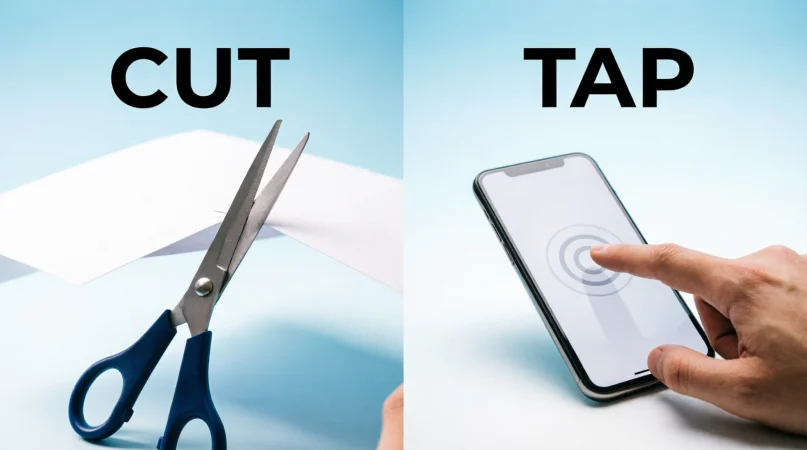
Quick answer: Choose Tap if you want a gentler, more precise action, and choose Cut if you need a stronger, more direct separation or removal.
The choice between “cut” and “tap” depends on the context, purpose, and level of force or precision required. Both words describe actions that involve contact, but they convey very different meanings. “Cut” generally refers to separating, removing, or dividing something using a sharp tool or decisive action. It suggests a permanent change and is often associated with editing, trimming, carving, or reducing.
In contrast, “tap” means to touch, strike, or press lightly and briefly. It implies a gentle action that does not usually alter the object being touched. In digital environments, “tap” is commonly used for touchscreen interactions, while “cut” is frequently used in writing, design, video editing, and physical tasks involving tools. Understanding the distinction is important for clear communication because the wrong word can change the intended meaning. Evaluating the situation, the desired outcome, and the degree of impact helps determine whether “cut” or “tap” is the more appropriate choice.
Quick Answer Table
| Feature | Cut | Tap |
| Correct Spelling | ✅ Cut | ✅ Tap |
| Part of Speech | Verb, Noun | Verb, Noun |
| Basic Meaning | To divide, remove, or separate using a sharp tool | To touch lightly, strike gently, or access by touching |
| Common Usage | Cutting paper, cutting costs, cutting hair | Tapping a screen, tapping a shoulder, tapping a rhythm |
| Example Sentence | Please cut the paper into two pieces. | Tap the screen to continue. |
| Pronunciation | /kʌt/ | /tæp/ |
| Interchangeable? | Usually No | Usually No |
Which One Is Correct?
The question “cut or tap” does not involve a correct-versus-incorrect spelling issue. Instead, it is a word choice question.
Both words are correct:
- Cut means to divide, remove, shorten, reduce, or create an opening.
- Tap means to touch lightly, strike gently, select something on a touchscreen, or draw liquid from a source.
The correct choice depends on what action you want to describe.
Examples
✅ Cut the rope with a knife.
✅ Tap the icon to open the application.
❌ Tap the rope with a knife. (Unless you literally mean touching it lightly.)
❌ Cut the icon to open the application. (Incorrect in most digital contexts.)
Meaning of the Correct Word: Cut
Definition
Cut is a verb and a noun that refers to separating, removing, reducing, shortening, or opening something by using force, typically with a sharp object.
Explanation
The word cut is one of the most frequently used verbs in English. It appears in everyday speech, business communication, education, medicine, sports, and technology.
Depending on context, it can mean:
- Divide something into parts
- Remove a portion
- Reduce an amount
- Interrupt a connection
- Create an opening
- Edit content
Common Uses of “Cut”
Physical Cutting
- Cut the apple into slices.
- She cut the ribbon during the ceremony.
Hair and Beauty
- I need to cut my hair.
- He got a fresh haircut yesterday.
Business and Finance
- The company decided to cut expenses.
- They cut their marketing budget.
Technology
- Cut and paste the text.
- Cut the video before uploading it.
Sports
- The athlete made a quick cut toward the goal.
Real-World Examples
- Please cut the vegetables before cooking.
- The editor cut several paragraphs from the article.
- The government plans to cut taxes.
- She accidentally cut her finger while cooking.
Meaning of the Correct Word: Tap
Definition
Tap means to touch lightly, strike gently, select something with a finger, or draw liquid from a source.
Explanation
The word tap has become increasingly common in the digital age because smartphones and tablets use touch-based interfaces.
It can also describe light physical contact or rhythmic striking.
Common Uses of “Tap”
Touchscreens
- Tap the button to continue.
- Tap the image to enlarge it.
Gentle Contact
- She tapped him on the shoulder.
- He tapped the table with a pencil.
Rhythmic Movement
- The musician tapped his foot to the beat.
- She tapped her fingers nervously.
Water and Liquids
- Turn off the tap.
- The workers tapped the maple tree for syrup.
Real-World Examples
- Tap the screen to unlock your phone.
- He tapped gently on the door.
- She tapped her pen while thinking.
- Please close the kitchen tap.
Meaning of the Incorrect or Alternative Word
In this comparison, neither cut nor tap is incorrect.
However, they are often confused because both can involve physical actions.
Why the Confusion Happens
Many learners assume that any action involving the hand can be described with either word. In reality:
- Cut involves dividing, removing, or separating.
- Tap involves touching lightly or making brief contact.
The actions are fundamentally different.
Example
Consider a smartphone:
✅ Tap the screen.
❌ Cut the screen.
Consider a piece of paper:
✅ Cut the paper.
❌ Tap the paper into two pieces.
The context determines which word is appropriate.
Key Differences Between the Two Words
Comparison Table
| Feature | Cut | Tap |
| Meaning | Divide, remove, shorten | Touch lightly or strike gently |
| Force Used | Usually strong enough to separate something | Usually gentle |
| Tool Required | Often yes | Usually no |
| Digital Usage | Editing functions | Touchscreen interaction |
| Physical Result | Changes or separates an object | Usually leaves no change |
| Common Contexts | Cooking, editing, business, sports | Technology, communication, music |
Spelling Difference
- Cut = 3 letters
- Tap = 3 letters
Both are simple, short English words.
Pronunciation Difference
Cut
- IPA: /kʌt/
- Rhymes with: hut, nut, shut
Tap
- IPA: /tæp/
- Rhymes with: cap, map, lap
Grammar Difference
Both words can function as verbs and nouns.
Cut as a Verb
- Cut the paper.
Cut as a Noun
- The cut was deep.
Tap as a Verb
- Tap the screen.
Tap as a Noun
- Turn off the tap.
Usage Difference
Use cut when something is divided, reduced, or removed.
Use a tap when something is touched lightly or selected briefly.
Common Mistakes People Make
Mistake 1: Using “Cut” for Smartphone Actions
❌ Cut the icon to open the app.
✅ Tap the icon to open the app.
Mistake 2: Using “Tap” for Dividing Objects
❌ Tap the bread into slices.
✅ Cut the bread into slices.
Mistake 3: Confusing Touch and Separation
❌ She tapped her hair.
✅ She cut her hair.
Mistake 4: Misunderstanding Digital Instructions
Many English learners encounter phrases such as:
- Tap here
- Tap to continue
- Tap the button
They sometimes replace tap with click or cut.
While a click can work on computers, a cut usually cannot.
Mistake 5: Translating Directly from Another Language
Direct translation often confuses because some languages use a single word for multiple hand actions.
English distinguishes clearly between:
- Cutting
- Touching
- Pressing
- Clicking
- Tapping
Correct Usage Examples
Casual Examples
- Can you cut the pizza into eight slices?
- Tap the picture to zoom in.
- He cut the string with scissors.
- She tapped me on the arm.
Professional Examples
- The company plans to cut operational costs.
- Employees should tap their ID cards at the entrance.
- The editor cut unnecessary sections from the report.
- Users must tap the confirmation button.
Educational Examples
- Students cut shapes from colored paper.
- Tap the answer choice on the tablet.
- Scientists cut samples for laboratory testing.
- The teacher tapped the desk to get attention.
Literary and Metaphorical Examples
- His words cut deeper than any knife.
- Rain tapped softly against the window.
- The river cut through the valley.
- Hope tapped gently at the door of her heart.
Technology Examples
- Tap the menu icon.
- Tap to download.
- Cut and paste the text.
- Cut the video clip before publishing.
Word Origin / Etymology
Origin of “Cut”
The word cut dates back to Middle English and likely comes from Old Norse influences. It has been used for centuries to describe actions involving separation, division, or incision.
Historically, the word expanded into many figurative meanings, including:
- Cut costs
- Cut ties
- Cut corners
- Cut a deal
Origin of “Tap”
The word tap comes from Germanic roots and originally referred to striking lightly or opening a cask to draw liquid.
Over time, it gained additional meanings such as:
- Gentle touching
- Rhythmic striking
- Accessing liquid flow
- Interacting with digital screens
The rise of smartphones made tap one of the most frequently used technology-related verbs in modern English.
Why the Incorrect Version Became Popular
Since neither word is incorrect, the real issue is contextual confusion.
Several factors contribute to this:
Growth of Technology
Touchscreen devices introduced millions of people to the verb tap.
Before smartphones, many users primarily encountered:
- Click
- Press
- Push
Now, tap dominates mobile instructions.
Similar Physical Actions
Both actions involve hand movement, leading learners to mix them up.
Translation Challenges
In some languages, a single word may cover:
- Touching
- Pressing
- Tapping
This can create uncertainty when selecting the correct English term.
Search Engine Queries
Many people search phrases such as:
- Cut vs tap
- Difference between cut and tap
- Tap meaning in English
- Cut meaning and usage
This ongoing confusion keeps the comparison relevant.
Easy Memory Tricks
Remembering the difference is simple when you use visual associations.
Trick #1: Cut Creates Change
Think:
Cut = Change
When you cut something, it becomes different.
Examples:
- Cut paper
- Cut hair
- Cut costs
The object changes.
Trick #2: Tap Touches Lightly
Think:
Tap = Touch
A tap is usually brief and gentle.
Examples:
- Tap a screen
- Tap a shoulder
- Tap a drum
Little or no permanent change occurs.
Trick #3: Smartphone Rule
If you’re using a phone:
👉 You usually tap.
If you’re using scissors:
👉 You usually cut.
This simple rule solves many usage problems instantly.
Comparison Summary
For readers seeking a quick answer:
| Question | Answer |
| Is cut a real word? | Yes |
| Is tap a real word? | Yes |
| Are they interchangeable? | Usually no |
| Which word relates to smartphones? | Tap |
| Which word relates to scissors? | Cut |
| Which word means divide or remove? | Cut |
| Which word means touch lightly? | Tap |
| Which is more common in technology? | Tap |
FAQs
1. What is the difference between cut and tap?
Cut means to divide, remove, or separate something, while tap means to touch lightly or briefly.
2. Is tap a synonym for cut?
No. The two words have different meanings and are generally not interchangeable.
3. Why do phones say “tap” instead of “click”?
Touchscreens are operated with fingers touching the screen rather than clicking a mouse button, so tap is the more accurate term.
4. Can cut and tap be used as nouns?
Yes.
Examples:
- He suffered a cut on his hand.
- Turn off the water tap.
5. Which word should I use for a touchscreen?
Use tap.
Example:
- Tap the button to continue.
6. Which word should I use when using scissors?
Use cut.
Example:
- Cut the paper carefully.
7. Are cut and tap both verbs?
Yes. Both words function as verbs and nouns depending on context.
8. Which word is more common in technology?
Tap is more common in mobile and touchscreen technology, while cut is common in editing and content management.
9. Can tap mean hitting something?
Yes. It can mean striking something lightly.
Example:
- He tapped the table with his fingers.
10. Can cut have metaphorical meanings?
Yes.
Examples include:
- Cut costs
- Cut ties
- Cut corners
- Cut through confusion
Conclusion
In conclusion, “Cut” and “Tap” come down to the purpose of the action and the effect you want to create. “Cut” is appropriate when something needs to be removed, separated, shortened, or permanently changed. It conveys a stronger and more decisive action. “Tap,” on the other hand, suggests a light touch, gentle contact, or a simple interaction, especially in digital and everyday situations.
Both terms are useful and widely accepted, but they serve different functions. Understanding their meanings helps ensure clear communication and prevents confusion. The best choice is the one that accurately reflects the action being performed.