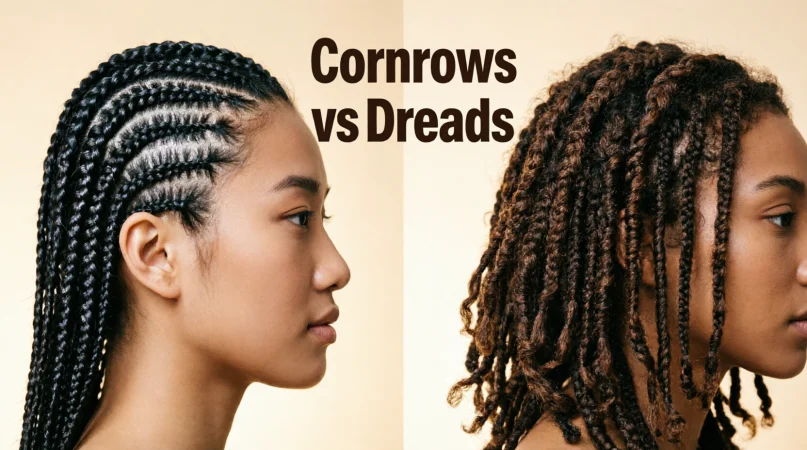
Quick answer: If you want a protective style that is neat, versatile, and relatively easy to change, cornrows are the better choice. If you prefer a long-term, low-maintenance hairstyle with a distinctive look and cultural significance, dreads (locs) are the better option.
Choosing between cornrows and dreads is a common decision for people seeking a protective hairstyle that balances style, maintenance, and long-term hair health. Both styles have deep cultural roots, practical benefits, and unique styling possibilities. Cornrows are a braided hairstyle that lies close to the scalp and can be customized into countless patterns, making them a versatile option for short- to medium-term wear. Dreadlocks, also known as locs, are formed by allowing hair to mat and lock over time, creating a distinctive, long-lasting look.
When comparing cornrows and dreads, factors such as maintenance requirements, styling flexibility, commitment level, and personal lifestyle play important roles. Cornrows typically require regular re-braiding, but are easy to remove and change. Dreads, on the other hand, involve a greater long-term commitment but often require less daily styling once mature. Understanding the advantages and challenges of each option can help you choose the hairstyle that best suits your personal preferences, hair type, and aesthetic goals.
Quick Answer Table
| Feature | Cornrows | Dreads (Dreadlocks) |
| Correct Term | Yes | Yes |
| Hairstyle Type | Braided hairstyle | Locked hairstyle |
| Hair Structure | Hair braided close to the scalp | Hair matted and locked into rope-like strands |
| Duration | Usually temporary | Often long-term |
| Maintenance | Regular re-braiding | Ongoing locking and maintenance |
| Example Sentence | She wore neat cornrows for the summer. | He has long dreads that reach his shoulders. |
| Pronunciation | KORN-rohz | DREDZ |
| Cultural Roots | Ancient African braiding traditions | Ancient locking traditions found in several cultures |
Which One Is Correct?
The question isn’t really which one is correct; it depends on the hairstyle being described.
- Use cornrows when referring to braids woven closely against the scalp in rows.
- Use dreads (short for dreadlocks) when referring to hair that has naturally or intentionally locked into rope-like sections.
Many people searching for “cornrows or dreads” are actually trying to understand the distinction between these two hairstyles. Both terms are valid, widely recognized, and commonly used in everyday English.
Meaning of the Correct Word: Cornrows
Definition
Cornrows are a style of braiding in which hair is braided very close to the scalp in continuous raised rows.
Explanation
Cornrows are created using an underhand braiding technique. The braids typically follow straight lines, but they can also form intricate patterns, geometric shapes, curves, and artistic designs.
This hairstyle is known for:
- Neat appearance
- Protective styling benefits
- Versatility
- Cultural significance
- Low daily maintenance
Usage
Cornrows are commonly worn by:
- Children
- Athletes
- Professionals
- Fashion enthusiasts
- Individuals seeking protective hairstyles
Real-World Examples
- She got cornrows before going on vacation.
- The athlete wore cornrows during the tournament.
- Intricate cornrow patterns have become popular in fashion campaigns.
- Cornrows can help reduce daily hair manipulation.
Meaning of the Correct Word: Dreads
Definition
Dreads, also known as dreadlocks, are sections of hair that become permanently locked or matted into rope-like strands.
Explanation
Dreads develop when hair strands intertwine and lock together over time. They may form naturally or be intentionally created using techniques such as:
- Twisting
- Backcombing
- Palm rolling
- Crochet methods
Unlike cornrows, dreads are generally considered a long-term hairstyle.
Usage
Dreads are often associated with:
- Personal identity
- Cultural expression
- Spiritual traditions
- Fashion
- Natural hair movements
Real-World Examples
- He has worn dreads for more than ten years.
- Her shoulder-length dreads require regular maintenance.
- Dreadlocks can vary greatly in size and thickness.
- Some people start dreadlocks using two-strand twists.
Is Either Word Incorrect?
No.
This is where many people become confused.
When comparing cornrows or dreads, neither term is incorrect. They describe entirely different hairstyles.
However, problems arise when:
- Someone calls cornrows “dreads.”
- Someone calls dreadlocks “cornrows.”
- The two styles are treated as interchangeable.
They are not synonyms and should not replace one another.
Key Differences Between Cornrows and Dreads
Comparison Table
| Feature | Cornrows | Dreads |
| Hairstyle Type | Braids | Locked hair |
| Appearance | Flat rows against scalp | Rope-like strands |
| Duration | Weeks | Months or years |
| Installation | Braiding | Locking process |
| Maintenance | Re-braiding | Retwisting or locking maintenance |
| Hair Movement | Flexible and loose at ends | Locked and structured |
| Removal | Easy to undo | Often time-consuming |
| Styling Base | Braids | Matted sections |
| Cultural Associations | African braiding traditions | Various cultural and spiritual traditions |
| Hair Texture Compatibility | Works best with textured hair | Works with multiple hair textures |
Pronunciation Differences
Cornrows
Pronunciation:
/ˈkɔːrn.roʊz/
Sounds like:
“KORN-rohz”
Dreads
Pronunciation:
/drɛdz/
Sounds like:
“dredz”
Example
- “She got cornrows before the trip.”
- “He has long dreads.”
The pronunciation difference is straightforward because the words are visually and phonetically distinct.
Grammar and Usage Differences
Cornrows
“Cornrows” functions as a plural noun.
Examples:
✅ She wears cornrows.
✅ His cornrows were freshly braided.
Less common:
✅ A cornrow braid crossed the center of the scalp.
Dreads
“Dreads” is also commonly used as a plural noun.
Examples:
✅ Her dreads are shoulder-length.
✅ He washed his dreads yesterday.
“Dreadlocks” may be used in more formal contexts.
Examples:
✅ The article discussed the history of dreadlocks.
✅ Dreadlocks require consistent care.
Common Mistakes People Make
When discussing cornrows or dreads, people frequently make the following mistakes.
1. Using the Terms Interchangeably
Incorrect:
❌ Those cornrows are nice dreads.
Correct:
✅ Those cornrows are beautifully braided.
2. Assuming Dreads Are Braids
Dreads are not braids.
While some hairstyles may resemble braided structures, dreadlocks form through locking rather than traditional braiding.
3. Thinking Cornrows Are Permanent
Cornrows are generally temporary.
They usually remain in place for several weeks before needing removal or reinstallation.
4. Believing All Dreads Form Naturally
Although some dreadlocks form naturally, many are intentionally created and maintained.
5. Ignoring Cultural Context
Both hairstyles have deep cultural roots and histories that deserve respectful understanding.
Correct Usage Examples
Casual Examples
- I plan to get cornrows for my vacation.
- My cousin recently started dreads.
- Cornrows help keep my hair manageable.
- His dreads have grown significantly over the years.
Professional Examples
- The stylist specializes in cornrows and protective hairstyles.
- Dreadlock maintenance appointments are available monthly.
- Cornrow patterns can be customized for individual clients.
- Proper care helps maintain healthy dreadlocks.
Educational Examples
- Cornrows represent one of the oldest documented braiding styles.
- Dreadlocks have appeared in numerous cultures throughout history.
- Protective hairstyles can reduce hair breakage.
- Hair texture often influences styling methods.
Literary and Metaphorical Examples
- Her cornrows traced elegant pathways across her scalp.
- His dreads flowed like ropes shaped by time.
- The intricate cornrows reflected generations of tradition.
- The dreads symbolized patience and personal growth.
Cultural Significance of Cornrows
Cornrows have a rich history that stretches back thousands of years.
Historically, cornrow styles have been used to represent:
- Family identity
- Social status
- Age
- Tribal affiliation
- Geographic origin
Today, cornrows remain a celebrated hairstyle in many communities worldwide.
The style has become a popular protective hairstyle while continuing to hold important cultural value.
Cultural Significance of Dreads
Dreads have existed across multiple civilizations and spiritual traditions.
Historically, locked hair has been associated with:
- Spiritual devotion
- Cultural identity
- Religious practices
- Personal expression
Modern dreadlocks are worn for many reasons, including aesthetics, convenience, cultural pride, and individuality.
Because of their cultural and historical significance, discussions about dreads often involve broader conversations about identity and representation.
Word Origin / Etymology
Origin of Cornrows
The term cornrows likely emerged from the hairstyle’s resemblance to rows of crops planted in agricultural fields.
The word combines:
- Corn
- Rows
The name visually describes the parallel braided rows running along the scalp.
Origin of Dreads
The term dreadlocks combines:
- Dread
- Locks
The exact origin remains debated among historians and linguists.
Over time, “dreads” became a common shortened form of “dreadlocks.”
Today, both “dreads” and “dreadlocks” are widely understood and accepted in everyday English.
Why the Confusion Between Cornrows and Dreads Exists
Several factors contribute to the confusion.
Similar Cultural Discussions
Both hairstyles often appear in conversations about:
- Natural hair
- Protective styles
- Black hair culture
- Hair history
Visual Misunderstandings
People unfamiliar with textured hair styling may assume all structured hairstyles are the same.
Media Representation
Movies, television, and social media sometimes use inaccurate terminology, leading to misunderstandings.
Lack of Hair Education
Many people simply haven’t learned the technical differences between braids and locked hair.
Cornrows vs Dreads: Which Hairstyle Lasts Longer?
If you’re deciding between cornrows or dreads, longevity is one of the biggest differences.
Cornrows
Typical lifespan:
- 2 to 8 weeks
Factors affecting longevity:
- Hair texture
- Maintenance
- Activity level
- Styling method
Dreads
Typical lifespan:
- Months to decades
Factors affecting longevity:
- Lock maturity
- Maintenance routine
- Hair growth
- Personal preference
For long-term wear, dreads generally last much longer than cornrows.
Cornrows vs Dreads: Maintenance Comparison
| Maintenance Task | Cornrows | Dreads |
| Washing | Moderate | Moderate |
| Retouching | Frequent | Periodic |
| Installation Time | Several hours | Several hours to months of locking |
| Removal | Easy | More difficult |
| Daily Styling | Minimal | Minimal |
| Long-Term Commitment | Low | High |
Easy Memory Tricks
Remembering the difference between cornrows and dreads is simple.
Trick #1: Think of Rows
Cornrows = Rows
The braids are arranged in visible rows across the scalp.
Trick #2: Think of Locks
Dreads = Locks
Dreads are another name for dreadlocks.
Trick #3: Braids vs Locks
Ask yourself:
- Is the hair braided? → Cornrows
- Is the hair locked? → Dreads
This quick test works almost every time.
People Also Ask
Are cornrows and dreads the same thing?
No. Cornrows are braids woven close to the scalp, while dreads are locked sections of hair.
Can cornrows turn into dreads?
Yes. Some people use braided styles as a starting point for creating dreadlocks.
Which came first, cornrows or dreads?
Both hairstyles have ancient origins, making it difficult to determine which appeared first historically.
Are dreads considered a protective hairstyle?
For many people, yes. Properly maintained dreadlocks can help reduce daily hair manipulation.
How long do cornrows last?
Most cornrows last between two and eight weeks, depending on care and hair type.
Can anyone get dreads?
People with various hair textures can develop dreadlocks, though the process may differ.
Are cornrows easier to remove than dreads?
Yes. Cornrows can typically be unbraided, while removing mature dreadlocks often requires significant effort.
Do cornrows damage hair?
When installed and maintained properly, cornrows are generally considered a protective hairstyle.
FAQs
What is the main difference between cornrows and dreads?
Cornrows are braided rows attached closely to the scalp, while dreads are locked strands of hair formed over time.
Is “dreads” short for dreadlocks?
Yes. “Dreads” is a common shortened version of the word “dreadlocks.”
Can you have both cornrows and dreads?
Yes. Some hairstyles combine braided sections with existing dreadlocks.
Which hairstyle requires more commitment?
Dreads typically require a greater long-term commitment because they are intended to remain locked.
Are cornrows considered braids?
Yes. Cornrows are a specific type of braid.
Are dreadlocks and locs the same thing?
In many contexts, yes. “Locs” is often used as an alternative term for dreadlocks.
Do cornrows help protect natural hair?
Yes. Cornrows are commonly categorized as a protective hairstyle.
Which hairstyle is more versatile?
Both are versatile in different ways. Cornrows allow intricate braid patterns, while dreads can be styled into various lengths and designs.
Can cornrows be used to start dreadlocks?
Yes. Braided starter methods are sometimes used when beginning the locking process.
Why do people confuse cornrows and dreads?
The confusion usually comes from unfamiliarity with textured hair styling and the fact that both hairstyles are often discussed in similar cultural contexts.
Conclusion
In conclusion, both “Cornrows and Dreads” offer excellent protective styling benefits, but the better choice depends on your needs and lifestyle. Cornrows are ideal for those who enjoy versatility, frequent style changes, and a neat appearance without a long-term commitment. Dreads are better suited for individuals seeking a permanent or semi-permanent hairstyle with a unique identity and lower day-to-day styling demands.
By considering factors such as maintenance, styling preferences, and personal expression, you can confidently decide whether cornrows or dreads are the right fit for you. Ultimately, the best hairstyle is the one that aligns with your comfort, goals, and sense of style.