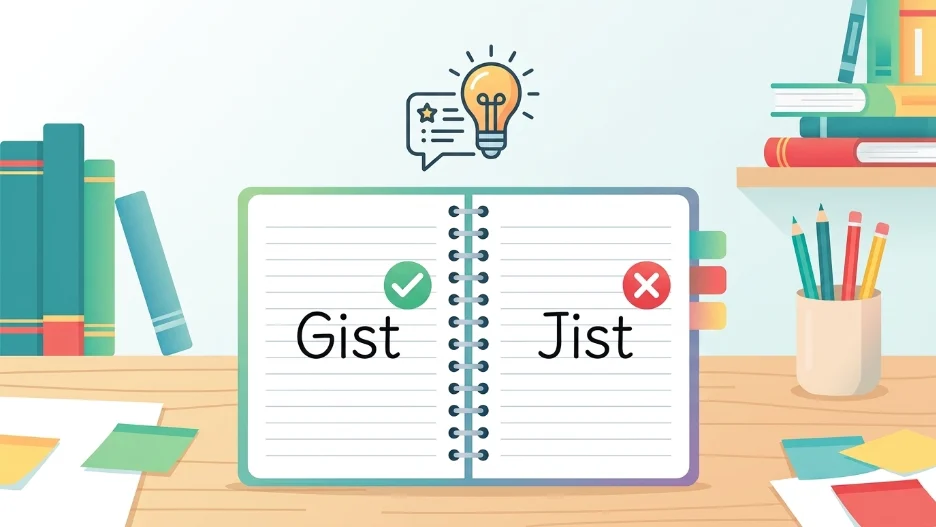
Gist is the correct spelling. It means the main point, central idea, or essential meaning of something (e.g., “I understood the gist of the conversation.”)..Jist is a common misspelling of gist and is not accepted in standard English. Always use gist in formal, academic, and everyday writing
Many English learners wonder whether gist or jist is the correct spelling. The confusion comes from pronunciation, as both words sound almost identical in many accents. However, only one of them is recognized as standard English.
Gist is the correct spelling and refers to the main idea, central point, or essential meaning of something. Jist is simply a common misspelling and should be avoided in formal, academic, and professional writing. This guide explains the difference, provides examples, and helps you remember the correct spelling every time.
Quick Answer Table
| Feature | The Correct Word | The Incorrect Variant |
| Spelling | Gist | Jist |
| Definition | The main point or essence of a matter | N/A (Common misspelling) |
| Status | Standard English | Incorrect spelling |
| Example | “I only caught the gist of the conversation.” | “Can you give me the jist of the report?” (Incorrect) |
| Part of Speech | Noun | Noun (considered an error) |
Which One Is Correct?
The correct spelling is gist. The word “jist” is a common misspelling. While you might see “jist” used in informal text messages or online comments, it is not recognized as a standard word by grammar authorities.
Think of it this way: if you are writing an email to your boss, a report, or even just a social media post, you want to use “gist.” Using “jist” is simply a grammatical error that can undermine your credibility.
Meaning of the Correct Word (Gist)
Definition
Gist is a noun. According to leading dictionaries, it refers to the main or essential part of a matter, the substance of an argument, or the core idea that distinguishes a point from the details that surround it. In legal terms, “gist” can also refer to the grounds of a legal action, but in everyday language, we use it to talk about the heart of a subject.
Usage in Context
When you ask for the “gist of it,” you are not asking for every detail. You are asking for the condensed version. You want the elevator pitch.
For example, imagine a colleague returns from a two hour meeting and you don’t have time for the blow by blow. You might ask, “Just give me the gist.” In this context, you are specifically asking for the essential points.
Real World Examples
To ensure you fully understand the correct word in action, it helps to see how others use it. Here are examples drawn from real world sources:
- “The gist of the message: Be mindful of the slick greens.”
- “But the gist of it all is that there’s still a team in there.”
- “The words may change a little, but the gist is always the same.”
- “Thirty managers might have 30 ways to say it, but the gist is the same.”
These examples highlight how “gist” is used to summarize opinions, messages, and situations accurately.
Meaning of the Incorrect Word (Jist)
Is “Jist” a Word?
Strictly speaking, “jist” is not a recognized word in standard English. It is simply a misspelling of “gist”. However, there are a few specific contexts where you might encounter “jist,” though these are not relevant to the standard definition we are discussing here:
- Dialect and Pronunciation: In some regional dialects—such as the Southern American accent—the word “just” is often pronounced with a short ‘i’ sound, sounding like “jist.” This creates phonetic confusion, as a sentence like “I just want the gist” can sound like “I jist want the jist”.
- Archaic Spelling: While rare, “jist” can occasionally appear in historical texts as a variant spelling of “just.” However, this does not make it a valid spelling for “gist.”
- The GitHub Feature: This is a common point of confusion. “Gist” is also a service on GitHub that allows users to share code snippets. In this context, the correct spelling remains “Gist .
In all standard cases, especially in professional or educational writing, “jist” is incorrect and should be avoided.
Key Differences Between Gist and Jist
It is important to understand that in the context of “meaning summary,” there is no “difference” between “gist” and “jist.” It is a binary situation. The correct spelling is the difference. Here is a breakdown:
| Feature | Gist | Jist |
| Spelling | G I S T | J I S T |
| Definition | The main point or essence | Incorrect spelling of “gist” |
| Acceptance | Accepted in all dictionaries | Not accepted in formal writing |
| Pronunciation | /dʒɪst/ (soft “G” like “gym”) | Often pronounced the same as “gist” |
| Recognition | Recognized in formal and legal English | Not recognized |
| Grammar | Noun | N/A |
It is also worth noting that “gist” should not be confused with “jest.” “Jest” is a noun or verb that means a joke or to joke. That is an entirely different word that is pronounced slightly differently.
Common Mistakes People Make
1. The “Just” Confusion
Because “just” and “gist” are sometimes pronounced similarly (especially “jist” vs. “gist”), people often confuse the spelling. When you ask for the “gist,” you are asking for the essence, but it is easy to mistakenly spell it the way “just” sounds.
2. The Soft “G” Rule
The letter “G” has a soft sound when followed by ‘e’, ‘i’, or ‘y’. Since “gist” starts with a soft ‘G’ (sounding like the ‘J’ in “jam”), it is natural for new learners or native speakers to mistakenly assume the word starts with a ‘J’. However, pronunciation does not always dictate spelling in English. Memorize that it is a “G.”
3. Informal Writing Habits
In digital communication, people often type the way they speak. If they hear “jist,” they may type “jist.” Over time, this habit can bleed into professional writing if you are not careful.
Correct Usage Examples
To cement the correct spelling in your mind, review these examples below. These are categorized to show how you can incorporate the word “gist” into any scenario, from casual chats to academic essays.
Casual Examples
- “She spoke so fast I only managed to catch the gist.”
- “I wasn’t paying attention during the movie, but I think I got the gist of the plot.”
- “Explain it to me again, but just the gist.”
Professional Examples
- “I need you to prepare a one paragraph summary that captures the gist of our Q3 strategy.”
- “The gist of the client’s complaint is that the timeline is too aggressive.”
- “Let’s skip the details. What’s the gist of the merger agreement?”
Educational Examples
- “To summarize a text effectively, you must identify the gist of the argument.”
- “The professor explained that historians look at the gist of documents, not necessarily the punctuation errors.”
- “When learning a new language, try to understand the gist of a conversation rather than translating every word.”
Literary/Metaphorical Examples
- “He was telling a long story about the war, and the gist was that he had survived due to luck.”
- “The gist of the poem is the fleeting nature of youth.”
Word Origin / Etymology
Understanding the root of the word “gist” can also help you remember why it has its unique spelling. The word has a fascinating history. It entered the English language from the Anglo French law term “cest action gist,” meaning “this action lies”.
The term comes from the Old French verb gesir, meaning “to lie” (as in “to be situated”), which ultimately stems from the Latin jacēre. In its original legal context, “the gist” was the point on which the action lay, or the grounds of a lawsuit. By the 18th century, the word had evolved beyond the legal arena. It started to be used more generally to describe the main point or the “heart” of any matter, whether it was a speech, a book, or a conversation.
Why the Incorrect Version Became Popular
Why do we see “jist” so often if it is wrong? It comes down to a few simple linguistic phenomena.
1. Phonetic Spelling (The Pronunciation Trap)
The most significant factor is pronunciation. The word “gist” is pronounced with a soft ‘G’, making it sound exactly like “jist” would sound if “jist” were a word. Because we often write based on how we hear words, it is a natural error to choose the ‘J’.
2. The Influence of “Just”
The word “just” is incredibly common in English. While the pronunciation of “just” can vary, it is frequently said quickly, sounding similar to “jist” in casual conversation. When you combine this with the soft G sound of “gist,” the similarity creates a mental connection for many writers. They subconsciously associate the ‘J’ from “just” with the ‘J’ sound in “gist.”
3. Lack of Exposure
In a world of spell check, many people rely on technology to fix their mistakes rather than memorizing rules. As the internet evolves, if enough people write “jist,” the error becomes normalized in informal settings, perpetuating the cycle of confusion.
Easy Memory Tricks
To ensure you never mix up “gist or jist” again, here are some mnemonic devices and memory techniques.
1. “G” is for “Get” the Point
When you want the “gist,” you want to “Get” the point. Both “Get” and “Gist” start with a “G.” “J” stands for “Just” the details, which you don’t want.
2. “Gist” has an “I” but no “J”
Remember the phrase “It is the essence.” The word “gist” is spelled with an ‘I’ and a ‘G’, just like the phrase “Good Idea.” A good idea is to only spell it with a ‘G’.
3. Just the Gist, Not the Jest
To avoid confusing “gist” with “jest” (joke), remember that your readers aren’t joking around about grammar. The “G” is for “General” idea. Use the table below as a quick reference.
| Memory Technique | Explanation |
| G for Get | You want to “Get the Gist.” |
| The Link | “Gist” = “General Idea” |
| The Warning | “Just” is a different word; don’t mix them. |
FAQs
1. What is the correct spelling, gist or jist?
The correct spelling is gist. “Jist” is a misspelling and is not recognized as a standard word for meaning “main point”.
2. Why do people spell it as “jist”?
People typically spell it “jist” because the word is pronounced with a soft ‘G’ (like a ‘J’), leading them to write the letter they hear. It is a phonetic error.
3. Is “jist” a word in the dictionary?
Generally, no. Standard dictionaries do not list “jist” as a variant of “gist.” If you look it up, you are usually redirected to “gist”.
4. What does “gist” mean in a legal context?
In law, the “gist” refers to the essential grounds or basis of a legal action; the substance of the claim.
5. Does “gist” mean summary?
Yes, informally. While it is not an exact synonym for a “summary,” it refers to the main point or essence of something, which is the core of a summary.
6. What is the difference between jest and gist?
“Gist” means the main point. “Jest” means a joke or to speak jokingly. They are two completely different words. “Jist” is a misspelling of the first.
7. How do you pronounce “gist”?
“Gist” is pronounced with a soft “G,” exactly like the word “just” but with the vowel sound closer to “miss” /dʒɪst/ .
8. What is a memory trick to remember the spelling of “gist”?
Think of “General Idea” or “Get the Gist.” The ‘G’ in “get” helps you remember to use a ‘G’ for “gist.”
9. Is “jist” ever used in programming (like GitHub)?
Yes. GitHub has a feature called Gist, but it is still spelled with a “G.” “Jist” is still a misspelling in this context.
Conclusion
In conclusion, gist is the correct spelling and the only form accepted in standard English. It refers to the main idea or essential meaning of something, while jist is simply a common misspelling.
To write accurately and professionally, always use gist in emails, essays, and everyday communication. Remembering this simple distinction will help you avoid a frequent spelling mistake.