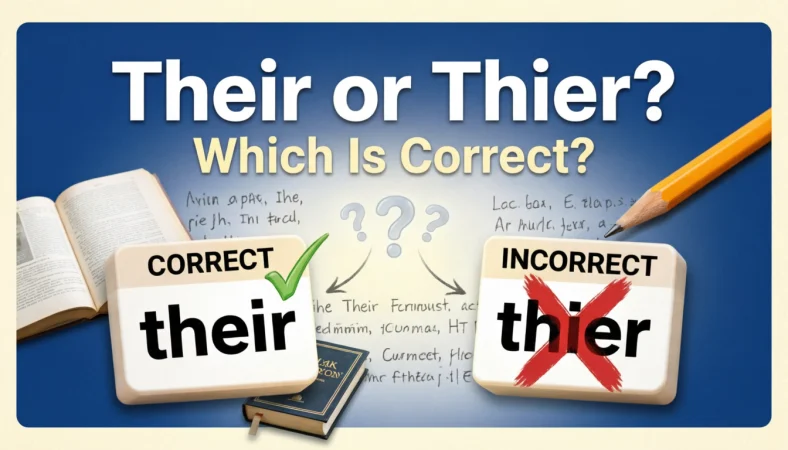
Quick answer:eir is the correct spelling.Thier is a common spelling mistake and is not correct in standard English .Memory trick: Remember “their” has “heir” inside it — an heir owns something, just like their shows ownership.
Their or Thier both words look almost identical, but only one is correct in standard English. Their is the correct spelling and is used as a possessive pronoun to show that something belongs to a group of people or things.
Thier is simply a common misspelling caused by mixing up the order of the letters i and e. Understanding the difference between their and thier helps you avoid a frequent grammar mistake and makes your writing clearer, more accurate, and more professional.
Quick Answer Table
| Aspect | Details |
| Correct Spelling | Their |
| InCorrect Spelling | Thier |
| Part of Speech | Possessive determiner (adjective) |
| Meaning | Belonging to or associated with the people or things previously mentioned |
| Pronunciation | /ðeər/ (rhymes with “hair” or “bear”) |
| Usage | Always used to show possession or association with plural subjects |
| Example Sentence | The students submitted their assignments on time. |
| Common Mistake | Writing “thier” instead of “their” due to the “i before e” confusion |
Which One Is Correct?
Let’s cut straight to the chase: their is the only correct spelling. Thier is always a misspelling and is not recognized as a valid word in standard English dictionaries. There is no context, dialect, or regional variation where thier would be considered acceptable usage.
This may seem straightforward, but the fact that so many people still hesitate—or write it incorrectly—shows just how confusing English spelling can be. To understand why their is correct and thier is not, we need to look at the rules of English orthography, the word’s etymology, and common patterns in our language that often trip us up.
The word their is a possessive determiner, which means it’s used before a noun to indicate that something belongs to a group of people or things. For example, when we say “their house,” we mean the house belonging to them. Similarly, “their ideas” refers to ideas held by a particular group. The spelling of this word has been standardized for centuries, and any variation from it is considered a spelling error.
One reason this mistake is so common is that English spelling rules about vowels can be confusing, especially when multiple vowel sounds are represented by only a few letters. The combination of “e,” “i,” and “r” in their doesn’t follow the neat patterns we sometimes expect, and many people inadvertently transpose the “e” and “i” when writing quickly.
Meaning of the Correct Word (Their)
Definition and Explanation
Their is a possessive determiner used to indicate that something belongs to or is associated with the people or things that have already been mentioned. It’s the possessive form of the third person plural pronoun they, and it functions similarly to my, your, his, her, its, and our.
When you use their, you’re essentially saying “belonging to them.” The word always requires a noun to follow it because it modifies that noun by showing ownership or association. For example, in the phrase “their books,” the word their tells us that the books belong to a specific group of people.
It’s important to note that their can refer to a group that is explicitly named, or it can refer to an implied group. For instance, in “The team celebrated their victory,” their clearly refers to the team members. In “Someone left their phone here,” their refers to an unknown person of unspecified gender. This latter usage has become increasingly common and accepted as a singular, gender neutral possessive pronoun.
Usage in Context
Their is used in several different contexts, all revolving around possession or association:
Group Possession: When referring to something owned or shared by multiple people or entities.
Association: When indicating a connection or relationship with a group.
Singular Gender Neutral: When referring to a single person whose gender is unknown or irrelevant.
Implied Subjects: When the subject is implied but not explicitly stated.
Real World Examples
everyday conversation:
- “The kids are playing with their toys in the backyard.”
- “My neighbors always water their plants in the morning.”
- “The couple bought their first home together.”
professional settings:
- “Employees are expected to submit their expense reports by Friday.”
- “The department presented their findings to the board of directors.”
- “Teams must complete their projects before the deadline.”
educational contexts:
- “Students should bring their textbooks to every class.”
- “The researchers published their results in a peer reviewed journal.”
- “Each participant shared their experience with the group.”
literary and metaphorical usage:
- “The trees shed their leaves in autumn.”
- “The stars shine their light across the galaxy.”
- “Nations must protect their sovereignty.”
Meaning of the Incorrect Word (Thier)
Is It a Real Word?
Simply put, thier is not a real word in the English language. It is a common misspelling of their that occurs when writers accidentally reverse the “e” and “i.” No dictionary, style guide, or grammar authority recognizes thier as an accepted spelling in any context.
Why It’s Not Valid
The primary reason thier is incorrect is that it doesn’t follow any established spelling pattern for this particular word. The word their has been spelled consistently throughout English language history, and there has never been a recognized variant spelling. Unlike some words that have multiple acceptable spellings (like “color” vs. “colour” or “organise” vs. “organize”), their has only one correct form.
Is It Ever Acceptable?
There are no situations where thier would be considered acceptable in formal or informal writing. It doesn’t appear in any English dictionary, and it’s not used in any dialect or regional variation of the language. It’s simply a typographical error that occurs when the “e” and “i” are swapped.
Even in informal contexts like text messages or social media posts, thier is still considered a spelling mistake. While informal writing often allows for more flexibility with grammar and spelling, thier is never the intended word; it’s always an accidental error.
Common Misconceptions
Some people mistakenly believe that thier might be an alternative spelling used in British English or another regional variant. This is false. The spelling their is used in all forms of English worldwide. Others think it might be related to the French word “tier” or a misspelling of “theirs.” Neither of these is true; thier is simply a typo, nothing more.
Key Differences Between Their and Thier
Spelling
Their is spelled T H E I R.
Thier is spelled T H I E R.
This is the most obvious difference between the two, and it’s the entire source of the confusion. The positioning of the “e” and “i” changes the word from correct to incorrect.
Meaning
Their has a clear, well defined meaning (possession or association).
Thier has no meaning because it is not a word. It is simply an error.
Pronunciation
Their is pronounced /ðeər/ and rhymes with “bear,” “hair,” “care,” “fair,” and “dare.”
Thier doesn’t have a standard pronunciation because it isn’t a recognized word. When people encounter the misspelling, they typically pronounce it the same way as their, recognizing the intended meaning from context.
Grammar
Their is a possessive determiner (also called a possessive adjective) that must precede a noun. It functions as part of a noun phrase to show possession.
Thier has no grammatical function because it’s not a valid word. It cannot be used in any grammatical structure.
Usage
Their is used in a wide variety of contexts to show possession or association with plural subjects (or singular unknown subjects).
Thier is only used in one context: as a spelling mistake that needs to be corrected.
Recognition
Their is universally recognized by all English speakers and appears in every English dictionary.
Thier is universally recognized as a spelling error. Spell checkers, grammar checkers, and readers will immediately identify it as incorrect.
Common Mistakes People Make
Confusing Their with Other Words
Many people don’t just misspell their; they also confuse it with other similar sounding words. The most common confusion is between their, there, and they’re. These three words are homophones (they sound the same but have different meanings) and are frequently mixed up even by native speakers.
- Their: Shows possession (belonging to them).
- There: Indicates a place or location.
- They’re: Contraction of “they are.”
Understanding the differences between these three words is essential for clear writing. A common error is writing “their going to the store” when you mean “they’re going to the store,” or “there book” when you mean “their book.” These mistakes change the meaning of your sentence entirely.
The “I Before E” Confusion
Many of us learned the rhyme “I before E except after C” in school. This rule states that when spelling words with the “ee” sound, we usually put “i” before “e” (like in “believe” and “field”), unless the combination comes after “c” (like in “receive” and “ceiling”).
However, their is one of the exceptions to this rule. It has “e” before “i,” not “i” before “e.” This is because the word doesn’t have the “ee” sound. It’s pronounced with an “air” sound, and the vowel order reflects the word’s etymology rather than standard English vowel patterns.
This exception is one of the main reasons people misspell their. They try to apply the “I before E” rule and write “thier” instead, not realizing that this word is one of the exceptions. Many other common words have this same pattern, including “their,” “their,” “weird,” “seize,” “either,” “neither,” “height,” “leisure,” and “foreign.”
Typing and Cognitive Errors
Sometimes the mistake isn’t about not knowing the correct spelling—it’s about fast typing and our brain moving faster than our hands. When you’re typing quickly, it’s easy to transpose letters, especially in words where the vowel placement feels counterintuitive. The word “their” has a relatively low frequency spelling pattern, making it more susceptible to this type of error.
Additionally, cognitive fatigue or distraction can lead to spelling errors. When you’re tired, writing under pressure, or not paying close attention, you’re more likely to make mistakes with commonly confused words like their.
Overcorrection
Some people are so aware of the “I before E” rule that they overcorrect. They know that many words follow the “ie” pattern, so they assume their should too. This overcorrection leads to “thier” even when they know better.
Mislearning
Some people genuinely learned the wrong spelling at some point and never had it corrected. This is particularly common among those who learned English as a second language or who were taught by someone who made the same mistake. Once a misspelling becomes a habit, it can be difficult to break, especially if no one ever points it out.
Correct Usage Examples
Casual Examples
Here’s how you might use their in everyday conversation and informal writing:
Social Media Posts:
- “My friends posted their vacation photos and now I’m jealous.”
- “The concert was amazing—everyone brought their energy!”
- “People need to mind their own business sometimes.”
Text Messages:
- “The kids are with their grandparents this weekend.”
- “Did you see their new puppy? It’s adorable!”
- “Our neighbors are having their party on Saturday.”
Personal Notes:
- “The team played their best game of the season.”
- “Students will get their test results next week.”
- “The flowers lost their petals in the storm.”
Professional Examples
Business Correspondence:
- “All employees must complete their timesheets by 5 PM.”
- “The board of directors expressed their approval of the proposal.”
- “Departments should submit their budgets for review.”
Academic Writing:
- “The researchers presented their findings at the conference.”
- “Students must cite their sources properly.”
- “Each participant shared their experiences during the interview.”
Corporate Communications:
- “Our clients value their partnership with our company.”
- “Teams are responsible for their project deliverables.”
- “The company appreciates their employees’ dedication.”
Educational Examples
Classroom Context:
- “Students should bring their textbooks to class.”
- “Each child contributed their ideas to the group project.”
- “Teachers often share their lesson plans with colleagues.”
Language Learning:
- “The students practiced their pronunciation.”
- “Learners are encouraged to use their dictionaries.”
- “Each participant recorded their native language examples.”
Academic Research:
- “Subjects submitted their responses anonymously.”
- “Participants shared their perspectives on the issue.”
- “Researchers documented their methodology carefully.”
Literary and Metaphorical Examples
Creative Writing:
- “The trees stretched their branches toward the sky.”
- “The mountains kept their ancient secrets.”
- “The stars whispered their light across the darkness.”
Poetic Usage:
- “The flowers turned their faces to the sun.”
- “The river carved their path through the valley.”
- “The clouds scattered their rain across the land.”
Figurative Language:
- “The years take their toll on even the strongest.”
- “The stories found their way into the hearts of readers.”
- “The memories held their power over him.”
Word Origin and Etymology
Understanding the history of the word their can help us appreciate why it’s spelled the way it is and why thier is incorrect.
Old Norse and Old English Roots
Their comes from the Old Norse word þeira, which was the genitive plural form of “they.” The Vikings brought this word to England during their invasions and settlements in the 8th to 11th centuries. The Old Norse influence on English is significant, and many common words we use today—including their, they, and them—have Scandinavian origins.
The Old Norse þeira was adopted into Middle English as “their,” “thair,” or “theire” during the 13th century. Over time, the spelling stabilized to its current form. The word displaced the earlier Old English possessive forms like “hiera,” which were falling out of use due to the Danish invasions and the mixing of languages.
The Shift from Old English
In Old English, the third person plural possessive was “hiera” (meaning “their”). However, when the Danish Vikings settled in England and the languages merged, the Old Norse forms þeir (they) and þeira (their) became dominant. By the 14th century, “their” was the standard spelling in most English dialects.
Spelling Standardization
The English language didn’t have standardized spelling until much later. The 15th and 16th centuries saw the beginning of spelling standardization, largely due to the introduction of the printing press. Early printed texts show various spellings of their, including “theyre,” “theire,” and “thaire.” By the 17th century, the spelling their had become the norm, and it has remained unchanged ever since.
The Lack of Etymology for “Thier”
Thier has no etymology because it’s not a word. It’s simply a spelling error that emerged later as people applied the “I before E” rule incorrectly. There’s no historical precedent for this spelling, no linguistic evolution that produced it, and no dialect that uses it. It’s a purely modern error, likely exacerbated by the way we learn spelling rules in school and the cognitive biases that come with fast typing.
Why the Incorrect Version Became Popular
The misspelling “thier” has become relatively common, and understanding why can help us avoid it and others like it.
The “I Before E” Rule Overgeneralization
This is the primary reason. The “I before E except after C” rhyme is one of the earliest spelling rules we learn, and it’s drilled into us from a young age. It’s a rule that works for many common words, such as “believe,” “field,” “piece,” “yield,” and “relief.” However, there are significant exceptions, and their is one of the most notable.
When children are learning to spell, they often apply this rule to all words with the “ee” or “air” sound. Since their doesn’t fit neatly into either category, it’s easy to assume it should follow the “ie” pattern. This assumption leads directly to the “thier” misspelling. The rule becomes overgeneralized to words where it doesn’t apply, creating a persistent error pattern.
Homophone Confusion
Their, there, and they’re are homophones. This can lead to cognitive confusion, where the brain correctly processes the sound but struggles with the correct spelling for the intended meaning. The more similar the words sound, the more likely we are to mix them up.
When you’re writing quickly, your brain might know which word you want to use, but your fingers might type the spelling that’s most familiar or easiest to recall. Since “there” is a very common word that follows different spelling rules, its familiarity can interfere with writing their correctly.
Visual Habit Reinforcement
Because “thier” is such a common error, people see it frequently, especially online. The more often we see a misspelling, the more familiar it becomes, and the more likely we are to reproduce it ourselves. Social media posts, comments, and informal communications are full of this error, creating a cycle of reinforcement.
Educational Gaps
Some educational systems don’t explicitly teach the exceptions to the “I before E” rule, or don’t emphasize the importance of recognizing words that follow alternative spelling patterns. When students aren’t taught specifically about words like their, weird, and either, they’re left to rely on general rules that don’t always apply.
Technology and Autocorrect
Ironically, technology can both help and hinder our spelling abilities. Autocorrect and spell check have made us less reliant on memorizing correct spellings. When we type “thier,” our devices typically correct it automatically. This convenience means we don’t always have to think about the spelling, which can lead to us not noticing the correction and continuing to type the misspelling. We become reliant on the technology to fix our mistakes, rather than learning the correct spelling ourselves.
Easy Memory Tricks
These techniques will help you remember the correct spelling of their and distinguish it from other similar words.
The Irony Trick
One of the most effective memory tricks is to remember that “their” is an exception to the “I before E” rule. Use this irony to your advantage. Remember: “Their is a rebel word. It refuses to follow the rule.” By personifying the word and giving it a characteristic that makes it memorable, you’re far less likely to make the mistake again.
The “Heir” Connection
Think of the word “heir.” An heir is someone who inherits property or possessions. The word their is about possession—it shows that something belongs to someone. The “heir” is at the center of this possession connection. Notice that both heir and their have the “e” before “i” pattern. They both involve ownership. If you can remember that an heir owns things, and so does someone who has “their” things, you’ll connect the spelling through meaning.
The “They” Foundation
Their is a possessive form of the word they. Remember that both they and their start with “the.” They are connected in meaning, so they should be connected in spelling. Both words begin with “the,” not “thi.” This is a strong anchor for correct spelling. If you can remember that they has an “e” before anything else, and their is related to they, you’ll know to put the “e” before the “i.”
Visual Association
Create a mental image that reinforces the “e” before “i” order. For example, imagine a group of people pointing to a book and saying, “That’s their book.” The pointing gesture can go from left to right: e (the first letter), i (the second), reminding you of the order. Or imagine the word “their” written with a large “E” and a small “I” placed behind it, indicating that the “E” comes first.
Sound Based Tricks
Remember that their rhymes with “hair,” “bear,” “fair,” and “dare.” All these words have the “air” sound and are spelled with an “a” or “e” before the “i.” None of these rhyming words have an “i” before the “e.” By associating the correct spelling of their with the spelling of these rhyming words, you can internalize the “e” before “i” pattern. Think, “If it rhymes with ‘hair’ and ‘bear,’ the ‘e’ must come first.”
Acronym Method
Create a simple acronym to remember the correct spelling: The Heirs Enjoy Inheritance Rights. This connects the “e” and “i” order to the concept of inheritance (possession), which is exactly what their signifies.
Distinguish From “There” and “They’re”
The most common confusion isn’t just between their and thier; it’s between their, there, and they’re. Use these memory tricks to keep them straight:
- Their contains “heir” (possession, inheritance).
- There contains “here” (location, place).
- They’re is a contraction of “they are” (subject+verb).
By associating “heir” with possession, “here” with location, and “are” with the contraction, you can always choose the right word.
Practice with Sentences
The best way to solidify the correct spelling is to write it repeatedly in context. Create a set of sentences and write them out, paying attention to the spelling of their. For instance:
- “The team brought their equipment to practice.”
- “The children lost their toys at the park.”
- “The students completed their assignments.”
Repetition with full engagement will train your brain and your fingers to automatically produce the correct spelling.
FAQs
Q1. Why do people spell “their” as “thier”?
People often write thier because they confuse it with the “i before e” spelling rule. However, their is an exception and the correct spelling.
Q2. Is “thier” ever correct?
No. Thier is not accepted in standard English. It is always considered a spelling mistake.
Q3. How can I remember their, there, and they’re?
- Their = possession (their car)
- There = place/location (over there)
- They’re = they are (they’re coming)
Q4. Can their be used for one person?
Yes. Singular their is widely accepted as a gender-neutral possessive pronoun.
Example: Someone forgot their phone.
Q5. Does autocorrect fix thier?
Most spell checkers correct thier to their, but learning the spelling is better than depending only on autocorrect.
Q6. How do you pronounce their?
Their is pronounced like there and they’re, rhyming with hair and care.
Q7. What is the origin of their?
Their comes from Old Norse þeira and developed into modern English through historical language changes.
Q8. Is singular their formal English?
Yes. Many modern style guides accept singular their in formal and academic writing.
Q9. What words are similar spelling exceptions?
Words like weird, either, neither, seize, and foreign are also exceptions to common spelling rules.
Q10. How do I stop writing thier?
Practice the correct spelling and remember: their contains “heir” because it shows ownership
Conclusion
The difference between their and thier is simple: their is the only correct spelling in standard English, while thier is always a spelling mistake. Although the error is common because of spelling rules and letter order confusion, learning the correct form helps improve writing accuracy.
Remember that their shows possession and connects to the idea of ownership, while thier has no accepted meaning. With practice and simple memory tricks, you can avoid this mistake and write with greater confidence, clarity, and professionalism.