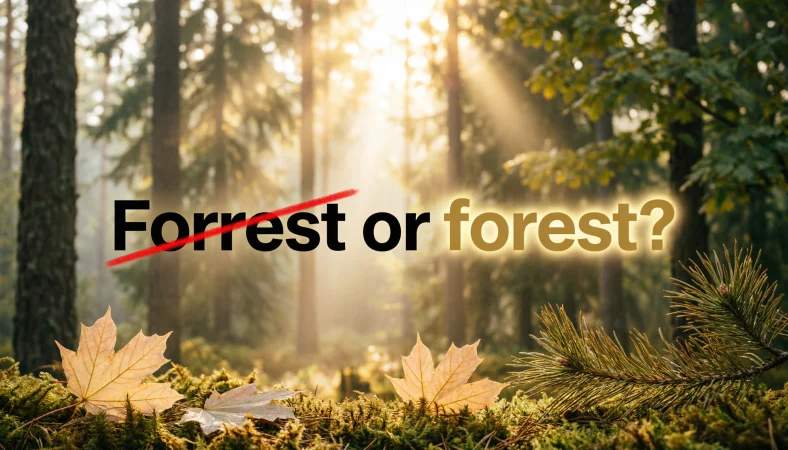
Quick answer:Forest is the correct spelling for a large area filled with trees.
Forrest is usually a proper name/surname (for example, a person’s name) and is not the standard spelling for a group of trees.
Forrest or Forest the two words look almost identical, but they are used differently. Forest is the correct standard English word for a large area covered with trees, plants, and wildlife. It is used in everyday writing, academic texts, and professional communication.
Forrest, with an extra “r,” is mainly used as a proper name or surname. Although it may appear in names and titles, it is not the correct spelling when referring to trees or woodland areas. Understanding this difference helps you write accurately and avoid a common spelling mistake
Quick Answer Table
| Feature | Forest | Forrest |
| Correct Spelling | Yes | No (except as a proper noun) |
| Part of Speech | Noun | Proper noun (surname) |
| Meaning | Large area covered with trees and undergrowth | A surname (e.g., Forrest Gump) |
| Usage | Describing wooded areas, ecosystems, natural landscapes | Referring to individuals with this surname |
| Example | “We walked through the dense pine forest.” | “Forrest Gump is a beloved film character.” |
Which One Is Correct?
The standard, correct spelling in English is “forest” with one ‘r. This is the only accepted spelling when referring to a large area covered with trees and undergrowth. The spelling “forrest” with two ‘r’s is considered a misspelling when used in this context.
However, there’s one important exception: “Forrest” (capitalized) is a legitimate proper noun—specifically, it’s a surname. You might recognize it from famous figures like actor Forrest Whitaker or the iconic movie character Forrest Gump.
In everyday writing, unless you’re specifically referring to someone’s name, you should always use “forest” with a single ‘r’.
Meaning of the Correct Word: Forest
Definition and Explanation
A forest is a large, densely wooded area dominated by trees and comprising a complex ecosystem. It’s more than just a collection of trees—it represents a living, breathing environment that supports diverse plant and animal life.
Forests cover approximately 31% of the Earth’s land surface and play an essential role in maintaining our planet’s ecological balance. They serve as the lungs of our planet, absorbing carbon dioxide and releasing oxygen, making them crucial for environmental health.
Types of Forests
Forests come in various types, including:
- Tropical rainforests located near the equator
- Temperate forests found in moderate climate zones
- Boreal forests (also called taiga) in cold northern regions
- Deciduous forests where trees shed their leaves annually
- Coniferous forests dominated by cone bearing evergreen trees
Usage Examples
Here are practical examples of how to use “forest” in different contexts:
Everyday conversation:
“The children loved exploring the magical forest behind their grandmother’s house.”
Professional context:
“The timber company has pledged to plant 10,000 new trees in the forest by 2025.”
Scientific writing:
“The Amazon rainforest produces approximately 20% of the world’s oxygen.”
Descriptive writing:
“Ancient oaks stood sentinel throughout the misty forest, their branches forming a natural canopy.”
Metaphorical usage:
“She felt lost in a forest of paperwork, unable to find the important document she needed.”
Environmental context:
“Climate change continues to threaten forest ecosystems worldwide, leading to biodiversity loss and habitat destruction.”
Travel writing:
“The Black Forest in Germany offers breathtaking views and delightful hiking trails through dense woodlands.”
Meaning of the Incorrect Word: Forrest
When written with two ‘r’s and no capitalization, “forrest” is simply a misspelling of “forest.” There is no legitimate alternative meaning for the lowercase “forrest” in standard English dictionaries.
When Is “Forrest” Correct?
“Forrest” becomes a valid word when used as a:
Proper noun (surname):
“Forrest Gump is one of the most iconic characters in American cinema history.”
Given name:
“Dr. Forrest Thompson has been practicing medicine for over thirty years.”
Place name:
“The town of Forrest City in Arkansas was named after General Nathan Bedford Forrest.”
In these cases, “Forrest” must always be capitalized to indicate it’s a proper noun. Without the capital letter, it’s simply a spelling error.
Key Differences Between the Two Words
Spelling
The most obvious difference lies in the number of ‘r’s. “Forest” uses one ‘r’, while “Forrest” uses two.
Meaning
- Forest: A large wooded area or ecosystem
- Forrest: A proper noun (person’s name or place name) when capitalized
Pronunciation
Both words are pronounced identically in standard English: /ˈfɒrɪst/ (British English) or /ˈfɔːrɪst/ (American English). The double ‘r’ in “Forrest” does not affect the pronunciation.
Grammar
- “Forest” functions as a common noun and can be used with articles (a forest, the forest)
- “Forrest” functions as a proper noun when capitalized
Usage Frequency
In written English, “forest” appears significantly more frequently than “Forrest.” According to Google Books Ngram Viewer, “forest” is used approximately 100 times more often than “Forrest” in published works.
Recognition
- Forest” is universally recognized as the correct spelling
- “Forrest” is only recognized when capitalized as a proper noun
Common Mistakes People Make
Type of Errors
Typographical errors: People often inadvertently type “forrest” due to muscle memory or keyboard mistakes.
Autocorrect issues: Some autocorrect systems may not flag “forrest” if it’s in their dictionary, leading to unnoticed errors.
Name confusion: Writers sometimes confuse the correct spelling of the common noun with the surname spelling.
Real World Examples of Common Mistakes
Incorrect: “We spent the afternoon hiking through the dark forrest.”
Correct: “We spent the afternoon hiking through the dark forest.”
Incorrect: “The forrest service has been monitoring the wildfire situation closely.”
Correct: “The forest service has been monitoring the wildfire situation closely.”
Incorrect: “The enchanted forrest was filled with mystical creatures.”
Correct: “The enchanted forest was filled with mystical creatures.”
Professional Consequences
In professional writing contexts, spelling errors like this can:
- Reduce your credibility
- Make your work appear unpolished
- Distract from your message
- Lower your ranking in search engine results
Correct Usage Examples
Casual Examples
- “My grandmother lives in a small cottage at the edge of a beautiful pine forest.”
- “Every morning, I enjoy jogging through the forest near my apartment.”
- “The camping trip was memorable because we slept surrounded by the sounds of the forest.”
Professional Examples
- “Our environmental consulting firm specializes in sustainable forest management practices.”
- “The government announced new legislation to protect endangered forest ecosystems.”
- “Forest conservation efforts have increased significantly over the past decade.”
Educational Examples
- “Students learned about the carbon cycle during their forest ecology field trip.”
- “The biology textbook explains how forest habitats support biodiversity.”
- “Research indicates that temperate forests store substantial amounts of carbon.”
Literary and Metaphorical Examples
- “The novelist described the forest as a living entity with a soul of its own.”
- “He wandered through the forest of his own thoughts, searching for clarity.”
- “Their love story unfolded beneath the canopy of an ancient forest.”
Environmental Context
- “Deforestation continues to threaten global forest coverage at alarming rates.”
- “The United Nations promotes sustainable forestry practices to combat climate change.”
- “Indigenous communities have protected forest ecosystems for generations.”
Word Origin / Etymology
The word “forest” has a fascinating linguistic history that traces back through multiple languages.
The term originated from the Old French word “forest” (12th century), which derived from the Medieval Latin “foresta.” This Latin term likely came from the Latin phrase “forestem silvam,” meaning “outside woods,” referring to hunting grounds or woodlands kept for hunting.
Interestingly, the Latin “foris” means “outside” or “outdoors,” and “silvam” means “woods” or “forest.” Together, they referred to woodlands that existed beyond cultivated areas.
The concept of forests in medieval times differed from our modern understanding. Medieval forests were often legally designated areas managed for royal hunting rather than merely wooded tracts. The Norman French introduced the word to England after the Norman Conquest in 1066.
The double ‘r’ spelling variation that we see in “Forrest” as a surname likely emerged from regional pronunciation differences and alternative spelling conventions in historical records. Many surnames have unique spellings that deviate from standard word forms.
Why the Incorrect Version Became Popular
Surname Influence
The primary reason “Forrest” with two ‘r’s appears frequently is due to its prevalence as a surname. Many notable individuals throughout history have carried this name, contributing to its visibility and familiarity.
Pop Culture Impact
Forrest Gump (1994 film) significantly popularized this spelling variation. The Academy Award winning film introduced the name to millions worldwide, making “Forrest” a recognizable spelling even when used incorrectly.
Spelling Inertia
Language learners and young writers often default to “forrest” because:
- Double consonants are common in English spelling rules
- The pronunciation doesn’t reveal the spelling difference
- Many similar words have double consonants (e.g., “aborration,” “battery”)
Social Media Influence
With the rise of informal communication on social media platforms, spelling errors spread more quickly. People see misspellings in posts and comments, potentially reinforcing incorrect usage habits.
Easy Memory Tricks
The “One Tree, One R” Rule
Remember that a forest has one ‘r’ because it contains many trees, but your spelling should have just one ‘r’.
The R E S T Association
Think: F O R E S T = For Really Excellent Scenic Trees
The “Two R’s = Two People” Rule
If you see two ‘r’s (Forrest), think of it as a name—you need the extra ‘r’ to represent a person. Since Forrest Gump has two ‘r’s, remember that it takes two ‘r’s to make a person, but only one to make a place full of trees.
Visual Associations
- Imagine the word “forest” with a single ‘r’ standing tall like a tree
- Picture “Forrest” with two ‘r’s walking together like people with the same surname
Similar Spelling Confusions
If you find yourself confusing “forest” and “Forrest,” you might also encounter these similar English spelling challenges:
- Desert vs. Dessert
- Principle vs. Principal
- Affect vs. Effect
- Stationary vs. Stationery
- Complement vs. Compliment
Each of these pairs requires careful attention to spelling and context.
When to Use Each Spelling: A Simple Guide
| Scenario | Correct Choice |
| Describing a wooded area | forest |
| Writing about environmental topics | forest |
| Referring to the Forest Service | forest |
| Mentioning the movie character | Forrest (capitalized) |
| Referring to someone’s surname | Forrest (capitalized) |
| Geographical names (forests) | forest |
| Geographical names (towns/cities named Forrest) | Forrest (capitalized) |
Technical and Scientific Usage
Ecology and Environmental Science
scientific contexts, “forest” appears consistently in terms like:
- Forest ecology
- Forest management
- Forest conservation
- Forest fragmentation
- Old growth forest
- Boreal forest
Computer Science and Technology
The word “forest” has also found its way into technology terminology:
- Random forest (machine learning algorithm)
- Decision forest
- Forest of trees (data structure)
In Business and Professional Contexts
- Forest products industry
- Forest certification
- Sustainable forest management
- Forest investment
Readers trust content that demonstrates expertise and attention to detail. Misspellings erode trust and reduce engagement.
FAQs
Q1. What is the correct spelling, forrest or forest?
The correct spelling for a wooded area is forest (one r). Forrest (two rs) is mainly used as a proper name, such as a first name or surname.
Q2. Why is Forrest spelled with two R’s?
Forrest is a name that developed through historical naming usage. It is not the standard spelling for a group of trees.
Q3. Is forrest a correct English word?
As a common noun, no. Forrest is generally a proper noun (name), not the word for woodland.
Q4. Can I use Forrest for a forest of trees?
No. Use forest when talking about trees, wildlife, or woodland areas.
Q5. Is Forest always spelled with one R?
Yes. The common English word forest always uses one r.
Q6. Do forest and Forrest have the same pronunciation?
Yes. Both are usually pronounced the same, which causes confusion.
Q7. What does forest mean?
A forest is a large area covered with trees, plants, and wildlife.
Q8. What is the plural of forest?
The plural is forests.
Example: Many forests are protected worldwide.
Q9. What is the difference between a forest and a jungle?
A forest is any large wooded area, while a jungle usually refers to a dense tropical forest.
Q10. How can I remember forest spelling?
Remember: forest has one “r” like “trees” are one natural group. Use Forrest only for names
Conclusion
The difference between forrest and forest is easy to understand: forest is the correct spelling for trees, woodlands, and natural areas, while Forrest is mainly used as a proper name. Keeping this distinction in mind helps you avoid a common spelling mistake.
Remember the simple rule: forest are trees, Forrest is name. Using the correct spelling shows accuracy and improves the quality of your writing. With this knowledge, you can confidently choose the right word in any context.