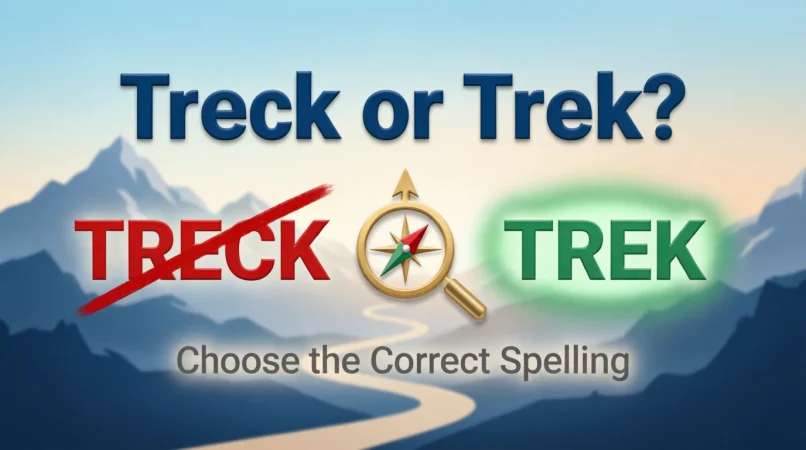
Quick answer:Trek is the correct spelling.
Treck is usually a misspelling. Trek means a long journey, hike, or trip, especially on foot.
Treck or Trek is a common spelling confusion because both words look and sound similar. However, in standard English, trek is the correct and widely accepted spelling. It refers to a long journey, hike, or difficult trip, especially one made on foot.
The word treck is generally considered a misspelling and is not used in standard English writing. Understanding the difference between trek and treck helps you avoid spelling mistakes and use the correct word in travel writing, everyday communication, and professional content
Quick Answer Table
| Aspect | Correct Form | Incorrect Form |
| Spelling | Trek | Treck |
| Part of Speech | Noun and Verb | Not applicable |
| Meaning | A journey or expedition, especially a difficult one; to travel slowly or with difficulty | Misspelling of “trek” |
| Pronunciation | /trɛk/ (rhymes with “check”) | Not used in standard English |
| Common Usage | “We went on a trek through the mountains.” | “Let’s go on a treck” (incorrect) |
Which One Is Correct: Treck or Trek?
Let’s settle this immediately: “trek” is the correct spelling. The version with a “ck” – “treck” – is a common misspelling that has no legitimate standing in standard English dictionaries.
The confusion between these two spellings is understandable. English contains many words that do end in “ck” (like “track,” “crack,” and “attack”), and the pronunciation of “trek” naturally leads some people to assume it follows the same pattern. Additionally, the “ck” ending is so common in English that it feels intuitive to many writers.
However, “trek” follows a different pattern. It’s a word of Dutch and Afrikaans origin, brought into English through South African English. In its original forms, it never featured the double consonant ending with “ck.” The spelling has remained consistent since its adoption into English.
Grammar experts and linguists agree that “trek” is the only acceptable form in formal writing. Using “treck” would be marked as an error in any professional or academic context. Spell checkers automatically flag it, and readers will notice the mistake.
It’s worth noting that language is always evolving, and some misspellings eventually become accepted alternatives. However, “treck” has not reached that status. It remains firmly in the category of errors rather than variant spellings.
Meaning and Usage of “Trek”
Definition and Core Meaning
The word “trek” functions as both a noun and a verb, carrying the core meaning of a challenging journey or expedition. As a noun, it refers to a long, difficult trip, especially one made on foot. As a verb, it describes the act of making such a journey.
Detailed Explanation
When you say you went on a trek, you’re implying more than just a casual walk. The word suggests purposeful movement across challenging terrain, often involving physical exertion and endurance. Treks typically happen in natural environments like mountains, forests, or deserts, though the term can be used metaphorically for any difficult journey.
The verb form carries similar weight. When you trek somewhere, you’re traveling slowly and with difficulty, usually over rough terrain. It’s not a word used for casual strolls or simple commutes.
Real World Usage Examples
As a noun:
- The five day trek through the Himalayas was life changing.
- Our trek across the desert tested our physical and mental limits.
- She documented her trek through the Amazon rainforest in a series of photographs.
As a verb:
- We trekked for six hours before reaching the first camp.
- Thousands of pilgrims trek to the holy site each year.
- The explorers trekked through uncharted territory for weeks.
Metaphorical uses:
- The corporate trek to success requires patience and strategy.
- Her educational trek from community college to PhD was inspiring.
Professional and Formal Contexts
In professional writing, “trek” appears in various fields. Travel writers and bloggers use it frequently to describe adventures. Historians might use it to describe migrations or expeditions. Even in business writing, you’ll sometimes see metaphorical uses to describe challenging projects or career paths.
The word has also become popular in job descriptions and recruitment contexts. Phrases like “career trek” or “professional trek” appear in motivation content and leadership literature. Interestingly, some healthcare and nursing job listings use “trek” metaphorically to describe the demanding journey of working in high stress medical environments.
Is “Treck” Ever Acceptable?
The short answer is no. “Treck” is not an acceptable variant, alternative spelling, or regional difference. It’s simply an error.
Why Do People Make This Mistake?
Several factors contribute to the persistent “treck or trek” confusion.
Phonetic reasoning: The pronunciation /trɛk/ naturally leads some writers to choose “ck,” which is a common way to represent the /k/ sound after a short vowel in English. Think of words like “back,” “sack,” and “track.”
Visual confusion: “Treck” looks similar to “wreck” and “crack,” which are correctly spelled with “ck.” This visual association makes the error more likely.
Typing errors: Sometimes, it’s simply a typo. The “c” and “k” keys are adjacent on QWERTY keyboards, and hitting both to form “ck” can happen accidentally.
Lack of exposure: People who have never seen “trek” in print may default to the more common “ck” pattern.
Does It Appear in Any Dictionary?
No reputable English dictionary includes “treck” as a standard or variant spelling. Merriam Webster, Oxford English Dictionary, Cambridge Dictionary, and Collins all recognize only “trek.”
Some online dictionaries might have entries for “treck” as a misspelling, often with a note directing users to the correct spelling. But this doesn’t legitimize it—it simply acknowledges that people search for the misspelling frequently enough to warrant a redirect.
Regional Variations
Unlike some words that have British/American spelling differences (like “colour/color” or “centre/center”), “trek” is spelled the same across all English speaking regions. Whether you’re in the US, UK, Australia, Canada, or South Africa (where the word originated), “trek” remains the standard.
Is It Slang or Informal?
No. “Treck” isn’t recognized as slang, informal speech, or any other legitimate variation. It’s simply incorrect. Even in casual writing, text messages, or social media posts, it would be considered a spelling error rather than an accepted alternative.
Key Differences Between “Treck” and “Trek”
Let’s break down the distinctions systematically:
Spelling
- Trek: T R E K (four letters)
- Treck: T R E C K (five letters, incorrect)
Meaning
- Trek: A challenging journey or the act of undertaking one
- Treck: No meaning; it’s a misspelling
Pronunciation
- Both words would be pronounced the same (/trɛk/). The “ck” doesn’t change the sound, which is part of why the error persists.
Grammar
- Trek: Functions as both noun and verb; follows standard English conjugation (trek, treks, trekking, trekked)
- Treck: Cannot be used in any grammatical construction correctly
Usage in Sentences
- Trek: “We plan to trek across the national park.”
- Treck: “We plan to treck…” (incorrect; would be marked as a spelling error)
Recognition
- Trek: Recognized by all dictionaries, spell checkers, and style guides
- Treck: Flagged as an error by all writing tools and style guides
Formal Writing Acceptability
- Trek: Acceptable in all contexts, from casual to formal
- Treck: Unacceptable in any professional or academic context
Common Mistakes People Make with “Trek”
Beyond the basic “treck or trek” confusion, other errors commonly occur with this word.
Confusing “trek” with “track”:
These words sound somewhat similar but have completely different meanings. “Track” refers to a path or course, or the act of following something. Mixing them up can confuse readers. Example of error: “We hiked along the trek.” (Correct: “We hiked along the track.”)
Tense confusion:
The verb “trek” follows regular conjugation rules. However, some writers mistakenly use “traked” or other irregular forms. The correct forms are:
- Present: trek
- Past: trekked
- Present participle: trekking
- Third person singular: treks
Using “trek” for casual walks:
While “trek” has expanded in usage, it still implies difficulty and distance. Calling a short walk in the park a “trek” sounds exaggerated. Reserve the word for genuine journeys or challenges.
Misspelling “trekked” and “trekking”:
When adding suffixes, people sometimes struggle with doubling consonants. The rule is straightforward: with a single syllable word ending in a consonant vowel consonant pattern, you double the final consonant before adding ed or ing. So “trek” becomes “trekked” and “trekking.”
Examples of common misspellings:
- Treked (should be trekked)
- Treking (should be trekking)
- Trecking (should be trekking)
Using “treck” in professional contexts:
This is particularly problematic. Job applications, business proposals, and academic papers all require correct spelling. A “treck” error can undermine credibility, especially in fields requiring attention to detail like nursing jobs, healthcare administration, or any writing intensive profession.
Correct Usage Examples
Casual Usage
- We’re going on a trek through the national park this weekend.
- I trekked all the way across town to get that coffee.
- The trail was tough, but the trek was worth it for the views.
- My phone says we’ve trekked 15 kilometers today.
Professional Usage
- The research team’s trek across the remote region yielded significant data.
- Our company’s financial trek through the recession required strategic planning.
- The documentary follows the nurse’s trek through rural communities providing healthcare.
- In her role as project manager, she led the team’s trek from concept to product launch.
Educational Usage
- Students will trek through various ecosystems during the biology field trip.
- The history lesson covered the Great Trek of the Boers in South Africa.
- Her academic trek from struggling student to valedictorian was inspiring.
- The geology class trekked across the fault line to study tectonic activity.
Literary and Metaphorical Usage
- The protagonist’s emotional trek through grief and recovery forms the novel’s core.
- Life is a trek filled with unexpected challenges and hidden beauties.
- Her spiritual trek toward enlightenment took her across continents.
- The corporation’s trek toward sustainability began with small, meaningful changes.
Travel and Adventure Usage
- Many travelers trek the Inca Trail to Machu Picchu each year.
- We trekked through knee deep snow for three hours.
- Guided treks are available for various skill levels.
- The coastal trek offers breathtaking ocean views.
Word Origin and Etymology
Understanding the origin of “trek” helps explain why it’s spelled without a “ck” and why it carries the meanings it does.
Dutch and Afrikaans Roots
“Trek” comes from the Dutch word “trekken,” meaning “to pull, haul, or march.” In the 17th and 18th centuries, as Dutch settlers established colonies in South Africa, the word entered the local dialect of Afrikaans. In Afrikaans, “trek” retained its Dutch spelling and took on additional meanings related to migration and traveling by ox wagon.
The Great Trek
The word gained international recognition through a significant historical event: the Great Trek. This was the mass migration of Boer settlers (Dutch descendants in South Africa) who left the British controlled Cape Colony in the 1830s and 1840s. They traveled northward, seeking independence and new lands.
The Great Trek involved thousands of people, covered vast distances, and significantly shaped South African history. Because this event brought the word into English language historical texts, “trek” became recognized in English with its current spelling.
Adoption into English
English adopted “trek” in the 19th century, maintaining the Dutch/Afrikaans spelling. Unlike many borrowed words that undergo anglicization, “trek” retained its original form. This is why it doesn’t follow the common English pattern of ending with “ck.
Related Words
The Dutch root “trekken” connects to several words across Germanic languages. In German, “trek” appears as “trecken” in some dialectal forms. The word also relates to the English word “truck,” which comes from the same root and originally meant “to exchange” or “to travel.”
Why “Treck” Became Popular
Despite its incorrect status, “treck” has gained visibility online. Understanding why helps you avoid falling into the same trap.
Search Engine Trends
Search data shows significant volume for both “treck or trek” and “treck meaning.” People are actively seeking clarification, which indicates the confusion is widespread. Some of this traffic comes from non native English speakers learning the language, while other searches come from native speakers who simply never learned the correct spelling.
Social Media Influence
Social media platforms have democratized language but also spread errors. When influential users or viral posts use “treck,” others copy it, assuming it’s acceptable. The copy and paste culture of social media accelerates the spread of misspellings.
Marketing and Branding Choices
Some businesses have intentionally used “treck” in brand names for uniqueness or visual appeal. When a brand consistently uses a misspelled word, it can create the illusion that the spelling is legitimate. However, these cases are deliberate deviations, not standard usage.
Auto Correct and AI Training
In an irony that frustrates many writers, some auto correct systems and AI models have been trained on data containing “treck.” This can lead to a situation where the error gets propagated rather than corrected. However, most modern spell checkers and writing assistants flag “treck” as an error.
Typing Culture
Fast typing without careful proofreading creates opportunities for errors. The “ck” key combination is common in English, making it an easy mistake when rushing. Over time, repeated errors can create false confidence in incorrect spelling.
Easy Memory Tricks to Remember “Trek”
These simple techniques will help you remember that “trek” has only four letters, ending with just “k” rather than “ck.”
Memory Trick 1: “Check your spelling, not your treck.”
Rhymes and simple phrases stick in your mind. This one uses the common “check” spelling to remind you that “trek” isn’t spelled the same way.
Memory Trick 2: Think of the four elements.
“Trek” has four letters. Four directions on a compass. Four seasons. Connecting the word to an easy to remember number helps lock in the spelling.
Memory Trick 3: Visualize the letters.
Picture the word “trek” as a stick figure walking. The “T” is the person’s head, the “R” is the body, the “E” is the first leg, and the “K” is the second leg. You don’t need an extra “C” because nobody walks with a third leg.
Memory Trick 4: Remember the origin.
The word is from Dutch/Afrikaans, and they spelled it with a “k.” Imagine the Netherlands and South Africa on a map—they don’t have a “ck” in their spelling system for this word.
Memory Trick 5: Use a mnemonic phrase.
“Trekking requires endurance, not extra letters.” The “k” is enough; adding a “c” is just wasted effort.
Memory Trick 6: Remember the Great Trek.
This historical migration had thousands of people, and they all managed to spell it “trek.” If they could get it right, you can too.
FAQs
1. Is it trek or treck in Australia?
Trek is correct in Australian English. Treck is a misspelling.
2. Is treck or trek correct in the UK?
The correct spelling is trek in British English too.
3. What does trek mean?
Trek means a long, difficult journey or hike.
4. How do you pronounce trek?
Trek is pronounced /trek/, rhyming with “check.”
5. Is it trekked or trecked?
The correct past tense is trekked.
6. What is the plural of trek?
The plural form is treks.
7. Can trek be used as a verb?
Yes, it means to travel a long distance with effort.
8. Is treck a real word?
No, treck is generally not accepted in standard English
Conclusion
The difference between treck and trek is simple: trek is the only correct spelling, while treck is a common misspelling. Using the right spelling improves your writing accuracy and shows attention to detail in both casual and professional communication.
Remember that trek means a long journey, hike, or challenging adventure. Just keep in mind: T-R-E-K is the correct form — no extra “c” needed. With this simple rule, you can write confidently and avoid this common spelling mistake
Read more links about
- Angel vs Vixen: Beauty, Charm and Attitude Compared In 2026
- Eiffel Tower vs Willis Tower: Which Landmark Is More Impressive 2026