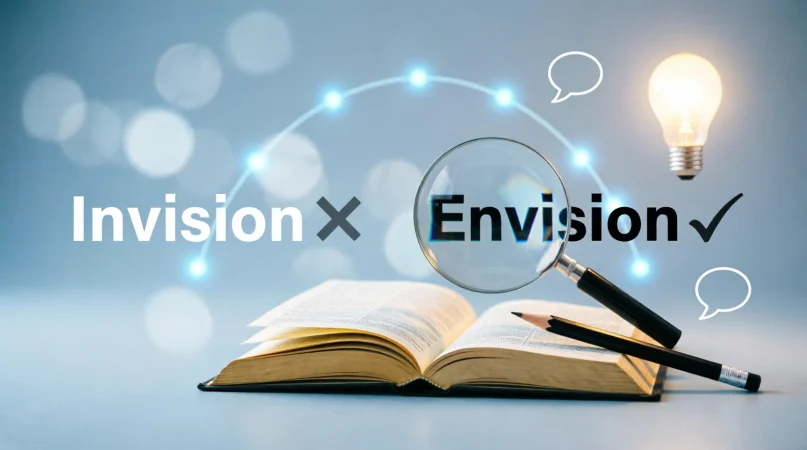
“Envision” means to imagine or visualize something in the future. “Invision” is often used as a brand name, but it is not the standard spelling in general English.
Invision and envision can be confusing because the two words look similar, but only one is recognized as a standard English verb. Envision means to imagine, visualize, or picture something in your mind, especially a future goal, idea, or outcome. It is widely accepted in dictionaries and used in academic, business, and everyday writing. Invision, on the other hand, is generally considered a misspelling of envision unless it refers to a specific brand or proper name, such as the former digital design platform InVision. Knowing the difference helps improve writing accuracy and prevents common spelling mistakes that can affect clarity and professionalism.
Search engines and readers both prefer clear, standardized language that follows grammatical rules. Understanding this difference is important for students and content writers who want to produce high-quality, trustworthy content that ranks well and communicates clearly.
Quick Answer Table
| Feature | Envision | Invision |
| Correct Standard English Word | ✅ Yes | ❌ Usually No |
| Meaning | To imagine or visualize something in the future | Generally considered a misspelling |
| Part of Speech | Verb | Not typically recognized as a standard verb |
| Pronunciation | en-VIZH-un | Often pronounced the same by mistake |
| Common Usage | Writing, business, education, and career planning | Mostly spelling errors or brand names |
| Example Sentence | I envision a successful future. | I invision a successful future. |
Which One Is Correct?
The correct word is envision.
When you want to express the idea of imagining, visualizing, foreseeing, or mentally picturing something, envision is the word you should use.
Correct
- I envision a better future.
- She envisioned herself becoming a doctor.
- The company envisions significant growth next year.
- Many students envision successful careers after graduation.
Incorrect
- I invision a better future.
- She invisioned becoming a doctor.
- We invision long-term growth.
In standard dictionaries and grammar references, envision is recognized as the accepted form.
Meaning of the Correct Word: Envision
Definition
Envision means:
To imagine, picture, foresee, or mentally visualize something that is not currently present.
It involves creating a mental image of a future possibility, goal, outcome, or situation.
Simple Explanation
When you envision something, you see it in your mind before it happens.
You may envision:
- Career success
- Business growth
- A new project
- Educational achievements
- Future technology
- Personal goals
Usage in Everyday English
The word is especially common in:
- Business communication
- Academic writing
- Personal development
- Strategic planning
- Career coaching
- Leadership discussions
Real-World Examples
- The architect envisioned a modern city skyline.
- Teachers envision better learning outcomes for students.
- Entrepreneurs envision innovative products.
- Parents often envision bright futures for their children.
- Healthcare professionals envision improvements in patient care.
For example, someone exploring nurse jobs may envision working in a leading hospital, helping patients, and advancing their healthcare career.
Meaning of the Incorrect or Alternative Word: Invision
Is Invision a Real Word?
In standard English grammar and dictionaries, invision is generally not accepted as a proper word.
Most of the time, it appears because of:
- Spelling confusion
- Typing mistakes
- Mishearing the pronunciation of envision
- Influence from the brand name InVision
The Brand Name Exception
InVision is a proper noun and refers to a digital product design and collaboration platform.
In that context, the spelling is completely correct because it is a company name.
For example:
- The design team used InVision to build prototypes.
However:
- I invision a successful business. ❌
This remains incorrect because the intended word should be envision.
Dictionary Recognition
Major dictionaries recognize:
- Envision ✅
But generally do not recognize:
- Invision ❌
as a standard English verb.
Key Differences Between the Two Words
Side-by-Side Comparison
| Feature | Envision | Invision |
| Standard English | Yes | No |
| Dictionary Entry | Yes | Usually No |
| Meaning | Imagine or visualize | Usually spelling error |
| Formal Writing | Accepted | Not accepted |
| Academic Writing | Accepted | Incorrect |
| Business Writing | Accepted | Incorrect |
| Grammar Status | Correct verb | Nonstandard |
| Search Popularity | High | Mostly typo searches |
Spelling Difference
Only one letter differs:
- Envision
- Invision
However, that single letter changes whether the word is accepted in formal English.
Meaning Difference
Envision has a clear and recognized meaning.
Invision generally has no independent meaning outside branding contexts.
Grammar Difference
Envision functions as a verb.
Examples:
- envision
- envisions
- envisioned
- envisioning
These forms are grammatically correct.
Pronunciation Differences
Interestingly, pronunciation contributes to the confusion.
Envision Pronunciation
/ɪnˈvɪʒən/
Sounds like:
en-VIZH-un
Because the first syllable often sounds similar to “in,” many people mistakenly assume the word starts with the letters in rather than en.
This phonetic similarity explains why the spelling error is so common.
Common Mistakes People Make
1. Writing What They Hear
Many learners spell words based on pronunciation.
Since envision sounds close to invision, they write the wrong version.
Example
Incorrect:
- I invision becoming a nurse.
Correct:
- I envision becoming a nurse.
2. Confusing the Word with the Brand Name
People familiar with InVision software sometimes assume the spelling applies everywhere.
Incorrect:
- We invision future success.
Correct:
- We envision future success.
3. Using It in Professional Documents
The error frequently appears in:
- Resumes
- Cover letters
- LinkedIn profiles
- Business proposals
- Academic papers
Since spelling mistakes can affect credibility, using envision correctly is important.
4. Assuming Both Spellings Are Acceptable
Unlike some English variants such as:
- Color / Colour
- Organize / Organise
The pair invision and envision are not standard alternative spellings.
Only envision is generally accepted.
Correct Usage Examples
Casual Examples
- I envision owning a beach house someday.
- Can you envision living abroad?
- We envision an exciting future.
Professional Examples
- The company envisions expanding into international markets.
- Management envisions long-term growth opportunities.
- Our team envisions a customer-focused strategy.
Educational Examples
- Students should envision their academic goals clearly.
- Teachers envision classrooms that encourage creativity.
- Researchers envision new scientific breakthroughs.
Career Examples
- Many graduates envision rewarding careers in healthcare.
- Candidates applying for nurse jobs often envision making a meaningful difference in patients’ lives.
- Professionals envision leadership opportunities as they gain experience.
Literary and Metaphorical Examples
- She envisioned the horizon as a gateway to possibility.
- The poet envisioned a world free from conflict.
- He envisioned hope blooming like spring flowers.
Common Phrases with Envision
The word frequently appears in common English expressions.
Examples
- Envision the future
- Envision success
- Envision growth
- Envision change
- Envision possibilities
- Envision opportunities
- Envision innovation
- Envision progress
These phrases commonly appear in:
- Corporate communication
- Leadership speeches
- Motivational writing
- Career development content
- Educational resources
Grammar Rules for Using Envision
Present Tense
- I envision success.
- They envision growth.
Past Tense
- She envisioned a brighter future.
- We envisioned new possibilities.
Present Participle
- They are envisioning improvements.
- We are envisioning expansion.
Future Tense
- The company will envision new markets.
- Students will envision future achievements.
Word Origin / Etymology
Understanding a word’s history often makes it easier to remember.
Origin of Envision
The word comes from:
- Prefix: en-
- Root related to vision
The prefix en- means:
To cause to be in or to put into.
The root vision comes from Latin visio, meaning:
Seeing or sight.
Combined, envision developed the meaning:
To see mentally or imagine.
The term became increasingly popular during the nineteenth and twentieth centuries as business, psychology, leadership, and personal-development language evolved.
Why the Incorrect Version Became Popular
Several factors explain why invision appears so frequently online.
Similar Pronunciation
The strongest reason is phonetics.
People hear:
en-VIZH-un
and assume the spelling begins with “in.”
Autocorrect and Typing Habits
Typing quickly can lead to letter substitution errors.
Brand Recognition
The popularity of the software platform InVision introduced the spelling to millions of users.
As a result, some writers began unconsciously applying the same spelling to the verb.
Search Engine Queries
Thousands of users search phrases such as:
- invision or envision
- envision meaning
- is invision a word
- envision definition
- envision vs invision
This demonstrates how widespread the confusion has become.
Envision in Business and Professional Communication
The word appears frequently in workplace settings.
Strategic Planning
- Leaders envision future goals.
- Organizations envision growth opportunities.
Project Management
- Teams envision successful outcomes.
- Managers envision efficient workflows.
Recruitment and Careers
Job seekers often envision ideal career paths.
For example:
- A nursing student may envision working in emergency care.
- Candidates exploring nurse jobs may envision leadership roles in healthcare administration.
- Professionals envision long-term advancement and career development.
Marketing
Marketers use envision to help audiences imagine benefits.
Example:
- Envision a healthier lifestyle.
- Envision your dream home.
- Envision business success.
Envision vs Similar Words
Many English learners also confuse envision with related terms.
Envision vs Imagine
| Envision | Imagine |
| Often future-focused | Can refer to any mental image |
| Common in professional settings | Common in everyday conversation |
| Suggests planning or vision | Broader meaning |
Example
- I envision opening my own clinic.
- I imagine what life would be like there.
Envision vs Visualize
| Envision | Visualize |
| Broader concept | Often focuses on mental imagery |
| Strategic or future-oriented | More picture-based |
Example:
- Leaders envision company growth.
- Athletes visualize winning competitions.
Envision vs Foresee
| Envision | Foresee |
| Imagination-based | Prediction-based |
| Often positive | Can be positive or negative |
Example:
- She envisions success.
- He foresees economic challenges.
Easy Memory Tricks
Trick #1: Think of “Vision”
The word contains:
en + vision
If you’re talking about seeing something mentally, remember the word vision.
Trick #2: Future Vision = Envision
When imagining the future:
- Envision success
- Envision growth
- Envision achievement
Always choose envision.
Trick #3: Remember the Dictionary Version
If you’re unsure, ask:
Would this appear in a professional report?
If yes, use envision.
Featured Snippet Answer
Is it Invision or Envision?
Envision is the correct English word and means to imagine or visualize something, especially in the future. Invision is generally considered a misspelling unless it refers to the brand name InVision.
FAQs
1. Is invision a real word?
Generally, no. In standard English, invision is considered a misspelling of envision. The exception is when referring to the brand name InVision.
2. Which spelling is correct: invision or envision?
Envision is the correct spelling in formal and everyday English.
3. What does envision mean?
Envision means to imagine, foresee, picture, or mentally visualize something, especially a future possibility.
4. Why do people write invision instead of envision?
The mistake occurs because the pronunciation of envision sounds similar to a word beginning with “in.”
5. Is envision a verb?
Yes. Envision is a verb used to describe imagining or mentally picturing something.
6. Can I use invision in academic writing?
No. Academic writing should use envision, not invision.
7. Is envision formal or informal?
It works in both formal and informal contexts but is especially common in professional, educational, and business writing.
8. What is the past tense of envision?
The past tense is envisioned.
Example:
- She envisioned a successful future.
9. How is envision pronounced?
It is pronounced:
/ɪnˈvɪʒən/
or:
en-VIZH-un
10. Can envision be used in career-related writing?
Absolutely. It is commonly used in resumes, career plans, leadership discussions, and professional development content, including discussions about healthcare careers and nurse jobs.
Conclusion
In conclusion, envision is the correct and standard English word used for imagining or planning future ideas, while invision is generally a brand-related term and not accepted in formal grammar. It means to imagine, visualize, or mentally picture a future possibility, goal, or outcome. While invision occasionally appears because of spelling mistakes, pronunciation confusion, or references to the InVision brand, it is not considered the standard English verb.