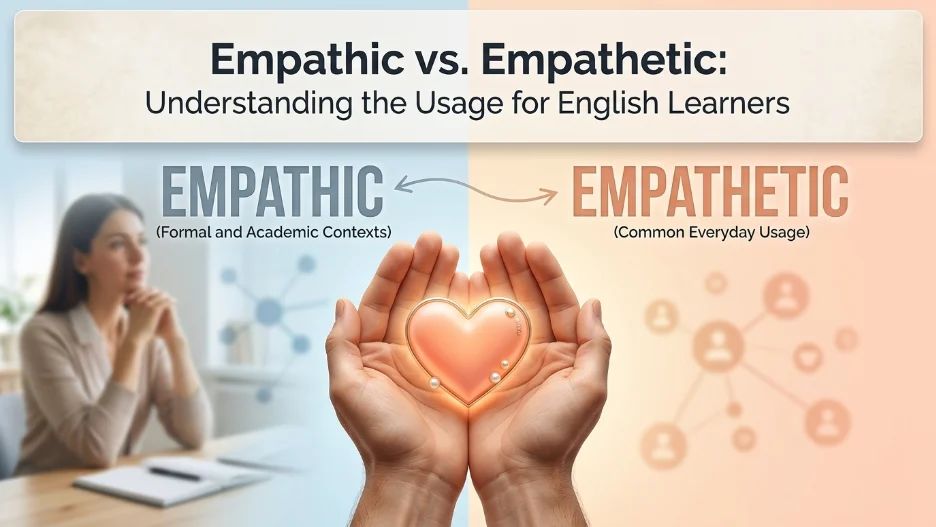
Empathic and empathetic are both correct and mean showing or expressing empathy. However, empathetic is far more common in everyday English, while empathic is used more often in psychology, counseling, and academic writing.Remember: For general writing, empathetic is the preferred choice. Use empathic mainly in technical or professional contexts.
Many English learners and writers wonder whether empathic or empathetic is the correct word to use. The good news is that both are correct and share the same basic meaning: showing, feeling, or expressing empathy toward another person. Because they are so similar, many people use them interchangeably.
Although the meanings overlap, empathetic is much more common in everyday English, business communication, and general writing. Empathic, on the other hand, appears more frequently in psychology, counseling, and academic contexts. This guide explains the subtle differences, usage examples, and when to choose each word.
Quick Answer Table
| Feature | Empathic | Empathetic |
| Correctness | ✅ Correct | ✅ Correct |
| Meaning | Showing empathy—understanding and sharing another’s feelings | Showing empathy—understanding and sharing another’s feelings |
| First Recorded Use | 1909 | 1932 |
| Common Usage | More common in psychology, clinical, and scientific writing | More common in everyday general usage |
| Pronunciation | /em pa thik/ | /ˌem pə the tik/ |
| Example | “Her empathic counseling style helped clients feel truly heard.” | “She gave an empathetic response that made everyone feel understood.” |
Which One Is Correct?
Here’s the good news: both “empathic” and “empathetic” are correct. They are interchangeable adjectives derived from the noun “empathy,” and they share the exact same definition.
According to Oxford Advanced Learner’s Dictionary, empathetic is defined as “able to understand how somebody else feels because you can imagine what it is like to be that person,” with empathic listed as an alternative form . Dictionary.com similarly states that empathetic means “having or tending to have empathy,” noting that “a less common variant of empathetic is empathic” .
So if both are correct, why does this confusion persist? And why do some people strongly prefer one over the other?
The answer lies in their origins, usage patterns, and the contexts where each tends to appear. While they’re technically synonyms, they’ve developed slightly different “personalities” over time.
Meaning of Empathetic
Empathetic is the adjective that most people encounter first. It describes someone who demonstrates empathy—the ability to understand and share the feelings of another person .
When you’re empathetic, you don’t just recognize that someone is sad; you can imagine what that sadness feels like from their perspective. You connect with their emotional experience.
Examples of empathetic in action:
- “The teacher’s empathetic approach helped struggling students feel supported rather than judged.”
- “My doctor was incredibly empathetic when she delivered the difficult news.”
- “Being empathetic doesn’t mean you have to agree with someone—it means you understand where they’re coming from.”
Meaning of Empathic
Empathic means the exact same thing. It describes the capacity for empathy—the ability to understand another person’s feelings or experiences .
However, empathic has a slightly different “flavor.” It’s the older of the two terms and has traditionally been more common in clinical and scientific contexts, particularly in psychology and psychoanalysis .
Examples of empathic in use:
- “The therapist’s empathic attunement created a safe space for healing.”
- “His empathic abilities made him exceptionally good at reading people’s emotional states.”
- “Research shows that empathic concern is linked to prosocial behavior.”
Key Differences Between the Two Words
Though they mean the same thing, empathic and empathetic differ in several ways that affect when and where you might use them.
Spelling and Formation
The most obvious difference is spelling. Empathetic follows the same pattern as “sympathetic”—adding ” etic” to the root word. Empathic is a more direct formation, simply adding ” ic” to “empathy” (dropping the “y”).
Some language experts note that empathetic makes more intuitive grammatical sense because it mirrors the familiar pairing of “sympathy/sympathetic” . After all, we say “sympathetic,” not “sympathic” (though that form did exist historically).
Pronunciation
The pronunciations differ slightly:
- Empathetic: /ˌem pə the tik/ (em puh THET ik)
- Empathic: /em pa thik/ (em PATH ik)
Notice that empathetic has four syllables and places emphasis on the third syllable, while empathic has three syllables with stress on the second syllable .
Usage Contexts
This is where the real difference emerges. While both words are technically interchangeable, they tend to appear in different settings.
Empathetic is far more common in everyday language. It’s what you’ll hear in casual conversation, see in general articles, and find in most business and educational writing . People naturally gravitate toward empathetic because it’s more familiar.
Empathic, on the other hand, appears more frequently in specialized contexts like psychology, psychiatry, and clinical writing. Researchers and mental health professionals often prefer empathic because it has a more precise, clinical feel . Some also use it to distinguish the professional ability to understand clients’ emotions from the more general, everyday quality of being empathetic.
Recognition and Common Usage
If we look at usage patterns, empathetic is the clear winner in general English. In the COCA corpus (Corpus of Contemporary American English), empathetic appears more frequently than empathic .
However, this pattern flips in certain specialized contexts. In Google Books (which includes many academic and scientific texts), empathic has historically been more common, largely due to its prevalence in psychology and psychoanalysis literature .
Common Mistakes People Make
Mistake #1: Thinking One Is Incorrect
Many people believe one form is wrong and the other is correct. This simply isn’t true. Both words are recognized by major dictionaries including Merriam Webster, Oxford, and Dictionary.com .
Mistake #2: Believing They Have Different Meanings
Some people claim empathic means one thing (like “feeling what others feel”) while empathetic means something different (like “understanding what others feel”). This distinction is not supported by dictionary definitions. Both words describe the same capacity for empathy .
Mistake #3: Confusing Empathy with Sympathy
This is a related but separate confusion. Remember:
- Empathy = understanding and sharing someone’s feelings (feeling with them)
- Sympathy = feeling concern or pity for someone (feeling for them)
You can be empathetic without being sympathetic, and vice versa. Empathy involves connecting with the other person’s emotional experience, while sympathy maintains more emotional distance.
Mistake #4: Overusing One Form Exclusively
Some writers stick rigidly to one form, unaware that context might make the other more appropriate. Using empathic in casual conversation can sound overly clinical, while using empathetic in a psychology paper might seem less precise.
Correct Usage Examples
Casual Examples
- “My best friend is so empathetic—she always knows exactly how I’m feeling.”
- “I appreciate having an empathetic partner who listens without judgment.”
- “His empathetic response to my struggles made me feel truly heard.”
Professional Examples
- “Empathetic leadership creates stronger team bonds and higher employee satisfaction.”
- “The customer service representative’s empathetic approach turned a complaint into a positive experience.”
- “Our company values empathetic communication in all client interactions.”
Educational Examples
- “Teachers who are empathetic create more inclusive classroom environments.”
- “Developing empathetic listening skills is essential for effective teaching.”
- “Empathetic education practices help students feel safe and motivated to learn.”
Literary or Metaphorical Examples
- “The novel’s empathetic narrator draws readers into the protagonist’s emotional journey.”
- Art has the power to create an empathetic bridge between diverse human experiences.”
- “In a divided world, empathetic storytelling reminds us of our shared humanity.”
Word Origin / Etymology
Both empathic and empathetic trace their roots to the noun empathy, which was coined in the early 20th century.
The term empathy was first used in English in 1909 as a translation of the German word Einfühlung (meaning “feeling into”). The German philosopher Rudolf Lotze had originally introduced the concept in 1858, drawing from the ancient Greek word empatheia, which means “passion” or “physical affection” .
The adjective empathic appeared around 1909, shortly after the noun itself entered the language. Empathetic followed later, first recorded in 1932 .
The later emergence of empathetic is significant—it was likely formed by analogy with sympathetic. Since sympathy and sympathetic were already established in English, people naturally created empathetic to mirror that familiar pattern .
Why the Incorrect Version Became Popular
Neither version is incorrect, but empathetic became the more popular choice for several reasons.
Analogy with “sympathetic”: Humans love patterns, and language is no exception. Since sympathy gives us sympathetic, it feels natural that empathy should give us empathetic. This is the most compelling reason for the rise of empathetic .
Comfort and familiarity: People tend to use words that sound familiar. Empathetic follows a recognizable word formation pattern in English, making it feel more intuitive to many speakers.
General vs. specialized use: As discussed, empathic was heavily used in psychology and academic circles. Meanwhile, the general public gravitated toward empathetic as the word entered everyday vocabulary. This created a division that persists today .
The “sympathic” analogy: Interestingly, sympathic did exist historically, but it lost out to sympathetic in the 17th century (except in technical medical use). The same pattern is happening with empathic vs. empathetic in general usage .
Easy Memory Tricks
Need a quick way to remember the difference? Try these tricks:
Trick 1: The “Sympathetic” Connection
Since we say sympathetic (not “sympathic”), remember that empathetic follows the same pattern. If you’d use sympathetic in a sentence, you can safely use empathetic.
Trick 2: Length Matters
Empathetic has four syllables; empathic has three. If you’re writing for a general audience, the longer form (empathetic) is often more familiar. If you’re in a clinical or academic setting, the shorter form (empathic) may feel more appropriate.
Trick 3: Context Cues
Think of empathic as “clinical” and empathetic as “everyday.” This isn’t a strict rule, but it can help you choose based on your audience and purpose.
FAQs
What is the difference between empathic and empathetic?
There is no difference in meaning between empathic and empathetic. They are synonyms that both mean “showing empathy” or “having the ability to understand another person’s feelings.” The primary difference is usage—empathic is more common in clinical and academic contexts, while empathetic is preferred in everyday writing.
Which is correct, empathic or empathetic?
Both are correct. Dictionaries recognize both words as valid English adjectives. Empathetic is more commonly used in general contexts, while empathic appears more frequently in psychology and scientific writing.
Is empathic a word?
Yes, empathic is absolutely a word. It has been in use since 1909 and appears in all major English dictionaries, including Oxford and Merriam Webster .
Why do people say empathetic instead of empathic?
People say empathetic because it follows the same pattern as sympathetic—a familiar and intuitive formation. It also sounds more natural to many English speakers and has become the more common choice in everyday language .
What does it mean to be an empathic person?
An empathic person is someone who can understand and share the feelings of others. They can imagine themselves in someone else’s situation and connect emotionally with that person’s experience. This ability is central to emotional intelligence and healthy relationships.
Can you use empathic and empathetic interchangeably?
Yes, you can use these words interchangeably in most contexts. However, be mindful of your audience. Empathetic works well in general writing, while empathic may feel more appropriate in clinical, academic, or scientific contexts.
Is empathetic or empathic more common?
Empathetic is more common in general English usage. In the Corpus of Contemporary American English (COCA), empathetic appears more frequently than empathic . However, in specialized contexts like psychology literature, empathic remains widely used.
What is the difference between empathic and sympathetic?
Empathic (or empathetic) means understanding and sharing another person’s feelings—feeling with them. Sympathetic means acknowledging someone’s feelings and feeling concern or pity—feeling for them from a distance . Empathy involves connection; sympathy involves acknowledgment.
Conclusion
In conclusion, empathic and empathetic are both correct words that describe the ability to understand and share another person’s feelings. While their meanings are nearly identical, empathetic is the more common choice in everyday English, whereas empathic is used more often in psychology and academic writing.
If you’re unsure which word to use, empathetic is usually the safest option for general communication. Understanding this small distinction will help you write more naturally and choose the most appropriate word for your audience.