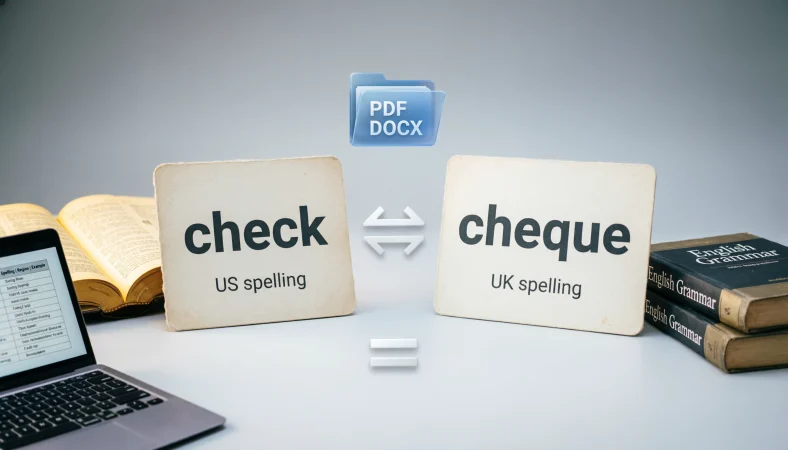
Quick Ans: Check and Cheque have the same meaning when referring to a bank payment document. Check is the American English spelling, while Cheque is the British English spelling.
Check can also mean to examine, verify, or stop something, but cheque only refers to a bank payment
The confusion makes perfect sense. Both words sound identical when spoken. Both relate to financial transactions or verification processes in some way. And both appear frequently in formal and informal writing across English-speaking countries.
But here is the truth: one spelling dominates in certain regions while the other reigns supreme elsewhere. Getting it wrong can make your writing look careless, unprofessional, or simply out of place depending on your audience.
By the end of this guide, you will never second-guess yourself again. You will learn exactly which spelling to use, when to use it, and why the difference exists in the first place. Let us clear up this confusion once and for all.
Quick Answer Table
| Feature | check | cheque |
| Correct Spelling | check | cheque |
| Primary Meaning | To examine, verify, or inspect; also a financial instrument in US English | A written order to a bank to pay money from an account |
| Primary Usage Region | United States, Canada (for verb usage), Philippines | United Kingdom, Australia, New Zealand, Ireland, South Africa, India, Canada (for financial noun) |
| Part of Speech | Verb and noun | Noun only |
| Example Sentence | Please check your work before submitting it. | I wrote a cheque to cover the rent payment. |
| Financial Context | Common in US: “I paid with a check” | Standard outside US: “I paid with a cheque” |
| Non-Financial Context | Always “check” (check the box, check the weather, safety check) | Never used |
Which One Is Correct?
The honest answer? Both check or cheque can be correct depending entirely on where you are writing and for whom.
Here is the rule that will save you every time:
Use check when you are writing in American English or when you are using the word as a verb meaning to examine or verify.
Use cheque when you are writing in British, Australian, New Zealand, or South African English and you mean the financial document that orders a bank to pay money.
Let me make this crystal clear with a simple breakdown.
In the United States and the Philippines, check serves double duty. It handles both the verb meaning to inspect and the noun meaning a bank draft. Americans write checks to pay bills. They also check their email, check the temperature, and check off items on a to-do list.
In the United Kingdom, Australia, New Zealand, Ireland, South Africa, India, and most other English-speaking nations, cheque specifically refers to the financial instrument. The verb form remains check across all varieties of English without exception.
No native English speaker anywhere writes “cheque” as a verb. You never “cheque your answers” or “cheque the expiration date.” That would be wildly incorrect.
Meaning of the Correct Word
The Meaning of Check
As a verb, check means to examine, verify, inspect, or confirm the accuracy or condition of something. It can also mean to stop or restrain something, as in “check your speed” or “check your temper.”
As a noun in American English, check also means a written order directing a bank to pay a specific amount of money from your account to the person or organization named on the document.
Here are real-world examples of check in action:
Verb usage:
- Please check the expiration date on that milk carton before drinking it.
- I need to check my flight status before leaving for the airport.
- The mechanic checked the brakes and confirmed they needed replacement.
- Could you check if the front door is locked?
Noun usage (American financial context):
- She handed the landlord a check for twelve hundred dollars.
- I deposited the check into my savings account this morning.
- The company issues paychecks every other Friday.
Noun usage (non-financial contexts universally):
- The chess player put his opponent in check.
- The luggage underwent a security check before boarding.
- We ran a background check on the new employee.
The Meaning of Cheque
Cheque is exclusively a noun. It has no verb form. It refers specifically to a printed document that you fill out, sign, and give to someone as a form of payment. The cheque instructs your bank to transfer the specified amount from your account to whoever presents the cheque for payment.
Examples of cheque in authentic use:
- The restaurant does not accept cheques, only credit cards or cash.
- I wrote a cheque for the full amount of the invoice.
- Would you prefer payment by cheque or bank transfer?
- The charity gratefully received a generous cheque from an anonymous donor.
- My grandmother still pays all her bills by cheque every month.
Notice that cheque appears exclusively in financial contexts. You will never see it used for verification, inspection, chess moves, restaurant bills, or any other non-banking situation.
Meaning of the Alternative or Less Common Spelling
Neither check nor cheque is truly incorrect or a typo. Both are legitimate spellings recognized by dictionaries worldwide. However, each belongs to a specific regional dialect.
The word check is the older spelling historically. When the financial instrument emerged in the 1700s, English speakers initially used “check” for everything. The French-influenced spelling cheque appeared later in British English as a way to distinguish the financial meaning from the word’s many other definitions.
Today, using check in British English to mean a bank draft will mark you as using American spelling. Some British readers might find it slightly jarring but perfectly understandable. Using cheque in American English to mean a bank draft will confuse American readers or make you look like you are trying too hard to sound British.
The true “incorrect” usage would be writing cheque as a verb or writing check in British English when referring to the financial document while claiming to follow British conventions.
Key Differences Between Check and Cheque
Let us break down every distinction between these two spellings so you never mix them up again.
Spelling Difference
The most obvious difference is the final four letters. “Check” ends with C-K. “Cheque” ends with Q-U-E. The Q-U-E spelling reflects the word’s French origins, while the C-K spelling follows standard English phonetic patterns.
Meaning Difference
“Check” has dozens of meanings including to inspect, to verify, to restrain, a restaurant bill, a pattern of squares, a chess move, and in American English, a bank draft. “Cheque” has exactly one meaning: a written bank order for payment.
Pronunciation Difference
Here is the tricky part. Both words sound absolutely identical when spoken aloud. They are perfect homophones. Native speakers pronounce “check” and “cheque” the same way every time. You cannot hear the difference. You can only see it in writing.
Grammar Difference
“Check” functions as both a verb and a noun. You can check something (verb), or you can write a check (noun). “Cheque” is only a noun. You cannot cheque anything. There is no verb form of cheque in any standard variety of English.
Usage by Region
American English and Canadian English use “check” for the financial instrument. British English, Australian English, New Zealand English, Irish English, South African English, Indian English, and most other Commonwealth varieties use “cheque” for the financial instrument.
Every English dialect everywhere uses “check” for the verb meaning to inspect or verify.
Recognition and Formality
Both spellings are recognized in major dictionaries from Oxford, Cambridge, Merriam-Webster, Collins, and Macmillan. Neither is more formal or informal than the other. The choice simply signals which English dialect you are using.
Common Mistakes People Make
Even experienced writers mess up the distinction between check or cheque. Here are the most frequent errors to watch out for.
Mistake 1: Using Cheque as a Verb
This is probably the most common and most noticeable error. You will sometimes see someone write “Please cheque your answers before submitting” or “I need to cheque the oven temperature.” This is always wrong in every variety of English. The verb is always, without exception, “check.”
Mistake 2: Using Check in British Financial Contexts
If you are writing for a British, Australian, or New Zealand audience and you refer to a “check” as a bank draft, your readers will notice. It will not cause confusion about meaning, but it will mark your writing as Americanized. For formal business writing in Commonwealth countries, use “cheque” for the financial document.
Mistake 3: Using Cheque in American Financial Contexts
Conversely, if you are writing for an American audience and you use “cheque,” your readers might think you are being pretentious or that you made a typo. American English has fully embraced “check” for all meanings.
Mistake 4: Inconsistent Usage Within a Single Document
If you start a paragraph using “cheque” and later switch to “check” when referring to the same financial instrument, your writing will look sloppy. Pick one spelling based on your target audience and stick with it consistently throughout the entire document.
Mistake 5: Using Check or Cheque When the Financial Instrument No Longer Exists
This is more of a modern awareness issue than a grammar error. Many younger English speakers have never written a physical check or cheque in their lives. Digital payments, bank transfers, and mobile apps have largely replaced paper financial instruments. However, the words still appear in legal contexts, formal agreements, and when discussing historical transactions.
Correct Usage Examples
Casual Examples
- Can you check if we have any milk left?
- I wrote a check for the contractor who fixed our sink. (US)
- I wrote a cheque for the plumber who fixed our leak. (UK)
- Let me double-check those dates before we book anything.
- Mom sent a check in the mail for my birthday. (US)
- Grandad still pays his newspaper delivery by cheque every month. (UK)
Professional Examples
- Please check the quarterly financial report for any discrepancies before the meeting.
- The accounting department requires all checks to be signed by two authorized signatories. (US)
- The finance team processes cheques within three to five business days of receipt. (UK)
- We will perform a background check on all final candidates.
- The vendor requested payment by certified check rather than personal check. (US)
- All cheques must be made payable to the company’s registered legal name. (UK)
Educational Examples
- Students should check their answers against the answer key provided at the back of the book.
- The textbook explains that a check is a negotiable instrument drawn on a bank account. (US)
- The lesson covers how to write a cheque safely and how to avoid cheque fraud. (UK)
- Before submitting your essay, check for common grammatical errors like subject-verb agreement issues.
- The professor reminded everyone to check the syllabus for the revised office hours.
Literary and Metaphorical Examples
- The general ordered his troops to check their advance at the riverbank.
- She had to check her temper before responding to the rude comment.
- The novel describes how the protagonist wrote a cheque that his reputation could not cash. (US)
- His promise was like a blank cheque written against an empty account.
- The new regulations act as a check on corporate power and excess.
Word Origin and Etymology
The history of check or cheque is surprisingly fascinating. The word traces back through French and Arabic to a Persian root meaning “king” or “royal.
The journey begins with the Persian word “shah” meaning king. From there, the Arabic language adapted it into “sakk” meaning a written document or legal deed. Arabic “sakk” entered medieval Italian as “banca” (related to bank) and also influenced Old French “eschequier” meaning a chessboard or counting table.
In medieval England, the Exchequer was the government department responsible for collecting royal revenues. The name came from the checkered cloth covering the counting tables, which resembled a chessboard. The word “check” became associated with financial accounting and verification.
By the 1600s, “check” meant a counter-register or a way to verify accounts. When paper financial instruments became common in the 1700s, English speakers called them “checks” because they functioned as a check against the account balance.
The variant spelling “cheque” appeared in the early 1700s, influenced by the French “chèque.” British English gradually adopted this spelling for the financial meaning only, keeping “check” for all other definitions. American English rejected the French-influenced spelling and kept “check” for everything.
Why the Incorrect Version Became Popular
Neither version is truly incorrect, but the confusion between check or cheque persists for several interesting reasons.
Global media plays a huge role. American movies, television shows, books, and websites use “check” exclusively. International audiences absorb American spelling conventions even when their own countries officially follow British conventions.
Spellcheck software and autocorrect features also cause confusion. A device set to American English will flag “cheque” as an error and suggest “check.” A device set to British English will do the opposite. Writers who switch between devices or collaborate internationally often end up with mixed usage.
The decline of physical checks and cheques has made the distinction less relevant for younger generations. Many people under thirty have never written either one. They see the word primarily in digital contexts where the regional spelling difference seems arbitrary and unimportant.
Additionally, the rise of international business English has created a hybrid environment. Many global companies adopt American spelling conventions regardless of their physical location because American English dominates international commerce and online communication.
Easy Memory Tricks
You will never confuse check or cheque again after using these simple memory tools.
Trick 1: The Q Connection
The word “cheque” contains the letter Q. Think of “Q” for “Queen” or “Queensland” or any British-Commonwealth association. Cheque with a Q is the British spelling for the financial document. Check without a Q is the American and universal verb spelling.
Trick 2: Examine the C
The word “check” contains C-H-E-C-K. The first five letters spell “chec” which sounds like “check.” The word “cheque” contains C-H-E-Q-U-E. That extra Q-U-E makes it look more French and more fancy. British English borrowed the fancy French spelling for the fancy banking document.
Trick 3: Verb or Noun?
Ask yourself one simple question: Am I describing an action (something I do) or a thing (something I hold)? If you are describing an action like inspecting or verifying, you must use “check.” The verb is always “check” in every country. If you are describing the paper thing you give to a bank, then your spelling depends on your region.
Trick 4: The Bank Test
Imagine handing a paper to a bank teller. Are you in New York? Then you are handing over a check. Are you in London, Sydney, or Toronto? Then you are handing over a cheque. Visualize the location and the spelling follows naturally.
Trick 5: Remember the Double Duty
American English uses “check” for everything. That is double duty. British English splits the duties: “cheque” for the bank paper, “check” for everything else. If you want to keep it simple, just use American English spelling and write “check” for all meanings. No one will misunderstand you, even in London.
FAQs:
1. Is cheque correct in the US?
No. Check is the correct American spelling for a bank payment.
2. Can I use check and cheque together?
It is better to choose one spelling style and stay consistent.
3. Which countries use cheque?
The UK, Australia, New Zealand, India, and many Commonwealth countries use cheque.
4. Do Canadians use check or cheque?
Canada commonly uses cheque for banking, but both spellings appear.
5. Is cheque the British spelling of check?
Yes, cheque is the British spelling for the payment document.
6. Why do Americans write check instead of cheque?
American English simplified many spellings, including check.
7. What is the plural of cheque?
The plural is cheques. The American plural is checks.
8. Are cheques still used today?
Yes, but digital payments have made them less common.
9. How do you pronounce cheque?
Cheque and check are pronounced exactly the same.
10. Is there a meaning difference between check and cheque?
No. They mean the same thing when referring to bank payments
Conclusion:
The difference between check and cheque mainly depends on region and usage. Check is used in American English for both the verb and the financial document, while cheque is the British spelling for the payment document only. Remember to keep your spelling consistent, never use cheque as a verb, and choose the style that best matches your audience for clear and professional communication