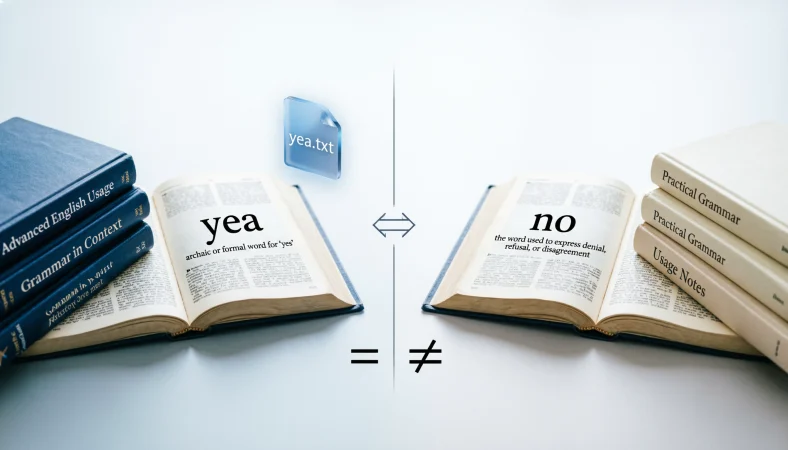
Yea and No are simple words used to express agreement or disagreement. While yea means yes or approval, no shows refusal, denial, or disagreement.
Have you ever seen the word “yea” and wondered whether it means the same thing as “yes” or “no”? Many English learners and even native speakers confuse these terms because yea appears rarely in modern conversation, while no is one of the most commonly used words in the language. Despite their simplicity, using the wrong word can completely change the meaning of a sentence.
Understanding the difference between yea and no is essential for clear communication. Based on standard dictionary definitions, historical usage, and modern English conventions, this guide explains when each word should be used, what they mean, and how they differ in everyday and formal contexts. By the end, you’ll be able to choose the correct term with confidence and avoid a common language mistake.
Quick Answer: Yea or No — Which Spelling Is Correct
Before we dive deep into explanations, here is a straightforward answer to the most pressing question.
| Category | Details |
| Correct spelling for casual agreement | Yeah |
| Incorrect spelling for this context | Yea (when used to mean casual yes) |
| Actual meaning of “yea” | Formal affirmative vote or archaic yes |
| Correct negative pairing | Yeah or no / Yes or no / Yea or nay |
| Pronunciation of “yeah” | Rhymes with “bear” or “hair” |
| Pronunciation of “yea” | Rhymes with “say” or “day” |
| Best for professional writing | Yes or no |
| Best for casual texting | Yeah or no |
The short answer is that “yea or no” is technically incorrect when you intend to express casual agreement. The proper informal spelling is “yeah or no.” The word “yea” has a completely separate meaning related to formal voting procedures, and it pairs with “nay,” not “no.”
However, the full story contains fascinating nuances. Regional variations, historical usage, and the natural evolution of language all play important roles in why this confusion exists. Understanding the complete picture will transform you from someone who guesses into someone who knows.
Which One Is Correct: Yea or Yeah
When asking someone a simple yes or no question in casual writing, the correct spelling is “yeah.” This applies to text messages, social media posts, informal emails, and everyday written conversations. The word “yea” belongs to a completely different context, one that most modern English speakers rarely encounter outside of formal meetings, legislative proceedings, or historical documents.
Think of it this way. If you are asking a friend whether they want pizza for dinner, you write “yeah or no.” If you are recording votes in a board meeting, you might note “yea or nay.” These two scenarios share almost no overlap in modern English usage.
The confusion persists because “yea” and “yeah” look nearly identical on screen. That missing letter “h” makes all the difference between proper spelling and an embarrassing mistake. Spell-checkers sometimes miss this error because “yea” is a legitimate word, just not the one you intend.
Meaning of the Correct Word: Yeah
The word “yeah” functions as an informal affirmative response in English. It serves as the casual equivalent of “yes” and appears primarily in spoken conversation and informal writing. Understanding its proper usage requires examining its definition, pronunciation, and contextual appropriateness.
Definition and Core Meaning
“Yeah” expresses agreement, confirmation, or positive acknowledgment. When someone asks a question requiring a yes or no answer, responding with “yeah” communicates the same fundamental message as responding with “yes.” The difference lies entirely in tone, register, and formality.
“Yeah” signals casual comfort between speakers. It suggests a relaxed relationship, an informal setting, or a desire to avoid sounding stiff or overly formal. In many social contexts, answering “yes” instead of “yeah” can actually sound unnatural, distant, or cold.
Pronunciation Guide
“Yeah” is pronounced with a single syllable that rhymes with words like “bear,” “hair,” “care,” and “there.” The vowel sound is the “eh” sound as in “bed” or “head,” followed by a soft “r” coloring in rhotic accents. In non-rhotic accents like many British English varieties, the “r” remains silent unless followed by a vowel sound.
The International Phonetic Alphabet represents “yeah” as /jɛə/ or /jɛ/. Regional variations exist across English-speaking countries, but the core pronunciation remains consistent enough that native speakers rarely misunderstand the word.
Appropriate Contexts for “Yeah”
“Yeah” belongs in informal and semi-formal communication channels. Text messages between friends, casual workplace chats, social media comments, and everyday spoken dialogue all welcome this relaxed affirmative. Fiction writers use “yeah” extensively in dialogue to create authentic character voices and natural conversational flow.
Academic papers, legal documents, formal business proposals, and professional correspondence with unfamiliar recipients should avoid “yeah.” These formal contexts demand “yes” to maintain appropriate professional distance and demonstrate proper writing standards.
Examples in Real-World Communication
Friends coordinating weekend plans use “yeah” constantly. “Yeah, Saturday works for me.” “Yeah, I saw that movie last week.” “Yeah, let us meet at the usual spot.” Each instance communicates agreement while maintaining the relaxed tone of friendship.
Customer service chat representatives sometimes use “yeah” to create friendly rapport with customers, though company policies vary on this practice. The key lies in reading the room and matching the communication style of the person you are addressing.
Meaning of the Incorrect or Alternative Word: Yea
The word “yea” carries a legitimate meaning in English, but that meaning differs dramatically from what most people intend when they type “yea or no.” Understanding this distinction clarifies why the error persists and how to avoid it.
The True Definition of Yea
“Yea” functions as a formal affirmative vote or declaration. Legislative bodies, corporate boards, and formal committees use “yea” when members cast votes in favor of a motion or proposal. The word pairs exclusively with “nay,” which represents a negative vote. Together, “yea” and “nay” form the traditional language of formal democratic proceedings.
Outside voting contexts, “yea” also appears in archaic or biblical language as an emphatic form of “yes” or “truly.” The King James Bible uses “yea” extensively in passages like “Yea, though I walk through the valley of the shadow of death.” This usage sounds distinctly old-fashioned to modern ears and would feel out of place in contemporary conversation.
Why People Confuse Yea and Yeah
The confusion stems from several overlapping factors. First, the visual similarity between “yea” and “yeah” makes the error easy to overlook. One missing letter transforms the meaning entirely, yet the words look nearly identical at a glance.
Second, pronunciation habits vary by region. Some English speakers pronounce “yeah” so quickly or casually that the ending consonant sound nearly disappears. This elision in speech creates uncertainty about how to represent the sound in writing.
Third, autocorrect and predictive text features on smartphones sometimes suggest “yea” when users begin typing “yeah.” If someone accepts the suggestion without checking carefully, the error propagates through their messages and eventually becomes habitual.
Regional and Dialectal Variations
Certain English dialects blur the distinction between “yea” and “yeah” more than others. In some Scottish and Northern English varieties, “yea” functions as a common spelling for the casual affirmative, representing genuine regional orthographic tradition rather than error. Similarly, some Irish English speakers use “yea” in informal writing as a dialectal preference.
These regional exceptions do not change the standard rule for global English communication. When writing for an international audience or in professional contexts, “yeah” remains the correct casual affirmative spelling. Awareness of regional variation simply helps explain why the “yea” spelling appears in certain contexts.
Key Differences Between Yea and Yeah
Understanding the distinctions between these words requires examining multiple dimensions of language. Spelling differences represent only the surface layer of a deeper linguistic divide.
Spelling Distinction
The most obvious difference lies in that single letter “h.” “Yea” contains three letters, while “yeah” contains four. This minimal orthographic difference creates maximum confusion because both spellings represent legitimate English words with separate meanings.
Semantic Divergence
“Yea” means formal affirmative vote or archaic emphatic yes. “Yeah” means casual modern yes. These definitions share a common ancestor but have evolved along completely separate paths in contemporary English. Using “yea” to mean casual agreement misapplies a formal term to an informal context, creating semantic dissonance for readers who know the distinction.
Pronunciation Patterns
“Yea” rhymes with “say,” “day,” “pay,” and “may.” The vowel sound is a long “a” as in “late” or “gate.” “Yeah” rhymes with “bear,” “hair,” “care,” and “there.” The vowel sound is a short “e” followed by an “r” coloring. This pronunciation difference helps speakers distinguish the words in formal settings but provides little help in casual speech where sounds blend together.
Grammatical Function
Both words function as interjections or response particles in English grammar. However, “yea” carries formal grammatical weight in parliamentary procedure, where it operates as a countable noun. Meeting minutes might record “15 yeas and 10 nays,” using the words as countable voting units. “Yeah” never functions this way in standard English.
Register and Formality
“Yea” belongs to formal, archaic, or procedural registers. “Yeah” belongs to informal, casual, and conversational registers. This register difference means the words rarely compete for the same usage context. Native speakers intuitively select “yea” for formal voting and “yeah” for casual agreement, though the spelling confusion betrays this intuition in writing.
Dictionary Recognition
Major dictionaries list both words with distinct entries and definitions. Merriam-Webster, Oxford, Cambridge, and Collins all recognize “yea” as a formal voting term and “yeah” as a casual affirmative. No standard dictionary accepts “yea” as the preferred spelling for casual agreement in modern English.
Common Mistakes People Make
The “yea or no” error represents just one manifestation of a broader pattern of confusion surrounding these similar-looking words. Understanding the full landscape of common mistakes helps writers avoid multiple pitfalls simultaneously.
The Yea and Yay Confusion
Many people conflate “yea” with “yay,” creating yet another layer of spelling chaos. “Yay” expresses excitement, celebration, or enthusiasm. Someone might exclaim “Yay!” when receiving good news or achieving a goal. This word has nothing to do with voting or casual agreement, yet the similar spelling leads to frequent mix-ups.
Writing “yea” when you mean “yay” transforms a celebratory exclamation into a formal vote. “Yea! We won the game!” reads as comically formal to anyone who knows the distinction. The correct spelling is “yay.”
The Yea and Nay Pairing Problem
When constructing the negative counterpart to “yea,” many writers instinctively reach for “no” rather than “nay.” This instinct creates the hybrid phrase “yea or no,” which mixes formal and informal registers awkwardly. The proper formal pairing is “yea or nay.” The proper informal pairing is “yeah or no.” Mixing these pairs signals uncertainty about both terms.
Autocorrect Sabotage
Smartphone keyboards and text prediction algorithms frequently contribute to the “yea or no” problem. When users type “yea” intending to write “yeah,” autocorrect systems often accept “yea” as valid because it exists in the dictionary. The software cannot detect that the user intends the informal meaning rather than the formal voting term. This technological blind spot reinforces the error across millions of messages daily.
Professional Communication Blunders
Job seekers sometimes use “yea” in cover letters or professional correspondence when they mean “yeah” or, better yet, “yes.” A sentence like “Yea, I have five years of experience in nurse jobs” contains two problems. First, “yea” is misspelled for this context. Second, “yea” or “yeah” is too informal for a job application regardless. The proper word choice for professional communication remains “yes.”
Correct Usage Examples
Seeing the correct word in action across different contexts builds intuitive understanding. These examples demonstrate proper usage patterns for “yeah,” “yea,” and related terms.
Casual Social Examples
“Yeah, I would love to grab dinner tonight.” This represents the standard casual affirmative in modern English texting and conversation.
“Are you coming to the party?” “Yeah, definitely.” The response communicates enthusiastic agreement in an informal register.
“Yeah, I heard about that. shocking story.” Here “yeah” functions as a conversation opener that acknowledges shared knowledge.
Professional Examples
“The board recorded 12 years and 3 days on the proposed merger.” This demonstrates the proper formal voting context for “yea.”
“All in favor, say yea. All opposed, say nay.” The chairperson uses the formal voting terms in parliamentary procedure.
“The committee voted yea on the resolution to increase funding for nurse jobs in rural communities.” Formal minutes document the voting outcome correctly.
Educational Examples
English teachers explain the distinction this way. “Remember, ‘yeah’ has an ‘h’ because it is the casual ‘yes’ you use with friends. ‘Yea’ drops the ‘h’ and becomes formal, like something you would hear in Congress.”
ESL instructors often create minimal pair exercises. “Yeah sounds like bear. Yea sounds like bay. Yeah for friends. Yea for formal votes. Yay for celebrations.”
Literary and Creative Examples
Fiction writers use “yeah” extensively in dialogue. “Yeah, I know,” she said, staring at the floor. The word choice reveals character voice and emotional state without requiring additional description.
Poets and songwriters sometimes employ “yea” for archaic effect. “Yea, I shall return to thee” evokes medieval or biblical language that creates a specific atmosphere of timelessness or solemnity.
Word Origin and Etymology
The intertwined histories of “yea,” “yeah,” and “yes” reveal how English affirmation words evolved from common Germanic roots. Understanding this etymology provides deeper insight into why the modern confusion exists.
Ancient Germanic Roots
All three words trace back to the Proto-Germanic particle “ja” or “jai,” which expressed affirmation or agreement. This ancient root word appears across Germanic languages. German “ja”, ” Dutch”ja,” Swedish “ja,” and Danish “ja” all derive from the same source. Old English inherited this particle as “gea,” pronounced with an initial “y” sound.
The Evolution of Yea
Old English “gea” evolved into Middle English “ye” or “yea,” serving as the standard affirmative response. The word carried no casual connotation at this stage. It was simply how English speakers said yes. Formal and informal registers had not yet developed distinct affirmative terms.
As English absorbed French influence after the Norman Conquest, “yes” emerged as an emphatic form combining “yea” with “si,” meaning “so be it.” This new word gradually claimed the standard affirmative role while “yea” retreated into formal and archaic usage.
The Birth of Yeah
“Yeah” appeared relatively recently in English history. The earliest written records date to the early 20th century, though spoken usage likely predates written evidence. Linguists classify “yeah” as a casual variant of “yes” that developed through natural speech patterns. The addition of the “h” reflects the breathier, more relaxed pronunciation characteristic of informal speech.
Parliamentary Persistence
“Yea” survived in parliamentary procedure because formal institutions resist linguistic change. Legislative bodies worldwide continue using “yea” and “nay” for voice votes, maintaining a direct connection to centuries of democratic tradition. This institutional conservatism preserved “yea” in active usage long after it disappeared from everyday conversation.
Why the Incorrect Version Became Popular
The prevalence of “yea or no” in informal writing did not happen randomly. Several cultural and technological factors converged to spread this spelling variant across English-speaking communities.
Phonetic Spelling Tendencies
English speakers often attempt to spell words based on how they sound. When someone pronounces “yeah” quickly in casual speech, the final breath sound can become nearly inaudible. This reduced pronunciation leads natural spellers to write “yea” because they do not perceive the “h” as a distinct phoneme worth representing orthographically.
Character Limit Pressures
The rise of social media platforms with character limits encouraged abbreviated spellings. Twitter’s original 140-character limit rewarded users who dropped letters wherever possible. Writing “yea” instead of “yeah” saved one precious character. Similarly, text messaging in the early 2000s, when many plans charged per message, incentivized brevity above accuracy.
Internet Culture and Meme Influence
Online communities develop their own spelling conventions that sometimes diverge from standard English. “Yea or no” gained traction in certain internet subcultures where the abbreviated spelling became a marker of in-group identity. New users adopted the spelling to fit in, perpetuating the nonstandard form.
Lack of Explicit Education
Most English education focuses on formal writing standards. Teachers correct “ain’t” but rarely address the spelling of casual affirmatives because these words appear primarily in informal contexts. Students may complete their entire education without anyone explicitly teaching the difference between “yea,” “yeah,” and “yay.”
Easy Memory Tricks
Developing reliable mental shortcuts prevents future mistakes. These memory techniques target different learning styles so everyone can find a method that works.
The H for Happiness Trick
Associate the “h” in “yeah” with happiness, helpfulness, and hanging out with friends. Casual affirmatives deserve the extra letter because casual relationships involve extra warmth. The “h” represents the breath of relaxed conversation, the exhale of comfortable agreement.
The Voting Visual
Picture a formal voting chamber whenever you consider using “yea.” Imagine senators in suits, raised hands, solemn expressions, and official record books. If your mental image looks nothing like a congressional hearing, you probably want “yeah” instead. The formality of the visual guides word selection.
The Rhyme Recognition Method
Create a mental rhyme dictionary. “Yea” rhymes with “say” and “day.” People say “yea” on voting day. “Yeah” rhymes with “bear” and “hair.” You say “yeah” when you do not care about being formal like a bear does not care about manners. Silly associations stick in memory better than dry rules.
The Nay Connection
Remember that “yea” always pairs with “nay,” never with “no.” If you find yourself writing “yea or no,” pause and recognize the mismatch. Either commit to the formal “yea or nay” or switch to the informal “yeah or no.” The pairing consistency reveals the appropriate word choice.
The Celebration Signal
“Yay” contains the letter “y” twice, creating a visual pattern that suggests arms raised in celebration. When expressing excitement, use the double-y spelling. When voting formally, use the single-y “yea.” When agreeing casually, use “yeah” with its distinctive “h.”
FAQs:
1. Is “yea or no” grammatically correct?
Usually no. For casual questions, use “yeah or no” or “yes or no.” Yea is mainly used with nay in formal voting.
2. What is the difference between yea, yeah, and yay?
Yea = formal yes/vote, yeah = casual yes, yay = happiness or excitement.
3. How do you pronounce yea and yeah?
Yea sounds like say, while yeah sounds like care.
4. Can I use “yea” in a text message?
You can, but many people may see it as a spelling mistake for yeah.
5. Why do people write “yea” instead of “yeah”?
Because the words sound similar, and some people spell based on pronunciation.
6. Is “yea” ever correct today?
Yes. It is correct in formal voting, meetings, and official records.
7. What should I use in professional writing?
Use yes in job applications, emails, and formal communication.
8. How can I remember the difference?
Yea pairs with nay, while yeah is the casual form of yes.
9. Does using “yea” incorrectly affect writing?
In formal writing, it can look like a spelling or usage mistake.
10. Where did “yeah” come from?
Yeah developed as a casual spoken form of yes and became common in modern English.
Conclusion:
The correct choice depends on the context. For casual questions, use “yeah or no” or “yes or no,” while “yea” is mainly used in formal voting situations with “nay.” Understanding the difference between yea, yeah, and yay helps you communicate more clearly and avoid common spelling mistakes in both personal and professional writing.