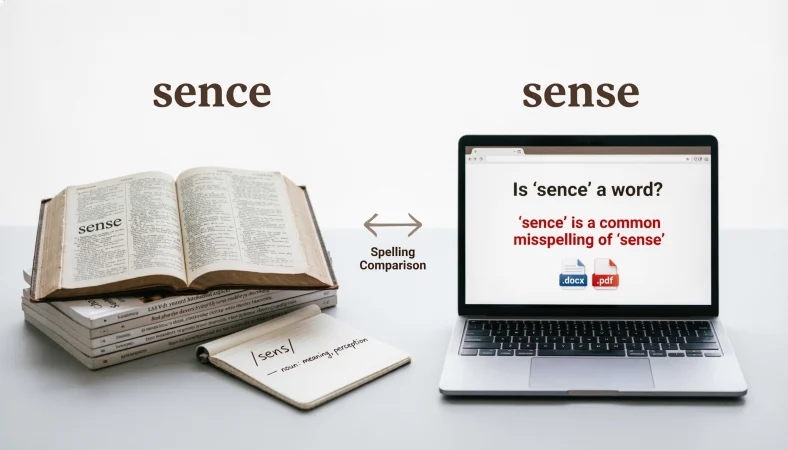
Sense is the correct English word and means understanding, meaning, judgment, or one of the five senses. Sence is a misspelling and is not recognized as a standard English word.
Have you ever typed “sence” when you meant “sense” and wondered whether both spellings are correct? This common spelling confusion affects many English learners and even experienced writers because the two words sound similar. However, only one of them is recognized as a standard English word, making it important to understand the difference before using it in academic, professional, or everyday writing.
To help you write with confidence, this guide examines sence vs. sense using trusted dictionary definitions, standard English grammar rules, and real-world examples. You’ll learn which spelling is correct, why the confusion occurs, and how to avoid this mistake so your writing remains clear, accurate, and professional.
Quick Answer Table
| Feature | Correct Version | Incorrect Version |
| Spelling | sense | sence |
| Status | Standard English word | Common typo / misspelling |
| Meaning | Perception, awareness, understanding, or a faculty of feeling | No meaning |
| Part of Speech | Noun and verb | None |
| Pronunciation | /sɛns/ (rhymes with “fence” and “dense”) | Not applicable |
| Example Sentence | “I have a strong sense that everything will work out.” | “I have a strong sence that everything will work out.” (incorrect) |
Which One Is Correct?
Let me state this clearly and without hesitation: “Sense” is the only correct spelling.
“Sence” is not a word. It does not appear in any standard English dictionary. It has no accepted meaning, no grammatical function, and no legitimate use in professional, academic, or casual writing.
If you write “sence,” you have made a spelling error. Full stop.
This might sound harsh, but the clarity matters. English has many words with legitimate alternate spellings (like “color” and “colour” or “judgment” and “judgement”). “Sense” has no such alternates. There is no British version, no American version, no historical variant, and no slang adaptation. There is only “sense.”
Every time you type “sence,” you are creating a typo. The good news? It is an incredibly common mistake, so you are far from alone. But the even better news? Once you understand why “sense” is spelled the way it is, you will likely never make this error again.
Meaning of the Correct Word: “Sense”
The word “sense” is remarkably versatile. It functions as both a noun and a verb, and it touches nearly every aspect of human experience from physical sensation to abstract intuition.
Definition
As a noun, “sense” refers to:
- Any of the five physical faculties of perception: sight, hearing, touch, taste, and smell
- A feeling or awareness about something not based on explicit facts
- Sound judgment or practical intelligence
- The meaning or interpretation of a word or phrase
As a verb, “sense” means:
- To perceive through any of the physical senses
- To become aware of something intuitively or instinctively
- To detect or register a physical stimulus
Detailed Explanation
Think of “sense” as your brain’s built-in antenna. It receives signals from the outside world (through your five senses) and also picks up internal signals (like intuition or “gut feelings”).
When someone says, “I sense tension in the room,” they are not using a thermometer to measure degrees of discomfort. They are relying on social awareness—a different kind of sense altogether.
When a nurse walks into a patient’s room and immediately knows something is wrong before any monitor beeps, that is “sense” in action. It is clinical experience combined with subconscious pattern recognition. And in nursing jobs, that kind of refined sense can save lives.
Real-World Examples
Here is how “sense” appears in everyday language:
Casual conversation:
- “I have a sense we’ve met before.”
- “Does that make any sense to you?”
- “You have no sense of direction, do you?”
Professional writing:
- “The proposal makes financial sense given our current budget constraints.”
- “Our sensors detected a magnetic field shift, indicating seismic activity.”
- “Employees reported a strong sense of belonging after the new policies were implemented.”
Healthcare context (relevant for nurse jobs and similar roles):
- “The nurse’s clinical sense alerted her to the patient’s deteriorating condition.”
- “Developing a strong sense of empathy is essential for patient care.”
- “Use your common sense when prioritizing tasks during an emergency.”
Metaphorical or literary:
- “She possessed a sense of wonder that never faded with age.”
- “The abandoned house gave off a sense of unease, as if it were watching.”
Meaning of the Incorrect Word: “Sence”
Sence” carries no meaning because it is not a recognized word in the English language.
When people write “sence,” they almost always intend to write “sense.” Occasionally, “sence” appears as a typo for other words like “since” or “hence,” but these errors are contextual and rare.
Is “Sence” Ever Acceptable?
No. Absolutely not.
You will not find “sence” in the Oxford English Dictionary, Merriam-Webster, Cambridge Dictionary, or any legitimate English reference. Spell-checkers flag it instantly. Grammar checking tools like Grammarly or ProWritingAid will underline it in red.
Some readers mistakenly believe “sence” might be an old or regional spelling. This is false. Even in Middle English, the word was spelled “sens” (borrowed from Old French), and later standardized to “sense.” The letter ‘c’ never replaced the ‘s’ in this word’s spelling history.
Why Do People Keep Writing “Sence”?
The persistence of “sence” comes down to three main factors:
- Phonetic confusion: The word “sense” contains an ‘s’ sound followed immediately by an ‘e’ that sounds like a soft ‘c’ in some accents. The human ear sometimes hears “sence” even though the spelling is “sense.”
- Analogy with other words: English has words like “fence,” “hence,” “pence,” and “commence” that end with the “-ence” pattern. The brain unconsciously applies this pattern to “sense,” creating the incorrect “sence.”
- Typing speed and carelessness: On a QWERTY keyboard, the letters S, E, N, C, and E are all close together. Fast typists often transpose letters, producing “sence” instead of “sense.”
Understanding why the mistake happens is the first step toward eliminating it from your writing forever.
Key Differences Between “Sense” and “Sence”
Let me break down every meaningful distinction between these two strings of letters. Remember that only one of them qualifies as an actual word.
| Category | Sense | Sence |
| Lexical status | Real word | Typo/misspelling |
| Dictionary entry | Yes | No |
| Spell-check recognition | Passes | Fails |
| Acceptable in formal writing | Yes | No |
| Acceptable in casual writing | Yes | No |
| Pronounceable | Yes (/sɛns/) | Yes, but incorrectly |
| Grammatical function | Noun and verb | None |
| Etymology | Latin “sentire” (to feel) | None |
| Frequency in English | Extremely common | Only appears as error |
Spelling Difference
The only difference is the fourth letter. “Sense” uses the letter ‘s’ (S-E-N-S-E). “Sence” incorrectly uses the letter ‘c’ (S-E-N-C-E).
This single letter swap transforms a legitimate word into a spelling error.
Pronunciation
Both “sense” and “sence” would be pronounced identically if “sence” were a real word. The ‘c’ in “sence” would sound like an ‘s’ because it appears before the letter ‘e’. This phonetic ambiguity is precisely why the misspelling is so common.
The correct pronunciation of “sense” rhymes with “fence,” “dense,” “offense,” and “commence.”
Grammar and Usage
“Sense” functions as both a countable and uncountable noun, as well as a transitive verb.
- As a noun: “He has no sense of humor.” (uncountable) / “These are the five senses.” (countable)
- As a verb: “I sensed movement behind the curtain.”
“Sence” has no grammatical function. You cannot use it as a noun, verb, adjective, or any other part of speech without being wrong.
Common Mistakes People Make (And How to Avoid Them)
Even experienced writers slip up with “sense” versus “sence” under certain conditions. Here are the most frequent errors:
Mistake #1: Writing “common sence”
This is the most widespread version of the error. The phrase “common sense” appears constantly in writing, and the pattern of other “-ence” words tricks people into writing “common sence.”
- Incorrect: “Just use some common sence.”
- Correct: “Just use some common sense.”
Mistake #2: Writing “make sence”
The phrase “make sense” is ubiquitous. The similar-sounding word “hence” (which ends with “-ence”) creates confusion.
- Incorrect: “Does this paragraph make sence to you?”
- Correct: “Does this paragraph make sense to you?”
Mistake #3: Confusing “sense” with “since”
This is a different but related error. “Since” refers to time or causation. “Sense” refers to perception or meaning. Some writers accidentally type “sence” when they mean “since,” creating a double error.
- Incorrect: “I haven’t seen her sence last Tuesday.”
- Correct: “I haven’t seen her since last Tuesday.”
- Also correct (different meaning): “I sense something has changed since last Tuesday.”
Mistake #4: Using “sence” in professional documents
Resumes, cover letters, and professional emails containing “sence” create a poor impression. In fields requiring precise communication—including nurse jobs, legal work, technical writing, and customer service—spelling errors suggest carelessness.
Mistake #5: Auto-correct failures
Sometimes autocorrect changes “sense” to “sence” if you have accidentally added the misspelling to your device’s dictionary. Always double-check your custom dictionary for corrupted entries.
Correct Usage Examples (Organized by Context)
Let me show you how “sense” works naturally across different situations. Pay attention to how the word adapts to each context.
Casual Everyday Examples
- “I have a gut sense that we should take the other road.”
- “Her outfit makes no sense with those shoes.”
- “You have the best sense of style in our friend group.”
- “Can you sense the tension between them?”
- “My sense of time is completely off today.”
Professional and Workplace Examples
- “The quarterly report indicates a strong sense of investor confidence.”
- “Use your professional sense to navigate this client complaint.”
- “Does this revised timeline make sense given our resources?”
- “I sense some hesitation from the stakeholders.”
- “A clear sense of purpose improves team productivity by 34%.”
Healthcare and Nursing Contexts
For readers interested in nurse jobs or currently working in healthcare, these examples are especially relevant:
- “A seasoned nurse develops a clinical sense that complements diagnostic tools.”
- “Sense of smell is crucial for detecting infections or metabolic disorders.”
- “Document any changes in the patient’s level of consciousness or sense of orientation.”
- “Trust your sense of urgency when a patient’s condition feels off.”
- “Common sense dictates checking the patient’s wristband before administering medication.”
- “The nurse’s intuitive sense of when to escalate care comes from years of experience.”
Educational and Academic Examples
- “The student demonstrated a sophisticated sense of historical context.”
- “Does this hypothesis make sense given the available evidence?”
- “Developing a sense of academic integrity begins in primary school.”
- “I sense that you understand the material but struggle with application.”
Literary and Metaphorical Examples
- “The forest had a sense of ancient memory, as if the trees remembered everything.”
- “He moved through life with a sense of quiet desperation.”
- “Her writing captures the sense of loss that follows unexpected change.”
- “There is a sense in which all art is autobiographical.”
Word Origin and Etymology
Understanding where “sense” comes from makes its spelling feel logical rather than arbitrary.
Ancient Roots
The word traces back to the Latin verb “sentire,” meaning “to feel” or “to perceive.” This Latin root also gives us words like:
- Sentiment (a feeling or opinion)
- Sentient (capable of feeling)
- Consent (to feel together, to agree)
- Resent (to feel again, to take offense)
- Sentinel (one who watches or perceives)
Journey Through French
Latin “sentire” evolved into Old French as “sens” (meaning direction, feeling, or meaning). The French word carried both concrete meanings (the five physical senses) and abstract ones (judgment, understanding).
Entry into English
English borrowed “sens” from French in the late 1300s. Over time, the spelling standardized to “sense” adding the silent ‘e’ that appears in countless English words derived from French (compare “house,” “horse,” “tense”).
The ‘-ense’ ending appears in many English words of Latin origin: “defense,” “offense,” “immense,” “condense,” “recompense.” Notice that all of these use ‘-ense’, not ‘-ence’. This pattern is your clue.
Why Not ‘-ence’?
Words ending in ‘-ence’ usually come from Latin ‘-entia’ (like “difference” from “differentia” or “patience” from “patientia”). Words ending in ‘-ense’ usually come from Latin ‘-ensus’ or ‘-ensum’ (like “sense” from “sensus” or “defense” from “defensus”).
This distinction is subtle, but it explains why “sense” follows the ‘-ense’ pattern while “fence” (from Old French “fence,” related to “defense”) follows a different historical path.
Why the Incorrect Version Became Popular
If “sence” is completely wrong, why does it appear so frequently?
The Power of Pattern Recognition
Your brain loves patterns. English contains hundreds of common words ending in “-ence”:
- Fence
- Hence
- Thence
- Commence
- Pence
- Vincence (rare but exists)
When your brain sees the letters S-E-N-, it expects to complete the pattern with either “-se” (sense) or “-ce” (sence). Because “-ence” appears in many common words, your brain sometimes reaches for that familiar ending.
Typing Dynamics
On a standard QWERTY keyboard, type the word “sense” slowly: S – E – N – S – E.
Now type “sence”: S – E – N – C – E.
Notice how your right hand stays in nearly the same position. The difference is moving your index finger from the ‘S’ key (left hand) to the ‘C’ key (left hand). For fast typists, this tiny movement sometimes gets executed incorrectly.
The Rise of Informal Digital Communication
Texting, social media, and instant messaging prioritize speed over accuracy. In these environments, “sence” appears frequently because autocorrect sometimes misses it (depending on your settings), and friends rarely correct each other’s casual typos.
However, what is acceptable in a text message is not acceptable in a resume, academic paper, or professional email. The prevalence of “sence” online does not legitimize it.
Search Behavior and Confirmation Bias
When people are unsure about “sence or sense,” they often search online. If they encounter forums or comment sections filled with the misspelling, they may falsely conclude that “sence” is an accepted variant.
This guide exists to correct that misinformation definitively.
Easy Memory Tricks That Actually Work
Stop guessing. Use these proven memory techniques to lock in the correct spelling forever.
Trick #1: “Sense Starts with ‘S’ and Ends with ‘Se'”
The word “sense” begins with the letter ‘S’ and ends with the letters ‘S’ and ‘E’ together (“se”). Think of it this way: “SENSE” has an ‘S’ at both ends (almost—it has an ‘S’ at position one and position four, with an ‘E’ at the end).
Visualize it: S E N S E — the two ‘S’s surround the middle letters.
Trick #2: “Your Senses Are Sensible”
“Sense” contains the word “sen” (like “senior” or “senate”) plus the letter ‘s’ and ‘e’. But a better trick: The word “sensible” (meaning reasonable or practical) contains “sense” inside it. Look closely:
Sensible = SENSE + ible
If you can spell “sensible,” you can spell “sense.” Just remove the “-ible” ending.
Trick #3: The Fence Analogy
Imagine a fence. A fence has posts. Your senses are like the fence posts that hold up your perception of reality. Now remember: “fence” ends with ‘-ence’, but “sense” ends with ‘-ense’. The fence is the exception, not the rule.
Better yet: “Common sense” helps you avoid walking into a fence. Both words look different because they are different. Write them side by side until the correct spelling feels natural.
Trick #4: Pronounce It Wrong on Purpose
This sounds silly, but it works. Say the word “sense” as “SENS-ee” in your head, emphasizing the two ‘S’ sounds. You cannot say “SENS-ee” and spell it “sence” because ‘c’ makes an ‘s’ sound, not a double ‘s’ sound.
The mnemonic: “Double S means double correct; C is just incorrect.”
Trick #5: Create a Visual Anchor
Picture a nurse using their clinical sense to assess a patient. In your mental image, see the word “SENSE” written on the nurse’s notepad. The nurse represents reliability, accuracy, and life-saving attention to detail. That is the energy you want to bring to your spelling.
FAQs
1. Is “sence” ever correct in any dialect of English?
No. No dialect of English accepts “sence” as a standard spelling. This includes British English, American English, Australian English, Canadian English, Irish English, Scottish English, Indian English, and all other regional varieties.
2. Why does spell-check sometimes not catch “sence”?
Some spell-checkers use fuzzy matching or have limited dictionaries. Others may ignore misspellings if you have previously added “sence” to your custom dictionary. Always verify your dictionary settings and never rely solely on automated tools.
3. How do I pronounce “sense” correctly?
Pronounce it to rhyme with “fence,” “dense,” or “tense.” The vowel sound is the short ‘e’ as in “bed” or “red.” The final ‘se’ sounds like an unvoiced ‘s’ (not a ‘z’).
4. What is the difference between “sense” and “since”?
“Since” relates to time (starting from a point) or causation (because). “Sense” relates to perception or meaning. Confusing them changes your meaning entirely.
- “I have not seen her since Monday” (time)
- “I sense something is wrong” (perception)
5. Can “sense” be used as a verb?
Yes. To sense something means to become aware of it through physical perception or intuition. Example: “Dogs can sense fear.”
6. How can I remember the correct spelling for professional writing, especially in nursing jobs?
Use this professional-grade mnemonic: “Sensitive Evaluation Never Spells Error.” The first letters spell SENSE. For nurses and healthcare workers, remember that accurate documentation reflects clinical competence. Spelling “sense” correctly signals attention to detail a quality every employer values.
7. What is the plural of “sense”?
The plural is “senses.” Example: “The five senses are sight, hearing, touch, taste, and smell.”
8. Are there any common phrases where “sense” is always used?
Yes. Many set phrases use “sense” and never “sence”:
- Common sense
- Make sense
- Sense of humor
- Sense of direction
- Sense of purpose
- Sense of belonging
- Sixth sense
- Sense of self
9. What should I do if I see a colleague or student writing “sence”?
Politely correct them. Say, “Just so you know, ‘sense’ is spelled S-E-N-S-E, not with a ‘c.’ Many people make that mistake.” Kind correction helps everyone improve.
10. Does “sense” appear in the phrase “horse sense”?
Yes. “Horse sense” is an old-fashioned synonym for common sense, referring to the practical intelligence attributed to horses (and good handlers). The spelling remains “sense.”
Conclusion
The correct spelling is “sense,” while “sence” is always incorrect and simply a spelling mistake. Although these two spellings are often confused, understanding the meaning and usage of sense helps avoid errors in writing.
Whether you are creating professional documents, writing emails, applying for jobs, or communicating daily, using sense correctly shows attention to detail, improves clarity, and makes your communication more effective. So remember: write with sense, not sence.