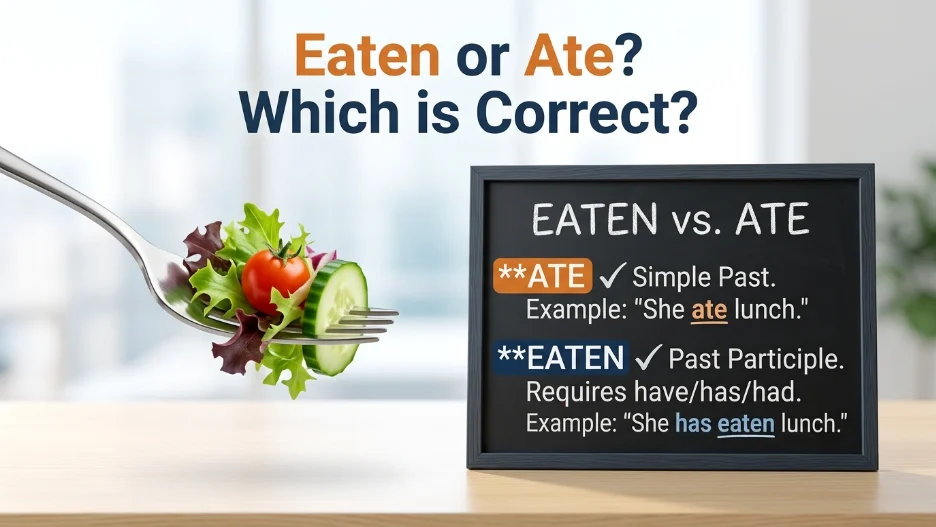
“Ate” is the simple past tense of eat, while “eaten” is the past participle and must be used with a helping verb such as has, have, had, or was.
- ✅ Ate: She ate breakfast this morning.
- ✅ Eaten: She has eaten breakfast already
- Quick Answer Table
| Feature | Ate | Eaten |
| Correct/Incorrect | ✅ Correct | ✅ Correct |
| Verb Form | Simple Past (V2) | Past Participle (V3) |
| Meaning | Completed action in the past | Completed action with present relevance or passive voice |
| Used With | Standalone verb | Auxiliary verbs: have, has, had, be (passive) |
| Example | I ate breakfast at 8 AM. | I have already eaten breakfast. |
| Tense | Past simple only | Perfect tenses & passive voice |
Which One Is Correct?
Here’s the straightforward answer: Both “ate” and “eaten” are correct—but they serve different grammatical purposes.
Ate is the simple past tense form of the verb “eat.” You use it when describing an action that started and finished entirely in the past. There’s no connection to the present moment.
Eaten is the past participle form. You never use it alone. Instead, it always appears with a helping (auxiliary) verb like have, has, had, or be to form perfect tenses or the passive voice.
The common mistake? Using “ate” where “eaten” is required, or vice versa. For example, saying “I have ate already” is grammatically incorrect—the correct form is “I have eaten already.”
Meaning of “Ate” (The Simple Past)
Definition and Usage
Ate is the simple past tense form of the irregular verb eat. You use it when:
- The action of eating is completed and finished in the past.
- The exact time is specified or implied.
- The action has no ongoing relevance to the present moment.
The simple past is used for actions that are “over and done with.”
Real World Examples
Casual conversation:
“I ate three slices of pizza for dinner last night.”
Professional context:
“Our team ate lunch together before the afternoon meeting.”
Narrative/storytelling:
“She ate every bite of her meal, then pushed the plate away with a satisfied sigh.”
Question form:
“Did you eat (ate) at the new restaurant downtown?”
Note: In questions with “did,” the base form “eat” is used, not “ate.”
Meaning of “Eaten” (The Past Participle)
Definition and Usage
Eaten is the past participle form of eat. It is never used alone—it always requires an auxiliary verb. You use eaten in two situations:
- Perfect tenses (with have, has, or had)—to talk about actions that happened at an unspecified time or have present relevance.
- Passive voice (with forms of be)—when the focus is on the food being eaten, not who ate it.
Real World Examples
Present perfect (action with present relevance):
“I have eaten already, so I’m not hungry.”
Past perfect (action completed before another past action):
“She had eaten dinner before the guests arrived.”
Future perfect (action that will be completed by a future time):
“By 7 PM, we will have eaten everything.”
Passive voice:
“The entire cake was eaten by the children in five minutes.”
Questions:
“Have you eaten lunch yet today?”
Key Differences Between “Ate” and “Eaten”
| Category | Ate | Eaten |
| Spelling | A T E (3 letters) | E A T E N (5 letters) |
| Pronunciation | /eɪt/ (rhymes with “late”) | /ˈiː.tən/ (rhymes with “beaten”) |
| Grammar Function | Simple Past (V2) | Past Participle (V3) |
| Helping Verb Required | ❌ No—can stand alone | ✅ Yes—must have have/has/had/be |
| Tense(s) Used In | Past simple only | Present perfect, past perfect, future perfect, passive voice |
| Time Specificity | Often specific time mentioned | Usually unspecified or result matters now |
Grammar Rule: One Sentence Summary
Ate = past action, standalone. Eaten = past participle, needs a helper.
If you see have, has, or had before the verb, you must use eaten. If there’s no helper verb and you’re describing a finished past action, use ate.
The Passive Voice Distinction
In passive voice sentences, you must use eaten, never “ate.” Compare:
- Active (correct with ate): “I ate the sandwich.” (Focus on who did the eating)
- Passive (correct with eaten): “The sandwich was eaten by me.” (Focus on the sandwich)
Notice the difference? In the passive construction, we use a form of be (was) + eaten. You can never say “The sandwich was ate” because that’s grammatically incorrect.
Common Mistakes People Make
❌ Mistake 1: Using “Ate” With “Have/Has/Had”
Incorrect: “I have ate breakfast.”
Correct: “I have eaten breakfast.”
Remember: If you use have, has, or had, always follow it with the past participle—eaten.
❌ Mistake 2: Using “Eaten” Without a Helping Verb
Incorrect: “I eaten breakfast an hour ago.”
Correct: “I ate breakfast an hour ago.”
Eaten cannot stand alone as the main verb in a sentence.
❌ Mistake 3: Mixing Tenses in the Passive Voice
Incorrect: “The pizza was ate by the dog.”
Correct: “The pizza was eaten by the dog.”
The passive voice always uses the past participle form.
❌ Mistake 4: Saying “Eated”
This is an overgeneralization of regular verb rules. “Eat” is irregular, so the past is ate, not “eated.” The form “eated” does not exist.
Correct Usage Examples
Casual/Everyday Examples
“I ate too much at the buffet last night.”
“Have you eaten anything since breakfast?”
“The kids have already eaten their snacks.”
Professional/Formal Examples
“During the conference, we ate lunch at the hotel restaurant.”
“All catered meals have been eaten by the staff.”
“Have you eaten with the clients before?”
Educational/Academic Examples
“In the study, participants ate a standardized breakfast each morning.”
“By the time the experiment concluded, subjects had eaten approximately 2,000 calories per day.”
“The sample was eaten by the laboratory rats.”
Literary/Metaphorical Examples
“Time ate away at their resolve.” (metaphorical use of ate)
“She felt as if she had been eaten alive by anxiety.” (metaphorical passive voice)
“The forest had eaten the old trail.” (personification with had + eaten)
Word Origin / Etymology
The verb eat has deep roots in the English language, tracing back to Old English etan, meaning “to consume food.” This came from Proto Germanic *etaną, and ultimately from the Proto Indo European root *ed , meaning “to eat”—the same source that gave us the Latin edere and the Greek edein.
The past tense ate evolved from the Old English ǣt, the past conjugation. Meanwhile, the past participle eten became eaten in Modern English.
Like many common English verbs, eat is irregular, meaning it doesn’t follow the standard “ ed” rule for forming past tenses. This irregularity is why “eated” doesn’t exist and why you simply must memorize the forms: eat—ate—eaten.
Why the Confusion Became So Common
Why do so many people, even native speakers, mix up eaten or ate? There are several reasons:
- Both describe the past. They both refer to eating that has already happened, so the difference in nuance can feel subtle.
- Regional dialects. In some informal dialects, speakers use “ate” in places where standard grammar requires “eaten.” For example, “I’ve ate” is heard in casual speech, though it’s considered grammatically incorrect.
- Irregular verbs confuse. Many irregular verbs have identical simple past and past participle forms (e.g., “I sat,” “I have sat”). But “eat” doesn’t follow that pattern, leading to uncertainty.
- Fast speech. In rapid conversation, the helper verb (have/has) often becomes contracted (I’ve, he’s) and can be hard to hear, making the distinction feel blurry.
Easy Memory Tricks
“Alone or Together”
- If the verb is alone, use ate.
- If it’s with a helper (have, has, had, be), use eaten.
Pronoun Test
- I ate. (No helper—correct)
- I have eaten. (Helper present—correct)
- I have ate. (Helper present but wrong form—incorrect)
Think of It Like “Drive” and “Driven”
“I drove yesterday” / “I have driven before.”
“I ate yesterday” / “I have eaten before.”
If you know the drive—drove—driven pattern, apply the same logic to eat—ate—eaten.
The Time Clue Trick
When you specify a specific time (yesterday, last night, at 8 AM), use ate: I ate at 8 AM.
When the time is unspecific or the result matters now (already, yet, ever), use eaten with a helper: I have eaten already.
Frequently Asked Questions
Is it “I ate” or “I have eaten”?
Both are correct. Use I ate for a specific past time and I have eaten when the exact time isn’t important or the result matters now.
Can I say “I haven’t ate yet”?
No. The correct form is I haven’t eaten yet because have must be followed by the past participle eaten.
Is it “had eaten” or “had ate”?
Had eaten is correct. After had, always use the past participle eaten, not ate.
Is “eaten” a real word?
Yes. Eaten is the correct past participle of eat and is used in perfect tenses and passive voice.
What is the difference between eat, ate, and eaten?
Eat is the present tense, ate is the simple past tense, and eaten is the past participle used with helping verbs.
What are the V1, V2, and V3 forms of eat?
V1: eat • V2: ate • V3: eaten.
Is it “was eaten” or “was ate”?
Was eaten is correct. Passive voice always requires the past participle eaten.
Should I say “Have you eaten?” or “Did you eat?”
Use Have you eaten? when asking generally up to the present, and Did you eat? when referring to a specific past time.
Is “eaten” American or British English?
Both. Eaten is standard in both American and British English.
What is the past tense of eat?
The simple past tense is ate, while the past participle is eaten.
Is it “I ate today” or “I have eaten today”?
Both are correct. I ate today states a past action, while I have eaten today emphasizes the present result.
What is the passive form of eat?
The passive form uses be + eaten, such as The cake was eaten or The meal will be eaten.
Conclusion
Mastering the difference between eaten or ate comes down to one simple rule: ate is the simple past and stands alone; eaten is the past participle and always needs a helper verb like have, has, or had.
To sum up:
- Use ate for finished past actions with a specific time: I ate lunch at noon.
- Use eaten in perfect tenses and passive voice: I have eaten lunch already. The lunch was eaten.