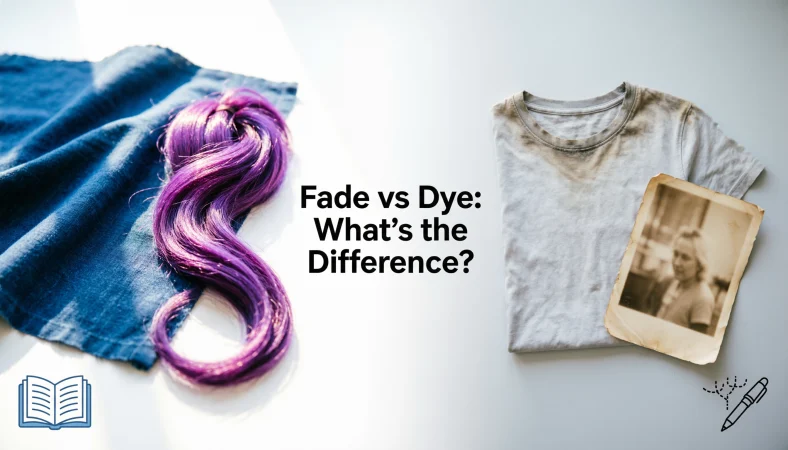
Have you ever wondered whether you should use fade or dye in a sentence? These two words are often associated with color, hair, clothing, and appearance, which can make them confusing for English learners and even native speakers.
Although fade and dye are both correct English words, they have completely different meanings and functions. Understanding the difference can help you communicate more clearly, avoid common grammar mistakes, and improve your vocabulary.
In this comprehensive guide, you’ll learn:
- The meaning of fade and dye
- When to use each word correctly
- Grammar and pronunciation differences
- Real-world examples
- Common mistakes to avoid
- Word origins and etymology
- Easy memory tricks
- Frequently asked questions
Whether you’re writing about hair color, fabric, art, fashion, or everyday life, this article will help you confidently choose the right word.
Quick Answer Table
| Feature | Fade | Dye |
| Correct Spelling | ✅ Fade | ✅ Dye |
| Part of Speech | Verb, Noun | Verb, Noun |
| Meaning | To gradually lose color, strength, or visibility | To add color to something |
| Usage | Color disappears over time | Color is intentionally applied |
| Example Sentence | The shirt began to fade after many washes. | She decided to dye her hair blue. |
| Pronunciation | /feɪd/ | /daɪ/ |
| Related To | Losing color | Adding color |
Which One Is Correct?
The answer is simple:
Both “fade” and “dye” are correct words.
However, they are not interchangeable because they describe opposite actions involving color.
- Fade means color becomes weaker, lighter, or disappears.
- Dye means color is added or changed intentionally.
Quick Example
✅ The curtains faded in the sunlight.
✅ She dyed the curtains green.
❌ She faded the curtains green.
❌ The curtains dyed because of sunlight.
The correct choice depends entirely on what you want to express.
Meaning of the Correct Word: Fade
Definition
Fade means to gradually lose brightness, color, strength, freshness, or visibility over time.
It often describes a natural process where something becomes less noticeable.
Dictionary-Style Meaning
To become weaker, paler, less visible, or less intense gradually.
Common Uses of Fade
The word fade is frequently used when talking about:
- Colors
- Memories
- Sounds
- Emotions
- Light
- Beauty
- Popularity
- Strength
Real-World Examples
Color
- My black jeans faded after several washes.
- The paint on the wall has faded over the years.
Light
- The sunlight slowly faded behind the mountains.
- The stars faded at dawn.
Sound
- Her voice faded into the distance.
- The music gradually faded out.
Memory
- Childhood memories sometimes fade with age.
- The details of the event have faded from my mind.
Fade as a Noun
Fade can also be a noun.
Examples:
- The movie ended with a fade to black.
- The barber gave him a skin fade haircut.
Common Expressions with Fade
- Fade away
- Fade out
- Fade into the background
- Fade from memory
- Fade to black
Meaning of the Correct Word: Dye
Definition
Dye means to add color to something intentionally.
The process involves applying a coloring substance to materials such as:
- Hair
- Fabric
- Leather
- Wool
- Paper
- Textiles
Dictionary-Style Meaning
To color a material by soaking or treating it with a coloring agent.
Common Uses of Dye
The word dye is commonly associated with:
- Hair coloring
- Fabric coloring
- Textile production
- Fashion
- Arts and crafts
Real-World Examples
Hair
- She wants to dye her hair red.
- Many people dye their gray hair.
Clothing
- I dyed my white shirt blue.
- The company dyes cotton fabric before selling it.
Crafts
- We used natural dyes to color Easter eggs.
- Artists often dye materials for creative projects.
Dye as a Noun
Dye can also be a noun.
Examples:
- This dye is made from natural plants.
- The fabric absorbed the dye quickly.
Common Expressions with Dye
- Hair dye
- Fabric dye
- Natural dye
- Synthetic dye
- Tie-dye
Meaning Relationship Between Fade and Dye
One of the easiest ways to understand fade or dye is to think of them as opposite color actions.
| Action | Word |
| Adding color | Dye |
| Losing color | Fade |
For example:
- You dye a shirt blue.
- After years of washing, the shirt fades.
The color first gets added, then eventually becomes weaker.
Key Differences Between the Two Words
1. Difference in Meaning
| Fade | Dye |
| Color disappears | Color is added |
| Natural process | Intentional action |
| Reduction | Application |
2. Difference in Usage
Fade
- Used when something becomes lighter.
- Usually happens naturally.
Examples:
- The photograph faded.
- The paint faded.
Dye
- Used when someone changes a color.
- Usually requires human action.
Examples:
- She dyed her hair.
- They dyed the fabric.
3. Difference in Grammar
Both words can function as nouns and verbs.
| Word | Verb Example | Noun Example |
| Fade | Colors fade quickly. | He got a fade haircut. |
| Dye | I dye my hair. | This dye is organic. |
4. Difference in Pronunciation
| Word | IPA | Sounds Like |
| Fade | /feɪd/ | fayd |
| Dye | /daɪ/ | die |
Despite both ending in a similar spelling pattern, they sound quite different.
5. Difference in Recognition
Fade is often recognized in discussions about:
- Aging
- Weathering
- Sun damage
- Memory loss
- Audio effects
Dye is commonly recognized in:
- Beauty industry
- Fashion industry
- Textile manufacturing
- Hair salons
- Craft projects
Common Mistakes People Make
Many learners confuse these words because both relate to color.
Mistake 1
❌ I faded my hair blue.
✅ I dyed my hair blue.
Reason: You add color with dye.
Mistake 2
❌ The sun dyed my curtains.
✅ The sun faded my curtains.
Reason: Sunlight removes color rather than adding it.
Mistake 3
❌ My shirt dyed after washing.
✅ My shirt faded after washing.
Reason: Washing usually causes fading.
Mistake 4
❌ The photograph dyed over time.
✅ The photograph faded over time.
Reason: Old photos lose color.
Mistake 5
❌ I need fade for my hair.
✅ I need hair dye for my hair color.
Or:
✅ I want a fade haircut.
Context determines which word is correct.
Correct Usage Examples
Casual Examples
- My favorite T-shirt faded after a year.
- I want to dye my hair purple.
- The logo faded in the rain.
- She dyed her jacket black.
Professional Examples
- The manufacturer tests how quickly colors fade under sunlight.
- Textile experts use specialized dyes for cotton fabrics.
- Exposure to ultraviolet light can cause materials to fade.
- The company dyes thousands of garments daily.
Educational Examples
- Students observed how pigments fade when exposed to sunlight.
- Scientists developed eco-friendly dyes from plants.
- The experiment measured the fading rate of colored paper.
- Natural dyes have been used for centuries.
Literary and Metaphorical Examples
- Hope slowly faded from his heart.
- The memory faded like an old photograph.
- Autumn leaves appeared as though nature had dyed them gold.
- Her smile faded into silence.
Grammar Notes for Fade and Dye
Verb Forms of Fade
| Form | Example |
| Base Verb | fade |
| Past Tense | faded |
| Past Participle | faded |
| Present Participle | fading |
Examples:
- Colors fade quickly.
- The paint faded last summer.
- The image has faded.
- The colors are fading.
Verb Forms of Dye
| Form | Example |
| Base Verb | dye |
| Past Tense | dyed |
| Past Participle | dyed |
| Present Participle | dyeing |
Examples:
- I dye my hair regularly.
- She dyed her hair yesterday.
- The fabric has been dyed.
- They are dyeing cotton.
Important Spelling Note
Many learners mistakenly write:
❌ dying
when they mean applying color.
Correct:
✅ dyeing
Reason:
- Dyeing = coloring something
- Dying = approaching death
This is one of the most important English spelling distinctions.
Word Origin / Etymology
Origin of Fade
The word fade entered English during the 14th century.
It developed from older European language roots associated with:
- Weakening
- Withering
- Losing freshness
Historically, it described flowers losing their beauty and colors becoming pale.
Over time, its meaning expanded to include:
- Sound
- Light
- Popularity
- Emotions
- Memories
Origin of Dye
The word dye comes from Old English roots connected to coloring and staining materials.
For centuries, humans have used natural dyes made from:
- Plants
- Flowers
- Minerals
- Insects
- Tree bark
The practice of dyeing fabrics dates back thousands of years and remains an important part of textile production worldwide.
Why the Confusion Between Fade or Dye Exists
Several factors contribute to the confusion.
Both Relate to Color
People often associate both words with appearance and color changes.
Similar Contexts
Consider these sentences:
- The shirt faded.
- The shirt was dyed.
Both involve color, but the action differs.
Hair-Related Discussions
Hair conversations frequently include both words.
Examples:
- She dyed her hair.
- The hair color faded.
Because both actions happen to hair, learners sometimes mix them up.
ESL Learning Challenges
English learners often focus on the topic rather than the action.
Since both words appear in discussions about:
- Fashion
- Beauty
- Clothing
- Art
they may accidentally substitute one for the other.
Easy Memory Tricks
Trick #1: Dye Adds Color
Think:
D = Deposit Color
Dye puts color onto something.
Trick #2: Fade Removes Color
Think:
Fade = Fewer Colors
The color becomes weaker.
Trick #3: Before and After
Imagine a shirt.
Step 1:
You dye it blue.
Step 2:
Years later, it fades.
This sequence makes the difference easy to remember.
Trick #4: Hair Salon Rule
At a salon:
- You dye your hair.
- Your color fades later.
Never reverse those actions.
Comparison Summary
If you’re searching for fade or dye, here’s the simple answer:
- Use dye when color is intentionally added.
- Use fade when color becomes weaker or disappears.
Both words are correct English vocabulary terms, but they describe opposite processes.
| Scenario | Correct Word |
| Coloring hair | Dye |
| Coloring fabric | Dye |
| Sun damage to fabric | Fade |
| Old photographs losing color | Fade |
| Hair color becoming lighter over time | Fade |
| Applying a new color | Dye |
FAQs
Is it fade or dye hair?
You dye hair when applying color. Hair color may later fade over time.
Can a color fade after being dyed?
Yes. Most dyed materials gradually fade because of washing, sunlight, aging, or environmental exposure.
Is dye the opposite of fade?
In many color-related contexts, yes. Dye adds color, while fade reduces or removes color intensity.
Which is more common: fade or dye?
Both are common English words, but they appear in different situations. Fade is common in general language, while dye is especially common in beauty and textile contexts.
Is “faded” the past tense of fade?
Yes. The past tense and past participle form of fade is faded.
Example:
- The paint faded quickly.
Is “dyed” the past tense of dye?
Yes.
Example:
- She dyed her hair brown.
What is the difference between dyeing and dying?
- Dyeing means coloring something.
- Dying means approaching death.
The extra “e” changes the meaning completely.
Can memories fade?
Yes. The verb fade is often used metaphorically for memories becoming less clear over time.
Can sunlight dye fabric?
Generally, no. Sunlight usually causes fabric to fade rather than become dyed.
Why does dyed hair fade?
Dyed hair fades because of washing, UV exposure, heat styling, chemical treatments, and natural wear over time.
Conclusion
Understanding the difference between fade or dye is easier once you focus on the direction of color change.
- Dye means adding or changing color intentionally.
- Fade means losing color gradually over time.
Although both words are connected to color, fashion, textiles, and hair care, they describe opposite processes. Using the correct term improves your grammar, vocabulary accuracy, and overall English fluency.
The next time you’re deciding between fade or dye, remember this simple rule:
You dye something to give it color, and it fades when that color begins to disappear.