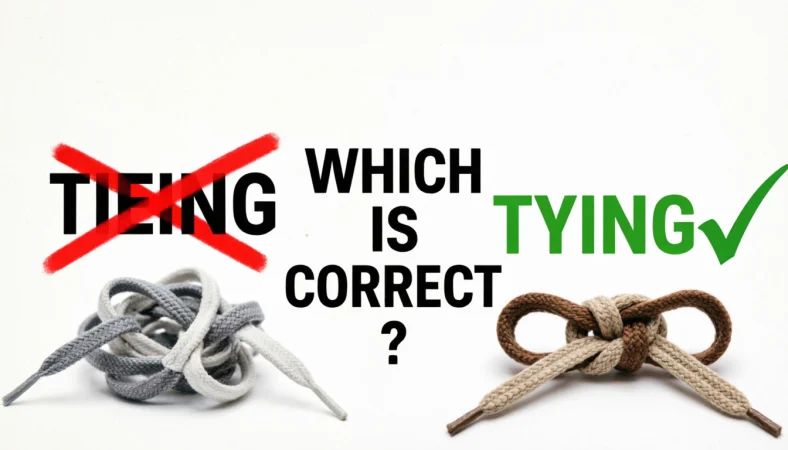
Tying is the correct spelling.
Tieing is a common misspelling and should be avoided in standard English.
Tying or Tieing is a common spelling confusion because both forms look similar, but only one follows the correct English spelling rule. The word comes from the verb tie, which means to fasten, connect, or secure something using a knot or string.
The correct spelling is tying because words ending in -ie change ie to y before adding -ing. This rule applies to words like tie → tying, lie → lying, and die → dying, while tieing is considered incorrect in standard English.
Quick Answer Table
| Feature | Tying | Tieing |
| Correct Spelling | Yes ✓ | No ✗ |
| Word Type | Present participle of “tie” | Common misspelling |
| Primary Meaning | The act of fastening, securing, or making a knot | InCorrect Spelling |
| Usage | Standard English, all contexts | Non standard, should be avoided |
| Example Sentence | “She is tying her shoelaces before the run.” | “She is tieing her shoelaces” (incorrect) |
Which One Is Correct?
The correct spelling is tying. This is the standard present participle form of the verb “tie” in all varieties of English, including American English, British English, Australian English, and every other major English dialect.
Tieing is considered a misspelling and is not recognized as standard in any English dictionary. While you might occasionally encounter it in informal writing or social media posts, it is grammatically incorrect and should be avoided in professional, academic, or any formal writing contexts.
The rule governing this spelling change is a fundamental principle of English orthography: when a verb ends with a silent “e,” you typically drop that “e” before adding the ” ing” suffix. “Tie” follows this rule perfectly, transforming “tie” into “tying” rather than “tieing.”
Meaning of the Correct Word: Tying
Definition and Explanation
Tying is the present participle form of the verb “to tie.” It describes the ongoing action of fastening, securing, binding, or connecting something using a rope, string, cord, ribbon, lace, or any similar material. It can also refer to creating a knot or bow, or metaphorically, to creating a connection or bond between things or people.
Primary Meanings of Tying
- Physical Fastening: The act of securing objects together with a cord or similar material.
- Creating Knots: The action of making a knot or bow in something.
- Securing: The act of making something safe or fixed in position.
- Connecting: Bringing things or people together in a bond or relationship.
- Equalizing: In sports, creating a tied score or equal standing.
- Restricting: Limiting or constraining someone or something.
Real World Usage Examples
Casual/Everyday Context:
- “I am tying my hair back before starting my workout.”
- “She spent the morning tying ribbons on all the wedding favors.”
- “Could you help me with tying this package? It keeps coming undone.”
- “He is tying his shoes before heading out for a walk.”
Professional/Business Context:
- “The team is tying up loose ends before the product launch.”
- “We are tying our marketing strategy to the upcoming seasonal trends.”
- “The legal department is tying together all the contract details.”
- “Our company is tying employee bonuses to performance metrics.”
Educational Context:
- “Students are learning the practical skill of tying various knots.”
- “The teacher demonstrated the correct technique for tying climbing ropes.”
- “The workshop covered tying fishing flies and basic fly fishing techniques.”
Literary/Metaphorical Context:
- “The novel explores themes of tying one’s identity to place and community.”
- “Their fates were mysteriously tying together as the story unfolded.”
- “She felt as though invisible threads were tying her to her childhood home.”
- “The filmmaker masterfully ties different storylines into a cohesive narrative.”
Sports Context:
- “The two teams are tied for first place in the league standings.”
- “With only minutes remaining, they are tying the game with a spectacular goal.”
- “Both players are tying the tournament record for consecutive wins.”
Nautical/Maritime Context:
- “The sailors are tying the ship to the dock with heavy mooring lines.”
- “We are tying down all loose equipment before the storm hits.”
- “He is tying a bowline knot, one of the most essential sailing knots.”
Meaning of the Incorrect Word: Tieing
Tieing is simply a misspelling. It carries the exact same intended meaning as “tying” because it represents the same verb, but it is spelled incorrectly. The spelling error occurs when writers fail to apply the standard rule of dropping the final ‘e’ before adding the ” ing” suffix.
Is Tieing Ever Correct?
No. In standard English, “tieing” is never considered correct. It is not a dialectal variation, nor is it an accepted alternative spelling in any reputable dictionary, style guide, or grammar reference.
That said, you might occasionally see “tieing” in:
- Informal social media posts where spelling rules are often relaxed
- Text messages where speed takes priority over accuracy
- Older texts where spelling was less standardized
- Non native English writing where the rule about dropping the ‘e’ is not known
However, seeing it in these contexts does not make it correct. In professional writing, academic papers, business communications, and any formal situation, you should always use “tying.”
Why Does Tieing Look So Common?
The confusion is understandable for several reasons:
- Visual familiarity: Many people see “tieing” and think it looks plausible because it resembles “tying” and seems to follow a pattern.
- Inconsistent English rules: English has many exceptions to its own rules, which makes people uncertain about which rules apply.
- Autocorrect limitations: Some spell checkers and autocorrect tools do not always catch “tieing” as an error, creating false confidence.
- Spelling patterns: Words like “dieing” (a misspelling of “dying”) follow the same pattern of confusion, reinforcing the error.
Key Differences Between Tying and Tieing
| Feature | Tying | Tieing |
| Spelling | T Y I N G | T I E I N G |
| Syllables | Two (ty ing) | Two (tie ing) |
| Correctness | Correct in all contexts | Incorrect in all contexts |
| Dictionary Recognition | Recognized in all major dictionaries | Not recognized in any standard dictionary |
| Usage | Standard English, formal and informal | Non standard, should be avoided |
| Rule Application | Applies the drop the e rule correctly | Violates the drop the e rule |
| Professional Acceptance | Fully accepted | Rejected in professional contexts |
| Number of Letters | 5 letters | 6 letters |
The Rule Behind the Difference
The key grammatical rule at play here is the “silent e” rule. When a verb ends in a silent “e,” you generally drop that “e” before adding ” ing.” This rule applies to most verbs ending in a silent “e”:
- Write → Writing
- Dance → Dancing
- Bake → Baking
- Hope → Hoping
- Tie → Tying
The rule exists because English orthography generally avoids having two vowels adjacent to each other when adding suffixes. Keeping the ‘e’ would create “tieing,” which has the awkward “ie” vowel combination that makes the word visually and phonetically less clear.
Common Mistakes People Make
1. Confusing Tying with Dying
One of the most common errors related to “tying” is confusing it with “dying.” While these are different words with different meanings, they follow the same spelling transformation rule:
- Die → Dying (present participle)
- Tie → Tying (present participle)
Both drop the final ‘e’ before adding ‘ ing.’ The confusion arises because “dying” refers to the act of ceasing to live, while “tying” refers to fastening or securing.
Common Error:
- “I am dieing to see the new movie.” (Wrong)
- “I am dying to see the new movie.” (Correct)
- “She is tieing her shoelaces.” (Wrong)
- “She is tying her shoelaces.” (Correct)
2. The “Ing” Suffix Confusion
Some writers mistakenly believe that adding ” ing” to verbs always requires simply attaching it to the base form. While this works for many verbs (walk → walking, talk → talking), verbs ending in silent ‘e’ are an exception.
Incorrect Assumption:
- Base: tie
- Add ing: tie + ing = tieing (WRONG)
- Correct: tie → ty ing (drop the ‘e’)
3. Applying the Wrong Rule
The English language has so many spelling rules and exceptions that it is easy to apply the wrong one. Some verbs ending in ‘e’ do keep the ‘e’ before adding ” ing” if the ‘e’ is pronounced or affects the pronunciation:
- Singe → Singeing (to distinguish from singing)
- Dye → Dyeing (to distinguish from dying)
- Eye → Eyeing (to distinguish from eying)
However, for “tie,” you always drop the ‘e’ because the ‘e’ is silent.
4. Regional and Historical Confusion
In older forms of English and in some non standard dialects, you might encounter variants. However, in modern standard English, “tying” is the only correct form, and “tieing” is considered an error.
5. Auto Correct Reliance
While modern spell checkers and grammar tools are generally reliable, they are not infallible. Some systems might not flag “tieing” as an error, particularly in informal or non standard contexts. Learning the rule ensures you do not have to rely on software.
Correct Usage Examples: Tying in Action
Everyday Situations
- “He is tying the perfect bow tie for the formal event.”
- “She spends hours tying intricate friendship bracelets.”
- “The mother is tying her toddler’s shoes before they leave the house.”
- “We are tying the balloons to the chairs for the party decorations.”
- “The fisherman is tying a new lure onto his fishing line.”
Professional and Business Scenarios
- “The project manager is tying all the tasks together into a coherent schedule.”
- “Our financial analyst is tying quarterly results to market trends.”
- “The IT team is tying legacy systems with new software solutions.”
- “Human resources is tying employee benefits to performance evaluations.”
- “The marketing department is tying multiple campaigns to seasonal promotions.”
Academic and Educational Contexts
- “The biology students are tying specimens to the dissection boards.”
- “The engineering class is tying theoretical concepts to practical applications.”
- “Students in the leadership workshop are tying teamwork strategies to successful outcomes.”
- “The history professor is tying ancient civilizations to modern societal structures.”
Creative and Literary Writing
- “The poet is tying images of nature to themes of human resilience.”
- “The director is tying the opening scenes to the final climactic moment.”
- “The songwriter is tying lyrics from different verses into a cohesive narrative.”
- “The novelist is tying parallel storylines together in the final chapter.”
Sports and Athletics
- “The midfielder is tying the defense together with strategic passes.”
- “She is tying the Olympic record in the 100 meter dash.”
- “Both quarterbacks are tying the game with remarkable last minute plays.”
- “The team is tying their winning streak to improved defensive strategies.”
Metaphorical and Figurative Uses
- “She is tying her happiness to external validation—a habit she needs to break.”
- “The community is tying its identity to the annual harvest festival.”
- “We are tying our financial future to wise investment decisions.”
- The artist is tying personal experience to universal human emotion.
Word Origin / Etymology
The Evolution of “Tie”
The word “tie” has a rich and ancient history. It traces back to Old English tīegan, meaning “to fasten” or “to bind.” This Old English verb originated from the Proto Germanic taugijan, which is also the source of the modern German word ziehen (to pull) and the Dutch word tijen (to tie).
The Proto Germanic root itself comes from the Proto Indo European deuk , meaning “to pull” or “to lead.” This ancient root also gave rise to Latin ducere (to lead) and Greek deukhein (to draw). The shared origin explains why the concept of “tying” has always been associated with pulling, drawing, or fastening things together.
Spelling Through the Ages
In Old English, the verb was spelled as tīegan, with a long vowel sound. Over centuries, the spelling shifted through various forms:
- Old English: tīegan
- Middle English: tien, teyen
- Early Modern English: tye, tie
The present participle form “tying” emerged as the standard spelling during the early modern English period. The spelling was influenced by the pronunciation—the ‘e’ at the end of “tie” is silent, so it naturally disappeared when adding ‘ ing.’
The “Tying” Form in Historical Texts
Historical examples of “tying” in English literature demonstrate its consistent use:
- Shakespeare used forms of “tying” in his plays, though the spelling conventions of Elizabethan English differed from modern standards.
- The King James Bible (1611) uses forms of “tying” in references to binding and fastening.
- 19th century novels consistently use “tying” as the standard spelling.
Why the Incorrect Version Became Popular
The Dyeing vs. Dying Exception
One of the primary reasons “tieing” persists is the existence of exceptions to the silent e rule. Some verbs do keep the ‘e’ before ‘ ing’ when dropping it would create ambiguity:
- Dye → Dyeing (to distinguish from “dying,” which means to cease living)
- Singe → Singeing (to distinguish from “singing,” which means producing music with the voice)
- Eye → Eyeing (to distinguish from “eying,” which is a less common variant)
Because writers see “dyeing” and “singeing,” they sometimes assume that “tieing” follows the same pattern. However, the rule applies differently to “tie” because there is no ambiguity—”tying” clearly refers to the verb “tie,” and no competing word creates confusion.
The Complexity of English Spelling Rules
English spelling is famously inconsistent. While many verbs follow the drop the e rule, there are enough exceptions to make writers cautious. This caution sometimes leads them to keep the ‘e’ when they should drop it.
Regular Verbs (Drop the ‘e’):
- Love → Loving
- Live → Living
- Believe → Believing
- Achieve → Achieving
Irregular Verbs (Keep or change the ‘e’):
- Dye → Dyeing
- Singe → Singeing
- Eye → Eyeing
- Hoe → Hoeing
- Toe → Toeing
The inconsistency makes it tempting to guess, and “tieing” seems like a reasonable guess—even though it is incorrect.
Autocorrect and Spell Check Limitations
While most grammar and spell check tools are highly accurate, they are not perfect. Some tools, particularly older versions or less comprehensive software, fail to flag “tieing” as an error. This oversight leads people to believe that “tieing” is acceptable.
Social Media and Informal Writing
Social media, texting, and informal online writing have relaxed spelling standards. In these contexts, people often type quickly and rely on autocorrect, leading to the proliferation of “tieing” in casual settings. This visibility creates the illusion that it is more common and more acceptable than it truly is.
Easy Memory Tricks
Use these proven techniques to ensure you never forget the correct spelling:
1. The “Drop the E” Rule
Memory Phrase: “When you tie, drop the ‘e’ and fly.”
Visualize tying a knot. As you pull the string, imagine the ‘e’ dropping away, leaving only “tying” behind.
2. Think About Pronouns
Memory Trick: “Tie” becomes “tying” just like “die” becomes “dying.”
If you know how to spell “dying” (and you likely do), you already know how to spell “tying.” The pattern is identical: remove the ‘e’ and add ‘ ing.’
3. The “I” Before “E” Connection
Memory Phrase: “Tying has a ‘y,’ not an ‘i’ before ‘e.'”
When you add ‘ ing’ to “tie,” the ‘e’ disappears, leaving the ‘y’ to carry the sound. “Tieing” awkwardly places the ‘i’ and ‘e’ together, which should be a red flag.
4. Count the Vowels
Memory Trick: “Tieing” has three vowels in a row (i e i), which is visually cluttered and unusual in English. “Tying” has only one vowel, which is more typical for a present participle.
5. Think of Similar Words
Memory Phrase: “Tying is like lying (not lieing).”
Both “tying” and “lying” follow the same pattern: they drop the ‘e’ before adding ‘ ing.’ If you can spell “lying,” you can spell “tying.”
6. The One Question Test
Ask yourself: “Does this word end in a silent ‘e’?” If the answer is yes and you are adding ” ing,” drop the ‘e.’
Application:
- Tie ends in a silent ‘e’? Yes.
- Add ‘ ing’? Yes.
- Drop the ‘e’? Yes.
- Result: Tying.
FAQs
1. Which is correct: tying or tieing?
Tying is correct. Tieing is a misspelling.
2. Why is it tying, not tieing?
Because tie changes ie → y before adding -ing.
3. Is tieing accepted in English?
No, standard English uses only tying.
4. Do tying and tieing have the same meaning?
They would mean the same, but only tying is correct.
5. How is tying pronounced?
It is pronounced “TY-ing” (/ˈtaɪ.ɪŋ/).
6. What is the past tense of tie?
The past tense is tied.
7. What does tying mean?
It means fastening, binding, or connecting something.
8. Is tying a verb or noun?
It can be a verb form or a gerund (noun).
9. Why do people write tieing?
They incorrectly add -ing without changing ie to y.
10. How can I remember tying?
Remember: tie → tying, die → dying
Conclusion
The difference between tying and tieing is simple once you understand the spelling rule. Tying is the only correct and standard spelling, while tieing is a common mistake that should be avoided in all types of writing.
Remember the rule: when a word ends in -ie, change ie to y before adding -ing. This gives us tie → tying, making your writing clearer, more accurate, and grammatically correct every time
Read more articles about
- McPherson vs Sanders: Cost, Comfort, and Stability Compared In 2026
- Admission or Door: The Surprising Difference Most Writers Miss in 2026