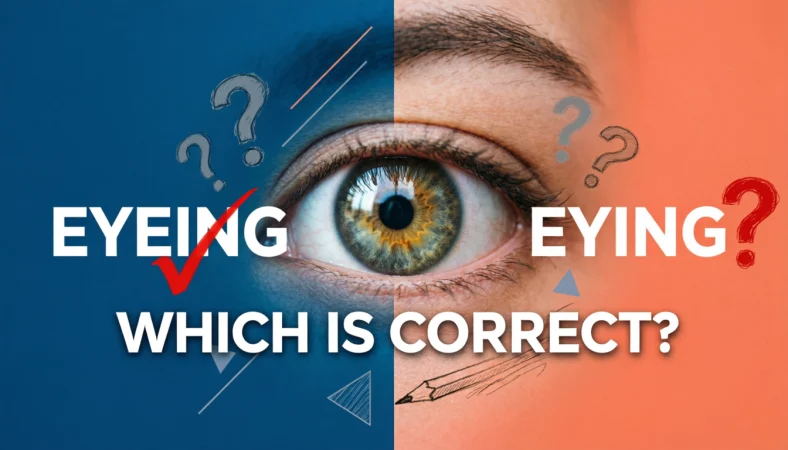
Quick answer : Eyeing is the correct and standard spelling.
Eying is a less common variant, but eyeing is preferred in modern English.
.Eying or Eyeing is a common spelling confusion because both forms look correct at first glance. The word comes from the verb eye, which means to look at, watch, or observe something carefully. When adding -ing, many people wonder whether to keep or remove the final e.
The correct and widely accepted spelling is eyeing. The extra e is kept to maintain the original word and avoid confusion with other forms. Although eying appears occasionally, eyeing is the preferred spelling in modern English.
Quick Answer Table
| Feature | Eyeing | Eying |
| Spelling | E Y E I N G | E Y I N G |
| Status | Standard, preferred spelling | Acceptable but less common variant |
| Meaning | Looking at, watching, observing | Looking at, watching, observing |
| Usage | Most style guides recommend this | Often used to simplify spelling |
| Pronunciation | EYE ing (two syllables) | EYE ing (two syllables) |
| Example Sentence | “She was eyeing the delicious cake.” | “She was eying the delicious cake.” |
Which One Is Correct?
Here’s the straightforward answer: both “eyeing” and “eying” are technically correct, but “eyeing” is the preferred and more widely accepted spelling in most English dictionaries and style guides.
The verb “to eye” means to look at something attentively, watch, observe, or examine with interest. When you add the ” ing” suffix to form the present participle, you have two acceptable options:
Eyeing (preferred): This spelling retains the ‘e’ from the base word “eye,” making it the more logical and traditional choice.
Eying (acceptable variant): This spelling drops the ‘e’ before adding ‘ ing,’ following the pattern of some other verbs that end in ‘e.’
While both spellings appear in published writing, “eyeing” is generally considered the standard form in American and British English. Major dictionaries like Merriam Webster, Oxford, and Cambridge list “eyeing” as the primary spelling, with “eying” as an acceptable variant.
Meaning of the Correct Word: Eyeing
Definition and Explanation
“Eyeing” (pronounced EYE ing) is the present participle of the verb “to eye.” It describes the action of looking at something or someone carefully, with interest, desire, suspicion, or attention. When you’re eyeing something, you’re not just casually glancing—you’re giving it focused attention.
The verb can carry various connotations depending on context:
- Desire or interest: Looking at something you want
- Suspicion or wariness: Watching something or someone with caution
- Observation: Paying close attention to details
- Evaluation: Assessing or appraising something
Real World Usage Examples
Here are practical examples showing how to use “eyeing” correctly in various contexts:
Casual/Everyday Context:
- “I saw her eyeing the last piece of pizza across the table.”
- “The cat was eyeing the bird outside the window with great interest.”
- “He kept eyeing my new phone, clearly impressed by the design.”
- “The children were eyeing the candy display in the store window.”
Professional/Business Context:
- “The company has been eyeing expansion opportunities in Asian markets.”
- “Investors are eyeing the tech startup as a potential acquisition target.”
- “She’s been eyeing a promotion for months and finally made her case.”
- “Several firms are eyeing the vacant office space downtown.”
Educational/Academic Context:
- “The students were eyeing the professor nervously before the exam.”
- “Researchers are eyeing the data for any unusual patterns.”
- “The scholarship committee is eyeing candidates with exceptional academic records.”
Literary/Metaphorical Context:
- “He was eyeing the horizon, searching for any sign of land.”
- “The old man sat eyeing the photographs, lost in memories.”
- “They were eyeing each other across the crowded room, neither willing to make the first move.”
- “Destiny seemed to be eyeing them from afar, waiting for the perfect moment.”
Contexts with Emotional Nuance:
- Desire: “She was eyeing the jewelry in the shop window longingly.”
- Suspicion: “The security guard kept eyeing the suspicious package.”
- Curiosity: “The tourists were eyeing the ancient ruins with wonder.”
- Competition: “The opposing team was eyeing our star player’s weaknesses.”
Meaning of the Alternative Word: Eying
“Eying” (also pronounced EYE ing) carries the exact same meaning as “eyeing”—it’s simply a variant spelling that omits the ‘e’ before adding the ‘ ing’ suffix.
Is Eying Incorrect?
No, “eying” is not incorrect, but it is considered a less common variant. Here’s what you should know:
Dictionary Status:
- Merriam Webster lists “eying” as a variant of “eyeing”
- Oxford English Dictionary accepts both spellings
- Cambridge Dictionary includes both forms
Usage Frequency:
- “Eyeing” appears significantly more frequently in published writing
- “Eying” is more common in informal writing and some regional contexts
Style Guide Recommendations:
- Most style guides (Chicago Manual of Style, AP Stylebook) prefer “eyeing”
- Academic writing typically uses “eyeing”
- British English tends toward “eyeing” more consistently than American English
The preference for “eyeing” makes logical sense because it preserves the visual connection to the root word “eye.” When you see “eyeing,” you immediately recognize the connection to “eye.” The variant “eying” looks somewhat abbreviated and can feel slightly informal.
Key Differences Between Eyeing and Eying
Spelling
| Aspect | Eyeing | Eying |
| Letters | E Y E I N G | E Y I N G |
| Vowel sequence | Y E I | Y I |
| Syllable structure | Eye + ing | Ey + ing |
| Visual recognition | Clearly related to “eye” | Slightly abbreviated appearance |
Meaning
Both words share identical meanings. There is no semantic difference between “eyeing” and “eying.” They both mean:
- Looking at something with attention or interest
- Observing or watching carefully
- Considering something with desire or intention
Pronunciation
Both spellings are pronounced identically: EYE ing (two syllables, with the stress on the first syllable). The pronunciation remains the same regardless of spelling because the ‘e’ that’s dropped in “eying” doesn’t affect how the word sounds.
Grammar
Both words function identically in sentences:
- They serve as present participles of the verb “to eye”
- They can be used in progressive tenses (“I was eyeing the painting”)
- They can function as gerunds (“Eyeing the competition is important”)
- They can be used as participial adjectives (“The eyeing customer was suspicious”)
Usage Frequency and Recognition
| Factor | Eyeing | Eying |
| Standard usage | Preferred | Acceptable variant |
| Professional writing | Recommended | Less common |
| Academic writing | Strongly preferred | Usually avoided |
| Informal writing | Common | Sometimes used |
| Major dictionaries | Primary listing | Secondary listing |
Historical Usage Trend
Interestingly, “eying” was more common in older English writing. Over time, “eyeing” has become the dominant spelling. Modern usage data shows that “eyeing” appears approximately three to five times more frequently than “eying” in published texts.
Common Mistakes People Make
Understanding these common errors will help you spot and correct them in your own writing.
1. Assuming One Is Always Wrong
The most common mistake is believing that only one spelling is correct. Many writers incorrectly “correct” “eying” to “eyeing” or vice versa, not realizing both are acceptable. The truth is that while “eyeing” is preferred, “eying” isn’t wrong.
2. Inconsistent Usage
Some writers use “eyeing” in one sentence and “eying” in another without realizing they’re being inconsistent. This looks unprofessional and careless. Choose one spelling and stick with it throughout your document.
3. Confusing with “Eye” vs. “I”
The spelling “eying” sometimes looks like it could be a misspelling of something else entirely. It’s one reason many readers prefer “eyeing” for clarity and immediate recognition.
4. Overlooking Context
In formal writing, using “eying” might be perceived as a spelling error by less informed readers. While it’s technically correct, some audiences might see it as a mistake. Understanding your audience helps determine which spelling to choose.
5. Mispronunciation
Some people assume “eying” is pronounced with a short ‘e’ sound (like “eh ying”) instead of “EYE ing.” This is incorrect—both forms are pronounced the same way.
6. Applying the Wrong Spelling Rule
English spelling rules often say to drop the final ‘e’ before adding ‘ ing’ (like “write” → “writing” or “make” → “making”). However, there’s an exception for words ending in ‘ye’ where the ‘e’ is often kept to prevent confusion. “Eye” is one of these exceptions.
7. Formatting Errors
Some writers accidentally add an extra ‘e’ (eyeeing) or misspell as “eyeing” when they meant something else entirely.
8. Confusion with “Eying” in Other Contexts
While “eying” is a variant of “eyeing,” it’s worth noting that there are no common words spelled “eying” with a different meaning, so confusion with other words is minimal.
Correct Usage Examples
Casual/Everyday Examples with “Eyeing”
- “I noticed you eyeing my sandwich—do you want a bite?”
- “The dog was eyeing the juicy steak on the kitchen counter.”
- “We were eyeing the beautiful sunset from the beach.”
- “He spent the whole date eyeing the waitress instead of paying attention to me.”
- “The kids were eyeing the cookies cooling on the rack.”
Professional/Business Examples with “Eyeing”
- “The marketing team has been eyeing new demographics to expand our customer base.”
- “Several companies are eyeing our latest innovation with keen interest.”
- “She’s eyeing a leadership position and has been taking extra courses to qualify.”
- “We’ve been eyeing that office space for months and finally made an offer.”
- “Industry analysts are eyeing our quarterly results with anticipation.”
Educational/Academic Examples with “Eyeing”
- “The doctoral candidate has been eyeing prestigious universities for her postdoc.”
- “The admissions committee is eyeing applicants with demonstrated research experience.”
- “Teachers were eyeing the new curriculum guidelines with mixed feelings.”
- “Students were eyeing the scholarship opportunities posted on the board.”
- “The researcher has been eyeing unusual patterns in the data for weeks.”
Literary/Metaphorical Examples with “Eyeing”
- “She sat in the corner, eyeing the crowd like a hawk watching its prey.”
- “Fate seemed to be eyeing him from the shadows, waiting for the right moment.”
- “The old mansion stood eyeing visitors with its dark, empty windows.”
- “They were eyeing each other across the chessboard, each calculating the next move.”
- “The opportunity had been eyeing him all along; he just hadn’t noticed.”
Professional Examples with “Eying” (Variant Spelling)
- “The consortium is eying a merger with the larger corporation.”
- “She’s been eying the role of department head for years.”
- “Venture capitalists are eying the startup’s growth metrics.”
- “The company is eying international expansion in the coming fiscal year.”
- “Investors have been eying renewable energy stocks with increasing interest.”
Formal Writing Recommendations
When writing in formal contexts, “eyeing” is the stronger choice. It appears more polished and aligns with the preferences of major style guides:
- Business Reports: Use “eyeing”
- Academic Papers: Use “eyeing”
- News Articles: Use “eyeing” (most publications)
- Corporate Communications: Use “eyeing”
- Legal Documents: Use “eyeing” for clarity
Informal Writing and Social Media
In informal contexts, “eying” is perfectly acceptable. Blog posts, social media updates, personal emails, and casual messaging can use either form. Consistency matters more than the specific choice in these situations.
Word Origin and Etymology
The story of “eyeing” and “eying” begins with the Old English word “ēage” (pronounced “ay ah guh”), which meant the organ of sight and was spelled something like “eage” in older texts. This word evolved through Middle English “eie” to Modern English “eye.”
The Verb “To Eye”
The verb form developed later, in the 16th century, meaning “to observe, watch, or look at.” It naturally derives from the noun “eye,” describing what the eye does.
The ” ing” Suffix Rule
When adding the ” ing” suffix to verbs ending in “e,” English generally follows this rule:
- If the word ends in a consonant + “e,” drop the “e” before adding ” ing”:
- “write” → “writing”
- “make” → “making”
- “come” → “coming”
- If the word ends in “ee,” keep both “e”s before adding ” ing”:
- “see” → “seeing”
- “agree” → “agreeing”
- “flee” → “fleeing”
- “Eye” is an exception because it ends in “ye.” The “e” at the end is kept to preserve clarity and prevent confusion. The “ye” sound (like the word “eye” itself) would be less recognizable without the final “e.”
Why the Exception Exists
If we applied the standard rule to “eye” (dropping the ‘e’), we would get “eying.” While this is acceptable, it obscures the word’s visual connection to “eye.” Some language experts argue that keeping the “e” helps maintain clarity, especially for readers who might otherwise misread or misunderstand the word.
The preservation of the “e” in “eyeing” follows the principle of maintaining morphological transparency—keeping the relationship between the base word and its derived forms visually clear.
Why the Incorrect Version Became Popular
The debate between “eyeing” and “eying” persists for several reasons:
The Standard English Spelling Rule
Most verbs ending in “e” drop that “e” before adding ” ing”:
- “make” → “making”
- “take” → “taking”
- “use” → “using”
- “write” → “writing”
This rule is drilled into English learners from an early age. It’s natural to assume “eye” should follow the same pattern, leading to the creation of “eying.”
Intuitive Application of the Rule
When people encounter “eye” and need to add ” ing,” many instinctively apply the familiar rule. They think: “It ends in ‘e,’ so drop the ‘e’ and add ‘ ing.'” This intuitive approach produces “eying.”
Regional Variations
“Eying” appears more frequently in certain regions and publications. While it’s not tied to a specific dialect, some writers and editors prefer it because it’s shorter and follows the standard rule more closely.
Historical Usage
In older English texts, “eying” was more common. Some writers maintain this older spelling tradition, either consciously or unconsciously, contributing to its continued presence.
Digital Typing Habits
In our digital age, people often type quickly, and autocorrect sometimes suggests one version over the other. The variant “eying” might appear because of typos that later become accepted as informal usage.
The Desire for Simplicity
Some writers simply prefer the shorter spelling. “Eying” has five letters instead of six, and for those who value concision, this is appealing.
Lack of Clear Guidance
Because both spellings are technically acceptable, many people aren’t sure which one to use. This uncertainty leads to inconsistent usage and perpetuates the confusion.
Easy Memory Tricks
Use these proven techniques to remember the preferred spelling and never second guess yourself again.
1. The “Eye” Connection
Remember: “Eye” + ” ing” = “Eyeing.” Think of it this way: you’re adding ” ing” to “eye,” and you keep the “eye” intact. The word “eye” contains two ‘e’s, and you keep both when forming the participle.
Memory Phrase: “Keep the eye in eyeing.”
2. Visual Recognition
When you see “eyeing,” you immediately recognize the connection to “eye.” The word looks exactly how it should—a combination of “eye” and ” ing.” This visual clarity makes “eyeing” the better choice for clear communication.
3. Consistency Pattern
Words ending in “ee” keep both ‘e’s before adding ” ing”:
- “see” → “seeing”
- “agree” → “agreeing”
- “flee” → “fleeing”
- “knee” → “kneeing”
- “eye” → “eyeing”
While “eye” ends in “ye” rather than “ee,” it follows a similar pattern of retaining the final ‘e’ for clarity.
4. The “Five Letters” Observation
If you see “eying” and it looks like it could be a typo or abbreviation, you’ll know to use “eyeing” instead. The extra ‘e’ in “eyeing” serves as a visual confirmation that you’re spelling it correctly.
5. Think of the “Eyes”
When you’re writing about someone looking at something, think about “eyes.” Both “eyes” and “eyeing” share the same “eye” base. This mental connection reinforces the correct spelling.
6. Style Guide Preference
Remember that major style guides prefer “eyeing.” If you’re writing professionally or academically, using the preferred spelling signals attention to detail and familiarity with standard conventions.
7. The “L” and “I” Check
Notice that “eying” has an ‘i’ after the ‘y,’ which might look like it should be spelled “eying” (a common misspelling of “eyeing”). If you keep the ‘e’ before the ‘i,’ you avoid this potential confusion.
8. “Dyeing” Comparison
“Dyeing” (coloring something) and “dying” (ceasing to live) are often confused. Similarly, “eyeing” and “eying” exist as acceptable variants. Just as “dyeing” is preferred for the coloring meaning, “eyeing” is preferred for the looking meaning. This analogy helps reinforce the choice.
Practical Application Guide
When to Use “Eyeing” (Recommended)
- ✅ Academic papers and research articles
- ✅ Business reports and corporate communications
- ✅ Professional emails and official documents
- ✅ News articles and journalistic writing
- ✅ Formal essays and creative writing
- ✅ When following major style guides (Chicago, AP, APA, MLA)
When to Use “Eying” (Acceptable)
- ✅ Personal blogs and informal writing
- ✅ Social media posts and casual messaging
- ✅ Creative writing where the author prefers it
- ✅ Poetry for metrical reasons (though both have same syllables)
- ✅ When consistency with other ‘ ing’ words is important to you
Practical Tips for Writers
Tip 1: Be Consistent
Whatever spelling you choose, use it consistently throughout your document. Switching between “eyeing” and “eying” looks unprofessional and can confuse readers.
Tip 2: Know Your Audience
If you’re writing for a formal audience or publication, choose “eyeing.” For informal contexts, either is acceptable.
Tip 3: Check Style Guides
If you’re writing for an institution or publication with specific style requirements, check their preferred spelling. Most use “eyeing.”
Tip 4: Use Spell Check as a Tool
Most spell check programs flag “eying” as potentially incorrect. This doesn’t mean it’s wrong, but it’s a good reminder that “eyeing” is the more standard choice.
Tip 5: Read Aloud
Both words sound identical, so reading aloud won’t help with spelling. Instead, rely on visual memory and the spelling patterns you’ve learned.
Final Comparison Chart
| Aspect | Eyeing | Eying |
| Status | Standard, primary spelling | Acceptable variant |
| Formality | Suitable for all contexts | Better for informal use |
| Dictionary listing | Primary listing | Secondary/alternative listing |
| Style guide | Recommended | Usually noted as variant |
| Visual clarity | Very clear connection to “eye” | Less obvious connection |
| Pronunciation | EYE ing | EYE ing |
| Meaning | Looking at attentively | Looking at attentively |
| Grammatical function | Present participle of “eye” | Present participle of “eye” |
| Recommended use | Professional, academic | Informal, casual |
FAQs
1. Is eying or eyeing correct?
Both are accepted, but eyeing is the preferred and more common spelling.
2. Why is eyeing preferred?
It keeps the original word eye clear before adding -ing.
3. Is eying wrong?
No, it is a valid but less common spelling variant.
4. Which spelling should I use?
Use eyeing in formal and professional writing.
5. Do eyeing and eying mean the same?
Yes, both mean looking at something carefully or with interest.
6. How is eyeing pronounced?
Both are pronounced “EYE-ing.”
7. Is eyeing used in British and American English?
Yes, eyeing is common in both.
8. Can eye be used as a verb?
Yes, “eyeing” is the -ing form of the verb eye.
9. Is eyeing better for exams?
Yes, eyeing is the safer standard choice.
10. How can I remember it?
Remember: Keep the “eye” in eyeing
Conclusion
The difference between eyeing and eying is mainly about spelling preference, not meaning. While both forms are accepted, eyeing is the more common and widely preferred spelling in modern English. It is the safest choice for formal writing and professional communication.
Rmembering “keep the eye in eyeing” makes the correct form easy to recall. Whether you are describing someone eyeing an opportunity, a meal, or a goal, using eyeing helps your writing stay clear, polished, and consistent.