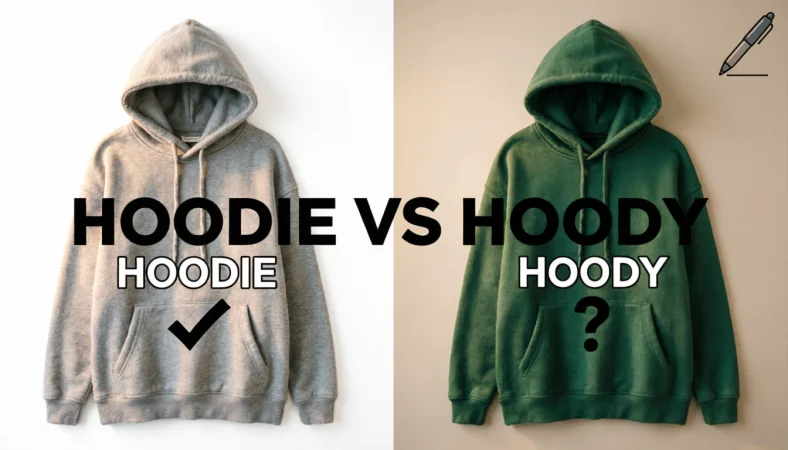
Hoodie is a sweatshirt or jacket with a hood. Example: I bought a new hoodie. Hoodyis a less common variant spelling, used in some regions but not preferred in general writing
Hoody or Hoodie is a common spelling confusion because both words refer to the same type of clothing: a sweatshirt or jacket with a hood. The word is widely used in fashion and everyday English to describe a comfortable, casual garment worn for warmth and style.
Although hoody appears as a variant spelling in some places, hoodie is the more popular and widely accepted spelling in modern English. Understanding this small difference helps you choose the standard form in writing and everyday communication
Quick Answer Table
| Feature | Hoodie | Hoody |
| Correct Spelling | H O O D I E | H O O D Y |
| Status | Standard, widely accepted | Less common, informal variant |
| Primary Meaning | A sweatshirt with a hood | Same as hoodie |
| Usage | Mainstream writing, fashion, retail | Casual contexts, some brands |
| Example Sentence | “I grabbed my favorite hoodie before heading out.” | “She wore a cozy hoody to the bonfire.” |
Which One Is Correct?
The short answer is both are technically correct, but one is significantly more common and preferred in standard English usage.
Hoodie is the standard spelling recognized by major dictionaries, style guides, and most English language authorities. It’s the spelling you’ll encounter in fashion magazines, retail websites, product descriptions, and everyday conversation. When in doubt, hoodie is your safest and most widely accepted choice.
Hoody, while not incorrect, is considered a less common variant. It appears occasionally in casual writing, some brand names, and informal contexts. However, it’s not the preferred spelling in formal writing or professional settings.
The confusion between these two spellings is understandable. English has many words that can end in either ” ie” or ” y,” and the choice often depends on regional preferences, personal style, or historical usage patterns.
Meaning of the Correct Word: Hoodie
Definition and Explanation
A hoodie (pronounced HUH dee) is a type of sweatshirt or jacket that features a hood attached to the back or neck area. It’s typically made from cotton, fleece, or synthetic fabrics and often includes:
- A hood with drawstrings or elastic for adjustability
- A front pocket (kangaroo pocket) or zippered closure
- Long sleeves with ribbed cuffs
- A relaxed, comfortable fit
Beyond its literal definition, “hoodie” has evolved to represent much more than just a piece of clothing. It symbolizes casual comfort, streetwear culture, youth fashion, and even social identity. Hoodies are worn by people of all ages, genders, and backgrounds, making them one of the most democratic fashion items in existence.
The term “hoodie” is also a popular colloquialism used in specific contexts like the gaming community, where a “hoodie” might refer to a character wearing a hooded garment, or as a shorthand for “neighborhood” in some urban slang contexts.
Real World Usage Examples
Here are practical examples showing how to use “hoodie” correctly in various contexts:
Casual/Everyday Context:
- “I love this hoodie because it’s so soft and warm.”
- “Make sure you grab a hoodie before we go for the evening walk—it’s getting chilly.”
- “My favorite hoodie has a giant cat face on the front.”
- “I practically live in my hoodie during the winter months.”
Fashion/Retail Context:
- “Our new collection features sustainable hoodies made from organic cotton.”
- “The oversized hoodie trend shows no signs of slowing down.”
- “This hoodie is available in five different colors and sizes XS to XL.”
- “Celebrities have been spotted wearing this brand’s signature hoodie.”
Professional/Career Context:
- “Tech startups have made the hoodie a symbol of their casual, innovative culture.”
- “She wore a stylish hoodie under her blazer for a smart casual look.”
- “The company gave every employee a branded hoodie as part of the onboarding package.”
Educational/School Context:
- “Most students wear a hoodie to class, especially during exam season.”
- “The school store sells hoodies with the university logo and mascot.”
- “He pulled his hoodie up and put his headphones on to focus on his studying.”
Gaming and Pop Culture Context:
- “The game’s protagonist is known for his signature red hoodie.”
- “Streamers often sell branded hoodies to their followers.”
Meaning of the Incorrect or Alternative Word: Hoody
Hoody is not incorrect in the sense that it’s a misspelling, but rather an alternative and less common spelling variant. It’s important to understand its status and appropriate usage contexts.
What Is a Hoody?
A hoody is the exact same garment as a hoodie—a hooded sweatshirt. The only difference is the spelling. “Hoody” is simply a variant that has existed for many years but never achieved the mainstream acceptance that “hoodie” enjoys.
Some fashion brands and retailers use “hoody” intentionally as part of their branding or product naming conventions. Others use it to sound more casual, streetwear oriented, or distinctive from competitors.
Usage Contexts for Hoody
Where You Might See “Hoody”:
Brand Names and Product Lines:
- Some clothing brands use “hoody” as a deliberate stylistic choice
- “The Original Hoody” or “Classic Hoody” appear in some product catalogs
- Streetwear brands sometimes prefer “hoody” for its edgier feel
Casual/Informal Writing:
- Personal blogs and social media posts
- Text messages and casual emails
- Informal online forums and community discussions
Regional Variations:
- In some parts of the United States and the United Kingdom, “hoody” appears more frequently
- Australian and New Zealand English sometimes lean toward “hoody”
Less Formal Retail Settings:
- Small boutiques or vintage shops
- Seller listings on platforms like Etsy or Depop
- Limited edition or capsule collections
Example Uses of “Hoody”:
- “I picked up this hoody from a local streetwear brand.”
- “She always wears that grey hoody to the gym.”
- “Limited edition hoody now available on our website.”
Key Differences Between Hoodie and Hoody
Spelling
| Hoodie | Hoody |
| H O O D I E | H O O D Y |
| 6 letters | 5 letters |
| Ends with “IE” | Ends with “Y” |
| Contains “I” before final “E” | Contains no “I” before the final “Y” |
Meaning
| Hoodie | Hoody |
| Hooded sweatshirt | Hooded sweatshirt |
| Identical meaning | Identical meaning |
| No difference in definition | No difference in definition |
Pronunciation
Both “hoodie” and “hoody” are pronounced exactly the same way: HUH dee (ˈhʊdi).
The pronunciation remains consistent regardless of spelling because both endings ( ie and y) produce the same “ee” sound in this context. This similarity in pronunciation contributes to the confusion—when words sound identical but are spelled differently, it’s natural for people to wonder which version is correct.
Grammar and Usage
Hoodie:
- Common noun
- Used in formal writing, journalism, and professional contexts
- Preferred by dictionaries: Merriam Webster, Oxford, Cambridge
- More common in UK and US mainstream usage
- Appears more frequently in published works
- The standard spelling for search engines and SEO purposes
- Used in most product descriptions and fashion articles
Hoody:
- Common noun
- Used primarily in casual or informal writing
- Sometimes used for branding or stylistic effect
- Less frequent in published works
- May be considered nonstandard in academic or professional contexts
- Regional preference in some areas
Recognition
Hoodie:
- Recognized universally
- Standard dictionary entry
- Dominant in online searches
- More likely to appear in style guides
- Preferred by major retailers (Amazon, ASOS, Zalando, etc.)
Hoody:
- Recognized but less common
- May be marked as variant spelling in dictionaries
- Lower search volume
- Considered informal by some authorities
- Sometimes flagged as incorrect by spell checkers
Common Mistakes People Make
Assuming “Hoody” Is Always Incorrect
One of the most common misconceptions is that “hoody” is a misspelling or typo. While “hoodie” is undeniably the preferred and standard spelling, “hoody” has legitimate usage in certain contexts. It’s not wrong—just less common.
Inconsistent Usage Within a Single Document
Some writers will use “hoodie” in one paragraph and “hoody” in the next, creating inconsistency. Choose one spelling and stick with it throughout your writing unless you have a specific reason to vary.
Forgetting the ‘ ie’ or ‘ y’ Rule
English has many words that end with a similar sound but different spellings. For example:
- “Corgi” (dog breed) ends in ” i”
- “Barbie” (doll) ends in ” ie”
- “Buddy” (friend) ends in ” y”
- “Candy” (sweet) ends in ” y”
Understanding these patterns helps with “hoodie” vs. “hoody” as well.
Overcomplicating the Choice
Some writers agonize over this decision unnecessarily. In most cases, especially in informal writing, either spelling is acceptable. The key is understanding your audience and context.
Misspelling Variations
Other misspellings to avoid:
- “Hoodey”
- “Hoodee”
- “Hoody” (acceptable but less common)
- “Hoodies” (plural always ends with ” ies”)
Correct Usage Examples
Hoodie Examples
Casual Examples:
- “I’m going to throw on my hoodie and go for a walk.”
- “This hoodie is the most comfortable thing I own.”
- “She borrowed my hoodie and never gave it back.”
- “My hoodie has a stain on it, but I don’t even care.”
Professional Examples:
- “The company distributed custom hoodies to employees as a team building gesture.”
- “He wore a black hoodie with a blazer for the casual Friday dress code.”
- “Our product line features premium hoodies with moisture wicking fabric.”
Fashion Examples:
- “The oversized hoodie trend dominated the fall/winter collections.”
- “This hoodie combines comfort with sustainability, using recycled materials.”
- “Designers are reimagining the hoodie as a high fashion staple.”
Pop Culture Examples:
- “Mark Zuckerberg is famously known for his grey hoodie.”
- “The character’s signature hoodie became iconic among fans.”
- “Streetwear brands have elevated the hoodie to luxury status.”
Educational Examples:
- “The school’s hoodie design competition attracted over 100 entries.”
- “Students are encouraged to wear their class hoodies on spirit days.”
Hoody Examples
Casual Examples:
- “I grabbed my hoody before heading to the gym.”
- “This hoody is perfect for lounging around the house.”
- “She gifted me a hoody with my favorite band’s logo.”
Brand/Retail Examples:
- “The brand launched its limited edition hoody collection.”
- “Our classic hoody is available in three colors.”
- “The hoody features a bold graphic print on the back.”
Regional Examples (UK/Australia):
- “He wore his team’s hoody to the match.”
- “The hoody is the ultimate comfort clothing.”
Word Origin / Etymology
Origin of Hoodie
The term “hoodie” is a relatively modern addition to the English language. The word derives from:
“Hood” (Old English hōd): A covering for the head, often attached to a cloak or coat. The word “hood” itself has ancient roots in Proto Germanic hodaz, meaning a covering or helmet.
The ” ie” Suffix: The diminutive suffix ” ie” (also ” y”) is used in English to create informal or affectionate versions of words. Examples include:
- “Doggie” (dog)
- “Cutie” (cute person)
- “Bookie” (bookmaker)
- “Cookies” (small cakes)
When the hooded sweatshirt became popular in the 1970s and 1980s, people naturally added the ” ie” suffix to describe this new, casual garment. The suffix conveys familiarity, informality, and a sense of comfort—perfectly matching the garment’s appeal.
Evolution of the Hoodie
1970s: The hoodie began its rise as practical sportswear, particularly in New York City. It was worn by workers, athletes, and young people.
1980s 1990s: The hoodie became associated with hip hop culture, skaters, and street fashion. It gained mainstream popularity and started appearing in movies and music videos.
2000s: The hoodie became a global fashion statement, worn by everyone from celebrities to CEOs. It transcended its humble origins to become a cultural symbol.
2010s Present: The hoodie is now a wardrobe staple, with countless variations in style, material, and design. It represents comfort, casual luxury, and individual expression.
Origin of Hoody
“Hoody” emerged around the same time as “hoodie,” likely as a natural spelling variation. The ” y” ending is also a common informal suffix in English (think “mommy,” “daddy,” “kitty”). Both spellings developed organically, but “hoodie” eventually became the dominant form for several reasons.
Why the Incorrect Version Became Popular
The ” y” vs. ” ie” Pattern in English
English has numerous informal nouns that end in ” y” or ” ie.” The choice often depends on:
- Regional preferences
- Historical usage
- Specific word conventions
- Personal style
For example:
- “Kitty” is standard, but “kittie” exists as a variant
- “Daddy” is standard, but “daddee” is not
- “Candy” is standard, “candie” is not
- “Hoodie” is standard, “hoody” is the variant
The uncertainty arises because there’s no fixed rule governing which suffix to use in every situation. Each word develops its own conventions.
Branding and Marketing
Some fashion brands deliberately choose “hoody” for their product names to:
- Stand out from competitors
- Create a distinctive brand identity
- Appeal to specific subcultures
- Sound edgier or more casual
Regional Preferences
In some English speaking regions, particularly parts of the UK and Australia, “hoody” appears more frequently in everyday writing. This regional variation contributes to ongoing confusion about which spelling is “correct.”
Internet Influence
Social media, online forums, and informal digital communication often use “hoody” more frequently than formal writing. As these platforms influence language, the variant spelling persists and sometimes gains traction.
Easy Memory Tricks
Remember “Hoodie” with “IE”
“I Enjoy” my hoodie! The “IE” in “hoodie” stands for “I Enjoy”—and who doesn’t enjoy wearing a comfortable hoodie?
“IE” for “Informal and Everyday”: Hoodies are informal, everyday clothing items. The “IE” ending matches this casual, approachable vibe.
“Y” is for “You” but “IE” is for “I”: When you’re talking about yourself and what you want to wear, use “hoodie.” The “I” comes first in both “I” and “hoodIE.”
Think of Similar Words
Words that end in ” ie” that you already know:
- “Cookie” (not “cooky”)
- “Movie” (not “mové” or “movy”)
- “Nightie” (nightgown, not “nighty”)
- “Auntie” (aunt, not “aunty” in standard UK usage)
If you can remember these words, “hoodie” follows the same pattern.
The Dictionary Test
If you’re ever unsure, remember that major dictionaries (Merriam Webster, Oxford, Cambridge) all list “hoodie” as the primary spelling. If a word is in the dictionary as the main entry, it’s the safest choice.
Context Matters
Think about where you’re writing:
- Academic or professional writing? Use “hoodie”
- Fashion publication? Use “hoodie”
- Product description? Use “hoodie” (most retailers do)
- Social media or text? Either is fine
- Brand specific usage? Follow the brand’s lead
FAQs
1. Is “hoody” or “hoodie” correct?
Both exist, but hoodie is the standard and preferred spelling.
2. Do hoody and hoodie mean the same thing?
Yes, both refer to a hooded sweatshirt.
3. Why are there two spellings?
English allows different informal spelling variations like -ie and -y.
4. Which spelling should I use?
Use hoodie for formal writing, SEO, and general use.
5. Is hoody a wrong spelling?
No, it is a less common variant spelling.
6. Is hoody British English?
It appears in British usage but is not a standard regional spelling.
7. Why do spell checkers flag hoody?
Because hoodie is the more common dictionary form.
8. What is the plural of hoodie/hoody?
Both become hoodies.
9. Can I use hoody in formal writing?
You can, but hoodie is more widely accepted.
10. Which spelling is common in fashion?
The fashion industry mostly uses hoodie.
11. Is hoodie better for SEO?
Yes, hoodie is more searchable and popular.
12. Will hoody look incorrect?
No, but it may look less standard than hoodie
Conclusion
The difference between hoody and hoodie is simple: hoodie is the most common, standard, and widely accepted spelling, while hoody is a less common variant. Both refer to the same hooded garment, but choosing hoodie is the safest option for professional writing and everyday use.
In the end, the spelling depends on your context and audience. For general communication, fashion, and online content, hoodie remains the preferred choice. Understanding this difference helps you write clearly and confidently without confusion