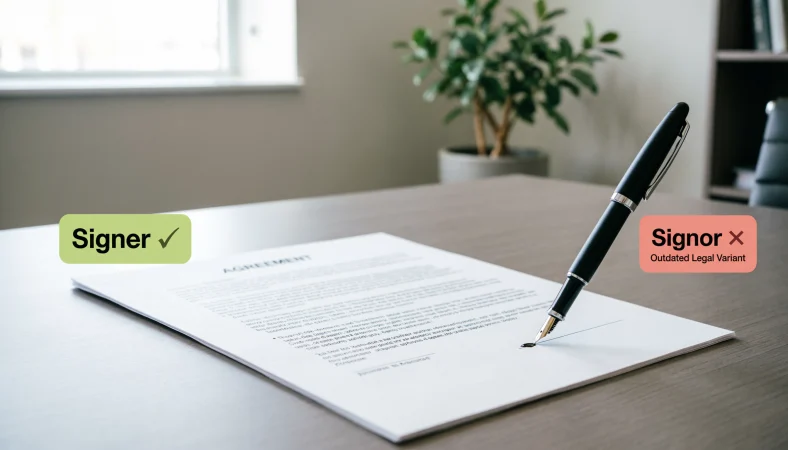
Quick Ans: Signer is the correct modern English word for a person who signs a document, while signor is an obsolete legal spelling and should generally be avoided except when referring to the Italian title meaning “Mr.” or “Sir.”
Have you ever stared at a legal document, a formal letter, or a job application and felt a twinge of uncertainty about whether to write signer or signor? You are not alone. This exact question trips up thousands of educated professionals, paralegals, nursing job applicants, and even seasoned contract managers every single day. The confusion between these two words sits quietly at the intersection of legal terminology, everyday English usage, and the kind of formal writing where mistakes feel particularly embarrassing.
The mix up persists because both words look plausible, both relate to the act of signing, and autocorrect frequently fails to flag the error. Yet only one of these spellings belongs in standard modern English. Using the wrong form in a professional document, a cover letter for nurse jobs, or a binding agreement can undermine your credibility in ways you might not even notice.
This comprehensive guide will walk you through the precise difference between signer and signor, explore why the confusion exists, and provide you with memory tools that will permanently settle the question. By the time you finish reading, you will know exactly which word to use in every context, how to pronounce each form, and why mastering this distinction signals genuine writing competence.
Quick Answer Table
| Question | Answer |
| Correct standard spelling | Signer |
| Alternative spelling status | Signor (archaic legal variant) |
| Primary meaning | A person who signs a document |
| Modern usage frequency | Signer dominates in all contexts |
| Recommended for professional writing | Always use signer |
| Example sentence | The signer must provide valid identification before the notary public can proceed |
Which One Is Correct?
The straightforward answer is that signer represents the correct, modern, and universally accepted spelling in American English, British English, Canadian English, and Australian English. Every major style guide, dictionary, and grammar authority recognizes signer as the standard form. The word signor exists as a historical variant that has largely disappeared from contemporary usage, surviving only in a handful of extremely specific and increasingly rare legal contexts.
When you write signer, you align yourself with the conventions followed by The Chicago Manual of Style, the Associated Press Stylebook, Merriam Webster, Oxford English Dictionary, and every widely respected authority on the English language. When you write signor, you risk appearing outdated, unaware of modern conventions, or simply mistaken.
Grammar experts and professional editors consistently recommend signer for all types of writing, from casual emails to Supreme Court briefs. The alternative spelling has not been the preferred form in any major English speaking jurisdiction for well over a century.
Meaning of the Correct Word
Signer functions as a noun that refers to any person who signs something. The definition is remarkably straightforward, yet the word carries significant legal and professional weight that makes understanding its proper usage essential for anyone who handles documents, contracts, or formal correspondence.
Definition and Core Explanation
A signer is an individual who affixes their signature to a document, thereby indicating agreement, acknowledgment, authorization, or attestation. The term applies whether the person signs with a pen on paper, uses an electronic signature pad, or clicks an “I agree” button on a digital platform. The act of signing transforms the individual into a signer at the moment the signature is completed.
The word describes a role rather than a permanent identity. You become a signer when you endorse a check, execute a will, finalize a mortgage, accept a job offer letter, or authorize a medical procedure. Before signing, you are a prospective signer. After signing, you become a signer of that specific document.
Professional and Legal Contexts
In legal environments, signer carries precise implications. The signer of a contract assumes whatever obligations the document describes. Notaries public verify the identity of signers. Banks maintain signature cards that link signers to specific accounts. Loan documents require multiple signers when co borrowers are involved. Each of these contexts demands the standard spelling signer.
Real World Usage Examples
A nurse accepting a position at a hospital becomes the signer of an employment contract. The human resources department processes the signed document and files it in the signer’s personnel record. If the nurse later applies for travel nurse jobs, each new assignment creates a new set of documents requiring the nurse’s signature, making them a signer multiple times throughout their career.
A small business owner signing a commercial lease becomes the signer on a legally binding agreement that may span five or ten years. The landlord and the tenant are both signers, each bound by the terms they accepted through their signatures.
A parent registering a child for school becomes the signer of permission slips, emergency contact forms, and liability waivers. Each document creates a record linking the signer to the permissions granted.
The Legal Weight of Being a Signer
Courts treat signers as having read and understood the documents they sign, even when this assumption proves factually incorrect in specific cases. This legal principle, known as the duty to read, places significant responsibility on every signer. The signature serves as prima facie evidence that the signer accepted the terms contained in the document. This reality makes the correct spelling of the word far less important than understanding the obligations it represents, but using the standard spelling demonstrates the professionalism that the role demands.
Meaning of the Incorrect or Alternative Word
Signor represents a fascinating linguistic artifact that reveals much about the history of English legal language while having almost no place in modern writing. Understanding where this spelling came from and why it persists in certain narrow contexts helps explain the confusion that brings readers to articles like this one.
The Historical Legal Variant
Signor emerged centuries ago as a variant spelling influenced by Anglo Norman legal terminology. After the Norman Conquest of England in 1066, French became the language of English law courts, and French derived legal terms flooded into English. The or suffix appeared in numerous legal nouns describing people who perform specific actions, including donor, grantor, lessor, mortgagor, and vendor. Signor followed this pattern naturally, fitting comfortably alongside its legal cousins.
For several centuries, signor appeared regularly in English legal documents. Lawyers, scriveners, and court clerks used the spelling without question. It represented not an error but a convention, a standard form within a specialized professional community that maintained its own linguistic norms separate from general usage.
Why Signor Fell Out of Use
Language evolves, and legal language evolves with it, albeit more slowly than everyday speech. The er suffix gradually overtook or as the standard agent noun ending in English. Words like baker, builder, painter, and teacher all use er. Signer followed this broader pattern, displacing signor in general usage by the nineteenth century and in legal usage by the early twentieth century.
Modern legal writing textbooks, including Bryan Garner’s authoritative works on legal style, recommend signer over signor without reservation. The shift reflects a broader movement toward plain language in legal writing, a recognition that legal documents should communicate clearly rather than preserve archaic forms for their own sake.
Modern Status as an Error
Today, signor counts as a spelling error in virtually every context. Microsoft Word and Google Docs flag it. Professional proofreaders correct it. Grammar checking software marks it. Law school writing programs teach students to avoid it. The consensus is overwhelming and consistent across every variety of English.
A handful of older attorneys may still use sign or sign out of habit, and you might encounter it in legal documents drafted decades ago. You might also see it in older court opinions or in the occasional template that has not been updated since the Nixon administration. Its presence in these contexts does not make it correct. It merely reflects the slow pace at which some legal writing conventions change.
Regional and Dialectal Considerations
No major English speaking region currently prefers sign language. British legal writing follows the same convention as American legal writing on this point. Canadian, Australian, New Zealand, and South African usage all favor signers. The spelling signor has no regional stronghold where it remains the accepted form.
Key Differences Between the Two Words
Understanding the precise differences between signer and signor requires examining multiple dimensions of language, from spelling and pronunciation to grammar and professional recognition. Each difference contributes to the clear conclusion that signer represents the only appropriate choice for modern writing.
Spelling Difference
The visible difference between the two words is a single letter. Signer ends with er. Signor ends with or. This tiny orthographic distinction carries outsized consequences for how readers perceive the writer’s competence. The er spelling signals familiarity with modern conventions. The spelling signals either outdated knowledge or simple error.
The er suffix serves as the standard agent noun ending in modern English. It attaches to verbs to create nouns describing people who perform the verb’s action. A person who signs is a signer. A person who teaches is a teacher. A person who drives is a driver. The pattern is consistent and productive, generating new words as needed without controversy.
The or suffix also creates agent nouns, but it typically attaches to verbs of Latin origin and often carries a more formal or technical connotation. Actors, creator, director, and inventor all use or. Sign does not belong to the Latin derived category of verbs that naturally take or, which helps explain why signor gradually lost ground to signer.
Pronunciation Difference
Both spellings are pronounced identically in modern English. The standard pronunciation is SYE ner, with the first syllable rhyming with “eye” and the second syllable using the schwa sound followed by an r. No pronunciation difference distinguishes the two spellings in any major English dialect.
This identical pronunciation contributes to the spelling confusion. When people hear the word spoken, they cannot tell which spelling the speaker would use. They must learn the correct written form through explicit instruction or exposure to properly edited text.
In some historical periods, signor may have received a pronunciation closer to the French influenced legal terms it resembled, but any such distinction has long since vanished from English speech.
Grammar and Word Formation
Signer follows the standard English pattern for forming agent nouns from verbs. Add er to the verb sign, and the result is signer. This pattern is so regular that native English speakers apply it instinctively, even to novel verbs. Someone who yeets becomes a yeeter. Someone who Googles becomes a Googler. The pattern is deeply embedded in English grammar.
Signor follows an irregular pattern borrowed from French and Latin. While English does use or for many agent nouns, these typically come from Latin verbs with specific stem forms. Actor comes from Latin actor. Creator comes from Latin creator. Signor lacks this Latin pedigree, which is why the spelling never fully stabilized in English.
Usage in Professional and Legal Documents
Modern legal documents, contracts, mortgage papers, employment agreements, and notary forms all use signers. This standardization reflects deliberate choices by legal publishers, bar associations, and continuing legal education providers who have worked for decades to modernize legal writing.
If you submit a document using a signature to a court, a government agency, or a corporate legal department, someone will likely correct it. In the best case, the correction happens quietly. In the worst case, the error undermines your credibility in a context where credibility matters enormously.
Recognition by Authorities
Merriam Webster lists signer as the standard form and does not recognize signor as a valid variant. The Oxford English Dictionary notes signor as an archaic form but directs users to sign for current usage. Black’s Law Dictionary, the most authoritative legal dictionary in the United States, uses signer in its entries and examples. Garner’s Dictionary of Legal Usage specifically advises against signor.
No significant dictionary, style guide, or usage authority supports signor for contemporary writing. The unanimity on this point is unusual and worth noting. In many usage disputes, respected authorities disagree. Here, they do not.
Common Mistakes People Make
The confusion between signer and signor stems from several predictable sources. Understanding these sources helps writers recognize why the error tempts them and how to resist that temptation consistently.
Overcorrection Based on Legal Terminology
Legal language contains numerous words that describe parties to transactions and legal relationships. Grantor, lessor, mortgagor, obligor, promisor, and vendor all end in or. People who encounter these words regularly, particularly paralegals, legal secretaries, contract administrators, and real estate professionals, may assume that signor follows the same pattern.
This assumption represents an overcorrection, an attempt to apply a pattern that does not actually extend to signer. The legal terms that end in or typically derive from Latin or Anglo Norman verbs that followed specific morphological rules. Sign comes from Latin signare, but it entered English through a different pathway that favored the ending.
Influence of Signor as a Title
Italian uses Signor as a courtesy title equivalent to “Mister” or “Sir.” This Italian word, pronounced seen YORE, looks identical to the archaic English legal spelling signor. People who have encountered the Italian title in travel, literature, or opera may unconsciously associate the spelling with formality and respect, making signor seem like the more proper or dignified choice for legal contexts.
The Italian Signor has no etymological connection to the English word for someone who signs a document. They are unrelated words that happen to share a spelling. The Italian word derives from Latin senior, meaning older or elder. The English word derives from Latin signum, meaning mark or token. Their identical appearance is a coincidence, not a clue to correct usage.
Autocorrect Failures
Many spell checking and autocorrect systems handle signer and signor inconsistently. Some systems flag both words as correct. Others flag signor but allow users to add it to their custom dictionaries, perpetuating the error across all future documents. The inconsistency of automated checking means writers cannot rely on technology to catch this particular mistake.
The solution is to learn the correct spelling so thoroughly that you no longer need a spell checker to catch the error. Internal knowledge serves more reliably than external tools.
Assumption That Unfamiliar Spells Correct
Writers sometimes encounter signors in an old document, a poorly edited template, or a colleague’s email and assume the unfamiliar spelling must be the correct one. This assumption, that the less common form represents the more specialized and therefore more authoritative version, leads many writers astray.
In reality, the more common spelling, the one that appears in modern dictionaries and professionally edited publications, is the correct spelling. Signer appears far more frequently than signor in every searchable corpus of contemporary English. Frequency does not always equal correctness, but in this case, it does.
Confusion with er and or Agent Nouns Generally
English contains hundreds of agent nouns that end in either a or or. The rules governing which suffix applies to which verbs are complex, inconsistent, and riddled with exceptions. Advisor and adviser are both acceptable. The actor uses or, but the baker uses er. The creator uses or, but the painter uses er. This inconsistency creates a general uncertainty that spills over onto signer, even though signer itself follows a perfectly regular pattern.
Correct Usage Examples
Examples organized by context help cement the correct usage in your mind. Each example uses signer in a natural, idiomatic way that reflects how the word appears in genuine writing and speech.
Casual and Everyday Examples
The bank requires every signer on the account to appear in person with valid identification before we can add the new signer to the signature card.
My grandmother asked me to witness her will, but I could not serve as a witness because I am also a signer on one of the beneficiary designation forms.
The petition needed fifty signers before the city council would consider adding the item to their agenda, and we gathered sixty signers in just two days.
Professional and Business Examples
The human resources department emailed the new hire a digital copy of the employment agreement and instructed the signer to complete the electronic signature process within forty eight hours.
Travel nurse jobs typically require the signer to review and accept assignment specific terms for each contract, even when the signer has worked with the same staffing agency for years.
The mortgage company sent a mobile notary to the signer’s home because the signer could not travel to the title office during regular business hours.
The procurement manager serves as the authorized signer for all purchase orders exceeding ten thousand dollars, which means no large equipment acquisition moves forward without the signer’s written approval.
Educational and Instructional Examples
Teachers often explain to students that becoming a signer on a legal document carries responsibilities that extend beyond simply writing one’s name on a signature line.
The adult education class covered practical topics including how to read a contract before becoming a signer and what questions to ask before signing any binding agreement.
Parent volunteers must complete a background check before the school will add them as an authorized signer on field trip permission forms.
Legal and Formal Document Examples
The notary public verified the signer’s identity by examining a current driver’s license and a secondary form of identification before administering the oath and witnessing the signer’s signature on the affidavit.
The power of attorney document designated the signer’s adult daughter as the agent authorized to make financial decisions on the signer’s behalf in the event of incapacity.
The settlement agreement required each signer to initial every page and sign the final signature page in blue ink to distinguish the original signed document from photocopies.
Both signers appeared before the notary simultaneously, acknowledged that they understood the contents of the prenuptial agreement, and affirmed that they were signing voluntarily and without coercion.
Literary and Metaphorical Examples
History remembers the signers of the Declaration of Independence as men who pledged their lives, fortunes, and sacred honor to the cause of liberty, making each signer a figure of tremendous historical significance.
In a metaphorical sense, every person who joins a social movement becomes a signer of an unwritten compact, committing to shared values without ever putting pen to paper.
The poet described the artist as a signer of an invisible contract with posterity, one that demands honesty even when honesty comes at great personal cost.
Word Origin and Etymology
The etymological journey that produced signer begins with the Latin noun signum, meaning a mark, token, indication, or military standard. This word carried the core idea of a visible indicator that pointed to something beyond itself, a meaning that persists in the modern English concept of a signature as an outward mark of inward intent.
From Latin to Old French
Signum evolved into the Latin verb signare, meaning to mark, to designate, or to seal. This verb entered Old French as signer, maintaining both the spelling and the general meaning of making a mark to indicate authorization or ownership. Old French speakers used the word in contexts ranging from royal decrees to commercial transactions, establishing the connection between signing and legal significance that remains central to the word’s meaning today.
Entry into Middle English
After the Norman Conquest, signer entered Middle English as a loanword from Anglo Norman French. Early English uses appear in legal and administrative documents from the thirteenth and fourteenth centuries, where the word described people who affixed their marks or seals to official records.
During this period, the er and or spellings competed without a clear victor. Medieval spelling was inconsistent in general, and legal scribes often preserved French influenced spellings as a marker of professional identity. Both signer and signor appeared in documents from the same period, sometimes in documents written by the same scribe.
Standardization in Modern English
The gradual standardization of English spelling during the Early Modern period, accelerated by the printing press and the work of dictionary makers, pushed signer toward dominance. Samuel Johnson’s landmark dictionary of 1755 listed signer as the standard form. Noah Webster’s American dictionary followed suit. By the nineteenth century, signor had become recognizably archaic, a spelling that marked a document as old fashioned even to contemporary readers.
The er ending benefited from its regularity. As English grammar instruction became more systematic, teachers presented er as the normal way to form agent nouns from verbs. Signer fit this pattern so naturally that the alternative spelling could not maintain its foothold.
The Separate Etymology of Italian Signor
The Italian courtesy title Signor derives from Latin senior through a completely separate linguistic pathway. Senior meant older, and it evolved into a term of respect in several Romance languages. Spanish Señor, French Seigneur, and Italian Signor all share this origin. The accidental resemblance between the English word for a document signer and the Italian word for a gentleman is a coincidence of spelling conventions, not evidence of any historical connection.
Why the Incorrect Version Became Popular
The persistence of signor as a common error cannot be attributed to a single cause. Multiple factors combine to keep this spelling alive despite universal agreement among authorities that signer is correct.
The Weight of Legal Tradition
Legal language changes slowly. Courts still use terms like “heretofore” and “aforementioned” long after they have vanished from everyday speech. This conservatism creates an environment where archaic spellings can survive for generations, passed down in templates and form books that lawyers inherit from their predecessors.
An attorney who learned to use signor from a senior partner in 1975 may still use the spelling today, and junior associates who see the spelling in the partner’s work may adopt it without question. The error propagates through a kind of professional inertia, a sense that the older form must be the correct form because it appears in documents drafted by experienced practitioners.
The Pattern of Other Legal or Words
The presence of so many legitimate or agent nouns in legal vocabulary creates a powerful analogical pressure. When people see grantor, lessor, mortgagor, obligor, and vendor, they naturally assume that signor belongs in the same category. The pattern feels right, even though the etymology does not support it.
This analogical thinking affects even sophisticated language users. The human brain seeks patterns, and once it identifies the legal or pattern, it may apply the pattern to signer without pausing to check whether the application is correct.
Limited Explicit Instruction
Most people never receive explicit instruction on the difference between signer and signor. Grammar curricula in schools cover common homophones and frequently confused words, but this particular pair rarely makes the list. Students learn about their/there/they’re and affect/effect, but signer and signor pass unremarked.
Without explicit instruction, people rely on their instincts. Their instincts, shaped by exposure to the many or words in legal contexts, lead them toward signor. Only conscious learning can redirect this instinct toward the correct form.
The Internet’s Amplifying Effect
Before the internet, a spelling error in a legal document might be seen by a handful of people and corrected before the document reached a wider audience. Today, templates, samples, and examples circulate freely online, often without professional editing. A poorly drafted power of attorney form that uses signor can be downloaded thousands of times, each download spreading the error to a new user who may assume the form’s spelling is authoritative.
This amplification effect makes contemporary spelling errors more persistent than their historical counterparts. The internet preserves errors and distributes them widely, making it harder for correct usage to drive out incorrect usage through sheer frequency of exposure.
Easy Memory Tricks
Several reliable memory aids can help you permanently remember the correct spelling and avoid the embarrassment of using the archaic variant in professional or personal writing.
The Teacher Connection
Signer ends with er, just like teacher, baker, builder, painter, and dozens of other common agent nouns. When you sign a document, you are the signer, just as when you teach a class, you are the teacher. The er pattern is the normal English pattern. If you can remember that the signer follows the same rule as the teacher, you will never accidentally use the signor again.
The Modern Marker
Think of the er in signer as standing for “everyday regular.” Signer is the regular, everyday spelling for regular, everyday use. The spelling belongs to a small, specialized set of words, but signer does not belong to that set. When in doubt, use the regular form.
The Signature Link
Signature, the noun describing the mark itself, does not contain an or. It uses an ure ending derived from Latin. If a signature does not have an or, then the person making the signature probably should not have an or either. This internal consistency check can help you remember that signer, like signature, avoids the or spelling.
The Spell Check Signal
Configure your word processor’s autocorrect function to automatically replace signer with signer. This technical solution provides a safety net for the occasions when your memory fails. Set it once, and let the software catch the error before anyone else sees it.
The Rhyme Reminder
Signer rhymes with liner, miner, diner, and finer, all of which use the er spelling. No common English word that rhymes with signer uses the or spelling. If you can remember that signer belongs to this rhyming family, the correct spelling will come naturally.
FAQs
What is the difference between signer and signor?
Signer is the correct modern term for someone who signs a document, while signor is an outdated legal spelling and should not be used today.
Is signor ever correct in legal documents?
No, modern legal documents should use signer, as signor is considered obsolete.
How do you pronounce signer and signor?
Both are pronounced the same way: SYE-ner.
Why do some legal documents use signor?
Some older legal forms still use signor due to historical tradition and outdated templates.
What does signer mean on a bank account?
A signer is a person authorized to access and conduct transactions on the account.
Can signor be used in British English?
No, British English also uses signer as the standard spelling.
What is the plural of signer?
The plural form is signers.
Is signor recognized by dictionaries?
Most modern dictionaries treat signor only as a historical or obsolete form.
What other words are commonly confused with signer?
Signatory is a common formal synonym for signer.
Does signor mean anything else in English?
Yes, signor is also an Italian title meaning “Mr.” or “Sir.”
Conclusion
When choosing between signer and signor, the correct choice in modern English is almost always signer. It refers to a person who signs a document and is the spelling recognized by dictionaries, style guides, and legal writing standards. While signor may appear in historical legal texts, it is considered outdated and should be avoided in contemporary writing.
Remember that signor is only correct when used as the Italian title meaning “Mr.” or “Sir.” For contracts, forms, business documents, and everyday English, signer is the clear and accepted standard.