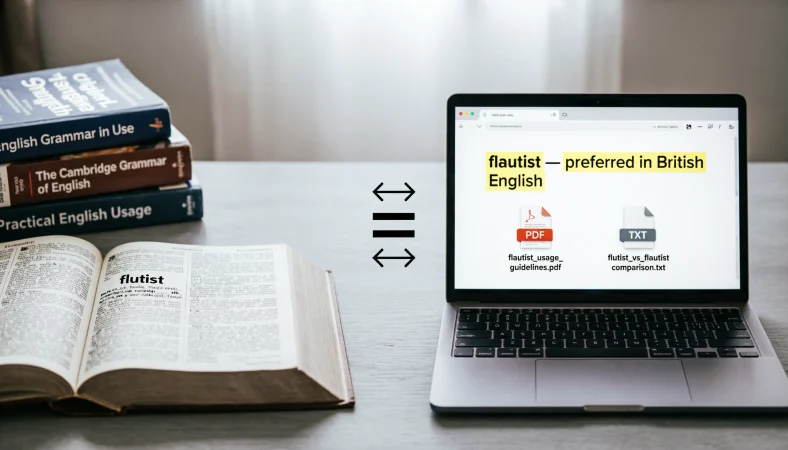
Quick answer : Flutist and Flautist both mean a person who plays the flute.
Flutist is the common American English spelling, while Flautist is preferred in British English. Both are correct.
Have you ever wondered whether the correct word for a flute player is “flutist” or “flautist”? This small difference has created a fascinating debate among musicians, writers, and language lovers for generations. Both words refer to the same person — someone who plays the flute — yet they carry different histories and regional preferences that often confuse English speakers.
The disagreement is not really about right or wrong, but about language, tradition, and culture. Flutist is the more common term in American English, while flautist is widely preferred in British English and many other English-speaking regions. Over time, some people have viewed one word as more formal or sophisticated than the other, adding to the confusion.
In this guide, we will explore the origins of flutist and flautist, explain their meanings, compare their usage, and help you understand which word fits your audience. Whether you are writing about classical music, introducing a musician, or simply improving your English vocabulary, you will discover that choosing between these two words is easier than it seems. By the end, you will have a clear answer and the confidence to use the right term in any situation
Quick Answer Table
| Feature | Flutist | Flautist |
|---|---|---|
| Meaning | A person who plays the flute | A person who plays the flute |
| Correctness | Correct spelling | Correct spelling |
| English Type | American English | British English |
| Pronunciation | FLOO-tist | FLAW-tist / FLOW-tist |
| Origin | English word formed from “flute + ist” | Influenced by Italian word “flautista” |
| Common Usage | General writing, US publications, modern music | UK publications, classical music settings |
| Popularity | More common worldwide due to US influence | More common in Britain and Europe |
| Example | She is a talented jazz flutist. | He is a famous orchestra flautist. |
| Professional Use | Preferred in American contexts | Preferred in British contexts |
| Which One to Choose? | Use for American audiences | Use for British audience |
Which One Is Correct?
Here is the beautiful truth that often gets buried under grammatical elitism: both words are completely correct. Unlike many of the spelling battles we dissect, this is not a case of an educated word versus an ignorant misspelling. It is a case of parallel evolution.
If you say “flutist,” you are speaking the native English tongue. If you say “flautist,” you are tipping your hat to Italian charm. Neither is a mistake. However, if you live in the United States, “flutist” is the far safer, more natural choice. If you are writing a program for a highbrow classical concert in London, “flautist” might be expected. The real error lies not in the usage of one word over the other, but in the insistence that one of them is wrong.
key Difference between two words
The battleground between “flutist” and “flautist” is rarely about meaning and almost always about identity and perception. The differences are not in the musical notes produced, but in the mouthfeel of the syllables.
Meaning of the Word Flutist
The word “flutist” is the straightforward, no nonsense English term. It dates back to around 1603, making it a proud, old word deeply rooted in the mechanics of the English language.
When you break down the word, it is a simple construction. Take the noun “flute,” and add the agent suffix ” ist,” which denotes a person who practices a specific art or skill. This is how we build words like “violinist,” “organist,” or “guitarist.” The etymology is logical, clean, and entirely Germanic English in its directness. The player is to the flute what the painter is to paint.
In terms of definition, a flutist is simply a person who plays the flute. This covers the entire spectrum of flute players, from the middle school student blowing squeakily into a silver plated beginner model to the studio musician laying down smooth jazz improvisations and the Irish folk artist breathing life into a wooden transverse flute.
You will find “flutist” dominating American English literature, journalism, and casual conversation. When The New York Times reviews a concert by a soloist performing a Mozart concerto, the copy editor will not flinch at the word flutist. It is considered the unpretentious, authoritative standard.
Real world examples:
The celebrated jazz flutist Herbie Mann brought the instrument to the forefront of popular music.
I am looking for a wedding flutist to play during the ceremony processional.
As a professional flutist, she spends more time cleaning her instrument than playing it.
Meaning of the Word Flautist
This is where linguistic purists start to sweat, and where European sophistication enters the chat. “Flautist” is not an incorrect word, nor is it a modern pretension. It is a fascinating historical import that refused to die.
The story goes like this: the English word “flute” rolled comfortably along for a few centuries. However, during the great cultural migrations of music and art, the Italian word flauto (meaning flute) began to influence the European musical lexicon. The Italian for flute player is flautista.
Somehow, perhaps through the affection of 19th century musicians who trained in Italy or wanted to sound like they did, the Italian ending grafted itself onto the English noun. This wasn’t a misspelling; it was a re borrowing. The word “flautist” entered the English vocabulary around 1860, and it arrived wearing a tuxedo.
Definitionally, a flautist plays the exact same instrument as a flutist. There is zero difference in the job description. The distinction is purely tonal, cultural, and contextual. “Flautist” often carries a connotation of classical training, high art, and European tradition.
In the United Kingdom, “flautist” is the heavily preferred term in professional settings, far surpassing “flutist.” Sir James Galway, arguably the most famous living flute player, is billed as a flautist. To an American ear, pronouncing it “FLAW tist” can sound immediately more formal or, depending on the listener, slightly pompous. To a British ear, “FLOO tist” can sound somewhat clunky and distinctly American.
Real world examples :
The principal flautist of the Berlin Philharmonic played a heart wrenching solo.
My grandmother, a retired flautist, insists that only wooden flutes produce a warm tone.
Critics have praised him as the most technically proficient flautist of his generation.
Key Differences Between the Two Words :
The battleground between “flutist” and “flautist” is rarely about meaning and almost always about identity and perception. The differences are not in the musical notes produced, but in the mouthfeel of the syllables.
Spelling
This is the most visible trigger. “Flutist” retains the English root “flute” intact. “Flautist” switches the central vowel, morphing the “u” into an “au.” This single vowel shift moves the word from a Germanic appearance to a Latinate one, similar to how “salt” becomes “saline” or “moon” becomes “lunar.” If you write “flautist,” you are signaling that you belong to a club that isn’t afraid of silent letters and Continental vowels.
Pronunciation and Phonetics
The pronunciation creates two very different auditory experiences. “Flutist” is pronounced FLOO tist, with a long, bright vowel that mimics the clear sound of the flute itself. It is a word that projects.
“Flautist” is generally pronounced FLAW tist, with a rounder, darker, more open vowel sound that feels heavier in the mouth. You may occasionally hear FLOW tist, but FLAW tist remains the standard. The phonetic shift can trigger a psychological barrier. Because “flautist” contains the word “flaw,” speakers sometimes subconsciously feel they are saying the word incorrectly, even when they are saying it perfectly.
Grammar and the ” ist” Suffix
Grammatically, “flutist” is a textbook English creation. We take a noun (flute) and add the agent suffix. This aligns with English morphology: you play a flute, so you are a flutist.
“Flautist” breaks this logical chain. You cannot take the English word “flute” and get to “flautist” without passing through the Italian flauto. This linguistic detour makes “flautist” grammatically irregular in English. It belongs to a tiny group of English words that had their spelling altered not by native evolution, but by foreign romanticism.
Usage and Perception :
This is the heart of the divide. In American English, “flutist” is the standard, clear, and professional term. In British English, “flautist” is the standard, clear, and professional term.
The friction happens when the two traditions overlap. An American using “flautist” might be perceived by fellow Americans as pretentious, a social climber trying too hard to sound cultured. Conversely, a Brit using “flutist” might be perceived as linguistically unsophisticated or simply Americanized. Professional musicians often navigate this by adjusting their terminology based on the gig. A player might be a “flautist” on the album cover of a classical symphony but a “flutist” in the liner notes of a smooth jazz collaboration.
Common Mistakes People Make :
The confusion between these two words spawns a few predictable errors. Awareness of these traps helps you write with more authority.
The biggest mistake is the hypercorrection. This is when a speaker, terrified of sounding lowbrow, insists that “flutist” is a grammatical error. They believe, erroneously, that the Italian derived “flautist” is the only historically valid word. This is factually wrong. Historical precedence actually belongs to “flutist.”
Another frequent gaffe is the misspelling “floutist.” This happens when a writer’s brain crosses the word “flout,” which means to openly disregard a rule, with the musician. A floutist is not a flute player; a floutist is someone who is probably getting a speeding ticket.
You will also encounter the pronunciation “FLAH tist,” using the short ‘a’ as in “cat.” This is incorrect in both American and British English. The correct vowel sound is the “aw” as in “claw.”
Lastly, many people assume these terms represent different instruments. A common misconception is that a flutist plays the modern metal flute, while a flautist plays a wooden Baroque flute. This distinction has absolutely no historical or factual basis. The instrument is the same.
Correct Usage Examples :
To truly grasp the flavor of these words, it helps to see them in their natural habitats.
Casual Examples
I didn’t know you were a flutist! Can you play that one Jethro Tull solo?
My daughter wants to quit soccer and become a flautist, so we are renting a flute this weekend.
We hired a jazz flutist for the cocktail hour.
Professional Examples
The position of Principal Flautist requires an audition of the Mozart Concerto in G.
The National Flute Association named her the flutist of the year.
Renowned flautist Emmanuel Pahud released a new recording of the complete Bach sonatas.
Educational Examples
Any young flutist should spend at least twenty minutes a day on long tones.
The masterclass was taught by a visiting flautist from the Vienna Conservatory.
She is a doctoral candidate and a highly skilled flutist specializing in contemporary techniques.
Literary and Metaphorical Examples
He spoke with the precision of a flutist, every word a perfectly placed note.
The wind moved through the canyon like an unseen flautist, playing the oldest song on Earth.
She was a flutist of emotions, able to coax joy and sorrow from a simple silver tube.
Word Origin and Etymology :
The history of these words is a winding road through European culture. Understanding this journey answers the “why” behind the debate.
The journey begins with the Old Provençal word flaut, which itself likely derived from a blend of Latin flare (to blow) and the Germanic echoic word for a rushing sound. This traveled into Old French as flaute and finally into Middle English as floute and then “flute.”
“Flutist” appeared first. In the early 17th century, English speakers applied their native suffix to their native word. The logic was crystalline.
Centuries later, the Italian flauto re entered the artistic consciousness. Italy was the center of the musical universe during the Baroque and Classical periods. The language of music was Italian. Even today, sheet music tells you to play allegro, piano, or forte. Musicians breathed Italian terminology. Because flautista sounded so similar to the cultural elite of music, the spelling drifted to “flautist” among those wanting to align themselves with that tradition. It was a linguistic loanword born not of necessity, but of cultural prestige.
Why the Incorrect Version Became Popular
To call “flautist” an incorrect version is to misunderstand its origin, but it is accurate to ask why a seemingly irregular spelling overtook the logical one in so much of the world. The answer lies in snobbery, publishing, and James Galway.
In 19th century England, class distinction was a national sport. French and Italian words carried an aroma of upper class travel and education. To say “flautist” was to subtly remind your peers that you had been to the Continent and knew the difference between a pub and a salon. The musical establishment standardized it.
The death knell for “flutist” in Britain came from the pens of editors. The Oxford English Dictionary records the heavy usage of “flautist” in British print, cementing it as the proper form. When the globe’s most visible classical flute superstar, Sir James Galway, proudly calls himself “The Man with the Golden Flute” but is consistently introduced by the BBC as a flautist, the word becomes immortalized in the public lexicon.
However, the American ear often rejects this. The United States, built on democratic ideals and a skepticism of aristocratic flourish, never fully adopted the Italian spelling. When American dictionaries like Merriam Webster weigh in, they give the crown to “flutist” and list “flautist” as the secondary variant. The popularity of the alternative version is, therefore, not universal. It is geographically bound and class bound, a linguistic badge of cultural allegiance.
Easy Memory Tricks :
When you are stuck in the moment, about to introduce a musician, you need a quick mental shortcut. Use these simple tricks to navigate the social nuance without breaking a sweat.
If you want to sound natural and avoid pretension in the U.S., think of the flute itself. You see the word “flute” right inside “flutist.” Flute + ist. It is honest, simple, and direct. You do not need to dress it up.
If you are in a classical, British, or high formal setting, think of the word “awe.” The music of a great flute player fills you with awe. That “aw” sound is the same vowel you find in the middle of “flautist.” Associate the feeling of awe with the FLAW tist pronunciation.
You can also remember the geography. Flute + ist = American. The ‘u’ in “flute” matches the ‘U’ in “U.S.A.” Flautist has an ‘a’ that matches the ‘A’ in “Anglophile.” If you are writing for an audience across the pond, use the ‘a’.
Another helpful trigger is to think of the word “flaw.” The pronunciation “FLAW tist” sounds like “flaw.” This is ironic, because there is no flaw in the word. Remembering this irony can help you recall that “flautist” contains the letters that spell a human imperfection, even when the playing is perfect.
Ultimately, the easiest memory trick is the person. Ask the player what they prefer. Some professional flute players detest the word “flautist.” Some refuse to be called a “flutist.” It is the ultimate trump card. Respecting the artist’s self identification ends the grammatical debate instantly.
FAQs :
1. Why do people say flautist instead of flutist?
Because flautist came from Italian influence and became common in British English and classical music.
2. Is flutist an Americanism?
Yes, but it is also the older English form and a fully correct word.
3. Which term does the National Flute Association use?
It uses flutist, especially in American music contexts.
4. Can I use both in one article?
Yes, but consistency is better. Choose one based on your audience.
5. What is a floutist?
Floutist is a spelling mistake, not a flute player.
6. Is there a gender difference?
No. Flutist and flautist are gender-neutral terms.
7. What do professional players prefer?
Preferences vary. Many Americans use flutist, while many British musicians use flautist.
8. Does flautist sound pretentious?
Sometimes in the US, but in the UK it is a normal standard word
Conclusion :
It is your linguistic birthright, the earliest English word for the player, and the choice of clarity. It carries the weight of Italian opera houses and gilded European concert halls.
The only true mistake is the one that silences conversation. Never let the terror of grammatical judgment stop you from praising the music. Walk up to the stage door, smile at the musician holding the long black case, and tell them their playing moved you.