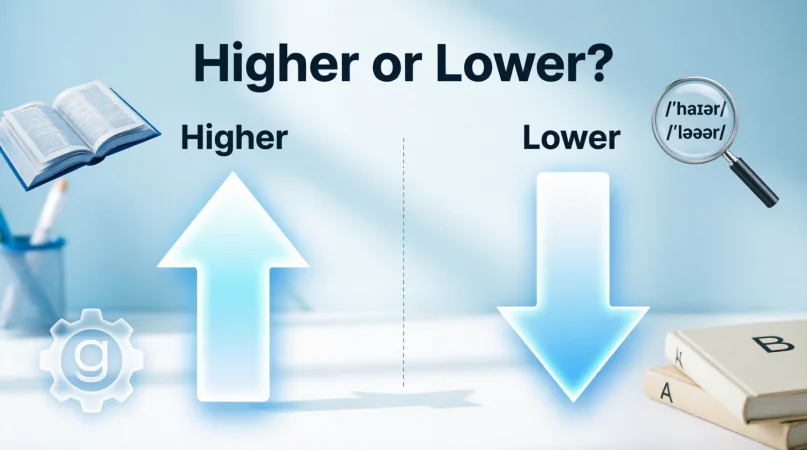
Neither word is incorrect. Higher and lower are both valid English words, but they have different meanings and grammatical functions.
When comparing “Higher or Lower,” the better choice depends entirely on the context, goal, and outcome being measured. Whether discussing prices, scores, temperatures, rankings, interest rates, or performance metrics, neither option is automatically superior. A higher value can represent growth, improvement, or greater achievement in situations such as income, test scores, and productivity. On the other hand, a lower value may be preferable when evaluating expenses, risks, error rates, debt, or environmental impact.
It is important to assess the purpose behind the comparison rather than assuming that bigger is always better or smaller is always preferable. Experts evaluate data within its specific context and consider both short-term and long-term consequences before concluding. Understanding the factors that influence results helps create more informed decisions and avoid misleading assumptions. Ultimately, determining whether higher or lower is better requires examining the objective, the available evidence, and the practical impact of each outcome.
Quick Answer Table
| Feature | Higher | Lowers |
| Status | Correct word | Correct word |
| Part of Speech | Adjective, adverb | Verb |
| Meaning | More elevated, greater in amount or level | Reduces, decreases, moves downward |
| Common Usage | Comparison | Action |
| Example | The mountain is higher than the hill. | She lowers her voice during meetings. |
| Pronunciation | /ˈhaɪər/ | /ˈloʊərz/ |
| Grammar Role | Describes something | Shows an action |
Which One Is Correct?
The question “higher or lower” can be misleading because these words are not direct alternatives.
Higher
Higher is the comparative form of high.
Examples:
- This building is higher than that one.
- Interest rates are higher this year.
- She achieved higher scores on the exam.
Lowers
Lowers is the third-person singular form of the verb lower.
Examples:
- The company lowers prices every summer.
- He lowers his head respectfully.
- The medication lowers blood pressure.
So, the correct choice depends entirely on what you want to say.
Meaning of the Correct Word: Higher
Definition
Higher means:
- More elevated
- Greater in amount
- Above another thing in position, quality, value, or rank
It is the comparative form of the adjective high.
Explanation
When comparing two things, English often adds -er to an adjective.
Examples:
- High → Higher
- Tall → Taller
- Fast → Faster
In this pattern, higher indicates a greater degree of height, level, status, or quantity.
Usage
You can use higher as:
Comparative Adjective
- The airplane flew higher than expected.
- Gas prices are higher today.
Comparative Adverb
- Jump higher.
- Aim higher.
Real-World Examples
- Higher education can open new career opportunities.
- The river reached a higher level after the storm.
- Investors seek higher returns on their investments.
- The athlete jumped higher than his competitors.
Meaning of the Alternative Word: Lowers
Definition
Lowers means:
- Reduces
- Decreases
- Moves downward
- Makes something less intense
It is the present-tense third-person singular form of the verb lower.
Explanation
Unlike higher, which describes a condition or comparison, lowers expresses an action.
Examples:
- lower → lowers
- raise → raises
- reduce → reduces
Usage
Lowers appears when the subject is singular.
Examples:
- She lowers the volume.
- The company lowers costs.
- The medication lowers cholesterol.
Real-World Examples
- A healthy diet lowers health risks.
- He lowers his voice in libraries.
- The government lowers taxes during economic downturns.
- Exercise lowers stress levels.
Is Lowers Incorrect?
No.
One of the biggest misconceptions behind the search term higher or lower is the belief that one of the words must be wrong.
In reality:
- Higher = adjective/adverb
- Lowers = verb
Both are grammatically correct.
The issue arises when someone tries to use one in a sentence where the other grammatical category is required.
Incorrect
❌ The mountain lowers than the hill.
Correct
✅ The mountain is higher than the hill.
Incorrect
❌ The company higher prices every year.
Correct
✅ The company lowers prices every year.
Key Differences Between the Two Words
1. Part of Speech
| Word | Part of Speech |
| Higher | Adjective/Adverb |
| Lowers | Verb |
2. Function
| Higher | Lowers |
| Describes | Acts |
| Compares | Changes |
| Shows degree | Shows action |
3. Meaning
Higher
- More elevated
- Greater amount
- Greater rank
Lowers
- Decreases
- Reduces
- Brings down
4. Pronunciation
| Word | Pronunciation |
| Higher | HYE-er |
| Lowers | LOH-erz |
5. Grammar
Higher
Usually follows a linking verb:
- is higher
- seems higher
- became higher
Lowers
Functions as the main action verb:
- lowers prices
- lowers standards
- lowers expectations
6. Recognition
Higher appears frequently in:
- Academic writing
- Comparisons
- Research papers
- Education
Lowers appears frequently in:
- Business writing
- Medical writing
- Economics
- Everyday communication
Common Mistakes People Make
Mistake #1: Using Lowers as a Comparison
❌ This tower is lower than the old tower.
✅ This tower is higher than the old tower.
Mistake #2: Using Higher as a Verb
❌ The company higher prices annually.
✅ The company lowers prices annually.
Mistake #3: Confusing Opposites
Many learners assume:
- Higher ↔ Lowers
However, grammatically, the real comparison is:
| Comparative Adjective | Comparative Adjective |
| Higher | Lower |
And:
| Verb | Verb |
| Raises | Lowers |
This distinction is essential.
Mistake #4: Ignoring Context
Context determines which word fits.
Example:
- The temperature becomes higher.
- Air conditioning lowers the temperature.
Different sentence structures require different words.
Correct Usage Examples
Casual Examples
- My new shelf is higher than the old one.
- He lowers the music when guests arrive.
- This hill is much higher than I expected.
- She lowers her sunglasses while driving.
Professional Examples
- The company reported higher profits this quarter.
- Management lowers operating costs through automation.
- Higher efficiency improves productivity.
- The software lowers processing time significantly.
Educational Examples
- Higher test scores often reflect effective study habits.
- Reading regularly lowers the risk of vocabulary stagnation.
- Students pursuing higher education gain specialized knowledge.
- The instructor lowers the assignment difficulty for beginners.
Literary and Metaphorical Examples
- Her hopes climbed higher with every success.
- The sunset lowers itself behind the mountains.
- Ambition carries people toward higher goals.
- Time lowers the walls of old resentment.
Word Origin / Etymology
Higher
The word higher comes from Old English hēah, meaning:
- Tall
- Elevated
- Exalted
Over time, English developed the comparative form higher, which became the standard way to compare height, rank, amount, and degree.
Lowers
The verb lower originates from Middle English and Old Norse influences related to concepts of reducing or bringing downward.
The form lowers emerged through normal English verb conjugation:
- I lower
- You lower
- He lowers
- She lowers
- It lowers
Both words have centuries of documented use in English literature and communication.
Why the Confusion Between Higher and Lower Exists
Several factors contribute to confusion.
1. Opposite Concepts
People naturally associate:
- Higher = upward
- Lowers = downward
Because they represent opposite directions, learners often assume they are direct grammatical opposites.
2. Similar Word Family
Both belong to discussions involving:
- Height
- Position
- Levels
- Increase and decrease
This semantic relationship creates confusion.
3. English Comparatives and Verbs
English learners sometimes mix:
- Comparative adjectives
- Action verbs
For example:
| Adjective | Verb |
| Higher | Raises |
| Lower | Lowers |
The categories are easy to confuse when learning grammar.
4. Search Engine Queries
Many users type phrases such as:
- higher or lowers
- higher vs lower
- Is it higher or lower
because they are unsure which form fits their sentence.
Easy Memory Tricks
Trick #1: Higher Describes
Think:
Higher = Description
Example:
- Higher mountain
- Higher salary
- Higher score
If you’re comparing things, use higher.
Trick #2: Lower Acts
Think:
Lowers = Action
Example:
- Lowers prices
- Lowers volume
- Lowers risk
If someone or something is doing an action, use lowers.
Trick #3: The “S” Clue
Notice the ending:
Lowers
The -s often signals a third-person singular verb.
Examples:
- Runs
- Walks
- Speaks
- Lowers
That makes it easier to identify as an action word.
Trick #4: Comparison Test
If the sentence contains than, you probably need higher.
Example:
- The building is higher than the school.
Higher vs Lower: The Comparison Many People Actually Need
Often, users searching for higher or lower actually mean:
Higher vs Lower
| Higher | Lower |
| Comparative adjective | Comparative adjective |
| More elevated | Less elevated |
| Greater amount | Smaller amount |
Examples:
- Higher temperature
- Lower temperature
- Higher salary
- Lower salary
- Higher ranking
- Lower ranking
This is the true grammatical comparison.
People Also Ask
What part of speech is higher?
Higher is primarily a comparative adjective and can also function as an adverb.
What part of speech is lowers?
Lowers is a verb, specifically the third-person singular present form of lower.
Is higher a verb?
No. Higher is not normally used as a verb in modern English.
Is lowers an adjective?
No. Lowers functions as a verb.
What is the opposite of higher?
The opposite comparative adjective is lower.
What is the opposite action of lowering?
The opposite verb is raises.
Can higher and lower be used interchangeably?
No. They belong to different grammatical categories and are not interchangeable.
Which is more common in academic writing?
Higher is generally more common because academic writing frequently involves comparisons and measurements.
FAQs
1. Is it correct to say “higher than”?
Yes. “Higher than” is a standard comparative structure in English.
Example: The mountain is higher than the hill.
2. Is “lowers” a real English word?
Yes. It is the third-person singular present-tense form of the verb lower.
3. Can higher be used as an adverb?
Yes.
Example: The bird flew higher.
4. What does lowers mean?
Lowers means reduces, decreases, or moves something downward.
5. Is higher the comparative form of high?
Yes. High → Higher → Highest.
6. What is the opposite of lowers?
The opposite verb is raises.
7. Why do people confuse higher and lower?
They relate to opposite directions and are often discussed in similar contexts involving levels, height, or quantity.
8. Which word should I use in comparisons?
Use higher when comparing two things.
Example: This building is higher than that one.
9. Can a sentence contain both higher and lower?
Yes.
Example: Increasing competition creates higher quality and lowers prices.
10. Is “higher or lower” a grammatical mistake?
Not necessarily. The phrase is often used when asking which word fits a sentence, but the two words are not direct grammatical equivalents.
Conclusion
In conclusion, there is no universal winner between higher and lower because the right choice depends on what is being measured and why it matters. Higher values can signal success, growth, or stronger performance, while lower values may indicate efficiency, affordability, or reduced risk.
The most reliable approach is to evaluate the specific context and desired outcome before deciding which option is preferable. By focusing on evidence and practical results rather than assumptions, individuals can make better-informed decisions and choose the option that best supports their goals.