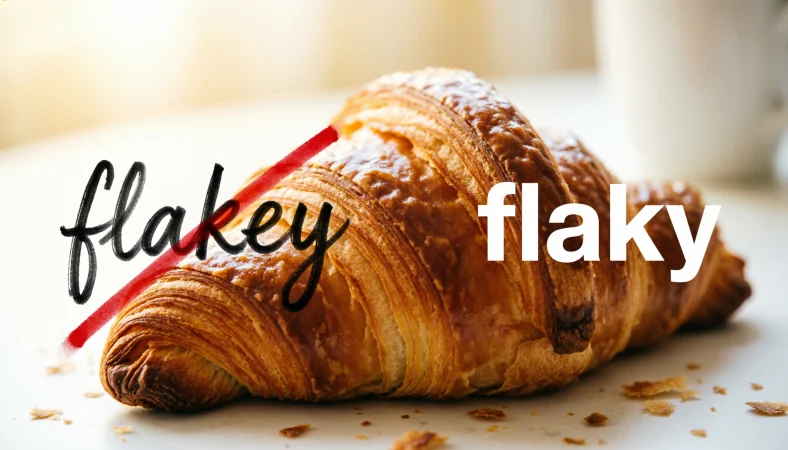
Quick answer:Flaky is the standard and most common spelling. Flakey is also accepted in some dictionaries, but it is much less common. Use flaky in most writing, especially formal or professional contexts.
Examples:
A flaky person = unreliable or inconsistent
Flaky pastry = breaking into thin layers
.Flakey or Flaky both forms appear in English writing, but they are not used equally. Flaky is the standard and widely preferred spelling, while flakey is a less common variant that some dictionaries recognize.
The word flaky can describe something that breaks into thin layers, such as pastry or skin, and it can also describe a person who is unreliable or inconsistent. Knowing the difference between flakey and flaky helps you choose the more accepted spelling and write with greater accuracy
Quick Answer Table
| Feature | Details |
| Correct Spelling | flaky |
| InCorrect Spelling | flakey (generally considered a misspelling) |
| Part of Speech | adjective |
| Primary Meaning | breaking into thin, flat pieces; unreliable or inconsistent |
| Common Usage | food, people, technology, materials |
| Example Sentence | The croissant was perfectly golden and flaky. |
Which One Is Correct?
The correct spelling is flaky. This is the standard, accepted form in all major English dictionaries, including Merriam Webster, Oxford, and Cambridge. Flakey is considered a misspelling, though it has gained some casual usage online.
Here is the simple rule: when adding the suffix ” y” to a word ending in “e,” we typically drop the “e.” This is a fundamental English spelling rule.
- flake → flaky (drop the “e”)
- shine → shiny (drop the “e”)
- smoke → smoky (drop the “e”)
- taste → tasty (drop the “e”)
Therefore, flakey is grammatically incorrect according to standard English spelling rules. The “e” is dropped before adding ” y” to form the adjective.
However, language is constantly evolving, and you may occasionally see “flakey” used in informal contexts. Some people mistakenly apply the rule for words ending in “ey” (like “honey” becoming “honeyed”) to “flake.” But this is incorrect. The proper spelling remains flaky.
Meaning of Flaky
Definition
Flaky is an adjective with two primary meanings:
- Physical description: Breaking or separating into thin, flat, light pieces or layers
- Figurative description: Unreliable, eccentric, or inconsistent in behavior or performance
Physical Meaning
In its physical sense, flaky describes things that naturally form or break into small, thin pieces. This is commonly used when discussing food, materials, or substances.
Common contexts for physical flaky:
- Food: pastries, croissants, pie crusts, biscuits
- Natural materials: snowflakes, soap flakes, dandruff
- Man made materials: paint, plaster, old wood
- Substances: asbestos, mica, fish scales
Figurative Meaning
The figurative use of flaky describes people or things that are unreliable, inconsistent, or strange. This meaning is frequently used in modern conversation.
Common contexts for figurative flaky:
- People: friends who cancel plans, unreliable colleagues
- Technology: inconsistent internet connections
- Performance: unpredictable behavior from machines or systems
- Plans: uncertain, constantly changing arrangements
Usage and Examples
Here are real world examples showing how to use flaky correctly in different contexts:
food:
- The baker is famous for her flaky, buttery croissants.
- Nothing beats a warm, flaky pie crust.
- These biscuits are so flaky they practically melt in your mouth.
people:
- Sarah is so flaky; she canceled our lunch plans three times.
- I need reliable employees, not flaky workers who show up late.
- My roommate is a bit flaky about paying bills on time.
technology:
- The internet connection has been flaky all day.
- My phone gets flaky when the battery is below 20%.
- The software is flaky and crashes ra materials:
- The old paint is becoming flaky and starting to peel.
- This wood is dry and flaky from sun damage.
- After the fire, the wall plaster was cracked and flaky.
Meaning of Flakey
Is It a Real Word?
Technically, flakey is a less common variant of flaky. However, most authoritative sources treat it as a misspelling rather than an acceptable alternative.
Key facts about flakey:
- It appears in some older English texts
- It is occasionally used in British English
- It is widely considered a spelling error in modern writing
- No major dictionary lists it as the primary spelling
Regional and Historical Usage
While flakey is generally incorrect, it has some historical presence:
Historical usage:
- Some 19th century texts used “flakey” more frequently
- Older British writers occasionally used this spelling
- It follows a pattern where some ” y” adjectives retained the “e” (like “hackneyed”)
Regional variation:
- More common in casual British English than American English
- Sometimes found in Australian or New Zealand English
- Almost always corrected in professional editing
Why People Use Flakey
The misspelling likely arises from several factors:
Confusion with similar patterns:
- Words like “hackney” → “hackneyed”
- Confusion about when to drop the “e”
- The “ey” ending appearing in common words like “hey” or “grey
Linguistic misconceptions:
- People think “flake” + “y” = “flakey” because they see the “e”
- The rule about dropping silent “e” is not always obvious
- Some think both spellings are acceptable
Practical factors:
- The “e” feels like it belongs visually
- Autocorrect sometimes does not catch it
- It is common enough in informal writing that people assume it is correct
Key Differences Between Flaky and Flakey
Spelling Difference
The most obvious difference is one letter:
| Aspect | Flaky | Flakey |
| Spelling | f l a k y | f l a k e y |
| Letters | 5 letters | 6 letters |
| Suffix | ” y” added after dropping “e” | ” y” added to “flake” without dropping “e” |
| Standard | Correct | Incorrect |
Meaning Difference
In practical terms, there is no difference in meaning between flaky and flakey. They mean the same thing. The difference is purely orthographic.
Consider this:
- Both words describe the same physical and figurative concepts
- Both can describe food, people, materials, or technology
- The intended meaning is identical
The only significant difference is that flaky is correct while flakey is not.
Pronunciation Difference
Here is some good news: there is no difference in pronunciation.
- Flaky: /ˈfleɪki/
- Flakey: /ˈfleɪki/
Both are pronounced exactly the same way. The “e” is silent when it appears, which is partly why many people misspell it. You hear “flaky” but sometimes write “flakey” because you see the “e” in the root word “flake.”
Grammar Difference
Grammatically, both words function as adjectives. However, flaky is the accepted form.
Parts of speech:
- Both are adjectives
- Can be used attributively (before a noun): “a flaky pastry”
- Can be used predicatively (after a verb): “the pastry is flaky”
Comparative and superlative forms:
- flaky → flakier → flakiest
- (flakey would follow the same pattern but is not used in formal writing)
Acceptance and Recognition
This is where the two words differ most significantly:
| Recognition Aspect | Flaky | Flakey |
| Dictionaries | Accepted by all major dictionaries | Not listed or listed as a variant |
| Spell check | Accepted as correct | Marked as spelling error |
| Professional writing | Acceptable | Avoided |
| Academic writing | Required | Rejected |
| Casual writing | Acceptable | Sometimes used |
| Global recognition | Universally accepted | Rarely seen |
Common Mistakes People Make
Understanding common errors will help you avoid them.
Spelling Confusion
The most frequent mistake is keeping the “e” when adding ” y.”
Incorrect: “These cookies are so flakey and delicious.”
Correct: “These cookies are so flaky and delicious.”
Overcorrection
Some people know the rule about dropping “e” but apply it inconsistently.
Incorrect: “The paint is flakey, and I need to scrape it.”
Correct: “The paint is flaky, and I need to scrape it.”
Plural and Tense Confusion
When using related forms of flaky, people also get confused.
Noun forms:
- flake (correct)
- flakiness (correct, not flakeyness)
Verb forms:
- flake (correct)
- flaked (correct)
- flaking (correct)
Auto Correct Reliance
Relying on spell check alone is not enough. Many writing tools now recognize both spellings as potentially valid, reducing their usefulness for this specific word.
Confusing Similar Rules
People sometimes confuse words ending in “ey”:
- “grey” → “grayish” (not greyish)
- “honey” → “honeyed” (keeps the “e”)
- “flake” → “flaky” (drops the “e”)
The rule about dropping the “e” applies when adding the suffix ” y,” but not when adding ” ed,” ” ing,” or other suffixes.
Correct Usage Examples
Casual Examples
- My friend is so flaky; she’s already changed our dinner reservation three times.
- The snow was light and flaky, perfect for skiing.
- I love these flaky, buttery biscuits from the local bakery.
- My phone has been acting flaky since I dropped it.
- That new employee seems a bit flaky; he’s already late twice.
- These flakes are so flaky they scatter everywhere when I eat them.
- My Wi Fi connection has been super flaky lately.
Professional Examples
- The software update caused flaky performance across the entire system.
- We cannot afford flaky employees in this high stakes project.
- The contractor recommended replacing the flaky plaster with drywall.
- Her flaky attendance record was noted in her performance review.
- The engineer identified flaky hardware as the source of random shutdowns.
- Sales have been flaky this quarter, making projections difficult.
- The manager dismissed flaky excuses from unreliable team members.
Educational Examples
- When heated, the sedimentary rock becomes flaky and prone to erosion.
- Students should understand that “flaky” is the standard spelling.
- The chemist observed flaky white crystals forming in the solution.
- In culinary arts, achieving a flaky texture requires cold butter.
- The geologist identified the flaky mineral as mica.
Literary and Metaphorical Examples
- Her memory was as flaky as an old parchment, crumbling with age.
- The fog rolled in, flaky and uncertain, obscuring the path ahead.
- His flaky promises were like paint peeling from an aging house.
- Trust, once broken, becomes flaky and difficult to rebuild.
- The truth emerged in flaky fragments, pieced together slowly.
- She wore her flaky reputation like a shield against expectation.
- The book’s plot was flaky and inconsistent, frustrating readers.
Word Origin and Etymology
Roots of Flaky
The word “flaky” has a clear etymological path:
Origin:
- Derived from the noun “flake”
- “Flake” comes from Old Norse “flak” meaning “flat piece”
- Related to Old English “flecian” meaning “to peel off”
- Added the ” y” suffix in the 16th century to form the adjective
Linguistic development:
- First recorded use as “flaky” in the 16th century
- The figurative meaning emerged in the 19th century
- American English quickly standardized the spelling
- British English showed some variation but eventually followed suit
Flakey in Historical Context
While flakey is incorrect today, it has an interesting history:
16th 18th centuries:
- “Flakey” appeared occasionally in British texts
- Spelling was not standardized in this period
- Both forms could be found in literature
19th century:
- “Flakey” was more common in British English
- “Flaky” was gaining ground in American English
- The difference in usage highlighted the divergence
20th century onward:
- Major dictionaries standardized “flaky”
- “Flakey” became increasingly rare
- Modern usage treats “flakey” as a misspelling
Why the Spelling Rule Changed
The standardization of “flaky” follows a broader pattern in English:
Phonetic spelling influence:
- “Flaky” better represents the pronunciation
- The silent “e” does not help with pronunciation
- Fewer letters make the word simpler and cleaner
Consistency with other words:
- “Make” → “making” (drops “e”)
- “Take” → “taking” (drops “e”)
- “Shake” → “shaky” (drops “e”)
This consistency helped cement “flaky” as the standard.
Why the Incorrect Version Became Popular
The prevalence of “flakey” is not random; several factors contribute to its persistence.
Online Influence
The internet has a significant impact on spelling variation:
Social media effect:
- People write quickly and casually
- Autocorrect sometimes suggests both forms
- Incorrect spellings spread rapidly
Search engine influence:
- Some users search both spellings
- Content creators sometimes use both to reach more searchers
- The algorithm sees both, creating confusion
Linguistic Illusions
Human brains process words in ways that encourage errors:
Visual similarity:
- Flakey looks like it should be right
- The “e” comes from the root word “flake”
- We expect the root to stay visible
Phonological confusion:
- The silent “e” remains in our mind
- We “hear” the “e” even though it is silent
- The spelling makes sense to our internal logic
Education Gaps
Spelling instruction affects how people write:
Incomplete rules:
- Some teachers do not cover the “drop the e” rule thoroughly
- Students learn individual words rather than rules
- The rule is not always reinforced
Inconsistent learning:
- Some people learned both forms as acceptable
- Corrections are not always given
- People default to what feels natural
The “Hackneyed” Pattern
One source of confusion is the ” ey” ending pattern:
Words that keep “e”:
- “hackney” → “hackneyed”
- “money” → “moneyed”
- “whey” → “wheyey”
Why this matters:
- These words show that adding suffixes to words ending in “ey” keeps the “e”
- People incorrectly think “flakey” follows this pattern
- However, “flake” ends in “e,” not “ey”
Easy Memory Tricks
These simple tricks will help you remember the correct spelling.
The “Drop the E” Rule
Remember this basic rule: when adding ” y” to a word ending in “e,” drop the “e.”
Examples:
- brake → braky
- brake → braky
- cake → caky
- flake → flaky
Mnemonic: “Flaky has no ‘e’ when it’s all about me.”
Visual Association
Picture the word visually to reinforce the correct spelling:
Imagine a flaky pastry:
- See the layers, thin and flat
- Each layer is separate, just like the letters
- The word is clean, simple, and without extra letters
Create a mental image:
- Picture a croissant with layers falling apart
- The word “flaky” has five letters, like five layers
- The extra “e” is an unnecessary layer
Sound It Out
Say the word slowly and pay attention to the sounds:
Listen to the pronunciation:
- fla key (two syllables)
- The “e” is completely silent
- If you cannot hear it, you should not write it
Compare with similar words:
- “shaky” (shak y) no “e”
- “baky” (bak y) no “e”
- All these follow the same pattern
The “E” Rule Reminder
Create a personal rule to remember:
Rule of thumb:
- If the word ends in a silent “e,” drop it
- If the word ends in a pronounced “e,” keep it
Application:
- Flake (silent “e”) → flaky
- Agree (pronounced “e”) → agreeable
Create Your Own Mnemonic
Make up a simple phrase to remember:
- “Flaky is correct, no extra e”
FAQs
Q1. Is flakey or flaky correct?
Flaky is the standard and preferred spelling. Flakey is a rare informal variant and should be avoided in formal writing.
Q2. Why is it flaky and not flakey?
Because when adding -y to a word ending in a silent e, the e is usually dropped (flake → flaky).
Q3. Is flakey ever acceptable?
It appears sometimes online, but flaky is the accepted form in standard English.
Q4. What does flaky mean?
It can mean breaking into thin layers (like pastry) or being unreliable/inconsistent.
Q5. How do you use flaky in a sentence?
Example: The pie has a flaky crust. / His flaky behavior caused problems.
Q6. Is flaky positive or negative?
For food, it is usually positive. For people or systems, it often has a negative meaning.
Q7. What is the noun form of flaky?
The noun form is flakiness.
Q8. Can flaky describe technology?
Yes. Example: The internet connection has been flaky.
Q9. What are synonyms for flaky?
Texture: crumbly, layered. Behavior: unreliable, inconsistent.
Q10. Is flaky used in British English?
Yes, British English also prefers flaky
Conclusion
The flakey or flaky confusion has a simple answer: flaky is the correct and standard spelling in modern English. Whether you are talking about a layered pastry, an unreliable person, or an unstable system, flaky is the form that fits all common writing situations.
Remember the easy spelling rule: when a word ends in a silent e and changes into an adjective with -y, the e is usually removed. By choosing flaky consistently, you keep your writing accurate, professional, and easy for readers to understand.