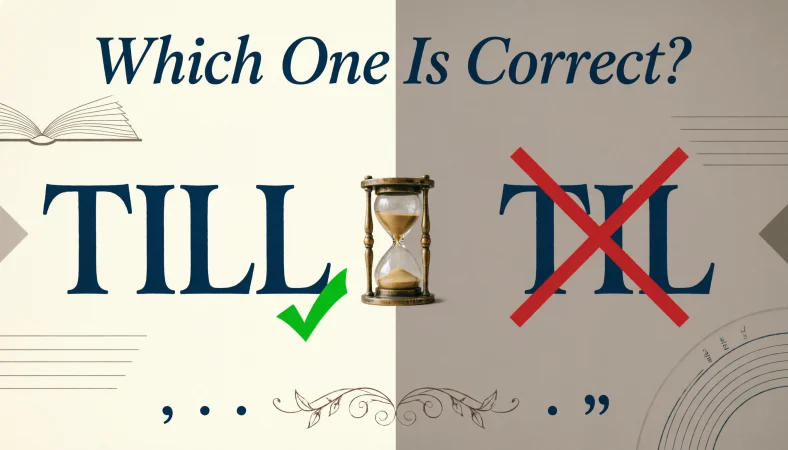
Quick answerTill is the correct and standard spelling in modern English.
Til is an informal abbreviation or shortened form often used in casual writing (especially online), but it is not preferred in formal writing:
Till or Til both forms appear in everyday writing, but they do not have the same level of acceptance. Till is the standard English word and has been used for centuries as a preposition and conjunction meaning up to a certain time.
Til is mainly an informal shortened form often seen in text messages, social media, and casual communication. While people understand it, till (or until in more formal contexts) is the safer choice for professional, academic, and standard English writing
Quick Answer Table
| Feature | Till | Til |
| Correct Spelling | Yes | No |
| InCorrect Spelling | No | Yes |
| Meaning | Up to the time of; before | Same meaning |
| Usage | Standard, formal, casual, professional | Informal, texting, slang, error |
| Example Sentence | I worked till 5 PM yesterday. | I worked til 5 PM yesterday. |
Which One Is Correct?
Let’s get straight to the point: “till” is the correct, standard spelling in both American and British English. The shorter version “til” is technically considered a misspelling, though it has gained significant popularity in casual contexts like text messaging and social media.
Here’s what surprises most people: “till” is not a shortened version of “until.” In fact, “till” appeared in English long before “until” did. Many mistakenly believe “till” is an informal abbreviation, but historical evidence proves otherwise. The word “till” has been a legitimate English word since at least the 8th century, derived from Old English “til,” meaning “to” or “toward.”
The confusion primarily stems from the fact that people often hear the word pronounced in casual speech and assume it’s a clipped form of “until.” When they write it down, they naturally drop the extra “l” to match what they think they’re hearing. This leads to the proliferation of “til” in informal writing.
Modern dictionaries, style guides, and grammar authorities unanimously recognize “till” as the correct spelling. The Associated Press Stylebook, Chicago Manual of Style, and Merriam Webster Dictionary all endorse “till” as proper English. While “til” appears in some dictionaries, it’s typically marked as informal or nonstandard.
The reality is that professional writing demands attention to these seemingly small details. Using “til” in a formal context can distract from your message and make you appear less knowledgeable about standard English conventions. When in doubt, always default to “till.”
Meaning of “Till”
Definition and Explanation
“Till” functions as both a preposition and a conjunction in English, expressing the concept of “up to the point in time” or “before” something else occurs. Its primary meaning establishes a temporal boundary, indicating when an action, state, or condition will persist or cease.
As a preposition, “till” connects a noun phrase to the rest of the sentence, indicating the endpoint of a time period. For example, “The store is open till 9 PM” indicates the store’s operating hours extend up to 9 PM and then close. Similarly, “I’ll wait till Tuesday” means the waiting will continue until Tuesday arrives.
As a conjunction, “till” connects two clauses, showing that the main clause’s action continues up to the point when the subordinate clause’s action occurs. “She practiced till her fingers ached” demonstrates how the practicing continued right up to the moment her fingers started hurting.
Usage Patterns
Native English speakers use “till” in various contexts without thinking about its grammatical classification. Here are the primary usage patterns:
- Temporal boundaries: “The meeting runs till 3 o’clock.”
- Conditional limits: “I won’t know till I see the results.”
- Duration markers: “They stayed at the beach till sunset.”
- Sequential timing: “Don’t start till I give the signal.”
Real World Examples
Professional context: “The quarterly report is due till the end of business Friday.” This usage is perfectly appropriate in workplace communication, from emails to formal documents.
Educational context: “The library remains open till 10 PM during exam weeks.” Universities frequently use “till” in signage and official communications.
Casual context: “I’ll be on vacation till next Wednesday.” This sentence works equally well in text messages, emails, and spoken conversation.
Literary context: Authors have used “till” for centuries, and it appears frequently in classic literature. Charles Dickens wrote, “I never saw the little woman, till she came to me.” This demonstrates how “till” carries formal literary weight despite some modern readers mistakenly viewing it as informal.
The key takeaway is that “till” is appropriate in every register of English, from the most casual conversation to the most formal academic writing. You can confidently use it anywhere without worrying about correctness.
Meaning of the Alternative Word
“Til” – The Informal Variant
“Til” exists as a legitimate spelling variant, but it’s important to understand its status in the English language. Dictionaries recognize it primarily as an informal, chiefly American shortening of “until.” However, its usage comes with significant restrictions.
The Oxford English Dictionary notes that “til” emerged as a written form in the 19th century, likely influenced by the contraction apostrophe in “’til.” This apostrophe version was an attempt to visually show that a word (until) had been shortened, much like “don’t” for “do not” or “can’t” for “cannot.”
Here’s the crucial distinction: while dictionaries may list “til” as an acceptable variant, style guides overwhelmingly advise against it in formal writing. The American Heritage Dictionary includes a usage note explaining that “til” is less common than “till” and is often considered a misspelling.
Is “Til” Ever Correct?
In the strictest sense of standard written English, “til” is not considered correct. However, language evolves, and usage patterns shift. You will encounter “til” in:
- Text messages and social media: People naturally abbreviate words in casual digital communication.
- Informal writing: Personal journals, notes, and informal emails might use “til.”
- Branding and creative works: Some businesses, songs, and artistic projects use nonstandard spellings for stylistic effect.
- Dialect representation: Writers sometimes use “til” to represent casual speech patterns in dialogue.
But just because you see it doesn’t mean you should use it. Think of “til” like wearing sweatpants to a job interview—acceptable in some contexts but never the best choice when you want to make a good impression.
The “‘Til” Apostrophe Variant
Many people add an apostrophe to create “’til,” believing this makes it a proper contraction. This version is also considered nonstandard and should be avoided in formal writing. The apostrophe doesn’t fix the underlying issue—the standard word remains “till,” and adding punctuation doesn’t change that fact.
Writers sometimes defend “’til” by comparing it to contractions like “don’t” or “won’t.” However, this comparison fails because “till” is already a complete word with an established history, not a contraction of a longer word.
Key Differences Between Till and Til
| Aspect | Till | Til |
| Spelling | Double “l” at the end | Single “l” at the end |
| Standard Status | Correct in all contexts | Informal/nonstandard |
| Dictionary Recognition | Fully recognized | Sometimes listed as variant |
| Formal Writing | Acceptable | Avoid |
| Professional Use | Recommended | Discouraged |
| Historical Usage | Since 8th century | Since 19th century |
| Etymology | Old English “til” | Shortened “until” |
| Pronunciation | /tɪl/ | /tɪl/ |
Spelling
The most obvious difference lies in the spelling. Till” ends with two “l”s, while “til” ends with a single “l.” This single character difference might seem minor, but it’s the primary factor distinguishing correct from incorrect usage.
Meaning
Both words share identical meanings. There is no semantic difference between “till” and “til”—they both express the same concept of “up to a certain time.” The distinction lies entirely in correctness and usage context.
Pronunciation
You pronounce both words exactly the same way. The single “l” in “til” doesn’t affect how you say it. Both are pronounced with a short “i” sound followed by an “l” sound, rhyming with “hill” or “will.” This pronunciation similarity contributes to the confusion, as people can’t distinguish them by sound alone.
Grammar
Both words function identically grammatically. They serve as prepositions and conjunctions in the same syntactic positions. The grammatical rules governing their use are identical—the difference is strictly orthographic (spelling related).
Usage
“Till” enjoys unrestricted usage across all contexts. You can use it in formal documents, academic papers, professional emails, and casual conversations without hesitation.
“Til” should be limited to the most informal contexts. Even then, using “till” is always a safer and more professional choice.
Recognition
“Till” is universally recognized and accepted by English speakers worldwide. “Til” may cause confusion or be perceived as an error, particularly by older readers, non native speakers, or those with strong grammar backgrounds.
Common Mistakes People Make
Mistake 1: Assuming “Till” Is a Shortened Version of “Until”
This is perhaps the most widespread misconception. Countless people believe that “till” is simply an informal abbreviation of “until.” This assumption leads them to use “’til” or “til” under the mistaken belief that they’re making the word more “correct” by showing it’s a contraction.
The truth is exactly the opposite. “Till” is the older word, and “until” is actually derived from “till” with the prefix “un ” added. The word “until” formed sometime in the 12th century by combining “un ” (meaning “up to”) with “till.” So “till” isn’t shortened “until”—”until” is lengthened “till.”
Mistake 2: Using Apostrophes to “Fix” the Word
Many writers add an apostrophe to create “’til,” believing this transforms the nonstandard spelling into a proper contraction. They assume that since “until” is a longer word, “’til” must be the appropriate shortened form.
This approach overlooks the fact that “till” is already a perfectly valid word. Adding an apostrophe doesn’t make “til” more correct—it just adds unnecessary punctuation to a misspelling. Style guides consistently advise against this practice.
Mistake 3: Overcorrection by Avoiding “Till” Entirely
Some writers, aware of the confusion, avoid “till” altogether and use only “until” in all contexts. While this strategy technically avoids the spelling error, it leads to unnecessarily repetitive and sometimes less natural writing.
Consider the phrase “push the button till the light turns green.” Replacing “till” with “until” in this context would be perfectly acceptable, but it makes the sentence slightly more formal and wordy. The natural rhythm of English often favors “till” in everyday situations.
Mistake 4: Inconsistent Usage
Some writers use “till” and “til” interchangeably within the same document, creating inconsistency that distracts readers. If you’ve written “till” three times, suddenly switching to “til” in the fourth instance signals carelessness or lack of attention to detail.
Maintaining consistency is essential for professional writing. Choose “till” and stick with it throughout your document.
Mistake 5: Using “Til” in Professional Communications
Perhaps the most damaging mistake is using “til” in formal or professional contexts. An email to your boss, a cover letter, an academic paper, or a business proposal should never contain “til.” This spelling error can undermine your credibility and make you appear less educated or less careful about your writing.
Remember that readers notice small details like this. When you’re competing for a job, a promotion, or a client, every word counts. Don’t let a simple spelling error distract from your message.
Correct Usage Examples
Casual Examples
- “I’ll be at the café till noon if you want to join me.”
- “The party doesn’t start till 9, so take your time getting ready.”
- “Can you hold this till I get back?”
- “She stayed up till 2 AM finishing her book.”
- “Wait till you see what I bought!”
Professional Examples
- “Our office remains open till 5:30 PM on weekdays.”
- “We need the project specifications till Friday at the latest.”
- “The payment deadline has been extended till the 15th.”
- “Please keep this information confidential till the official announcement.”
- “The training session runs till 4 PM with a lunch break at noon.”
Educational Examples
- “Students must complete the reading assignment till chapter 6.”
- “The exam will cover material from the beginning of the semester till the midterm.”
- “Submit your research proposals till the department deadline.”
- “The library study rooms are available for booking till 10 PM.”
- “Scholarship applications are accepted till March 1st.”
Literary and Metaphorical Examples
- “The river stretched on for miles till it disappeared into the horizon.”
- “She pushed through the pain till she reached her goal.”
- “I’ll love you till the ocean ceases to flow.”
- “He worked tirelessly till his dreams became reality.”
- “The darkness lingered till the first rays of dawn appeared.”
Word Origin / Etymology
The Ancient Roots of “Till”
The story of “till” begins in Old English, where the word “til” appeared as a preposition meaning “to” or “toward.” This early word came from the North Germanic languages, with cognates in Old Norse “til” (to, until) and Gothic “tils” (appropriate). These Germanic roots trace back even further to the Proto Indo European root “do”, which gave rise to words meaning “to” or “toward” in numerous languages.
The Old English “til” evolved in Middle English to become “tille” or “till,” with the spelling eventually standardizing as “till” by the 16th century. Throughout this evolution, the word retained its core meaning of expressing direction toward a point in space or time.
The Emergence of “Until”
The word “until” didn’t appear until around the 12th century, formed by combining the Old Norse prefix “und ” (meaning “up to” or “as far as”) with “till.” This prefix later merged with the English “un ” in some dialects, creating the compound we know today.
Interestingly, “until” originally carried a slightly more specific meaning than “till” in some contexts, emphasizing the notion of “as far as” or “all the way to” a certain point. Over time, the two words became nearly interchangeable, with only slight differences in formality and usage frequency.
The Evolution of the Spelling Confusion
The confusion between “till” and “til” has relatively modern origins. The spelling “til” without the second “l” began appearing in American English during the 19th century, likely influenced by the rise of written contractions in general. As people became more comfortable with apostrophes indicating omitted letters, they extended this pattern to “till,” incorrectly treating it as a contraction of “until.”
This process accelerated in the 20th century with the rise of informal written communication. Newspapers, magazines, and advertising increasingly adopted shortened forms, and “til” appeared with growing frequency. The digital age and text messaging further popularized the shortened spelling, as character limits and typing speed encouraged abbreviation.
Why the Traditional Spelling Persists
Despite the popularity of “til,” standard English has preserved “till” as the preferred spelling. Dictionaries and style guides maintain this preference for several reasons:
- Historical precedence: “Till” has a longer documented history.
- Consistency with other words: “Till” follows the same doubling pattern as other short words like “well” and “still.”
- Clarity of meaning: The single l spelling could potentially be confused with the word “tilt” in certain contexts.
- Prescriptive tradition: Grammar authorities have consistently recommended “till.”
The persistence of “till” in standard English demonstrates how written language often preserves historical forms even as spoken language evolves.
Why the Incorrect Version Became Popular
Phonetic Influence
The spelling “til” gained popularity partly because people hear the word and intuitively spell it with one “l.” Our ears don’t distinguish between one “l” and two, so the shorter spelling feels natural. This phonetic influence affects many English words, contributing to common misspellings.
Consider how many people spell “until” as “untill” or “untill” because they hear a doubled sound. The same logic in reverse leads people to drop one “l” from “till.” When you’re writing quickly, especially on your phone, the single “l” version just feels more streamlined.
The Ambiguity of Abbreviations
The word “until” is clearly longer than “till,” leading many to assume that “till” must be an abbreviation. This assumption is reinforced by the existence of other common abbreviations like “gonna” for “going to” and “wanna” for “want to.”
The same pattern that creates contractions like “don’t,” “can’t,” and “won’t” has been applied to “until.” People assume the pattern extends logically: “until” shortens to “’til” just as “cannot” shortens to “can’t.” This mistaken logic has made “’til” incredibly common, even among educated writers.
The Role of Advertising and Marketing
Businesses and advertisers have embraced “til” and “’til” for their punchy, informal appeal. Restaurant signs advertising “open til 10” or retail promotions with “sale runs til Friday” have normalized the shortened spelling in public spaces.
These commercial uses have a powerful influence on language perception. When people repeatedly see a particular spelling in professionally designed environments—storefronts, billboards, and websites—they begin to assume it’s acceptable. The commercial world’s embrace of “til” has significantly contributed to its widespread use.
Social Media and Digital Communication
The rise of social media and texting has accelerated the acceptance of abbreviated spellings. Character limits on platforms like Twitter (now X) and the casual nature of digital communication have created an environment where efficiency often trumps correctness.
When you’re typing quickly on your phone, the extra keystroke for the second “l” in “till” feels like a minor annoyance. Over time, these small shortcuts become habits, and “til” starts to feel like the natural choice. The circular nature of this effect is noteworthy: people see “til” in social media posts, so they use it themselves, and the pattern spreads.
The Influence of Music and Pop Culture
Song titles, book titles, and brand names have embraced “til” for its phonetic simplicity. “Til Tuesday” (the band), “Til I Collapse” (Eminem song), and countless other artistic works have used the shortened spelling for stylistic effect.
Cultural exposure to “til” in these high visibility contexts has normalized it for many people. When you see your favorite artist using a spelling, you’re naturally inclined to adopt it yourself. This cultural endorsement has given “til” a legitimacy that transcends pure grammatical correctness.
Easy Memory Tricks
Remember “Till” Has Two L’s, Like “All”
Here’s a simple trick: “till” has two “l”s because it’s meant to express “all the way until.” Associate the word with “all”—you’re staying “till” all the way to the endpoint. Just as “all” has two “l”s, “till” has two “l”s.
Visual learners can picture a clock face with two hands (both resembling the letter “L”) pointing to the time when an action ends. When you write “till,” think about those two hands on the clock marking the stopping point.
Think of “Until”
Another helpful trick: if you can say “until” in the same sentence, the correct spelling is “till.” Since “until” is a complete, proper word, its shortened form should maintain that completeness. “Till” is a complete word on its own and doesn’t need to be any shorter.
You can also think: “until” has “ti l” at the end, so the shorter version should preserve that spelling. If you look at “until,” you’ll notice the “til” is already there. But in the full word, it’s actually “t i l,” while “until” ends with “til.” The final “l” comes from “till,” not from the prefix.
Use the “Two L’s for Two Points” Rule
Think of two points in time: the starting point and the ending point. “Till” has two “l”s to represent these two temporal markers—you’re marking time from one point to another. Each “l” stands for a boundary point on the timeline.
When you write “till,” visualize a line between two points, both of which are represented by the letter “L.” The first “L” represents where you started, and the second “L” represents where you stop. This visual association helps embed the correct spelling in your memory.
Rely on Spell Check
If you’re unsure, type “till” into your word processor and watch for the red underline. If it doesn’t appear (and it won’t, because “till” is correct), you’re safe. If you type “til” and see a red underline or a suggested correction, you’ll know to change it to the correct spelling.
Most modern writing tools will flag “til” as an error or suggest “till” as a correction. Following these suggestions trains you to automatically choose the correct spelling over time.
Practice with Quick Sentences
Write these sentences five times each to build muscle memory:
- “I will wait till 5 PM.”
- “Keep working till you finish.”
- “We’re open till 9 PM.”
- “Don’t leave till I return.”
- “Save your work till the end.”
The more you physically write the correct spelling, the more automatic it becomes. Over time, you’ll stop second guessing yourself.
FAQs
Q1. Is “till” or “til” correct?
Till is the correct standard spelling. Til is informal and should be avoided in formal writing.
Q2. Is till a real word?
Yes, till is a standard English word meaning up to a certain time.
Q3. Is till short for until?
No. Till is actually older than until and is not an abbreviation.
Q4. Can I use til in formal writing?
No. Use till or until in professional, academic, and formal writing.
Q5. Is til acceptable in texting?
Yes, til is sometimes used in casual online communication, but till is always better.
Q6. Why do people write ’til?
Many people mistakenly think till comes from until, but till is a complete word.
Q7. What does till mean?
It means up to a certain time (e.g., “Wait till tomorrow”).
Q8. Is until more formal than till?
Slightly. Both are correct, but until often sounds more formal.
Q9. Is till used in British and American English?
Yes, both British and American English use till.
Q10. Does til change the meaning?
Conclusion
The till or til confusion has a simple answer: till is the correct and standard spelling in modern English. It is a complete word with its own history, not merely a shortened form of until. While til may appear in casual online conversations, it is not the preferred choice for formal, academic, or professional writing.
Using the correct spelling shows attention to detail and helps maintain clear, polished communication. Remember the easy rule: choose till when you mean up to a certain time. With this small distinction mastered, you can write confidently and avoid one of English’s common spelling mistakes.