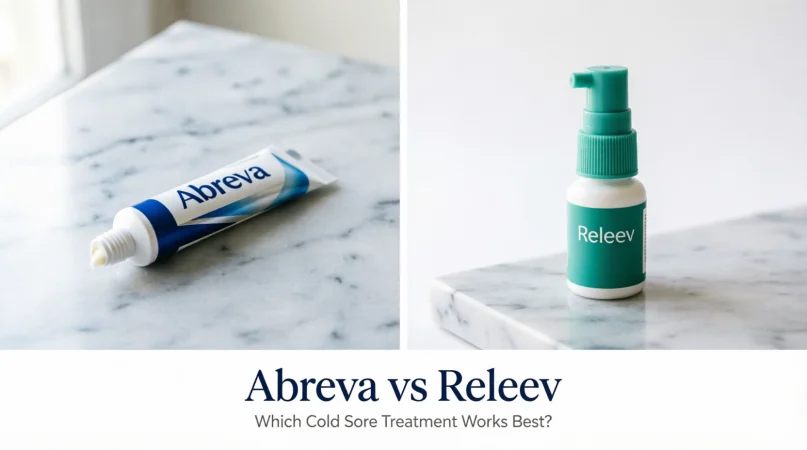
Use Abreva at the very first tingle of a cold sore. It’s the only FDA‑approved OTC treatment that actually shortens healing time. Use Releev only for symptom relief after the blister appears.
Abreva is an over-the-counter topical cream whose active ingredient is 10% docosanol, a 22-carbon saturated fatty alcohol. It is FDA-approved specifically for the treatment of herpes labialis (cold sores). Releev is an over-the-counter topical treatment for cold sores that uses a proprietary botanical formula called Viracea, which contains the antiseptic benzalkonium chloride combined with echinacea extract.
That familiar tingle on your lip. You know what’s coming. Another cold sore. And now you’re standing in the pharmacy aisle, staring at two familiar names: Abreva and Releev. As someone who has dealt with recurrent cold sores for years, I have tried everything: prescriptions, home remedies, and every over-the-counter option on the shelf. I’ve also spoken with pharmacists, dermatologists, and fellow sufferers who swear by one product or the other.
Quick Answer Table
| Feature | Abreva | Releev |
| Active ingredient | Docosanol 10% | Benzalkonium chloride (plus other ingredients) |
| FDA approval | Yes (first and only OTC cold sore treatment) | No (marketed as a topical antiseptic) |
| How it works | Blocks virus entry into healthy cells | Antiseptic + skin softening |
| Best used when | First tingle (prodromal stage) | After the blister appears |
| Healing time claim | 4.1 days vs. 8.3 days with placebo | Varies (limited clinical studies) |
| Typical price | $$ (more expensive) | $ (affordable) |
Which One Is Correct? Abreva or Releev?
Here’s the truth: Both are real products but they are not interchangeable.
- Abreva is the only FDA-approved over-the-counter cold sore treatment that actually shortens healing time.
- Releev is a topical antiseptic that can relieve symptoms but lacks the same clinical evidence.
The confusion between Abreva and Releev happens because both are sold in the same pharmacy aisle, both treat cold sores, and both have enthusiastic user reviews. But scientifically, they work very differently.
Understanding those differences can save you time, money, and discomfort.
Meaning of Abreva (The FDA-Approved Heavy Hitter)
Abreva is a topical cream containing 10% docosanol, a fatty alcohol that interferes with the herpes simplex virus’s ability to enter healthy skin cells.
How Abreva works
Docosanol prevents the virus from fusing with cell membranes. Think of it as locking the door before the virus can get inside. That’s why timing is everything: Abreva works best when applied at the very first sign of a cold sore (tingling, itching, or redness).
Key facts about Abreva
- FDA approval: Yes (1995 for cold sores)
- Available without prescription: Yes
- Proven results: Clinical trials show healing time reduced from 8.3 days to 4.1 days
- Application: 5 times daily until healed
- Side effects: Mild (headache, skin irritation in some users)
Real-world usage examples
- At the first tingle, I reached for Abreva. Twelve hours later, the blister never fully formed.
- My doctor recommended Abreva because it’s the only OTC option with real clinical data.
- Abreva didn’t make my cold sore disappear overnight, but it healed in 4 days instead of 10.
Meaning of Releev (The Antiseptic Alternative)
Releev is a topical liquid (not a cream) that contains benzalkonium chloride (an antiseptic) along with other inactive ingredients like aloe and tea tree oil.
How Releev works
Releev doesn’t attack the virus directly. Instead, it cleanses the area and may create an environment less hospitable to viral reproduction. It also softens scabs and moisturizes, which can reduce cracking and pain.
Key facts about Releev
- FDA approval: No (not as a cold sore treatment)
- Available without prescription: Yes
- Proven results: No large-scale clinical trials specific to cold sores
- Application: 3–4 times daily
- Side effects: Rare (skin sensitivity possible)
Real-world usage examples
- I tried Releev after the blister had already formed. It didn’t stop it, but it hurt less.
- Releev is gentler on my sensitive skin than Abreva.
- For the price, Releev is fine. But don’t expect miracles.
Key Differences Between Abreva and Releev
| Category | Abreva | Releev |
| Active ingredient | Docosanol 10% | Benzalkonium chloride |
| Product type | Cream | Liquid |
| FDA approved for cold sores? | Yes | No |
| Clinical evidence strength | Strong (peer-reviewed studies) | Weak (mostly user testimonials) |
| Best stage of a cold sore | Tingle/prodromal (first 12–24 hours) | Blister/crust stage |
| Prevents future outbreaks? | No | No |
| Dries out the blister? | No (creamy, moisturizing) | Yes (liquid dries faster) |
| Common side effects | Headache, mild rash | Skin dryness, stinging |
| Cost per treatment course | $15–25 | $8–12 |
Common Mistakes People Make
Even experienced cold sore sufferers get this wrong. Avoid these errors:
Mistake 1: Using Abreva too late
❌ “I’ll start Abreva when the blister is huge.”
✅ Abreva works ONLY at the tingle stage. Once the blister forms, the virus has already entered cells. Abreva can’t help much then.
Mistake 2: Expecting Releev to work like Abreva
❌ “Releev will heal my cold sore in 2 days.”
✅ Releev is an antiseptic, not an antiviral. It helps with discomfort but doesn’t stop viral replication.
Mistake 3: Using both products at the same time
❌ “More products = faster healing.”
✅ No evidence supports layering. Stick with one product to avoid skin irritation.
Mistake 4: Stopping treatment too soon
❌ “The blister is gone, so I’ll stop.”
✅ Continue for the full recommended duration (usually 5–10 days) to prevent recurrence at the same site.
Mistake 5: Ignoring prescription options
❌ “I’ll just keep buying OTC products forever.”
✅ If you get 6+ cold sores per year, ask your doctor about prescription antivirals (valacyclovir, acyclovir). They’re more effective than any OTC product.
Correct Usage Examples
Casual examples (everyday use)
- I keep Abreva in my medicine cabinet for the instant I feel a tingle.
- My roommate swears by Releev, but I think it’s just glorified hand sanitizer.
- Abreva or Releev? My rule: tingle = Abreva. Blister = Releev for pain relief.
Professional examples (pharmacy & medical advice)
- Pharmacists commonly recommend Abreva over Releev because only Abreva has FDA approval for cold sore treatment.
- In clinical practice, dermatologists prescribe topical antivirals like Abreva for early intervention and oral antivirals for frequent outbreaks.
- When a patient asks Abreva or Releev, I explain the difference: one blocks viral entry; the other soothes symptoms.
Educational examples (health literacy)
- Students learning about herpes simplex should understand that over-the-counter treatments like Abreva are palliative, not curative.
- The mechanism of docosanol (Abreva) is unique among OTC products it disrupts viral fusion with host cell membranes.
- A common exam question asks: “Which cold sore treatment has FDA approval?” Answer: Abreva.
Literary/metaphorical examples
- She applied Abreva like a shield before the enemy arrived at the gates of her lip.
- Releev was the bandage. Abreva was the sword.
- The cold sore came anyway but with Abreva, it was a skirmish, not a siege.
Word Origin / Etymology
Abreva is a brand name with no Latin or Greek root. It was created by the pharmaceutical company Avanir (now part of Otsuka). The name likely evokes “abreviate” (shorten) because it shortens healing time.
Releev is also a brand name, blending “relief” with a soft -eev ending. The spelling suggests “re-leave” as in “to leave behind” the cold sore.
Neither word has ancient origins. Both are modern pharmaceutical trademarks.
Why “Abreva or Releev” Became Such a Common Debate
Online forums and Reddit threads are filled with this exact question. Why?
- Similar packaging – Both are small tubes/liquids found in the same pharmacy aisle.
- Word-of-mouth confusion – “My aunt swears by Releev” vs. “My doctor said Abreva only.”
- Price difference – Releev is cheaper, so budget-conscious buyers want it to work.
- Misunderstanding of FDA approval – Many people don’t know that Releev lacks the same evidence.
The result? Millions of searches asking Abreva or Releev from genuinely confused and uncomfortable cold sore sufferers.
Easy Memory Tricks
Never second-guess Abreva or Releev again with these simple tricks.
| Product | Memory trick |
| Abreva | Abreva = Antiviral (stops the virus) |
| Abreva | “Abreva” sounds like “a break from” pain |
| Releev | Releev = Relief (symptoms only, not cure) |
| Releev | “Releev” sounds like “relieve” – that’s all it does |
One-sentence rule:
At the first tingle, grab Abreva. For anything else, Releev is just symptom relief.
The alphabet trick:
- Abreva comes at the start (first tingle)
- Releev comes right after the blister appears (R = later in alphabet = later stage)
FAQs
Is Abreva or Releev better for a cold sore that has already blistered?
Releev may be better at that stage, but only for symptom relief. Abreva is largely ineffective once the blister forms because the virus has already entered your cells. For best results, use a prescription antiviral if you’re already in the blister stage.
Can I use Abreva and Releev together?
There’s no known drug interaction, but it’s not recommended. Layering products can irritate sensitive skin on your lip. Choose one product and use it as directed.
Which one heals cold sores faster, Abreva or Releev?
Abreva has clinical proof of faster healing (4.1 days vs. 8.3 days placebo). Releev has no comparable studies. If speed matters, choose Abreva but only if you apply it at the tingle stage.
Is Releev FDA-approved for cold sores?
No. Releev is marketed as a topical antiseptic. It does not have FDA approval specifically for treating cold sores. Abreva is the only OTC cold sore treatment with that approval.
Which is cheaper, Abreva or Releev?
Releev is significantly cheaper (
8–12vs.
8–12 vs..15–25 for Abreva). However, cheaper doesn’t mean better. Consider the stage of your cold sore before deciding based on price.
Do I need a prescription for either?
No. Both Abreva and Releev are available over the counter without a prescription. However, if you have frequent outbreaks (6+ per year), ask your doctor about prescription antivirals—they work better than either OTC option.
Conclusion
To conclude, Abreva is the superior choice for clinically proven cold sore healing, especially when used early. Releev can serve as a supportive or budget-friendly option, particularly for keeping the area clean, but it lacks the same level of FDA validation and healing data as Abreva. And remember the golden rule: Timing is everything. No OTC product can undo a cold sore once the blister is fully formed.
When choosing between Abreva and Releev, the best option depends on your priorities: FDA-approved clinical efficacy or immediate antiseptic action. For best results: Use Abreva at the first tingle. If sores have already opened, consider Releev for its antiseptic properties, or consult a doctor for prescription antivirals like Valacyclovir.