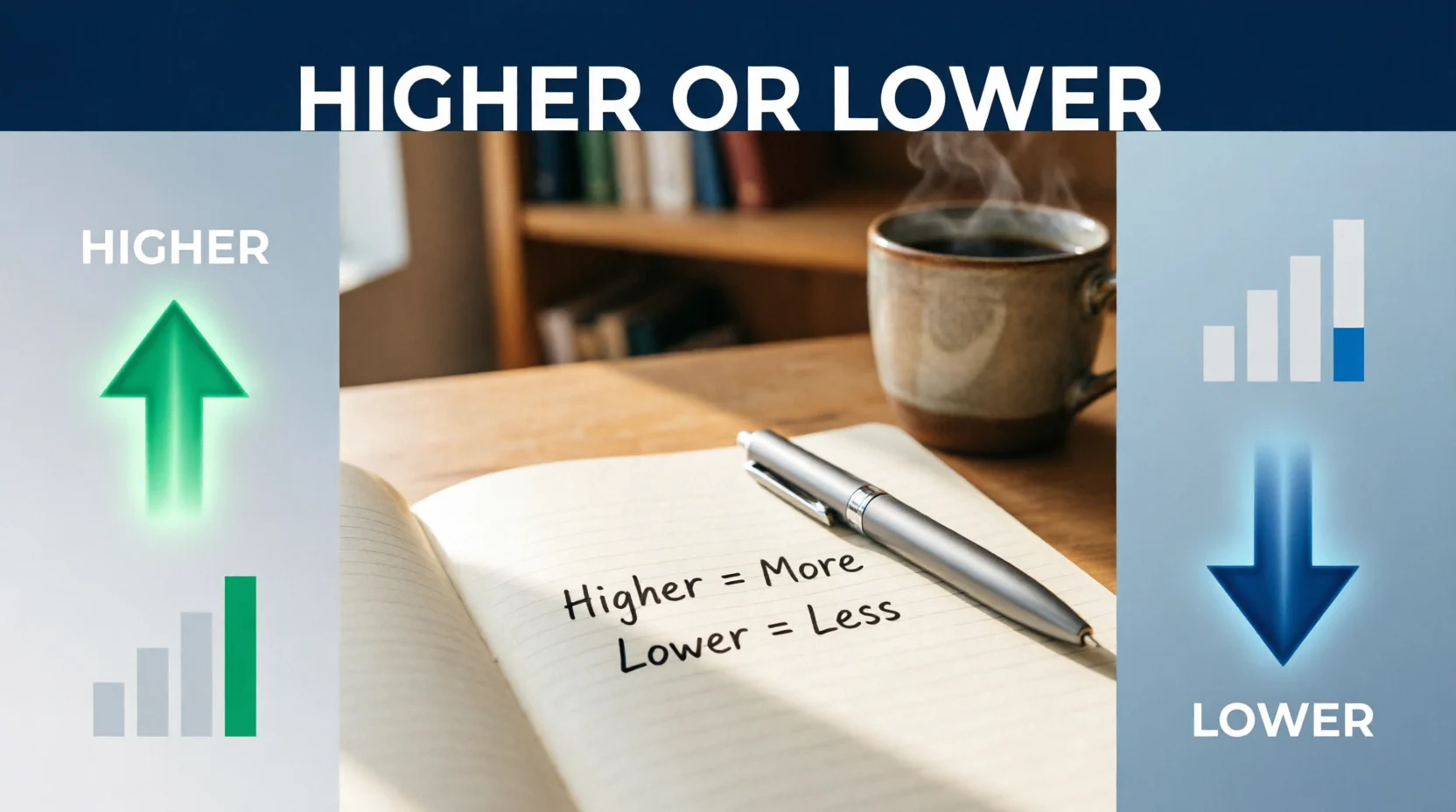
Use higher for greater size, amount, or intensity; use lower for smaller size, amount, or intensity, and only lower works as a verb meaning “to move down.”
The concepts of higher and lower are commonly used in daily life, education, mathematics, science, and economics to compare values, positions, levels, or amounts. Understanding the difference between higher and lower helps people make better decisions and improve problem-solving skills. In mathematics, a higher number represents a greater value, while a lower number shows a smaller value. Similarly, in temperature, prices, or heights, higher values indicate an increase, and lower values indicate a decrease.
These terms are also important in business, where higher profits are desirable and lower costs help companies succeed. Students learn these comparisons from an early age because they are essential for analyzing information and understanding relationships between objects or data. By studying the meanings and uses of higher and lower, people can develop stronger logical thinking and apply these concepts effectively in real-life situations, academic studies, and professional environments.
Quick Answer Table
| Feature | Higher or Lower |
| Correct Form | Higher or lower (both words correct) |
| Incorrect Form | None (but misuse is common) |
| Core Meaning | A comparison asking whether a value exceeds or falls below another |
| Grammatical Role | Comparative adjective phrase |
| Primary Usage | Questions, decisions, data interpretation, games |
| Example Sentence | Is the stock price higher or lower than yesterday’s close? |
Which One Is Correct?
Here is the short answer: both “higher” and “lower” are perfectly correct English words.
There is no spelling mistake to avoid. Instead, the real challenge lies in understanding when and how to use them together as a comparative pair.
The phrase “higher or lower” functions as a complete grammatical structure used to:
- Ask a comparison question
- Present a binary choice between two directions
- Interpret changes in data, measurements, or values
Incorrect usage does not come from misspelling. It comes from using the phrase in the wrong grammatical context or confusing its meaning with other comparative structures.
For example:
✅ Correct: “Is the temperature higher or lower today?”
❌ Incorrect: “This temperature is higher or lower than yesterday.” (Missing question structure or proper comparison context)
So remember: the words themselves are correct. Your sentence structure determines whether the phrase works properly.
Meaning of “Higher or Lower” (The Correct Phrase)
Definition
Higher or lower is a comparative question phrase used to determine whether a specific measurement, quantity, or value is greater than (higher) or less than (lower) a reference point.
Simple Explanation
Imagine you have two numbers: 50 and 75.
If someone asks “higher or lower?” regarding 75 compared to 50, the answer is “higher” because 75 exceeds 50.
The phrase forces a directional decision: upward (higher) or downward (lower).
Core Usage Areas
| Context | How “Higher or Lower” Is Used |
| Mathematics | Comparing numerical values |
| Statistics | Interpreting data trends |
| Finance | Analyzing price movements |
| Weather | Comparing temperatures |
| Gaming | Guessing numbers or values |
| Education | Teaching comparative concepts |
Real-World Examples
Example 1 (Weather):
“Is the humidity higher or lower than it was at noon?”
Example 2 (Finance):
“Are our quarterly earnings higher or lower compared to last year?”
Example 3 (Health):
“Is your cholesterol level higher or lower after changing your diet?”
Example 4 (Gaming):
“Guess the number. Is it higher or lower than 500?”
Meaning of “Higher” and “Lower” Separately
To fully understand the combined phrase, you must know each word individually.
Meaning of “Higher”
Higher is the comparative form of the adjective “high.”
It indicates:
| Aspect | Meaning |
| Quantity | Greater in number or amount |
| Level | Above a standard or average |
| Position | Physically elevated |
| Degree | Increased intensity |
| Value | Larger numerical worth |
Examples of “Higher” alone:
- “Her test score was higher than mine.”
- “Prices are higher during peak season.”
- “The mountain peak is higher than the clouds.”
Meaning of “Lower”
Lower is the comparative form of the adjective “low.”
It indicates:
| Aspect | Meaning |
| Quantity | Smaller in number or amount |
| Level | Below a standard or average |
| Position | Physically less elevated |
| Degree | Reduced intensity |
| Value | Smaller numerical worth |
Examples of “Lower” alone:
- “His blood pressure is lower this month.”
- “Temperatures are lower in the evening.”
- “That price is lower than the competitor’s.”
Key Differences Between Higher and Lower
While both are comparative adjectives, they represent opposite directions of comparison.
| Feature | Higher | Lower |
| Direction | Upward / Increase | Downward / Decrease |
| Numerical Value | Greater | Smaller |
| Emotional Connotation | Often positive (growth, improvement) | Often neutral or negative (reduction, decline) |
| Physical Reference | Above a point | Below a point |
| Synonym | Greater, taller, increased | Smaller, shorter, reduced |
| Antonym | Lower | Higher |
Grammar Role of the Full Phrase
When combined as “higher or lower,” the phrase typically functions as:
1. An Interrogative Phrase
Used to ask a direct comparison question.
“Is the new model’s battery life higher or lower than the previous version?”
2. A Choice Indicator
Presenting two possible directions in decision-making.
“You must decide whether to set the price higher or lower than the competition.”
3. A Comparative Clause Component
Embedded within larger comparative structures.
“The study measures whether patient recovery rates are higher or lower with each treatment.”
Pronunciation Guide
Correct pronunciation helps with fluency and listener comprehension.
| Word | Phonetic Spelling | Audio Tip |
| Higher | /ˈhaɪ.ər/ | Rhymes with “tire” or “fire.” |
| Lower | /ˈloʊ.ər/ | Rhymes with “slower” or “grower.” |
| Higher or lower | /ˈhaɪ.ər ɔr ˈloʊ.ər/ | Stress falls equally on both words |
Common Pronunciation Mistakes to Avoid:
❌ Saying “high-er” with a hard G sound
✅ Keep the “gh” silent: “hi-er.”
❌ Rushing “lower” into “lo.r”
✅ Pronounce the full “low-er” with a clear W sound
Common Mistakes People Make with Higher or Lower
Even experienced English speakers make errors with this phrase. Here are the most frequent mistakes and how to avoid them.
Mistake 1: Using Double Comparatives
❌ Incorrect: “Is the price higher or lower?”
✅ Correct: “Is the price higher or lower?”
Why it is wrong: “Higher” and “lower” are already comparative forms. Adding “more” creates a redundant double comparative.
Mistake 2: Forgetting Question Structure
❌ Incorrect: “The temperature is higher or lower today.”
✅ Correct: “Is the temperature higher or lower today?”
Why it is wrong: The phrase requires auxiliary verb support (is, are, was, were) to form a proper question.
Mistake 3: Using with Non-Comparable Items
❌ Incorrect: “Is your name higher or lower than mine?”
✅ Correct: “Is your score higher or lower than mine?”
Why it is wrong: “Higher or lower” compares measurable quantities, not categorical or nominal data.
Mistake 4: Missing the Reference Point
❌ Incorrect: “Is it higher or lower?” (without context)
✅ Correct: “Is it higher or lower than yesterday?”
Why it is wrong: The phrase needs a clear reference point for meaningful comparison.
Mistake 5: Incorrect Word Order in Embedded Questions
❌ Incorrect: “Can you tell me whether the value is higher or lower than the value?”
✅ Correct: “Can you tell me whether the value is higher or lower?”
Why it is wrong: Embedded questions require proper clause structure with “whether” or “if.”
Correct Usage Examples (By Context)
Casual / Everyday Conversation
“Is the gas price higher or lower than last week?”
“Do you think his new apartment rent is higher or lower?”
“Guess whether my birthday number is higher or lower than 15.”
Professional / Business English
“Our analysis determines if operating costs are higher or lower after the merger.”
“Please indicate whether this quarter’s revenue is higher or lower than projections.”
“The board needs to decide if interest rates will trend higher or lower next year.”
Academic / Educational
“Students must calculate whether the experimental yield is higher or lower under controlled conditions.”
“The graph shows whether population growth is higher or lower in urban versus rural areas.”
“Determine if the median score is higher or lower than the class average.”
Literary / Metaphorical
“Her spirits climbed higher or lower with each passing day, mirroring the uncertain tides of fate.”
“In matters of the heart, emotions run higher or lower than logic ever dares to travel.”
Scientific / Technical
“The algorithm predicts whether air pressure will be higher or lower ahead of the storm front.”
“Researchers measured whether cognitive response times were higher or lower after sleep deprivation.”
Word Origin / Etymology
Understanding where “higher” and “lower” come from deepens your grasp of their modern usage.
Etymology of “Higher”
- Old English: “hēah” meaning “tall, elevated, lofty.”
- Proto-Germanic: “hauhaz” (high)
- Comparative formation: Added “-er” suffix to create a comparative degree
- Evolution: “hēah” → “higher” (Middle English) → “higher” (Modern English)
Etymology of “Lower”
- Old Norse: “lág” meaning “low, not tall” (borrowed into English during Viking settlements)
- Old English alternative: “hlǣw” (hill/mound), but the Norse form dominated
- Comparative formation: “low” + “-er.”
- Evolution: “lág” → “low” (Middle English) → “lower” (Modern English)
Why They Paired Together
English naturally pairs opposites as comparative pairs because:
- Cognitive simplicity: Binary comparisons are easier to process
- Mathematical utility: Many real-world measurements move in two directions
- Game theory: Guessing games rely on directional choice
Why the Phrase “Higher or Lower” Became Popular
You might wonder why this specific phrase gained such widespread use rather than alternatives like “greater or smaller” or “more or less.”
Reason 1: Simplicity
The words “high” and “low” are among the first adjectives English learners acquire. Their comparative forms feel intuitive.
Reason 2: Game Show Influence
Television game shows like The Price Is Right and Higher or Lower (a British game show) cemented the phrase in popular culture.
Reason 3: Digital Integration
Mobile apps and online guessing games use the phrase as a core mechanic. The popular app “Higher or Lower” (based on Google searches) has millions of downloads.
Reason 4: Data Visualization
In an era of dashboards, charts, and analytics, people constantly ask whether metrics are trending up (higher) or down (lower).
Reason 5: Universal Applicability
Unlike specialized comparatives (e.g., “hotter or colder” for temperature, “faster or slower” for speed), “higher or lower” works for:
- Numbers
- Prices
- Temperatures
- Scores
- Levels
- Percentages
- Rankings
Easy Memory Tricks
Never confuse when or how to use “higher or lower” with these simple memory aids.
Trick 1: The Mountain Visual
Imagine a mountain.
👉 Higher = climbing UP the mountain
👉 Lower = walking DOWN the mountain
When you ask “higher or lower,” you are asking someone to choose a direction on that mountain.
Trick 2: The Number Line
Draw a mental number line:
Lower ← 0 — 25 — 50 — 75 — 100 → Higher
- Moving right = higher
- Moving left = lower
Trick 3: The Price Tag Rule
Think of shopping:
👉 Higher = more expensive (costs more money)
👉 Lower = cheaper (costs less money)
Trick 4: The Temperature Anchor
Think of a thermometer:
👉 Higher = hotter (mercury rises)
👉 Lower = colder (mercury falls)
Trick 5: The Acronym: H = Help Up, L = Let Down
- H for Higher = Help the value go Up
- L for Lower = Let the value go down
Advanced Usage: Higher or Lower in Data Interpretation
In professional settings, “higher or lower” is a gateway to deeper analytical thinking.
Statistical Context
When analyzing data distributions:
“Is the new sample mean higher or lower than the population mean?”
Financial Chart Analysis
“Based on the moving average crossover, should we expect prices to move higher or lower?”
A/B Testing
“Is the conversion rate for variant A higher or lower than that of variant B at 95% confidence?”
Machine Learning Evaluation
“Is the model’s accuracy higher or lower after feature engineering?”
Pro Tip: In formal data reports, replace “higher or lower” with “statistically significantly higher or lower” when discussing confidence intervals.
Higher or Lower vs. Similar Comparative Phrases
| Phrase | Best Used For | Example |
| Higher or lower | Numbers, levels, quantities, prices | “Is the temperature higher or lower?” |
| More or less | Amounts, degrees, abstract quantities | “Do you want more or less sugar?” |
| Greater or smaller | Mathematical values, formal contexts | “Is 75 greater or smaller than 50?” |
| Hotter or colder | Temperature, emotional intensity | “Is the oven hotter or colder now?” |
| Faster or slower | Speed, pace, rate | “Is the internet faster or slower?” |
| Bigger or smaller | Physical size, scale | “Is the box bigger or smaller?” |
Key Distinction: “Higher or lower” emphasizes vertical measurement (elevation, value on a scale), while “more or less” emphasizes quantity without directional metaphor.
Grammar Deep Dive: Comparative Structures with Higher or Lower
Structure 1: Direct Question
Auxiliary verb + subject + higher or lower + than + reference point?
Examples:
- “Is the price higher or lower than last month?”
- “Were the scores higher or lower than the national average?”
Structure 2: Embedded Question (Statement Form)
Subject + verb + whether/if + noun phrase + is + higher or lower + than + reference
Examples:
- “I wonder whether the new rent is higher or lower than my old place.”
- “Please determine if the error rate is higher or lower than acceptable limits.”
Structure 3: Choice Presentation
Verb + to + infinitive + higher or lower
Examples:
- “We need to decide whether to go higher or lower.”
- “The algorithm chooses to adjust higher or lower automatically.”
Structure 4: Conditional Comparison
If + comparison + then + result
Example:
“If the bid is higher or lower than our limit, the system will reject it automatically.”
Common Misconceptions (Debunked)
Misconception 1: “Higher or lower” is informal and unprofessional.
Truth: The phrase appears in academic journals, financial reports, and scientific papers. It is perfectly professional when used correctly.
Misconception 2: “Higher” only refers to physical height.
Truth: “Higher” applies to any measurable scale, including temperature, prices, scores, and abstract quantities.
Misconception 3: “Lower” always has a negative meaning.
Truth: “Lower” can be positive (lower blood pressure, lower costs, lower risk).
Misconception 4: You can use “higher or lower” without a reference point.
Truth: Meaningful comparison always requires a clear baseline or reference value.
FAQs
1. What does “higher or lower” mean in English?
“Higher or lower” is a comparative phrase used to ask whether a specific value, measurement, or quantity is greater than (higher) or less than (lower) a given reference point.
2. Is “higher or lower” grammatically correct?
Yes, both words are correct comparative adjectives. The phrase follows standard English grammar rules for forming comparison questions.
3. When should I use “higher or lower” instead of “more or less”?
Use “higher or lower” for values on a vertical scale (prices, temperatures, scores, levels). Use “more or less” for quantities or amounts without a vertical metaphor.
4. Can “higher or lower” be used in formal writing?
Absolutely. The phrase appears in academic papers, financial analyses, scientific reports, and professional correspondence.
5. What is the opposite of “higher”?
The direct opposite of “higher” is “lower.” They are antonymous comparatives.
6. How do I pronounce “higher or lower” correctly?
Higher = /ˈhaɪ.ər/ (sounds like “hi-er”)
Lower = /ˈloʊ.ər/ (sounds like “lo-er”)
Say them with equal emphasis.
7. Is “higher or lower” only used in questions?
No, but questions are the most common form. You can also use it in statements (“whether X is higher or lower than Y”) and choices (“decide higher or lower”).
8. What is the most common mistake with this phrase?
Using double comparatives (“more higher”) or forgetting to include a clear reference point for comparison.
9. Can I use “higher or lower” for non-numerical comparisons?
Generally no. The phrase works best for measurable, quantifiable values. For qualitative comparisons, use “better or worse” or “more or less effective.”
10. Why do guessing games use “higher or lower”?
Because binary directional questions efficiently narrow down a hidden value. Each “higher or lower” question eliminates half the remaining possibilities.
11. Is there a difference between British and American usage?
No significant difference. Both dialects use “higher or lower” identically in grammar and meaning.
12. Can “higher or lower” start a sentence?
Yes, when forming a direct question: “Higher or lower, which direction will the market move?”
Conclusion
In conclusion, understanding Higher or Lower is really about mastering one of the most basic but powerful comparison tools in English. Both words are correct, but they work as opposites that help describe change, difference, and measurement in a clear way.
Whenever you compare two things, whether it is numbers, prices, marks, temperature, or trends, this phrase helps you express it: something is either increasing (higher) or decreasing (lower). The key takeaway is straightforward.
Use higher or lower whenever you want to compare two values and show direction or difference. Once you get comfortable with it, you will notice how often it appears in daily English, exams, and real-world communication.