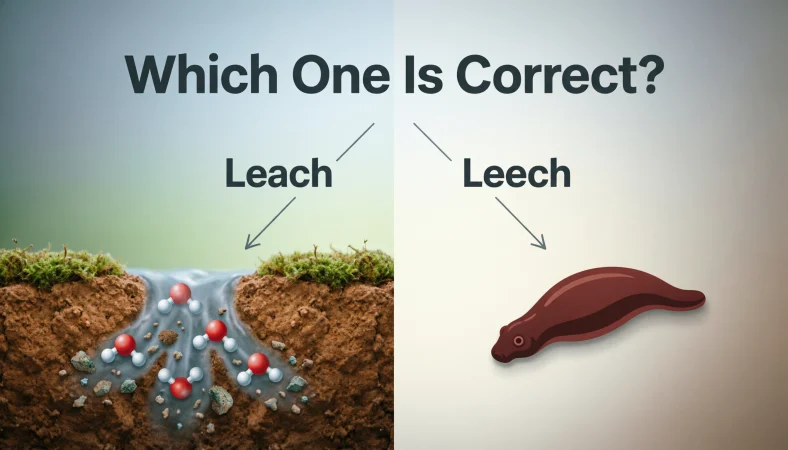
Leach and leech are both correct words, but they have different meanings.
- Leach → means to drain, remove, or filter a substance (usually liquid through soil or material).
Example: Chemicals can leach into the water. - Leech → refers to a blood-sucking worm, or a person who takes advantage of others.
Example: A leech attached to the skin.
Leach or Leech is a common English word confusion because both words sound almost identical but have completely different meanings. Leach is mainly used as a verb meaning to drain, remove, or filter a substance from a material, while leech refers to a blood-sucking creature or a person who takes advantage of others.
Understanding the difference between leach and leech helps you avoid spelling mistakes and use each word correctly in the right context. Although they share a similar pronunciation, their meanings, origins, and uses are completely separate, making this distinction important for clear and accurate writing.
Quick Answer Table
| Feature | Leach | Leech |
| Correct Spelling | Yes | Yes |
| Part of Speech | Verb (mainly); noun (rare) | Noun (mainly); verb (rare) |
| Primary Meaning | To drain, filter, or remove substances through percolation | A blood sucking worm; a person who exploits others |
| Common Usage | Chemistry, agriculture, environmental science | Biology, medicine, figurative speech |
| Example Sentence | Rainwater can leach nutrients from the soil. | The leech attached itself to the swimmer’s leg. |
| Pronunciation | /liːtʃ/ | /liːtʃ/ |
Which One Is Correct?
Here is the short answer: both “leach” and “leech” are correct words in the English language. Neither is a misspelling of the other—they are simply different terms with different meanings. This is why the question of “leach or leech” is not about right versus wrong, but about which word fits your intended meaning.
However, confusion arises because these words are homophones, meaning they sound exactly the same when spoken. When you are writing quickly or relying on spell check software, it is easy to choose the wrong one. Both words appear in dictionaries, and both have legitimate uses across various fields and contexts.
The real challenge lies in knowing when to use each word appropriately. Using “leach” when you mean a parasitic worm will confuse your reader and undermine your credibility. Similarly, using “leech” when you are describing a chemical process will make your writing sound unprofessional. Let us explore each word in detail so you can make the right choice every time.
Meaning of the Correct Word: Leach
Definition and Explanation
Leach primarily functions as a verb that describes the process of removing soluble substances from a material by passing water or another liquid through it. In simpler terms, when you leach something, you are washing or draining certain components out of it. This process can happen naturally through environmental forces like rainfall or be performed deliberately in industrial and scientific settings.
The term is especially common in soil science, agriculture, chemistry, and environmental studies. When water percolates through soil or rock, it dissolves minerals and carries them away—this is leaching in action. The same principle applies to how groundwater becomes contaminated or how certain industrial processes separate valuable materials from waste.
Expanded Usage
Leaching is a fundamental concept in many scientific disciplines. .
Real World Examples
Environmental Context:
- Excess nitrogen from agricultural fertilizers can leach into nearby rivers and lakes.
- Heavy metals may leach from old pipes into drinking water over time.
- The minerals naturally present in the soil leach downward with each heavy rainfall.
Scientific and Industrial Context:
- The laboratory technician used a solvent to leach the desired compound from the plant material.
- Coffee makers work by allowing hot water to leach flavor compounds from ground coffee beans.
- The mining industry employs leaching techniques to extract copper from low grade ores.
Everyday Context:
- If you soak a tea bag too long, the tannins will leach out and make the tea bitter.
- Rainwater can leach color from dyed fabrics if left outside.
- Over time, the salt leached from the cured meat into the surrounding broth.
Important Grammar Notes
While “leach” is overwhelmingly used as a verb, you might occasionally encounter it as a noun. In technical contexts, a “leach” can refer to the liquid that has passed through a material (also called leachate) or the vessel used for the leaching process. However, these noun forms are rare and mostly confined to specialized industrial or scientific jargon.
The verb forms follow standard conjugation: leach, leached, leaching. For example:
- Present: Water leaches minerals from the soil.
- Past: The chemicals leached into the groundwater.
- Present Participle: Leaching is a common soil degradation process.
Meaning of the Incorrect Word: Leech
Definition and Explanation
Leech is primarily a noun that refers to a type of segmented worm belonging to the class Hirudinea. These creatures are known for their distinctive body shape—flattened, often dark colored, and equipped with suction cups at both ends. Most leeches live in freshwater environments like ponds, lakes, and slow moving rivers, although some species inhabit marine or terrestrial habitats.
The most famous characteristic of leeches is their feeding habit: they are ectoparasites that attach to the skin of vertebrates and suck blood. They secrete anticoagulants in their saliva to prevent blood from clotting while they feed. Historically, this property made leeches valuable in medicine for bloodletting procedures, and modern medicine still uses them in certain surgical applications.
Figurative and Extended Meanings
Beyond the literal biological definition, “leech” has evolved a powerful figurative meaning. When you call a person a leech, you are comparing them to the parasitic worm—someone who attaches themselves to others and drains resources, energy, or money without contributing anything in return. This metaphorical usage is common in everyday speech and writing.
Real World Examples
Literal Biological Context:
- A leech attached itself to the hiker’s leg during the rainforest trek.
- The hospital uses medicinal leeches to reduce blood pooling after reconstructive surgery.
- Leeches are hermaphroditic and reproduce by laying eggs in cocoons.
Figurative and Metaphorical Context:
- He refused to lend money to his brother in law, whom he described as a financial leech.
- The department had to let go of several staff members who had become more of a leech than an asset.
- She felt drained after years of supporting her friend, who acted like an emotional leech.
Verb Form of Leech:
- The patient required multiple leechings to restore proper circulation.
- He leeched off his parents well into his thirties without contributing to household expenses.
Important Grammar Notes
Although “leech” is primarily a noun, it can function as a verb in specific contexts. When used as a verb, “to leech” means to behave like a leech—either literally (as in the action of the worm attaching and feeding) or figuratively (as in exploiting others). The verb form is “leech,” with “leeched” as the past tense and “leeching” as the present participle.
For example:
- Present: The patient is leeching on the healthcare system without contributing through taxes.
- Past: He leeched off his friends until they finally cut ties.
- Present Participle: Leeches are leeching onto the skin to feed.
Key Differences Between the Two Words
Spelling
The most obvious difference lies in the vowel sequence. “Leach” contains “ea” while “leech” contains “ee.” This spelling distinction is your first clue when deciding which word to use. However, because both are valid dictionary entries, you cannot rely on spell check alone to catch errors.
Meaning
The semantic difference is stark. “Leach” deals with extraction, drainage, and percolation—processes of separation and removal. “Leech” deals with a specific biological organism and its behavioral analogs—attachment, exploitation, and parasitism. These are entirely unrelated concepts.
Pronunciation
Here is where the confusion originates: both words are pronounced exactly the same way—/liːtʃ/. This identical pronunciation makes them homophones in spoken English. You have to rely on context to understand which word someone means when speaking aloud.
Grammar and Parts of Speech
“Leach” is primarily a verb, with rare noun uses in highly technical contexts. “Leech” is primarily a noun, with a secondary verb usage that either describes literal leech behavior or figuratively describes exploitative behavior. Their grammatical patterns are distinct and worth noting.
| Feature | Leach | Leech |
| Main Part of Speech | Verb | Noun |
| Secondary Part of Speech | Noun (rare, technical) | Verb (common in figurative use) |
| Common Conjugation | leach, leached, leaching | leech, leeched, leeching |
| Subject Typically | Liquid, chemical, water, solvent | Worm, person, parasite, exploiter |
Usage in Different Fields
The contexts where these words appear are usually quite different. “Leach” is at home in scientific, agricultural, and technical writing. “Leech” appears in biology texts, medical discussions, and figurative or metaphorical language. Crossing these contextual boundaries can confuse your reader.
Recognition and Common Knowledge
Both words are widely recognized and understood by educated English speakers, though their familiarity varies. “Leech” is probably more commonly known to the general public due to its dramatic biological nature and colorful figurative usage. “Leach” tends to be more specialized, though it appears frequently in environmental discussions.
Common Mistakes People Make
The most frequent error is using “leach” when “leech” is intended, or vice versa. Here are some of the most common mistakes writers make and how to avoid them.
“leach” in a biological context
- Incorrect: The doctor applied a medicinal leach to the patient’s wound.
- Correct: The doctor applied a medicinal leech to the patient’s wound.
“leech” in a scientific context
- Incorrect: The chemicals will leech into the surrounding soil.
- Correct: The chemicals will leach into the surrounding soil.
Figurative
- Incorrect: He feels that taxes leach money from his paycheck.
- Correct: He feels that taxes leech money from his paycheck. (Here, the exploitation sense is clearer with “leech.”)
Mistake 4: Past tense confusion
- Incorrect: The company leached off its customers for years before going bankrupt.
- Correct: The company leeched off its customers for years before going bankrupt.
Mistake 5: Confusing the noun forms
- Incorrect: The environmental report measured the leech found in groundwater samples.
- Correct: The environmental report measured the leach found in groundwater samples. (Leachate would be even more precise.)
Correct Usage Examples
Casual and Everyday Examples
Using Leach:
- The coffee grounds sat too long, allowing bitter compounds to leach into the brew.
- When I wash my jeans too frequently, the color leaches out and they look faded.
- Heavy rain can leach nutrients from your garden soil, so you might need to add fertilizer.
Using Leech:
- I found a leech on my ankle after swimming in the lake.
- My cousin is such a leech—he always shows up when there is free food.
- The investor was a leech who sucked profits from struggling companies.
Professional and Business Examples
Using Leach:
- The material safety data sheet warns that this chemical can leach into groundwater if improperly disposed.
- Our soil testing indicates that nitrates are leaching at unacceptable rates from the agricultural fields.
- The filtration system is designed to leach impurities without affecting the essential minerals.
Using Leech:
- The consulting firm became a leech on our budget, consuming resources without delivering value.
- We need to identify which departments are leeching productivity from the organization.
- The new partnership is designed to prevent any single stakeholder from leeching off the others.
Educational and Academic Examples
Using Leach:
- Geology students learn how various minerals leach from different rock types over time.
- The experiment demonstrated how temperature affects the rate at which salt leaches from the sample.
- Understanding nutrient leaching is essential for sustainable farming practices.
Using Leech:
- The biology class dissected a leech to study its digestive system.
- The life cycle of the medicinal leech has been extensively studied for surgical applications.
- Leech populations are used as bioindicators of water quality in freshwater ecosystems.
Literary and Metaphorical Examples
Using Leach:
- Time seemed to leach the joy from his memories until they were mere shadows.
- The city’s relentless pace had leached all her creative energy away.
- As the years passed, the color leached from the old photographs.
Using Leech:
- Greed is a leech that consumes everything in its path.
- She described her anxiety as a leech that sucked away her peace of mind.
- Toxic friendships are leeches that drain your emotional reserves.
Word Origin and Etymology
Etymology of Leach
“Leach” traces its roots back to Old English “leccan,” which meant “to moisten” or “to water.” This word has Germanic origins, related to the Dutch “lekken” meaning “to leak” and the German “lecken” meaning “to leak or drip.” Over centuries, the meaning shifted from simply moistening to specifically describing the action of water passing through a substance and carrying away dissolved materials.
The historical development reflects the agricultural importance of understanding how water interacts with soil. Early farmers needed to know how irrigation would affect their crops, and they observed that water could both nourish and deplete soil nutrients. By the 17th century, “leach” had acquired its modern meaning in scientific and agricultural contexts.
Etymology of Leech
“Leech” has a completely different etymological path. It comes from Old English “læce,” which originally meant “physician” or “healer.” This connection makes sense historically because leeches were widely used in medieval medicine for bloodletting. The word for the worm became associated with healing because of its medical applications.
Interestingly, the Old English “læce” also had a secondary meaning of “teacher” or “counselor,” highlighting how medical knowledge and education were intertwined in early Germanic societies. The medical application of leeches continued for centuries, and the word’s association with medicine only strengthened.
By the 18th and 19th centuries, “leech” had developed its figurative meaning of someone who attaches themselves to others for personal gain. This metaphorical extension was natural because the behavior of the blood sucking worm made a vivid comparison for exploitative human behavior.
Etymological Contrast
The table below shows the stark contrast in etymological development:
| Feature | Leach | Leech |
| Origin | Old English “leccan” | Old English “læce” |
| Original Meaning | To moisten, to water | Physician, healer |
| Related Words | Leak, lecher (related to moisture) | Leechcraft (healing art) |
| Path to Modern Meaning | From watering to dissolving | From healer to worm to exploiter |
Why the Incorrect Version Became Popular
Several factors have contributed to the widespread confusion between “leach” and “leech.” Understanding these can help you avoid the same pitfalls.
Phonetic Confusion
The identical pronunciation of the two words creates a natural vulnerability in both speaking and writing. When you only hear the word, you have no auditory cue to distinguish them. This phonetic overlap is the primary driver of confusion.
Spell Check Limitations
Standard spell check software recognizes both “leach” and “leech” as correctly spelled words, so it will not flag either one. This means you can type the wrong word and never receive a spelling warning. Without a dictionary or grammar checking tool that understands meaning, you are on your own.
Frequency and Familiarity
“Leech” is arguably more common in everyday speech and popular culture due to its dramatic qualities and colorful figurative usage. Many people have seen leeches in documentaries or heard them mentioned in medicine or travel contexts. This greater familiarity means that “leech” comes to mind more readily, even when “leach” is the correct choice.
Semantic Overlap Confusion
Although the meanings are distinct, there is a subtle conceptual overlap that can confuse writers. Both words involve something passing from one thing to another—leaching involves substances moving from soil into water, while leeching involves resources moving from one person to another. This thematic connection can blur the lines in a writer’s mind.
Digital Autocorrect Errors
Mobile devices and writing software sometimes “helpfully” change one word to the other based on faulty autocorrect algorithms. This can create errors that writers do not catch during editing.
Regional Variation
In some English speaking regions, “leech” is occasionally used informally to mean “to drain” or “to extract,” blurring the distinction further. This regional usage, while nonstandard, contributes to the overall confusion.
Easy Memory Tricks
Trick 1: Think “E” for Extraction
Remember that “leach” deals with extraction—removing substances by passing liquid through. The “A” in “leach” can remind you of “away” (the nutrients leach away) or “across” (water moves across and carries things).
Trick 2: Think “E” for Exploiter
“Leech” with double “E” is the word for that pesky worm—and for people who exploit others. The double “E” can stand for “Egotistical Exploiter” or “Everything taker.”
Trick 3: Relate to “Soil”
Ask yourself: is this about soil, water, chemicals, or extraction? If yes, use “leach.” Is this about a creature, parasitism, or exploitation? Use “leech.”
Trick 4: Visualize the Words
Picture the double “E” in “leech” as two eyes staring at you—like a worm looking for a host to latch onto. The single “A” in “leach” can look like a droplet of water carrying something away.
Trick 5: Use Mnemonic Sentences
- “Leech has two E’s because it takes everything.”
- “Leach has one A because it takes away.”
Trick 6: Contextual Check
Before you write either word, ask yourself: “Could I replace this with ‘drain’ or ‘extract’?” If yes, you likely want “leach.” “Could I replace this with ‘parasite’ or ‘exploiter’?” If yes, you likely want “leech.”
Trick 7: Reverse Mnemonic
“Leaching” removes “A” (any valuable component). “Leeching” removes “E” (everything good from someone else).
FAQs
Q1. Is “leach” or “leech” correct?
Both are correct words, but they have different meanings. Leach means to drain or extract, while leech refers to a worm or someone who exploits others.
Q2. What does leach mean?
Leach means to remove a substance by allowing liquid to pass through something, such as soil or material.
Q3. What does leech mean?
A leech is a blood-sucking worm or a person who takes advantage of others.
Q4. Can leach and leech be used interchangeably?
No. They sound the same but have different meanings and should not be swapped.
Q5. How do you use leech in a sentence?
Example: The leech attached to his leg.
Example: He leeched off his friends.
Q6. Are leach and leech pronounced the same?
Yes. Both are pronounced /liːtʃ/ and rhyme with beach and teach.
Q7. Is leech always negative?
No. The animal is neutral, but describing a person as a leech is usually negative.
Q8. What is the noun form of leach?
The noun form is leachate, meaning liquid that has passed through a substance and carried dissolved materials.
Q9. How can I remember leach vs leech?
Remember: Leach = away (things wash away), while leech = creature/person that takes.
Q10. Why do people confuse leach and leech?
They are homophones (same pronunciation), so people often mix them up when writing
Conclusion
The difference between leach and leech becomes clear once you focus on their meanings. Leach is related to the process of draining, filtering, or removing substances through liquid, while leech refers to a blood-sucking creature or a person who takes advantage of others. Although they sound identical, they are used in completely different situations.
Remember the simple rule: leach is about things being taken away, such as minerals or chemicals, while leech is about something or someone taking from another source. By understanding this distinction, you can avoid common spelling mistakes and make your writing clearly.