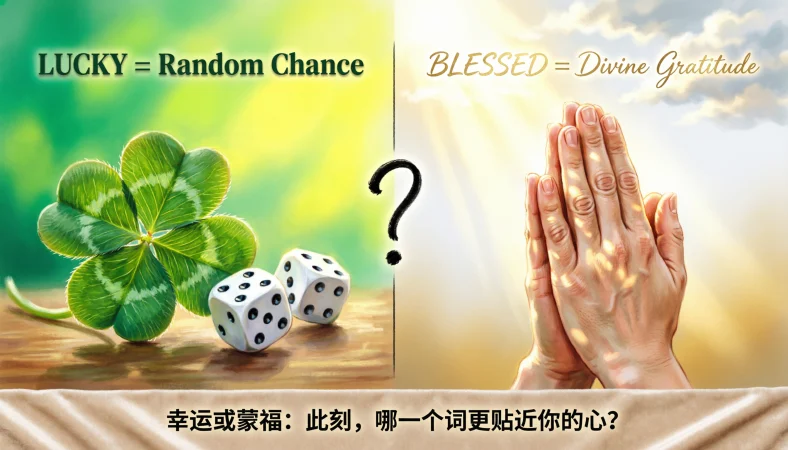
“Lucky” usually refers to success or good things happening by chance, while “blessed” often means receiving goodness through gratitude, faith, or divine favor.
The words “lucky” and “blessed” are often used to describe positive experiences, success, or unexpected good fortune, but they carry very different meanings and emotional depth. “Lucky” usually relates to chance, coincidence, or random favorable outcomes, while “blessed” is more connected to gratitude, spirituality, appreciation, and a sense of purpose. In everyday conversations, people may use these terms interchangeably, yet understanding their true meanings can help improve communication and emotional expression.
From personal achievements to life-changing moments, the choice between saying “lucky” and “blessed” often reflects an individual’s beliefs, mindset, and perspective on life. Experts in language, psychology, and culture recognize that these words influence how people view success, relationships, and personal experiences. Exploring the difference between lucky and blessed helps clarify understanding of positivity, thankfulness, and the role of faith or fortune in everyday life.
Quick Answer Table
| Feature | Lucky | Blessed |
| Correct spelling | ✅ Yes | ✅ Yes |
| Incorrect spelling | ❌ Luckey, Luckky, Luky | ❌ Blest, Blesed, Blesssed |
| Core meaning | Favorable outcomes by chance or luck | Favorable outcomes by divine favor or deep gratitude |
| Source of good fortune | Randomness, probability, coincidence | God, the universe, fate, or a higher power |
| Example sentence | I got the last parking spot—how lucky is that? | I feel so blessed to have a healthy family. |
Which One Is Correct?
Both lucky and blessed are 100% correct English words. You can use either to describe a positive outcome. But the subtext is completely different.
- Lucky = “Good things happened to me by chance. I didn’t earn them. They just… happened.”
- Blessed = “Good things happened to me because someone or something looked out for me. I’m grateful to a higher power or to fate itself.”
The confusion happens because people often use them interchangeably in casual speech. But in writing—or in sensitive company—the distinction matters.
You wouldn’t tell a deeply religious person that surviving a car accident was “luck.” And you might sound overly dramatic if you call a free coffee “a blessing.”
Meaning of Lucky
Lucky describes someone who experiences favorable outcomes by chance, accident, or randomness. No divine intervention required. No moral judgment attached. Just a probability swinging your way.
What does ” lucky ” mean in different contexts:
| Context | Meaning of lucky | Example |
| Gambling | Winning against statistical odds | I got lucky at the blackjack table. |
| Everyday life | Convenient or fortunate timing | Lucky you—the bus came right away. |
| Close calls | Narrowly avoiding disaster | We were lucky the tree missed the house. |
| Criticism disguised as a compliment | Undeserved success | He’s a lucky CEO, not a skilled one. |
Key characteristics of luck:
- Random. No one earned it or prayed for it
- Neutral Luck can be good or bad (“bad luck”)
- Temporary Luck runs out
- Statistically predictable. Over time, luck evens out.
✅ Correct usage:
I found a twenty-dollar bill on the sidewalk. How lucky is that?
❌ Incorrect usage (if you mean blessed):
I’m so lucky my mother recovered from cancer. → Many would find this offensive. It implies her recovery was a random chance, not medical care, prayer, or hard work.
Meaning of Blessed
Blessed has two main meanings: one religious, one secular, but deeply grateful.
Religious meaning:
In Judaism, Christianity, Islam, and other faiths, blessed means receiving divine favor, protection, or approval from God. The blessing can be a prayer (“Bless this food”) or a state of being (“Blessed are the poor in spirit”).
Secular meaning:
Outside religion, blessed expresses profound gratitude for good fortune that feels meaningful—not random. You feel blessed when you recognize that your good luck came from somewhere (family, community, hard work, fate, the universe) rather than thin air.
What does ” blessed ” mean in different contexts:
| Context | Meaning of blessed | Example |
| Religious | Receiving God’s favor | The priest said, “Blessed are the peacemakers.” |
| Gratitude | Deep, heartfelt thanks | I’m blessed to have you in my life. |
| Irony or humor | Sarcastic thanks for something unwanted | Blessed with another flat tire. Great. |
| Parenting/mom blogs | General gratitude for family life | Blessed beyond measure. #grateful |
Key characteristics of blessed:
- Grateful, always positive (you can’t have “bad blessed”)
- Meaningful implies recognition of a source (God, family, hard work)
- Permanent(ish) Being blessed is usually a lasting state, not a one-time event
- Humble, blessed people acknowledge they didn’t earn it all themselves
✅ Correct usage:
We feel so blessed to have a roof over our heads and food on the table.
❌ Incorrect usage (if you mean lucky):
I’m blessed that the vending machine gave me two candy bars. → This is trivial. Blessings are for meaningful things. Candy bars are luck.
Key Differences Between Lucky and Blessed
| Category | Lucky | Blessed |
| Syllables | 2 (luck-ee) | 2 (bless-ed or blest) |
| Pronunciation | /ˈlʌki/ (LUCK-ee) | /ˈblɛsɪd/ (BLESS-id) or /blɛst/ (BLEST) |
| Source of good fortune | Chance, randomness, probability | God, universe, fate, community, gratitude |
| Can you have bad luck? | ✅ Yes (“bad luck”) | ❌ No (“bad blessed” isn’t a phrase) |
| Religious connotation | ❌ None | ✅ Strong (but can be secular) |
| Implies gratitude? | ❌ No (just acknowledgment) | ✅ Yes (deep thankfulness) |
| Can it be used sarcastically? | ✅ Yes (“Lucky me…”) | ✅ Yes (“Bless your heart” in the South) |
| Grammatical forms | lucky (adj), luck (noun), luckily (adv) | blessed (adj), blessing (noun), bless (verb) |
| Common pairs | “lucky break,” “lucky charm,” “lucky guess” | “blessed event,” “blessed relief,” “blessed assurance.” |
Common Mistakes People Make
- Using “blessed” for trivial things, “I’m blessed I found my keys,” sounds either sarcastic or overly dramatic. Save blessed for meaningful good fortune (health, family, safety, opportunities). Use luck for small wins.
- Using “lucky” for serious, earned, or prayed-for outcomes. Telling someone their cancer remission was “lucky” dismisses their doctors, their prayers, and their struggle. Say blessed or simply grateful.
- Misspelling “blessed” as “blest.” Blest is an archaic spelling (found in old hymns and poems). In modern English, always write blessed.
- Misspelling “lucky” as “luckey” or “luky” are common typo. Lucky has a C and a K: L-U-C-K-Y. No E. One K.
- Assuming “blessed” is always religious, it’s not. Many non-religious people say “I feel blessed” to mean “deeply grateful for circumstances I didn’t fully control.” The word has secularized in recent decades.
- Using “lucky” when you mean “fortunate.” Fortunate sits between lucky and blessed. It implies good outcomes without specifying chance or divine intervention. If you’re unsure which word fits, use fortunate.
❌ I’m so blessed I got a 10% off coupon.
✅ I got lucky with that coupon.
❌ You’re so lucky your daughter survived the accident.
✅ You’re so fortunate your daughter survived. (Or: You’re blessed if the person is religious.)
Correct Usage Examples
Casual / Everyday conversation
- Lucky you—you got the window seat on the plane.
- I feel blessed to have friends who show up when I’m struggling.
Professional / Workplace
- We were lucky that the server crashed after we backed up the data. (Chance, not gratitude.)
- This team is blessed with exceptional talent and a work ethic. (Acknowledges the source—good hiring, training, or fortune.)
Educational / Writing class
- In academic writing, avoid “blessed” unless discussing religion. Use “fortunate” or “lucky” for neutral good outcomes.
- The word “lucky” derives from the Middle Dutch “luc,” meaning happiness or good fortune, with no spiritual connotation.
Literary / Metaphorical
- He was a lucky man, they said. Never knew hunger. Never knew war. Never knew why.
- She counted her blessings each night not because God was listening, but because gratitude was its own kind of prayer.
Social media / Captions
- Lucky to live five minutes from the beach. (Casual, humblebrag acceptable.)
- Blessed beyond measure. #grateful #familytime (Formal gratitude, common on mom blogs and influencer posts.)
Word Origin / Etymology
Lucky
| Stage | Word | Meaning |
| Middle Dutch | luc | happiness, good fortune |
| Middle Dutch | lucke | chance, fortune (by the 15th century) |
| Early Modern English | luck (noun) | chance, fortune (imported 15th century) |
| 16th century | lucky (adjective) | having good luck |
| Modern English | lucky | favored by chance |
Interesting fact: Lucky has no Old English root. English borrowed it from Dutch gambling and maritime slang. Before 1500, English speakers used “happ” (where we get “happen” and “haphazard”) to describe chance events.
Blessed
| Stage | Word | Meaning |
| Old English | blētsian | to consecrate with blood (pagan ritual) |
| Christianization | blētsian | to bless (Christian meaning overlaid) |
| Proto-Germanic | blōþisōną | to sprinkle with blood (sacrificial rite) |
| Modern English | bless | to invoke divine favor; to make happy |
Interesting fact: The Old English blētsian originally meant “to mark with blood” (from blōd = blood). When England converted to Christianity, the word shifted in meaning from blood sacrifice to divine favor. But the pagan root survives in the spelling (*bl-* from blood) and in related words like “bleeding” and “bless you” (originally a protection against evil spirits after a sneeze).
So blessed literally used to mean “sprinkled with blood.” Language is wild.
Why the Confusion Between Lucky and Blessed Became Common
Three reasons: secularization, social media humility culture, and the fear of downplaying effort.
1. Secularization of “blessed.”
Fifty years ago, blessed was primarily a religious word. Today, it’s everywhere on mugs, T-shirts, Instagram captions, and home decor. As religion declined in public life, blessed became a generic gratitude word. But that shift created confusion: Is a non-religious person using blessed wrong? Most linguists say no. Language evolves. But the ambiguity remains.
2. Humblebrags and social media
On Instagram, “I’m so lucky” sounds like you won a lottery you didn’t earn. “I’m so blessed” sounds like you’re grateful for hard work and fate. Influencers prefer blessed because it implies humility. But overuse has made blessed feel cliché. Now people swing back to luck for authenticity.
3. The effort vs. chance problem
When something good happens, was it:
- Luck (no effort, just chance)?
- Blessing (divine or cosmic favor)?
- Earned (hard work paid off)?
Most good outcomes are a mix of all three. But English forces you to pick one word. If you say “lucky,” you downplay your effort. If you say “blessed,” you might sound religious or cheesy. So people stumble, hedge, or overthink.
Search data shows that “lucky or blessed” queries spike after major life events: graduations (MayJune), weddings (summer), births (anytime), and awards shows (winter). People write captions and freeze. Which word fits?
Easy Memory Tricks
For Lucky:
🍀 Lucky = Leaves it to chance. Both start with L. Luck is a leaf in the wind. You don’t control it. You just catch it.
Also: Lucky has a “u” like “unexpected.” Luck is unexpected. Blessings feel deserved (even when they’re not).
For Blessed:
🙏 Blessed = Believes something else did it. Both start with B. Blessed people believe (in God, fate, family, hard work something beyond random chance).
Also: Blessed has “ss” like “thanks” has “s” sounds. Say “thanks” (hiss of S). Say “blessed” (hiss of SS). Gratitude sounds like a whisper.
To never confuse them again:
| Situation | Say “lucky” if… | Say “blessed” if… |
| Found a parking spot | ✅ Totally random | ❌ Too dramatic |
| Survived a car crash | ❌ Sounds dismissive | ✅ Acknowledges help (doctors, divine intervention) |
| Got a promotion | ⚠️ Maybe (if it was unexpected) | ✅ (If you’re grateful for opportunities) |
| Won the lottery | ✅ Pure chance | ⚠️ Some religious people say blessed; others say lucky |
| Healthy children | ❌ Sounds cold | ✅ Standard usage |
| Free coffee | ✅ Lucky you! | ❌ Please don’t |
The safe middle word: If you’re unsure, say fortunate. It has no religious baggage and doesn’t downplay effort or chance. I’m fortunate to have this job. Everyone wins.
FAQs
1. Is it offensive to say “lucky” instead of “blessed”?
Sometimes, yes. Telling a religious person that their answered prayer was “luck” can feel dismissive of their faith. Telling a cancer survivor their remission was “luck” ignores their struggle and medical care. When in doubt, say “fortunate” or simply “I’m so glad that happened.”
2. Can atheists say “blessed”?
Yes. Many atheists and agnostics use blessed to mean “deeply grateful for circumstances I didn’t fully control.” The word has secularized. However, some atheists avoid it because of religious connotations. Personal choice. No grammar police will arrest you.
3. How do you pronounce “blessed” correctly?
Two pronunciations, two meanings:
| Spelling | Pronunciation | When to use |
| Blessed (two syllables) | BLESS-id | Adjective before a noun: the blessed child |
| Blessed (one syllable) | BLEST | Past tense verb: The priest blessed the water |
| Blessed (two syllables, casual) | BLESS-id | Also used as a standalone adjective: I feel blessed |
In modern English, BLEST as a verb, BLESS-id as an adjective. But many speakers use BLESS-id for everything, especially in the US.
4. Is “luck” real or just probability?
Scientifically, luck is just probability plus human pattern-seeking. A “lucky” person is someone who takes more chances, recovers faster from failure, or notices opportunities. But colloquially, luck means “random favorable outcomes.” The word works even if you don’t believe in supernatural luck.
5. Why do people say “blessed” instead of “lucky” on social media?
Because lucky sounds like you didn’t earn your success. Blessed sounds like you’re grateful while still implying you deserve it (because a higher power blessed you specifically). It’s a humblebrag workaround. Also, blessed performs better in Instagram algorithms (higher engagement on gratitude posts).
6. What’s the difference between “blessed” and “fortunate”?
| Word | Implication |
| Blessed | Good fortune came from a source (God, universe, fate). The speaker feels gratitude toward that source. |
| Fortunate | Good fortune happened. The speaker doesn’t specify the source. Neutral, safe, professional. |
Use fortunate in business emails and academic writing. Use blessed in personal, religious, or heartfelt contexts. Use lucky for trivial chance events.
7. Can you be “lucky” and “blessed” at the same time?
Absolutely. Many people believe God blesses them through random chance. Example: “I prayed for a job, and I got lucky that this position opened up.” Luck is the mechanism. Blessing is the interpretation. They’re not mutually exclusive.
Conclusion
The distinction between “lucky” and “blessed” reflects varying interpretations of positive experiences. “Lucky” conveys chance and unexpected fortune, while “blessed” emphasizes gratitude, meaning, and often a spiritual perspective. The appropriate term depends on context, personal beliefs, and emotional intent.
Recognizing when to use each word enhances communication and fosters a deeper connection to associated feelings, ultimately encouraging appreciation of life’s good moments, whether viewed as random or meaningful.