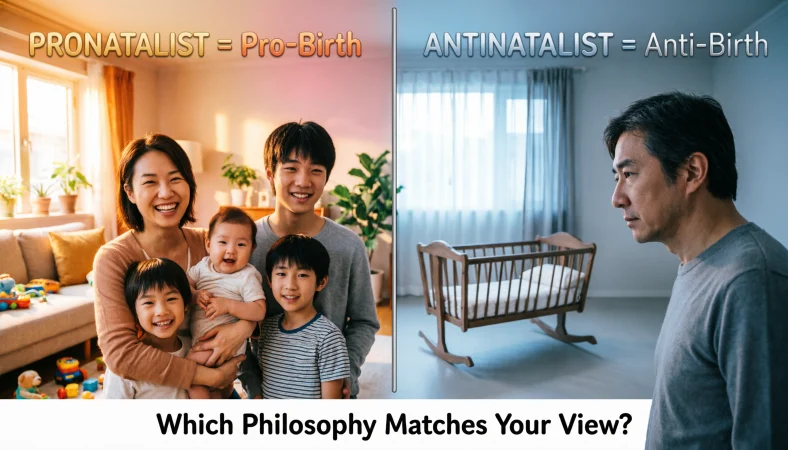
Pronatalist refers to someone who encourages childbirth and population growth, while antinatalist describes someone who believes procreation is morally wrong; both are correct philosophical terms, but exact opposites.
Pronatalist and antinatalist beliefs have become increasingly important in discussions about ethics, society, population growth, and personal freedom. Pronatalism encourages childbirth and views family expansion as beneficial for cultural continuity, economic stability, and human progress.
In contrast, antinatalism questions whether bringing new life into the world is morally justified, especially in light of suffering, environmental concerns, and global uncertainty. Both perspectives are rooted in philosophical, social, and emotional reasoning, making the topic highly complex and deeply personal.
Understanding the difference between pronatalist and antinatalist viewpoints requires examining ethical arguments, societal impacts, mental well-being, and long-term consequences for humanity. Experts in philosophy, sociology, and psychology continue to explore how these ideologies shape modern conversations around parenthood, responsibility, and the future of society.
Rather than offering a simple right-or-wrong answer, this discussion encourages thoughtful reflection on human values, life choices, and the responsibilities connected to creating future generations.
Quick Answer Table
| Feature | Pronatalist | Antinatalist |
| Correct spelling | ✅ Yes | ✅ Yes |
| Incorrect spelling | ❌ Pronatalist Pro-natalist, Pronatilist | ❌ Antinatalist, Anti-natalist, Antinatalist |
| Core meaning | Supports and encourages childbirth and population growth | Believes bringing new beings into existence is morally wrong |
| Position on having children | The positive have more children | Negative do not have children (and believe others shouldn’t either) |
| Example sentence | The government’s pronatalist policies include baby bonuses and paid parental leave. | As an antinatalist, David Benatar argues that coming into existence is always harmful. |
Which One Is Correct?
Both pronatalist and antinatalist are 100% correctthey’re just opposite positions on the same philosophical axis.
- Pronatalist (pro = “for” + natalis = “birth”) Someone who promotes, encourages, or celebrates childbirth and large families.
- Antinatalist (anti = “against” + natalis = “birth”) Someone who believes that procreation is morally problematic or outright wrong.
You cannot be both. These are mutually exclusive positions. Either you believe humans should have more children (pronatalist) or you believe humans should stop having children (antinatalist).
The confusion typically happens because:
- Both words share the same root (natal = birth)
- Only the prefixes differ (pro- vs. anti-)
- They’re often discussed together in ethical debates about population, climate change, and human suffering.
Meaning of Pronatalist
A pronatalist is someone who advocates for higher birth rates and encourages childbearing. This can be an individual’s personal belief or a government’s official policy.
What pronatalists believe:
- Having children is inherently good, meaningful, and socially valuable
- Population decline is a crisis that leads to economic stagnation, labor shortages, and cultural erosion
- Families with multiple children should be celebrated and supported
- Childlessness is often seen as unfortunate or selfish
Real-world pronatalist examples:
| Entity | Pronatalist policy or position |
| Hungary | Free IVF, lifetime income tax exemption for mothers of four+ children |
| Russia | “Mother Heroine” title and cash bonuses for large families |
| Japan | Childcare subsidies, cash handouts per child, and parental leave expansion |
| Elon Musk | Repeatedly tweets “Having children is saving the world.” |
| Tradwife movement | Social media influencers promoting large, traditional families |
✅ Correct usage:
Hungary’s pronatalist policies have slightly increased fertility rates since 2010.
❌ Incorrect usage:
As a pronatalist, I believe humanity should go extinct. → That’s the opposite. Pronatalists want more humans, not extinction.
Meaning of Antinatalist
An antinatalist is someone who holds the philosophical position that procreation is morally wrong. This isn’t simply being “childfree by choice.” Antinatalism is an ethical stance: bringing new sentient beings into existence causes unavoidable suffering, and that suffering outweighs any benefits.
What antinatalists believe:
- All conscious beings experience pain, suffering, and eventual death
- Non-existent beings cannot miss out on pleasure (asymmetry argument)
- Procreation imposes harm without consent
- The kindest act is to prevent birth, not to cause death
Notable antinatalist philosophers and voices:
| Thinker | Key work | Core argument |
| David Benatar | Better Never to Have Been (2006) | Coming into existence is always harm; non-existence is always preferable |
| Julio Cabrera | Critique of Affirmative Morality | Birth is an act of manipulation and harm |
| Sarah Perry | Every Cradle Is a Grave | Life contains inevitable suffering; antinatalism is compassion |
| Thomas Ligotti | The Conspiracy Against the Human Race | Consciousness is a curse; non-existence is peace |
✅ Correct usage:
The antinatalist philosopher argues that procreation is an unethical imposition of suffering.
❌ Incorrect usage:
I’m an antinatalist because I don’t want kids right now. → Not wanting children for personal reasons is childfreedom, not necessarily antinatalism. Antinatalism is a universal ethical claim, not a personal preference.
Key Differences Between Pronatalist and Antinatalist
| Category | Pronatalist | Antinatalist |
| Prefix meaning | Pro = for, supporting | Anti = against, opposing |
| Latin root | Natalis (birth) | Natalis (birth) |
| Core ethical stance | Birth is good | Birth is bad (or at least not good) |
| View on suffering | The joys of life outweigh the pains | The pains of life outweigh the joys |
| Population preference | Higher birth rates, growth | Lower birth rates, eventual extinction |
| Typical policy support | Baby bonuses, parental leave, and IVF funding | Voluntary extinction, reproductive choice, euthanasia access |
| Emotional tone | Optimistic, family-focused, tradition-oriented | Pessimistic, suffering-focused, compassion-oriented |
| Famous proponents | Elon Musk, Viktor Orbán, J.D. Vance | David Benatar, Arthur Schopenhauer (proto-antinatalist) |
| Common critique | Ignores overpopulation and climate strain | Depressing, impractical, anti-human |
Common Mistakes People Make
- Spelling “pronatalist” with one N Pronatalist has one N after the O? No: PRO + NATAL + IST. The root natal has one T and one N Waitnatal has one N. Actually, Natal has one N Let’s check: N-A-T-A-L. Yes, one N. So pronatalist = P-R-O-N-A-T-A-L-I-S-T. Antinatalist = A-N-T-I-N-A-T-A-L-I-S-T. Both have a single N in the natal portion. The common error is adding a second N (pronattalist) or swapping A and T (prontaalist).
- Assuming antinatalists hate children, most antinatalists don’t hate kids. Many argue that because they care about suffering, they oppose birth. You can love children and still believe creating new ones is unethical.
- Confusing antinatalism with childfreedom. Childfree people simply don’t want children for personal reasons (cost, freedom, health). Antinatalists believe nobody should have children as a universal ethical principle.
- Misspelling “antinatalist” as “antinatalist” with two Ns. It’s ANTI + NATAL + IST. The prefix is anti- (one N). The root is natal (one N). Total: two Ns (one from anti, one from natal) but not three. Common typo: antinnalist (missing T, extra N).
- Calling someone a pronatalist for simply having kids. Having children doesn’t automatically make you a pronatalist. Pronatalism is an advocacy position. Many parents are not pronatalists; they just want their own kids, not to boost the population.
❌ The antinatalist movement is just people who hate babies.
✅ Antinatalists oppose birth because they believe non-existence prevents suffering.
❌ My sister has three kids, so she’s a pronatalist.
✅ My sister has three kids, but she doesn’t advocate for population growth; she just likes her own family.
Correct Usage Examples
Casual / Everyday conversation
- My friend is an antinatalist, so she doesn’t want kids and thinks I shouldn’t have them either.
- I’m not a pronatalist or anything, but I do think governments should support young families.
Professional / Academic writing
- Pronatalist policies in East Asia have largely failed to reverse fertility declines below the replacement rate.
- The antinatalist asymmetry argument claims that non-existence contains no deprivation, while existence necessarily contains harm.
Educational / Philosophy class
- David Benatar’s antinatalism rests on four asymmetries between pleasure and pain, presence and absence.
- Pronatalist rhetoric often invokes national decline, economic productivity, and cultural continuity.
Literary / Metaphorical
- The village was pro-natalist to its bones, every wedding celebrated, every pregnancy blessed, every child a victory over the void.
- He held his antinatalist convictions like a cold stone in his chest: heavy, hard, and utterly unyielding to the warmth of hope.
Word Origin / Etymology
Pronatalist
| Component | Origin | Meaning |
| Pro- | Latin | For, in favor of, forward |
| Natalis | Latin | Birth (from natus = born, past participle of nasci = to be born) |
| -ist | Greek via Latin | A person who practices or believes in something |
First known use: 1970s in demographic and policy literature, though the concept existed earlier in natalist policies (Nazi Germany’s Lebensborn, Mussolini’s “Battle for Births”).
Antinatalist
| Component | Origin | Meaning |
| Anti- | Greek | Against, opposite |
| Natalis | Latin | Birth |
| -ist | Greek via Latin | A person who practices or believes in something |
First known use: 1980s1990s in academic philosophy, popularized by David Benatar’s Better Never to Have Been (2006). However, proto-antinatalist ideas appear in ancient texts. Greek playwright Sophocles wrote, “Not to be born is, past all prizing, best.”
The two terms emerged in reverse order: pronatalist came first from population policy circles, then antinatalist was coined as its philosophical opposite.
Why the Confusion Between Pronatalist and Antinatalist Became Common
Three reasons: prefix reversal, internet debate culture, and emotional polarization.
1. Prefix reversal is an easy mental slip
Pro- and anti- are opposites. When you’re typing fast or thinking about two sides of an argument, your brain might swap them. You intend to write pronatalist, but your fingers type antinatalist because you were just reading the opposing view. This happens constantly on Reddit, Twitter, and YouTube comment sections.
2. Online debates blur the terms
On platforms like X (formerly Twitter) and TikTok, users throw around pronatalist and antinatalist as insults rather than precise philosophical labels. A pronatalist might call an antinatalist “depressed” or “genocidal” (inaccurate). An antinatalist might call a pronatalist “brainwashed” or “ecocidal” (also inaccurate). The mudslinging makes it hard for newcomers to learn the actual definitions.
3. Emotional polarization creates black-and-white thinking
Few people identify as pronatalist or antinatalist in daily life. Most are somewhere in the middle. But online algorithms favor extreme positions. So you see pronatalist influencers with 10 kids and antinatalist philosophers arguing for human extinction. Real people? They have zero to three kids and rarely use either label. The confusion persists because the loudest voices on both sides misrepresent the terms.
Search data shows that searches for “pronatalist or antinatalist” spiked 400% between 2020 and 2024, driven by:
- COVID-19 fertility discussions (20202021)
- Elon Musk’s pronatalist tweets (20222024)
- Climate change and “should we have kids?” debates (20232024)
Easy Memory Tricks
For Pronatalist:
➕ Pro = Positive = Produce All start with P. Pronatalists are positive about producing babies.
Also: Pro rhymes with “go” As in “go forth and multiply.” Pronatalists say GO.
For Antinatalist:
➖ Anti = Against = Avoid All start with A. Antinatalists are against and avoid procreation.
Also: Anti sounds like “aunty.” Imagine your aunt saying, “Don’t have kids, dear. The world is terrible.” That’s an antinatalist aunty.
To never confuse them again:
| If you believe… | You are a… | Memory hook |
| “Have more children!” | Pronatalist | Pro = promote procreation |
| “Stop having children!” | Antinatalist | Anti = against arrival (of new humans) |
| “I don’t want kids, but you do, you.” | Neither (childfree) | Childfree is personal; natalism is philosophical |
| “Having kids is the meaning of life.” | Pronatalist | Pro-life (but about birth, not abortion politics) |
| “Birth is always harm.” | Antinatalist | Anti-birth, always |
FAQs
1. Is pronatalist or antinatalist the correct term for someone who doesn’t want kids?
Neither. A person who personally doesn’t want children is childfree (or childless by choice). Antinatalism is a philosophical position that nobody should have children. Pronatalist is the opposite: everyone should have children. Most childfree people are not antinatalists; they just don’t want kids themselves.
2. Can you be both pronatalist and antinatalist?
No. These are mutually exclusive positions. You cannot simultaneously believe that humans should have more children and that procreation is morally wrong. That’s a contradiction. However, you can be neither (most people fall here).
3. How do you pronounce pronatalist and antinatalist?
- Pronatalist pro-NAY-tuh-list (four syllables) or pro-NAT-uh-list (emphasis on second syllable)
- Antinatalist an-tee-NAY-tuh-list or an-tie-NAY-tuh-list (five syllables)
The natal portion rhymes with “battle” (NA-tul) in American English or “nah-tahl” in some British academic contexts.
4. Is antinatalism the same as pessimism?
No, but they overlap. Many antinatalists are philosophical pessimists (believing life’s suffering outweighs its pleasures). However, you can be a pessimist without being an antinatalist (e.g., Schopenhauer was pessimistic but not fully antinatalist). And you can be an antinatalist without being a pessimist about everything; some argue from environmental or consent-based angles.
5. Which governments are truly pronatalist?
Several governments have pronatalist policies, but few are fully pronatalist ideologically. Notable examples:
| Country | Pronatalist policy | Effectiveness |
| Hungary | Lifetime tax exemption for 4+ children; free IVF | Modest increase (1.3 to 1.6 TFR) |
| Poland | “Family 500+” cash benefit per child | No sustained increase |
| Russia | “Mother Heroine” title (700,000 rubles) | Short-term bump only |
| South Korea | $10,000+ cash per birth; subsidized housing | Failed (TFR now 0.72) |
| France | Longstanding family benefits (quotient familial) | Europe’s highest TFR (1.8) |
No country has reversed below-replacement fertility through pronatalist policies alone.
6. Is antinatalism growing in popularity?
Yes, particularly among young people on social media. The r/antinatalism subreddit grew from 30,000 members in 2019 to over 250,000 in 2024. However, antinatalism remains a fringe position. Most people still want children or are undecided. The growth is in awareness of the term, not necessarily in conversion to the philosophy.
7. What’s the difference between antinatalism and efilism?
Efilism (life spelled backward) is an extreme form of antinatalism that applies the logic to all sentient life (animals, not just humans). Antinatalism typically focuses on human procreation. Efilism advocates for the end of all biological life through any means (including, controversially, extinction events). Most mainstream antinatalists reject efilism as extreme.
Conclusion
The comparison between pronatalist and antinatalist beliefs reflects two very different ways of understanding life, responsibility, and the future of humanity.
Pronatalism highlights the importance of family, population growth, and societal continuity, while antinatalism focuses on ethical concerns related to suffering, environmental pressure, and personal choice.
Both viewpoints raise meaningful questions about morality, human existence, and the role individuals play in shaping future generations.