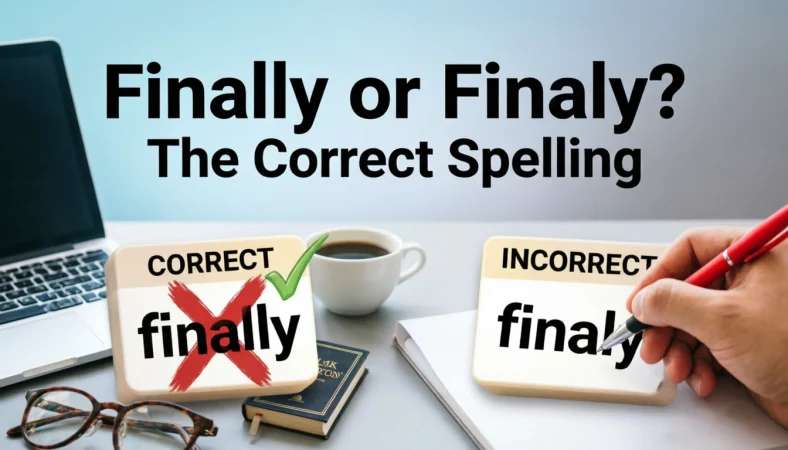
Quick answer:Finally is the correct spelling.Finaly is a common spelling mistake and is not correct in standard English.Memory trick: Remember that finally has two “l” letters because it comes from final + ly.
Finally or Finaly both forms look almost identical, but only one is correct in standard English. Finally is the correct spelling and is used to mean “at last,” “eventually,” or “in the end.”
Finaly is a common misspelling caused by forgetting the second l before adding -ly. Understanding this small spelling difference helps you avoid mistakes and makes your writing clearer, more accurate, and more professional.
Quick Answer Table
| Feature | Correct Version | Incorrect Version |
| Spelling | Finally | Finaly |
| Status | Correct Standard English | Common Misspelling |
| Part of Speech | Adverb | Incorrect Form |
| Meaning | After a long time; in the end; conclusively | No Standard Meaning |
| Pronunciation | /ˈfaɪ.nəl.i/ | /ˈfaɪ.nəl.i/ (Same but Misspelled) |
| Usage | Widely Used in All Contexts | Incorrect; Should Be Avoided |
| Example | “We finally reached the summit.” | “We finaly reached the summit.” (Wrong) |
Which One Is Correct?
The answer is clear and straightforward: finally is the only correct spelling. Finaly” is a misspelling and is never considered correct in standard English usage. Despite what you might see in informal texts or social media posts, “finally” is the accepted and proper form of this word.
Finally is an adverb that means “after a long time” or “in the end.” It is a commonly used word in both written and spoken English. The incorrect version “finaly” drops one of the essential letters—the second “l”—which changes the word structurally and makes it grammatically incorrect.
Meaning of the Correct Word: Finally
Definition and Core Meaning
Finally is an adverb with several related meanings. At its heart, it expresses the idea of something happening after a period of time, effort, or anticipation. It can also indicate that something is the last point in a sequence or a concluding statement.
Primary Uses of Finally
Finally can be used in several distinct ways:
- To indicate the end of a long wait
- “The bus finally arrived after an hour of waiting.”
- “She finally got the promotion she deserved.”
- To signal the last item in a sequence
- “First, we need to plan. Second, we need to execute. Finally, we need to review.”
- “Finally, I would like to thank everyone for their support.”
- To express relief or resolution
- “I finally finished my thesis!”
- “They finally agreed to the terms.”
- To introduce a concluding thought
- “Finally, remember that practice makes perfect.”
- “Finally, let us consider the long term implications.”
Meaning of the Incorrect Word: Finaly
Is Finaly a Word?
Strictly speaking, “finaly” is not a word in standard English dictionaries. It is a typographical error, a misspelling that occurs when someone accidentally omits one of the “l”s in “finally.” There is no legitimate context where “finaly” is considered correct English usage.
Common Misconceptions
Some people mistakenly believe that “finaly” might be an alternative spelling or a regional variation. This is not true. Unlike the differences between American and British spellings (like “color” vs “colour”), there is no official variant that spells “finally” without the second “l.
Instances Where Finaly Might Appear
You might encounter “finaly” in:
- Typos in casual writing
- Text messages and social media posts where speed matters
- Early drafts where spell check has not been applied
- Non native English writing where spelling rules are less familiar
In all these cases, it remains a mistake that should be corrected in formal writing.
Key Differences Between Finally and Finaly
Spelling Difference
The most obvious difference is the spelling. “Finally” contains two “l”s, while “finaly” only has one. This might seem small, but in English, every letter matters. The double “l” is not arbitrary—it follows specific spelling patterns that we will explore in the grammar section.
Meaning Difference
- Finally has a clear, rich meaning in English. It expresses time, sequence, and conclusion.
- Finaly has no meaning because it is not a recognized word.
Pronunciation
Interestingly, both versions are pronounced the same way: /ˈfaɪ.nəl.i/ . The pronunciation does not change whether you spell it with one or two “l”s. This is part of why misspelling is so common. When people hear the word, they might not think about the spelling, and because they pronounce it with a single “l” sound, they often write it that way too.
Grammar
Finally is an adverb. It modifies verbs, adjectives, or other adverbs. In contrast, “finaly” has no grammatical function because it is not a valid word.
Recognition and Usage
- Finally is recognized by every spell checker, dictionary, and grammar tool.
- Finaly triggers spelling errors and is flagged as incorrect in all professional contexts.
Common Mistakes People Make with Finally
The Spelling Error
The most frequent mistake is simply forgetting the second “l.” This is especially common when people are typing quickly or when they are not paying attention to their spelling. The error is easy to make because the word “final” has only one “l,” and “finally” is formed by adding ” ly” to “final.” When people think of “final,” they often carry that single “l” over to “finally.”
Using Finally as a Conjunction
Some writers incorrectly use “finally” as a conjunction to connect two independent clauses. This is a grammatical error.
- Incorrect: “We waited for hours, finally the train arrived.”
- Correct: “We waited for hours. Finally, the train arrived.”
- Correct: “We waited for hours, and finally, the train arrived.”
Overuse in Writing
While “finally” is a useful word, overusing it can make your writing repetitive. Vary your vocabulary with words like:
- Eventually
- Ultimately
- In the end
- At last
- Lastly
Confusing Finally with Eventually
Although “finally” and “eventually” both refer to time, they are not always interchangeable. “Eventually” simply means “at some point in the future,” while “finally” often implies that something happened after a delay or difficulty.
- “He will eventually graduate.” (Sometime in the future)
- “He finally graduated.” (After a long wait or struggle)
Correct Usage Examples of Finally
Casual Examples
- “I finally got the chance to read that book you recommended.”
- “We finally decided to order pizza instead of cooking.”
- “She finally texted me back after two days.”
- “The weekend finally arrived!”
Professional Examples
- “The project was finally approved by the board.”
- “We have finally reached an agreement with our partners.”
- “I finally completed the annual report ahead of schedule.”
- “The client finally responded to our proposal.”
Educational Examples
- “After hours of study, Maria finally understood the concept.”
- “The students finally completed their research projects.”
- “We finally concluded that the hypothesis was correct.”
- “The professor finally explained the complex theory.”
Literary and Metaphorical Examples
- “The sun finally emerged from behind the clouds.”
- “After a lifetime of searching, he finally found peace.”
- “The truth finally came to light.”
- “The once divided nation finally united.”
Word Origin and Etymology of Finally
The Etymology of Finally
Understanding the history of the word can help you remember its correct spelling. “Finally” traces its roots back to the Latin word “finalis” , which means “pertaining to an end.” This Latin term comes from “finis,” meaning “end” or “boundary.”
The journey of the word through history is fascinating:
- Latin: “finalis” (pertaining to an end)
- Old French: “final” (end, conclusion)
- Middle English: “final” (same meaning)
- Modern English: “finally” (adverb formed by adding ” ly”)
The ” ly” suffix is a common way to form adverbs in English, turning adjectives into words that describe how something is done. When you add ” ly” to “final,” you get “finally.”
Why Double L?
The double “l” in “finally” comes from the base word “final.” When you add the suffix ” ly” to a word ending in “l,” you keep the “l” and add the ” ly” suffix. This creates a double “l” in the resulting word.
This follows a consistent English spelling rule:
- Base word ending in “l” + suffix starting with “l” = double “l”
- Final + ly = finally
Why the Incorrect Version Became Popular
The Influence of Other Words
One reason “finaly” is such a common misspelling is the influence of other words that end in ” ly” but have only one “l.” For example:
- Specifically
- Totally
- Completely
- Fortunately
When people see that many adverbs keep only one “l” after adding ” ly,” they might assume the same rule applies to “final.” However, the difference is that “final” already ends in an “l,” so the addition of ” ly” creates a double “l.”
The Final Trap
The word “final” has a single “l.” Since “finally” is formed from “final,” many people mistakenly think the spelling should be “finaly” with a single “l.” This is a logical assumption but grammatically incorrect.
Typing Speed and Texting Culture
In our fast paced digital world, people often prioritize speed over accuracy. When typing quickly on smartphones or keyboards, it is easy to drop a letter by accident. The similar pronunciation of “finally” and the nonexistent “finaly” further compounds the problem.
Autocorrect and Spell Check
Ironically, autocorrect features can sometimes make the problem worse. If someone types “finaly,” their phone might not always flag it as a misspelling. Over time, this leads to reinforcement of the error.
Easy Memory Tricks to Remember Finally
The Double L Rule
Remember that “finally” has two “l”s because it comes from “final” plus ” ly.” Think of it this way:
FINAL + LY = FINALLY
The base word “final” already has one “l.” Adding ” ly” gives you a second “l.” It is that simple!
The “L” Sequence Trick
Think of the sequence of “l”s in “finally” as representing a journey:
- First L: The end of the word “final”
- Second L: The start of the suffix ” ly”
Together, they form a double “l” that signals the word is correct.
Visual Memory Aid
Visualize the word “finally” as containing two “l”s stacked like pillars. These two pillars represent the time it takes to reach the end of something—one “l” for the anticipation and the second for the actual arrival.
Sound It Out
While pronunciation does not reveal the double “l,” you can use a mental trick. When you say the word “finally,” emphasize the “l” sound slightly by holding it longer in your mind. This helps your brain associate the longer “l” sound with the double spelling.
Related Words Reminder
Think of other words that follow the same pattern:
- General + ly = generally (double “l”? No! Wait, “general” ends in “l”? No, “general” ends in “l” too? Actually “general” ends with “l” but when adding ” ly,” do you double the “l”? Let’s check: “general” ends with “l,” plus ” ly” gives “generally” with one “l”? No, actually “generally” has two “l”s? Let’s check the spelling: “generally” has two “l”s. In fact, “generally” has two “l”s because “general” ends with “l” and you add ” ly.” There is only one “l” in “general” and one in ” ly” making two total? Actually, “generally” is spelled with two “l”s: g e n e r a l l y. Yes! So “generally” has two “l”s as well.)
Wait, let’s clarify this. In “generally,” the base word “general” ends in “l,” and you add ” ly,” which creates two “l”s. In “finally,” the base word “final” ends in “l,” and you add ” ly,” creating two “l”s. So both follow the same rule.
FAQs
Q1. Is “finaly” ever correct?
No. Finaly is never correct in standard English. The correct spelling is always finally with two l letters.
Q2. How do you spell finally correctly?
The correct spelling is: f-i-n-a-l-l-y.
It has two l’s and one y at the end.
Q3. What part of speech is finally?
Finally is an adverb. It describes when or how something happens.
Q4. Is finally an adverb of time?
Yes. It shows that something happens after waiting, delay, or a sequence of events.
Q5. What is the difference between finally and at last?
Both mean something happened after a delay. Finally is more neutral, while at last often shows stronger relief or emotion.
Q6. Can finally start a sentence?
Yes. Example: Finally, we completed the project.
Q7. What are synonyms of finally?
Some synonyms include: eventually, ultimately, at last, lastly, in the end.
Q8. Is finally spelled differently in British and American English?
No. Both use finally with the same spelling.
Q9. Why do people write finaly?
People often forget the second l because many words ending in -ly have only one letter before the suffix.
Q10. How can I remember finally spelling?
Remember: final + ly = finally → the final already has one l, and adding -ly keeps another l.
Conclusion
The “finally or finaly” confusion is a classic example of how small spelling differences can cause big uncertainty. The answer is clear: finally is always correct, and finaly is always a misspelling. Remember that this versatile adverb comes from the word “final” and adds ” ly” to create “finally,” keeping both “l”s intact.
Whether you are writing an academic paper, a professional email, or a casual message, using the correct spelling of “finally” demonstrates attention to detail and command of the English language. The double “l” is not just a grammatical requirement—it is a small but quality.