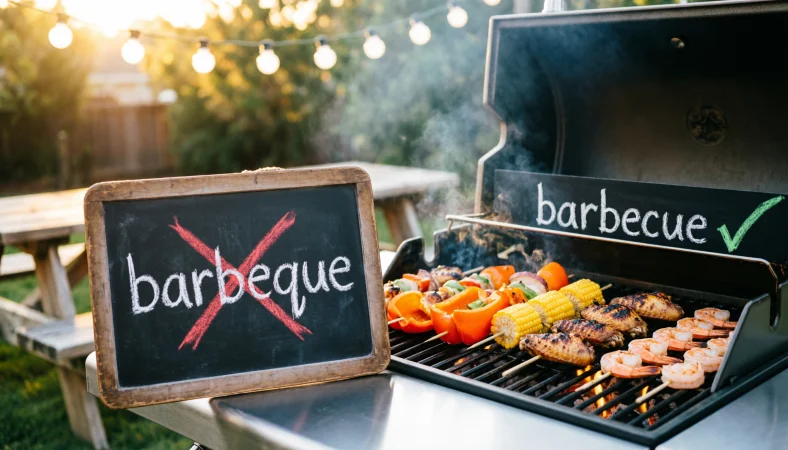
Quick answer:Barbecue is the preferred and standard spelling. Barbeque is a common variant spelling, but barbecue is more widely accepted in dictionaries, formal writing, and professional contexts.
Quick Answer Table
| Aspect | Barbecue | Barbeque |
| Correct Spelling | Yes | No |
| Status | Standard accepted spelling | Common misspelling |
| Meaning | A method of cooking meat slowly over low heat with smoke | Same meaning |
| Usage | Preferred in formal writing, dictionaries, and professional contexts | Informal, casual, and regional usage |
| Recognition | Recognized globally | Recognized but considered a variant |
| Dictionary Inclusion | All major dictionaries | Some dictionaries list as variant |
| Example Sentence | We’re hosting a barbecue this weekend for all our neighbors. | We’re having a barbeque party at our house on Saturday. |
Which One Is Correct?
The definitive answer to the barbeque or barbecue question is clear: barbecue is the correct spelling. This is the version you’ll find in major dictionaries like Merriam Webster, Oxford English Dictionary, and Cambridge Dictionary. It’s the standard form used in professional writing, academic contexts, and formal communications.
However, language is wonderfully fluid, and the barbeque variation has gained significant traction over the years. While it’s technically considered a misspelling, many people use it so frequently that it’s become an accepted alternative in casual settings. Think of it like the “color” versus “colour” debate – one is standard in American English, while the other is preferred in British English.
But unlike that example, barbeque isn’t a regional variation. It’s simply an error that became popular through widespread use. Many restaurants and food brands have adopted the shorter spelling for branding purposes, which has further normalized its usage. Still, if you want to sound professional and demonstrate strong language skills, barbecue is your go to choice.
The confusion stems partly from the word’s pronunciation. When we say it out loud, “barbecue” sounds like it could logically end with a “q” instead of a “cue.” This phonetic ambiguity creates the perfect conditions for spelling errors. Additionally, the abbreviation “BBQ” doesn’t help clarify matters – it can represent either spelling, leaving writers uncertain about the full version.
For SEO professionals and content creators, using the correct spelling is particularly important. Search engines favor authoritative sources, and consistently using the standard spelling signals expertise and trustworthiness. This is especially relevant for anyone writing about food, cooking, or grilling techniques.
Meaning of the Correct Word
Definition
Barbecue refers to a method of cooking food, typically meat, slowly over low heat with smoke generated from wood or charcoal. The process involves cooking food for extended periods – sometimes up to 12 hours or more – allowing the smoke to infuse the meat with rich, complex flavors while the low temperature breaks down tough connective tissues.
Explanation
Beyond being a cooking method, the word has evolved to encompass multiple related meanings:
- The physical equipment or grill used for outdoor cooking
- The event or social gathering where barbecue is prepared and enjoyed
- The specific style of food preparation found in different regions
- The overall culture and tradition surrounding outdoor cooking
Usage
Barbecue appears across multiple contexts in everyday language. Professional chefs use it to describe specific smoking techniques, while home cooks use it to refer to their weekend grilling plans. Regional variations exist, with Texas, Kansas City, Memphis, and North Carolina each offering their unique interpretations of authentic barbecue.
Real World Examples
- “The neighborhood barbecue brought together families from all over the community.”
- “She mastered the art of low and slow barbecue over several years.”
- “The restaurant is famous for its signature barbecue sauce recipe.”
- “He built a custom barbecue pit in his backyard for weekend gatherings.”
Meaning of the Incorrect or Alternative Word
A Common Misspelling
Barbeque falls into the category of common misspelling that has gained enough popularity to become recognized as a variant. It’s what linguists call a “folk etymology” – a misspelling that people adopt because it seems to make more sense based on pronunciation or familiar patterns.
Usage Contexts
While technically incorrect, barbeque appears frequently in:
- Casual social media posts
- Restaurant names for branding purposes
- Informal text messages
- Product labels where space is limited
- Casual marketing materials
Dictionary Recognition
Some dictionaries now include barbeque as an alternative spelling, noting its widespread usage. However, they typically label it as a variant rather than the standard form. This inclusion reflects modern lexicography’s descriptive rather than prescriptive approach – documenting how people actually use language rather than dictating how they should use it.
Regional Usage
In some regions, particularly in Australia and parts of the United Kingdom, barbeque appears more frequently. However, even in these areas, barbecue remains the preferred spelling in formal documents and educational materials.
Key Differences Between the Two Words
Spelling
The most obvious difference lies in the spelling:
- Barbecue: Uses “cue” at the end
- Barbeque: Uses “que” at the end
This four letter difference (actually just a one letter swap, since “cue” replaces “que”) creates all the confusion. The “q” without the “u” in barbeque contradicts typical English spelling patterns, where “q” is almost always followed by “u” except in borrowed words.
Meaning
Both words share identical meanings. There’s no semantic difference whatsoever. Whether you’re using barbecue or barbeque, you’re referring to the same cooking method, equipment, or social gathering. The distinction is purely orthographic (relating to spelling), not semantic.
Pronunciation
Interestingly, both words are pronounced identically. The standard pronunciation is BAR bih kyoo. The “q” in barbeque doesn’t change how we say the word, nor does the “cue” spelling in barbecue. This identical pronunciation contributes significantly to the confusion.
Grammar
Both words function the same grammatically. They can be used as:
- Nouns: “We’re having a barbecue this weekend.”
- Verbs: “We need to barbecue the chicken before guests arrive.”
- Adjectives: “The barbecue sauce adds wonderful flavor.”
Usage Patterns
Usage patterns show interesting differences:
| Context | Preferred Spelling |
| Formal writing | Barbecue |
| Dictionaries | Barbecue |
| Professional food writing | Barbecue |
| Restaurant names | Varies (often barbeque) |
| Social media | Varies |
| Text messages | Varies |
| Product packaging | Varies |
Recognition
Barbecue enjoys universal recognition as the standard spelling. Barbeque is recognized as a common variant but carries a casual, informal tone. Some style guides explicitly prohibit using barbeque, while others acknowledge its existence but recommend the standard spelling.
Common Mistakes People Make
Spelling Errors
The most frequent mistake involves swapping “cue” for “que” at the end of the word. This error is so common that many people don’t even realize it’s incorrect. They’ve seen “barbeque” on signs, menus, and social media, so they assume it’s an accepted spelling.
Overcorrection
Some people become so concerned about getting it right that they overthink and create other variants. Occasionally, you’ll see bizarre attempts like “barbaque” or “bar b que.” These are clearly incorrect and stem from trying too hard to figure out the right spelling.
Unnecessary Hyphenation
Another common mistake involves unnecessary hyphenation. People sometimes write “bar be que” or “bar b que,” treating the word as if it needs hyphens to be read correctly. In modern English, these hyphenated versions are considered outdated and unnecessary.
Apostrophe Misuse
Some writers mistakenly add an apostrophe, writing “barbeque’s” or “barbecue’s” when they mean the plural form. The correct plurals are “barbecues” or “barbeques” without any apostrophe.
Pronunciation Related Errors
Because the word originates from a foreign language, some people mispronounce it, further confusing the spelling. The correct pronunciation is BAR bih kyoo, with emphasis on the first syllable. Mispronunciations like “bar BEK” or “bar be Q” often lead to spelling errors.
Correct Usage Examples
Casual Examples
- “Let’s fire up the barbecue and cook some burgers for lunch.”
- “I need to buy new barbecue tools before the party tomorrow.”
- “We spent the afternoon at the park, enjoying a community barbecue.”
- “His specialty is barbecue ribs that fall right off the bone.”
Professional Examples
- “The executive chef demonstrated classic barbecue techniques during the culinary workshop.”
- “Our restaurant specializes in authentic Southern barbecue prepared using traditional smoking methods.”
- “The food critic praised the establishment’s commitment to traditional barbecue craftsmanship.”
- “Professional barbecue competitions attract hundreds of participants annually.”
Educational Examples
- “Students learned about the science behind barbecue cooking during chemistry class.”
- “The culinary school offers a course in regional American barbecue traditions.”
- “Understanding the Maillard reaction is essential for perfect barbecue results.”
- “History classes explore how barbecue evolved from indigenous cooking methods.”
Literary and Metaphorical Examples
- “She was seasoned by life’s trials like meat on a barbecue.”
- “His temper flared like hot coals in a barbecue pit.”
- “The community came together in a cultural barbecue of diverse traditions.”
- “Their relationship slow cooked like a barbecue, building flavor over time.”
Word Origin / Etymology
Indigenous Roots
The word barbecue traces its roots to the Caribbean. It comes from the Taino word “barbacoa,” which referred to a wooden framework used for cooking and storing food. Spanish explorers encountered this cooking method in the Caribbean and adopted the word into Spanish as “barbacoa.”
Spanish Influence
The Spanish brought the word back to Europe, where it spread to other languages. The French version became “barbecue,” which is likely how the English word developed its spelling. French influence on English during the Middle Ages explains why the word has such an unusual spelling pattern.
American Evolution
When the word entered American English, it took on additional meanings. It expanded from just the cooking structure to encompass the entire cooking method, the food itself, and the social gatherings surrounding it. Regional American styles emerged, each with their own techniques and traditions.
Spelling History
The “cue” spelling has been the standard since the word entered English. Historical texts from the 17th and 18th centuries show consistent use of the “cue” ending. The “que” variation is a relatively recent development, gaining popularity in the 20th century.
Modern Development
The abbreviation BBQ appeared in the early 20th century, and some speculate that this contributed to the “barbeque” variant. When people see “BBQ,” their brain might reconstruct it as “barbeque” because it seems more phonetically logical.
Why the Incorrect Version Became Popular
Branding Influence
Restaurants and food brands have played a significant role in popularizing “barbeque.” The “que” ending looks more distinctive and memorable on signs and logos. Many businesses deliberately choose this spelling for its visual appeal and unique appearance.
Social Media Simplification
On social media platforms, where character counts matter and informality rules, the shorter “barbeque” has become common. People type quickly without thinking about proper spelling, and the “barbeque” variant appears frequently in hashtags and casual posts.
Phonetic Logic
The pronunciation of the word makes “barbeque” seem more logical to many people. When we say “barbecue,” the final syllable sounds like “cue,” which is exactly how “barbeque” ends. This phonetic similarity makes the incorrect spelling feel intuitively right.
Regional Dialects
In some English varieties, especially American English, the “que” ending appears in other words like “unique” and “cheque.” This familiarity makes “barbeque” feel more natural to some speakers, even if it’s technically incorrect.
Digital Autocorrect Failures
Autocorrect and spell check systems often accept “barbeque” as a valid spelling, preventing people from learning the correct version. Some systems even suggest “barbeque” as an alternative, further reinforcing the error.
Easy Memory Tricks
The “Cue” Connection
Remember that barbecue is about cooking, and cooking involves “cues” – signals that tell you when food is ready. Think about how chefs read visual cues, temperature cues, and aroma cues while cooking. The “cue” in barbecue reminds you to pay attention to these cooking cues.
Phonetic Breakdown
Break the word into its parts: “barb” + “ecue.” While this isn’t etymologically accurate, it helps with spelling. Think of it as “bar” + “be” + “cue” – three distinct syllables that create one delicious word.
The “Q” Rule
Remember the English spelling rule: A standalone “q” is almost always followed by “u” in English. The “barbeque” spelling breaks this rule, which is a red flag that it’s not quite right. While there are exceptions (like “qat” and “qoph”), barbecue isn’t one of them.
Visual Association
Visualize a barbecue grill shaped like the word itself. Picture the “cue” part as the handle of the grill, with the “barbe” forming the cooking surface. This visual association can help cement the correct spelling in your memory.
Writing Practice
Write the word correctly multiple times. Repetition reinforces memory. Try writing it 10 times: barbecue, barbecue, barbecue. You’ll train your fingers to type the correct sequence automatically.
FAQs
Q1. Is barbeque or barbecue correct?
Barbecue is the correct and standard spelling. Barbeque is a common variant, but barbecue is preferred in formal writing.
Q2. Why do people spell it barbeque?
People use barbeque because it matches the pronunciation and is common in casual writing, restaurant names, and branding.
Q3. Are both spellings acceptable?
Both are understood, but barbecue is the safer choice for academic, professional, and formal communication.
Q4. What does barbecue mean?
Barbecue refers to cooking food, especially meat, slowly with heat and smoke. It can also mean the grill, event, or cooking tradition.
Q5. Is BBQ short for barbeque or barbecue?
BBQ is short for barbecue. The abbreviation does not make barbeque the standard spelling.
Q6. Which spelling is more common?
Barbecue is more common and widely accepted worldwide, especially in dictionaries and formal texts.
Q7. Why is barbecue spelled this way?
The word comes from Spanish barbacoa, which influenced the modern spelling barbecue.
Q8. Can I use barbeque on a menu?
Yes, but barbecue looks more professional and follows standard English usage.
Q9. Are barbeque and barbecue pronounced differently?
No. Both are pronounced the same: BAR-bih-kyoo.
Q10. What should I remember?
Use barbecue for correct standard English. Use barbeque only as an informal variant.
Conclusion
The barbeque or barbecue debate ultimately resolves in favor of barbecue as the standard, correct spelling. While barbeque has become a widely used variant in casual contexts, it remains a misspelling in formal and professional writing. Understanding the distinction between these two spellings demonstrates language proficiency and attention to detail.
Throughout this article, we’ve explored the rich history and evolution of this beloved word. We’ve examined its indigenous roots, its journey through multiple languages, and its transformation into a global culinary phenomenon. We’ve also addressed common mistakes and provided practical.