Quick answer:Worshiping and Worshipping are both correct spellings.
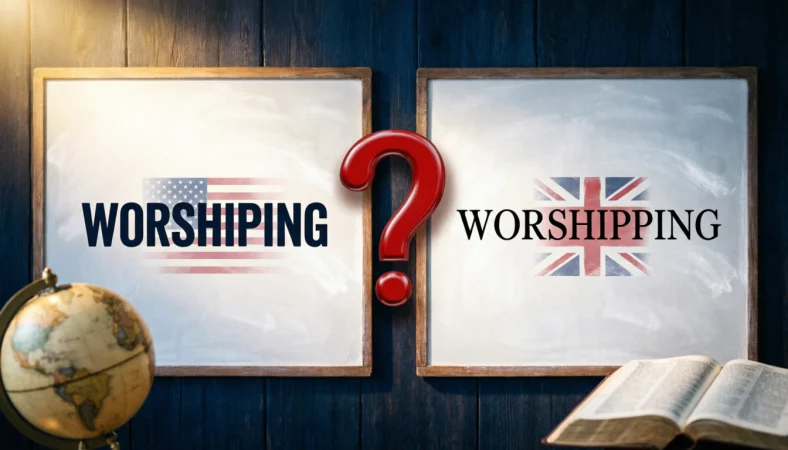
Worshiping (one “p”) is preferred in American English, while worshipping (double “p”) is common in British English. Both mean showing respect, devotion, or reverence.
Worshiping or Worshipping is a common spelling difference . Both forms come from the verb worship, meaning to show devotion, respect, or admiration toward someone or something. The difference is not in meaning but in regional spelling rules.
Worshiping is the preferred spelling in American English, while worshipping is more common in British English and other Commonwealth varieties. Understanding this small variation helps you choose the correct form for your audience and keep your writing consistent.
Quick Answer Table
| Aspect | Worshiping | Worshipping |
| Correct Spelling | Yes | Yes |
| Primary Usage | American English | British English |
| Meaning | Showing reverence, adoration, or devotion to a deity or admired person/thing | Same meaning |
| Grammar Rule | Follows American spelling conventions for verbs ending in consonant + vowel + consonant | Follows British spelling conventions |
| Example Sentence | She spends every Sunday worshiping at her local church. | She spends every Sunday worshipping at her local church. |
| Pronunciation | WUR ship ing | WUR ship ing |
| Formality Level | Widely accepted in formal and informal writing | Widely accepted in formal and informal writing |
Which One Is Correct?
Here is the straightforward answer: both “worshiping” and “worshipping” are correct spellings. The difference lies in the variety of English being used.
The spelling “worshiping” with one ‘p’ is the preferred spelling in American English. If you are writing for an American audience, following American style guides, or using American English conventions, this is the spelling you should use.
The spelling “worshipping” with two ‘p’s is the preferred spelling in British English. This version is also commonly used in other English speaking countries like Australia, Canada, New Zealand, and the United Kingdom.
This spelling variation follows a broader pattern in English where American English tends to simplify certain spellings. The same rule applies to words like:
- Traveling (American) vs. Travelling (British)
- Labeling (American) vs. Labelling (British)
- Canceling (American) vs. Cancelling (British)
- Modeling (American) vs. Modelling (British)
The key takeaway is that neither spelling is incorrect. Your choice should depend on your audience and the style guide you are following. If you are writing for an international audience, you can choose either spelling as long as you remain consistent throughout your document.
Meaning of the Correct Word
Definition
The word “worshiping” (or “worshipping”) refers to the act of showing reverence, adoration, devotion, or deep respect for a deity, religious figure, or object of admiration. The term carries strong emotional and spiritual connotations and is used in various contexts beyond just religion.
Primary Meanings and Usage
Religious Context
In its most common usage, “worshiping” describes participation in religious ceremonies, prayers, hymns, and rituals dedicated to a divine being. This includes activities like attending church services, offering prayers, singing religious songs, and engaging in spiritual practices.
Extended Usage
Beyond formal religion, the word can describe intense admiration or devotion toward people, causes, or objects. For example, fans might be described as “worshiping” their favorite celebrity, or someone might be accused of “worshiping” money or material possessions.
Real World Examples
Here are some practical examples showing how “worshiping” is used in everyday language:
Religious Examples
- The congregation gathered early on Sunday morning for worshiping and prayer.
- Worshiping at the temple is an essential part of her daily routine.
- The pilgrims traveled thousands of miles to experience worshiping at this sacred site.
- Many different cultures have unique traditions for worshiping their gods.
Secular Examples
- The young fans were practically worshiping their favorite pop star at the concert.
- His obsession with success bordered on worshiping material wealth.
- The art world has been worshiping this painter’s work for decades.
- Modern society often focuses on worshiping celebrities rather than celebrating real heroes.
Meaning of the Incorrect or Alternative Word
Neither “worshiping” nor “worshipping” is incorrect. Both spellings are valid and recognized in different regions. However, it is important to understand that using the wrong variant for your audience can seem less professional or out of place.
Think of it like choosing between “color” and “colour” – both are correct, but you would not use “colour” when writing for an American publisher, nor would you use “color” when writing for a British newspaper.
Regional Usage Breakdown
| Region | Preferred Spelling |
| United States | Worshiping |
| United Kingdom | Worshipping |
| Canada | Worshipping (though American influence is growing) |
| Australia | Worshipping |
| New Zealand | Worshipping |
| India | Worshipping (British influence) |
| South Africa | Worshipping (British influence) |
The important thing to remember is that while one spelling might be more common in your region, the other is not wrong. It is simply a different convention. The same applies to the secondary keywords ‘or nurse jobs’, which follow similar patterns in professional documentation across different regions.
Key Differences Between the Two Words
Spelling
The most obvious difference is the presence of a double ‘p’. “Worshiping” has one ‘p’ while “worshipping” has two. This spelling pattern follows the general American tendency to simplify double consonants when adding suffixes.
Meaning
Both versions share the exact same meaning. There is no difference in definition based on spelling. Whether you write “worshiping” or “worshipping”, you are describing the same action of showing reverence or devotion.
Pronunciation
Both spellings are pronounced exactly the same way – WUR ship ing. The number of ‘p’s does not affect the pronunciation at all. Here is a simple breakdown:
- WUR (rhymes with “fur”)
- ship (as in the boat)
- ing (as in “sing”)
Grammar Rules
The spelling difference comes down to how American and British English apply the rule for doubling consonants when adding suffixes to verbs.
The General Rule
When a verb ends with a consonant vowel consonant pattern and has a stressed final syllable, you double the final consonant before adding ” ing” or ” ed”.
Examples:
- Run → Running
- Stop → Stopping
- Plan → Planning
The American Exception
American English often makes an exception when the final syllable is not stressed or the word has more than one syllable. Since “worship” has two syllables with the stress on the first syllable (WOR ship), American English does not double the ‘p’.
The British Approach
British English tends to double the final consonant in such cases, even when the stress is on the first syllable. This is why “worshipping” has a double ‘p’ in British English.
Usage in Professional Writing
- Academic Writing: Your professor or institution’s preferred style guide will determine which spelling to use. American universities typically use APA or Chicago style, which favor American spellings. British universities often use Oxford or Cambridge style guides.
- Business Writing: The spelling should match the regional English of your audience. American companies use “worshiping”, while British and Australian companies use “worshipping”.
- Digital Content: If you are writing for an international audience, you can choose either spelling. For better search engine optimization and consistency, choose one and stick with it throughout your content.
Dictionary Recognition
Both spellings are recognized in major dictionaries. The Merriam Webster Dictionary lists “worshiping” as the primary American spelling. The Oxford English Dictionary lists “worshipping” as the primary British spelling.
Common Mistakes People Make
1. Mixing Spellings Inconsistently
The biggest mistake is using both spellings in the same document without consistency. For example:
- “She enjoys worshiping on Sundays. Her family also spends time worshipping together.”
This inconsistency looks unprofessional and can confuse readers. Choose one spelling and stick with it throughout your writing.
2. Using the Wrong Regional Variation
Using “worshipping” in American English or “worshiping” in British English can make your writing seem out of place. For example, an American job application might appear less polished if it uses “worshipping” throughout.
3. Overthinking the Choice
Many writers waste time agonizing over which spelling to use. The truth is that both spellings are correct. If you have no specific audience or style guide requirement, choose one and move forward with confidence.
4. Double Checking Spell Checker Suggestions
Spell checkers can be helpful but also confusing. American English spell checkers will flag “worshipping” as incorrect, while British English spell checkers will flag “worshiping”. If you are writing for a specific region, ensure your spell checker is set to the correct English variant.
5. Assuming One Is More “Proper”
Neither spelling is more proper or correct than the other. They are simply regional preferences. Just like “color” vs “colour” or “realize” vs “realise”, both forms are equally valid in their respective regions.
Correct Usage Examples
Casual Contexts
- I love worshiping at the beach; the sound of the waves makes me feel connected to something greater.
- Are you coming to the worshiping session tonight?
- Many people find peace in worshiping through music and song.
- My grandmother has a beautiful singing voice and loves worshiping during family gatherings.
Professional Contexts
- The organization promotes freedom of worshiping for all employees.
- The conference addressed religious differences and the importance of respectful worshiping.
- International studies show that worshiping practices vary greatly across cultures.
- Our company respects various forms of worshiping and provides flexible scheduling for religious observances.
- The research team studied the psychological effects of regular worshiping.
Educational Contexts
- Students learned about different cultural practices of worshiping around the world.
- The anthropology professor discussed the historical evolution of worshiping traditions.
- Worshiping rituals provide insight into a civilization’s values and beliefs.
- The textbook dedicates an entire chapter to comparative worshiping practices.
- Understanding different worshiping methods promotes cross cultural awareness.
Literary and Metaphorical Contexts
- He spent his entire life worshiping the ideals of freedom and justice.
- The artist’s style became increasingly refined through his worshiping of classical techniques.
- Her worshiping of the natural world influenced every poem she wrote.
- The protagonist’s journey was a worshiping of truth in all its forms.
- Their worshiping of tradition preserved ancient customs for future generations.
Word Origin / Etymology
The word “worship” has a fascinating history that helps us understand its spelling and usage.
Origins in Old English
“Worship” comes from the Old English word “weorthscipe”, a combination of “weorth” (worth) and “scipe” (shape or condition). This literally meant “worth ship” or the condition of being worthy.
Over time, “weorthscipe” transformed into “worship”, and its meaning evolved. Originally, it referred to the recognition of someone’s worth or dignity. This is why even today, we use “worship” to describe showing deep respect, not just to deities but to highly respected people or ideals.
Evolution of Meaning
The modern English word “worship” has evolved through several stages:
Early Usage: The word was used to describe giving respect or honor to someone, whether a king, noble, or beloved leader.
Religious Usage: Over time, the word became primarily associated with religious devotion and reverence for God or gods.
Modern Application: Today, “worship” can be used in both religious and secular contexts, from church services to expressions of admiration for art, nature, or personal heroes.
The Spelling Journey
The spelling “worship” was relatively stable throughout Middle English and Early Modern English. The variation in the ” ing” form arose as English spelling began to be standardized differently in the United States and the United Kingdom.
American English often simplified spellings, including reducing double consonants when adding suffixes. British English tended to keep the traditional forms with double consonants. This is why we have both “worshiping” and “worshipping” today.
Why the Incorrect Version Became Popular
The popularity of both spellings is directly tied to the global influence of American and British English.
The Rise of American English
American English became increasingly influential throughout the 20th century, especially after World War II. The global spread of American media, technology, and business practices led to wider adoption of American spelling conventions.
The Dominance of British English
At the same time, British English maintains its prestige, particularly in academic circles, former British colonies, and regions where British English is the standard.
The Result
Both spellings continue to thrive in different parts of the world. The choice between “worshiping” and “worshipping” reflects which English tradition a writer follows.
The Influence of Style Guides
Style guides play a significant role in standardizing spelling choices. The Chicago Manual of Style and APA style guide prefer American spellings. The Oxford Style Guide and Cambridge Style Guide prefer British spellings. Writers who follow these guides will naturally choose the corresponding spelling.
Easy Memory Tricks
These simple memory tricks can help you choose the correct spelling every time.
1. Think About Your Audience
If your audience is in the United States or uses American English, use “worshiping” with one ‘p’. If your audience is in the United Kingdom, Australia, or other British English speaking regions, use “worshipping” with two ‘p’s.
2. Remember the “American” Rule
American English prefers simpler spellings. Just like “color” instead of “colour”, American English uses “worshiping” instead of “worshipping”. The one ‘p’ is simpler.
3. Associate with Related Words
Words like “traveling” and “modeling” follow the same pattern. If you know how to spell these words in your preferred English variant, apply the same rule to “worship”.
4. Use the “Double P for British” Trick
Think of the double ‘p’ as being “double the British”. This can help you remember that “worshipping” with two ‘p’s is the British spelling.
5. Check Your Spell Checker Settings
Your word processor or browser should have an English variant setting. Set it to the correct region, and it will flag any mismatches for you automatically.
6. Create a Mental Picture
Imagine a British person saying “I’m worshipping” and pausing after the ‘p’ sound, as if to emphasize the double letter. This mental association can help solidify the memory.
FAQs
1. Is “worshiping” a correct word?
Yes, worshiping is the American English spelling of the word.
2. Is “worshipping” a correct word?
Yes, worshipping is the British English spelling.
3. Are worshiping and worshipping different in meaning?
No, both have the same meaning: showing devotion or respect.
4. Which spelling should I use in American English?
Use worshiping (one “p”).
5. Which spelling should I use in British English?
Use worshipping (double “p”).
6. Can I use both spellings in one document?
It is better to choose one and stay consistent.
7. Is the pronunciation different?
No, both are pronounced the same.
8. Is worshiped or worshipped correct?
Both are correct depending on region: American worshiped, British worshipped.
9. Does spelling affect SEO?
Not much, but matching your audience’s spelling can improve relevance.
10. Why are there two spellings?
They come from differences between American and British English spelling rules.
Conclusion
Understanding the difference between worshiping and worshipping helps you handle one of the most common American and British English spelling variations. Both spellings are correct and have the same meaning: showing devotion, respect, or admiration.
The simple rule is to match your spelling with your audience. Use worshiping for American English and worshipping for British English and Commonwealth varieties. The most important thing is consistency throughout your writing.
Once you understand this difference, you can choose the right spelling confidently. Both forms are accepted, so focus on clear communication and keeping your language style consistent.