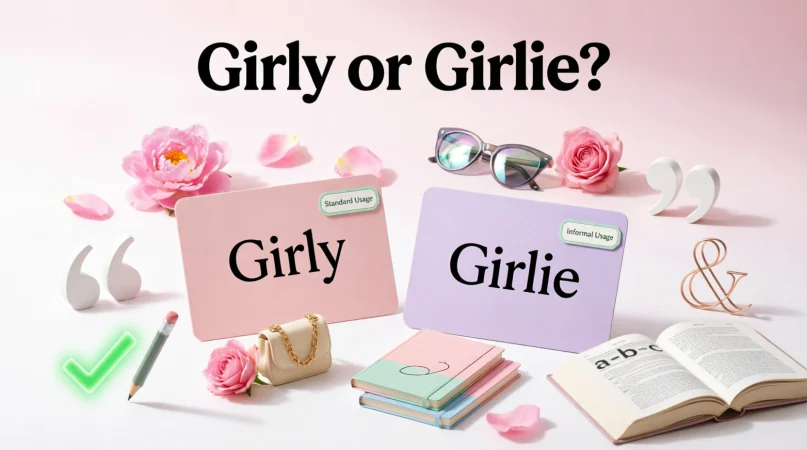
Quick answer: Girly is the most common and standard adjective used to describe something feminine or traditionally associated with girls. Girlie is a valid informal noun or adjective, but it is less common and often used playfully, affectionately, or in slang contexts.
The correct spelling is “girly” or “girlie.” Both words are found in everyday conversation, social media, fashion blogs, and online searches, often leading to confusion. They are similar in meaning and closely related, but their usage depends on context, regional preference, and tone. Most dictionaries define “girly” as the usual adjective for something conventionally feminine. “Girlie” is a rare alternative spelling, often found in informal writing, nicknames, or branding.
Understanding the difference can help you select the right word for school papers, professional writing, creative content, or casual communication. This guide explains the meanings, spelling differences, examples, and when each version is appropriate. By the end, you’ll know which spelling fits your purpose and how to use it confidently in both formal and informal English.
Quick Answer Table
| Feature | Girly | Girlie |
| Standard English Spelling | ✅ Yes | ✅ Yes |
| Most Common Form | ✅ Yes | ❌ Less common |
| Meaning | Feminine, characteristic of girls | Informal term for a girl or feminine person |
| Dictionary Recognition | ✅ Widely recognized | ✅ Recognized but informal |
| Professional Writing | ✅ Acceptable | ⚠ Usually avoided |
| Casual Usage | ✅ Common | ✅ Common |
| Example Sentence | She loves girly colors like pink and lavender. | The group called themselves the girlies. |
Which One Is Correct?
The answer depends on what you want to say.
If you are describing something as feminine, the preferred and most widely accepted word is:
✅ Girly
Examples:
- She likes girly fashion.
- The room has a girly design.
- That movie has a girly vibe.
If you are referring to a girl in an informal, playful, or affectionate way, you may encounter:
✅ Girlie
Examples:
- Hey girlie, how are you?
- The girlies are going out tonight.
In modern English, girly is significantly more common than girlie, especially in writing, publishing, education, and professional communication.
Meaning of the Correct Word: Girly
Definition
Girly is an adjective that describes something associated with girls or traditional femininity.
Dictionary-Style Definition
Having qualities, characteristics, styles, or interests traditionally associated with girls or women.
How Girly Is Used
The word is commonly used to describe the following:
- Fashion
- Colors
- Decorations
- Personal interests
- Behaviors
- Aesthetic styles
Although the word traditionally referred to stereotypically feminine traits, modern usage is broader and often used positively to describe personal style and identity.
Real-World Examples
Fashion
- She prefers girly dresses with floral patterns.
- The boutique specializes in girly clothing.
Home Decor
- The bedroom has a very girly appearance.
- Pink curtains create a girly atmosphere.
Personal Style
- Her style is elegant and girly.
- She enjoys girly accessories and jewelry.
Social Media
- Many influencers promote a soft, girly aesthetic.
- Girly lifestyle content remains popular online.
Common Synonyms for Girly
Semantic alternatives include:
- Feminine
- Ladylike
- Womanly
- Pretty
- Delicate
- Elegant
- Graceful
- Soft
- Chic
- Fashionable
Each synonym has slightly different connotations, but they often overlap with the meaning of girly.
Meaning of the Alternative Word: Girlie
Is Girlie a Real Word?
Yes.
Contrary to what many people believe, girlie is not a misspelling.
It is a legitimate English word, although it is considerably less common.
Definition of Girlie
“Girlie” is generally used as
- An informal noun referring to a girl or young woman.
- An affectionate nickname.
- A playful adjective in some contexts.
Examples of Girlie as a Noun
- Hi, girlie!
- The girlies met for brunch.
- Come on, girlie, you can do it.
In these examples, the word functions as a friendly term of address.
Examples of Girlie as an Adjective
- She enjoys girlie magazines.
- The event had a girlie theme.
However, in modern English, many writers would choose girly instead.
Modern Internet Usage
Social media platforms have helped revive the word girlie.
Examples include:
- Hot girlie summer
- Clean girlie aesthetic
- Book girlie
- Fitness girlie
- Travel girlie
In these cases, girlie often serves as a playful identity label rather than a traditional grammatical adjective.
Key Differences Between the Two Words
1. Spelling
| Girly | Girlie |
| Ends in -y | Ends in -ie |
| More common | Less common |
| Standard adjective | Informal noun or adjective |
2. Meaning
| Girly | Girlie |
| Feminine qualities | Informal reference to a girl |
| Describes things | Often describes people |
| Neutral meaning | More playful meaning |
3. Pronunciation
Interestingly, both words are usually pronounced the same way:
Girly → /ˈɡɜːrli/
Girlie → /ˈɡɜːrli/
Because the pronunciation is identical, confusion often occurs when writing.
4. Grammar
Girly
Usually functions as an adjective.
Examples:
- girly outfit
- girly style
- girly bedroom
Girlie
Often functions as a noun.
Examples:
- Hi, girlie.
- The girlies arrived early.
5. Recognition and Popularity
| Factor | Girly | Girlie |
| Everyday English | High | Medium |
| Academic Writing | Common | Rare |
| Professional Writing | Common | Rare |
| Social Media | High | High |
| Formal Contexts | Acceptable | Usually avoided |
Common Mistakes People Make
Mistake #1: Assuming Girlie Is Incorrect
Many learners believe girlie is a spelling error.
It isn’t.
It is a real English word with established usage.
Mistake #2: Using Girlie in Formal Writing
Formal sentence:
❌ The company adopted a girlie marketing strategy.
Better:
✅ The company adopted a girly marketing strategy.
Or:
✅ The company adopted a feminine marketing strategy.
Mistake #3: Confusing Parts of Speech
Incorrect:
❌ She is very girlie decorations.
Correct:
✅ She likes girlie magazines.
Or:
✅ She likes girly decorations.
Mistake #4: Treating Them as Perfect Synonyms
Although related, they are not always interchangeable.
Context matters.
Correct Usage Examples
Casual Examples
- She loves girly makeup tutorials.
- That handbag looks very girly.
- Hey girlie, what’s new?
- The girlies are planning a weekend trip.
Professional Examples
- The brand targets consumers seeking a girly aesthetic.
- The product packaging features a girly color palette.
- The design appeals to customers who prefer feminine styles.
Educational Examples
- The adjective “girly” describes characteristics associated with girls.
- Girlie may function as an informal noun in conversational English.
- Students should recognize the difference between standard and informal usage.
Literary and Metaphorical Examples
- The garden bloomed with a girly charm of pink roses and soft fragrances.
- The nickname “girlie” reflected warmth and friendship.
- The cottage carried a girly elegance that softened its rustic appearance.
- Her laughter had a girlie energy that brightened the room.
Word Origin / Etymology
Understanding the history of these words helps explain why both forms exist.
Origin of Girl
The root word “girl” entered Middle English centuries ago.
Originally, it referred broadly to a young person and later became associated specifically with female children.
Development of Girly
The suffix -y commonly creates adjectives in English.
Examples:
- Cloud → cloudy
- Wind → windy
- Dirt → dirty
Similarly:
- Girl → girly
The meaning became “having qualities associated with girls.”
Development of Girlie
The suffix -ie often creates affectionate, informal, or diminutive forms.
Examples:
- Dog → doggie
- Bird → birdie
- Sweet → sweetie
Likewise:
- Girl → girlie
This development gave the word a friendlier and more playful tone.
Why the Incorrect Version Became Popular
Interestingly, neither version is technically incorrect.
However, because “girly” dominates standard English, some people mistakenly assume “girlie” is wrong.
Several factors contributed to the popularity of girlie:
Social Media Trends
Platforms like TikTok, Instagram, and X have popularized expressions such as the following:
- Fashion girlie
- Makeup girlie
- Book girlie
- Travel girlie
- Wellness girlie
These phrases create a sense of community and identity.
Informal Online Communication
Users often prefer playful language.
The ending “-ie” feels
- Friendly
- Casual
- Trendy
- Personal
As a result, girlie continues to thrive in digital culture.
Marketing and Branding
Many lifestyle brands use informal language to connect with younger audiences.
Terms like:
- Beauty girlie
- Coffee girlie
- Fitness girlie
sound more conversational than their formal alternatives.
Easy Memory Tricks
Remembering the difference is simple.
Trick #1: Y” Means Describe”
Girly = adjective
Think:
Y = describes something
Examples:
- girly dress
- girly room
- girly style
Trick #2: IE Means “Person”
Girlie = person or nickname
Think:
- sweetie
- bestie
- auntie
- girlie
Most words ending in -ie often refer to people in an affectionate way.
Trick #3: Formal vs Informal
Use this shortcut:
- Formal writing → Girly
- Casual conversation → Girlie may work
Featured Snippet Answer: Girly or Girlie?
“Girly” is the standard and most commonly used English adjective meaning feminine or characteristic of girls. Girlie is also a valid word but is generally informal and often used as a playful noun, nickname, or social media expression. For professional and educational writing, “girly” is usually the preferred choice.
FAQs
Is girly or girlie the correct spelling?
Both are correct words, but girly is much more common and widely accepted in standard English.
Is girlie a real word?
Yes. “Girlie” is a recognized English word used informally as a noun, nickname, or casual descriptor.
Which word should I use in formal writing?
Use “girly” or an alternative such as “feminine.” Avoid “girlie” in formal or academic contexts.
Are girly and girlie pronounced differently?
No. Both words are generally pronounced the same way: /ˈɡɜːrli/.
Is girlie considered slang?
Not exactly. It is a legitimate word, but its modern usage often appears in informal speech and internet culture.
Why do people say “the girlies”?
“The girlies” is a playful expression referring to a group of girls or women, commonly used on social media.
Can girly have a negative meaning?
Sometimes. Depending on context, it may be used stereotypically. However, many people use it positively to celebrate femininity and personal style.
Is girlie becoming more popular?
Yes. Social media trends have increased the visibility of girlie, especially among younger audiences.
Can I use girlie in business communication?
It is generally better to avoid girlie in professional communication and choose girly or feminine instead.
What is the difference between feminine and girly?
Feminine is broader, more formal, and often more neutral. Girly is more casual and specifically associated with traditional girlhood aesthetics or interests.
Conclusion
The choice between girly and girlie depends on how you plan to use the word. “Girly” is the standard, widely accepted spelling found in dictionaries and is the best choice for formal writing, articles, and most everyday situations. Girlie is an informal variant that may be used in casual conversations, affectionate nicknames, or brand names to create a playful tone. When accuracy and clarity matter, girly is the safer option, while girlie works well in relaxed, creative contexts.