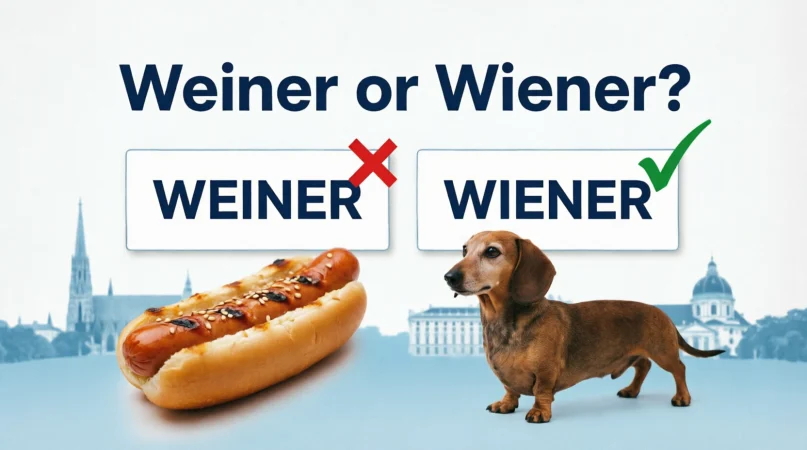
Quick Answer: The correct and standard spelling in English is Wiener. Weiner is generally considered to be a misspelling, though it does appear as a surname or given name on occasion.
Both spellings, Weiner and Wiener, can be confusing because they both appear online, but only one is the common English word in most contexts. Wiener: If you mean the sausage, the hot dog, or anything else out of Vienna. The term is derived from the German word “Wiener,” meaning “from Vienna” (German: “Wien”).
In contrast, “weiner” is generally a misspelling when referring to food, although it is a legitimate surname and may appear as a family name or in proper nouns. Understanding the difference helps ensure accurate spelling in everyday writing, recipes, restaurant menus, and educational content. This guide explains the meanings, origins, and correct usage of both words, provides easy examples, and clears up common misconceptions so you can confidently choose the right spelling in any situation.
Quick Answer Table
| Feature | Wiener | Weiner |
| Standard spelling | ✅ Yes | ❌ Usually no |
| Dictionary recognition | ✅ Widely recognized | ⚠️ Limited recognition |
| Meaning | Hot dog, sausage, dachshund, person from Vienna | Usually a misspelling of wiener |
| Common usage | Correct in most contexts | Often used accidentally |
| Pronunciation | WEE-ner | Usually intended to sound the same |
| Example | “I ordered a wiener at the ballpark.” | “I ordered a wiener.” (commonly considered a spelling error) |
Which One Is Correct?
The correct spelling in standard English is:
✅ Wiener
The spelling “wiener” appears in dictionaries and is widely accepted when referring to
- A hot dog
- A sausage
- A dachshund dog
- A person from Vienna, Austria
- Foods derived from Viennese culinary traditions
The spelling:
❌ Weiner
It is usually an incorrect rearrangement of the letters. Many people mistakenly write “wiener” because English spelling patterns often place “ei” before “ie”; however, this word follows a different pattern.
Correct Example
- I bought a wiener from the food stand.
Incorrect Example
- I bought a weiner from the food stand.
Meaning of the Correct Word
Definition of Wiener
A wiener is a noun with several related meanings.
1. A Hot Dog or Sausage
The most common meaning refers to a long, thin sausage often served in a bun.
Examples:
- The baseball stadium sells thousands of wieners every game.
- She topped her wiener with mustard and onions.
2. A Dachshund Dog
Informally, some people use wiener as shorthand for a dachshund because of its long body shape.
Examples:
- Their adorable wiener chased squirrels around the yard.
- The wiener dog won first prize.
3. A Person from Vienna
Historically, a Wiener is someone from Vienna, Austria.
Examples:
- The museum highlighted famous Wieners from the nineteenth century.
- Traditional Wiener cuisine influenced many European dishes.
4. Food Originating from Vienna
The term appears in culinary names such as Wiener Schnitzel.
Examples:
- Wiener Schnitzel is a famous Austrian dish.
- The restaurant specializes in authentic Wiener recipes.
Meaning of the Incorrect or Alternative Word
Is “weiner” a real word?
In most English writing, weiner is considered a misspelling of wiener.
However, there are a few exceptions.
As a Surname
Some individuals legitimately have the surname Weiner.
Examples include:
- Family names
- Business names
- Personal identities
In these cases, Weiner is correct because it is part of a proper noun.
As a Typographical Error
Most appearances of weiner result from the following:
- Spelling confusion
- Typing mistakes
- Misremembering the letter order
Therefore, if you’re referring to a sausage, hot dog, or dachshund, wiener is almost always the correct choice.
Key Differences Between the Two Words
Comparison Table
| Feature | Wiener | Weiner |
| Standard English spelling | ✅ Yes | ❌ No |
| Dictionary entry | ✅ Common | ⚠️ Rare |
| Meaning | Multiple accepted meanings | Usually none outside proper names |
| Academic writing | ✅ Preferred | ❌ Avoid |
| Professional writing | ✅ Preferred | ❌ Avoid |
| Search recognition | High | Lower |
| Grammar acceptance | Correct | Usually incorrect |
Spelling Difference
The only difference is the order of the vowels:
- Wiener → ie
- Weiner → ei
That small change determines whether the word is standard English or usually considered a mistake.
Pronunciation Difference
Interestingly, both versions are usually pronounced the same:
WEE-ner
This identical pronunciation contributes to the confusion.
Usage Difference
Wiener
- Accepted by dictionaries
- Appropriate in formal writing
- Recognized globally
Weiner
- Often flagged by spell-checkers
- Considered nonstandard
- Usually corrected in professional editing
Common Mistakes People Make
Many writers struggle with “weiner” or “wiener” because English spelling rules are not always intuitive.
Here are the most common mistakes.
1. Reversing the Vowels
People often write:
❌ Weiner
Instead of:
✅ Wiener
2. Assuming “I Before E” Applies
Many students learn:
I before E except after C.
Unfortunately, English contains numerous exceptions.
The word wiener comes from German and does not neatly follow this rule.
3. Trusting Autocorrect Too Much
Some older systems or user dictionaries may fail to recognize the intended word.
Always double-check the spelling.
4. Confusing Surnames with Common Nouns
A person named “Weiner” may spell their name that way, but the food remains a wiener.
Correct Usage Examples
Casual Examples
- Let’s grab a wiener from the concession stand.
- My wiener dog loves running in the park.
- He ordered two wieners and a soda.
Professional Examples
- The menu includes grilled wieners served with artisan bread.
- Consumer demand for premium wieners increased this year.
- The manufacturer exports wieners across North America.
Educational Examples
- The term “Wiener” originates from the German word meaning “from Vienna.”
- Students often misspell “wiener” as “weiner.”
- Dictionaries list Wiener as the standard spelling.
Literary or Metaphorical Examples
- The tiny wiener dog marched through the garden like a fearless explorer.
- The sizzling wiener became the centerpiece of the summer celebration.
- Memories of street vendors selling warm wieners filled his mind.
Word Origin / Etymology
This is why Wiener is spelled with the “ie.”
The word comes from German:
Wiener
Meaning:
“Someone or something from Vienna.”
The German city of Vienna is called Wien.
Therefore:
- Wien = Vienna
- Wiener = From Vienna
Originally, the term described sausages associated with Vienna.
Over time, English speakers adopted the word and began using it to describe hot dogs and similar sausages.
Etymology Timeline
| Period | Development |
| German origins | Wiener means “from Vienna” |
| 19th century | Sausages gain popularity |
| Early English adoption | Word enters English vocabulary |
| Modern usage | Refers mainly to hot dogs and dachshunds |
Why the Incorrect Version Became Popular
The popularity of weiner stems from several linguistic factors.
1. Sound-Based Spelling
People hear:
“WEE-ner”
Then attempt to spell it phonetically.
2. Vowel Confusion
English contains many words with “ei”:
- Receive
- Vein
- Reign
As a result, writers sometimes instinctively choose “ei.”
3. Typing Habits
Fast typing often causes vowel transposition errors.
4. Internet and Social Media Usage
Repeated exposure to incorrect spellings online can make them appear legitimate.
However, widespread use does not automatically make a spelling correct.
Easy Memory Tricks
Remembering the correct spelling doesn’t have to be difficult.
Trick 1: Think of Vienna
Wiener comes from Wien (Vienna).
Since Vienna is Wien in German, keep the letters:
Wien → Wiener
Trick 2: Remember “IE”
Visualize:
WIENER
The “ie” comes directly from Wien.
Trick 3: Connect It to Austria
Whenever you see Wiener, imagine Austrian cuisine and Vienna’s culinary traditions.
Trick 4: Learn the Phrase
Wien gives Wiener.
This simple phrase helps reinforce the correct spelling.
Weiner or Wiener in Dictionaries
Major dictionaries consistently recognize Wiener as the standard spelling.
Common dictionary definitions include:
- A frankfurter
- A hot dog
- A sausage
- A dachshund
- A person from Vienna
The spelling weiner generally receives one of the following treatments:
- Alternative spelling
- Misspelling notice
- Proper surname reference
This further confirms that Wiener should be your default choice.
Weiner or Wiener in Everyday English
In modern English, you’ll encounter wiener in several contexts.
Food Industry
- Hot dogs
- Frankfurters
- Sausages
Pet Communities
- Wiener dog
- Miniature dachshund
- Long-haired dachshund
Travel and Culture
- Viennese cuisine
- Austrian food traditions
- Historical references to Vienna
Because of these widespread uses, mastering the correct spelling can improve both writing accuracy and vocabulary confidence.
Grammar Tips for Using Wiener Correctly
As a Common Noun
Use lowercase letters.
Examples:
- I ate a wiener.
- The wieners were delicious.
As Part of a Proper Name
Capitalize when appropriate.
Examples:
- Wiener Schnitzel
- Wiener Philharmonic
Plural Form
The plural is:
wieners
Examples:
- The grill is full of wieners.
- We served fifty wieners at the picnic.
Possessive Form
Examples:
- The wiener’s bun was toasted.
- The wieners’ toppings were varied.
People Also Ask: Weiner or Wiener
Is it spelled “weiner” or “wiener”?
The correct spelling is wiener. “Weiner” is usually a misspelling unless it is a person’s surname.
Why is Wiener spelled with “ie”?
The word comes from the German word “Wiener,” meaning “from Vienna.” Vienna is called Wien in German.
Is “weiner” a real word?
It can be a surname, but it is not the standard spelling for the sausage or hot dog.
Which spelling do dictionaries prefer?
Major dictionaries overwhelmingly prefer Wiener.
Are weiner and wiener pronounced differently?
No. They are generally pronounced the same way: WEE-ner.
Is Wiener German?
Yes. The word originates from German and refers to something or someone from Vienna.
Can I use weiner in formal writing?
Only if it is part of a person’s name. Otherwise, use Wiener.
Why do people confuse the two spellings?
Because the pronunciation is identical, English vowel patterns can be confusing.
FAQs
1. What is the correct spelling: weiner or wiener?
Wiener is the standard and correct spelling in English.
2. Is Weiner always wrong?
Not always. It can be correct as a surname, but it is usually incorrect when referring to food or dachshunds.
3. What does Wiener mean?
It can refer to a sausage, hot dog, dachshund, or something associated with Vienna.
4. How do you pronounce wiener?
It is commonly pronounced WEE-ner.
5. Where does the word wiener come from?
It originates from the German word Wiener, meaning “from Vienna.”
6. Is Wiener an English word?
Yes. English borrowed it from German and uses it widely today.
7. What is the plural of wiener?
The plural form is wieners.
8. Why is Weiner so common online?
Many people accidentally reverse the vowels because both spellings sound the same when spoken.
9. Is a wiener dog the same as a dachshund?
Yes. “Wiener dog” is a popular nickname for a dachshund.
10. Can a wiener refer to a person?
Historically, yes. A Wiener is a person from Vienna.
Conclusion
In conclusion, “Weiner” or “wiener” is straightforward: “wiener” is the correct and widely accepted spelling. The word has deep roots in German, originating from “Wien,” the German name for Vienna. Today, it commonly refers to a hot dog, sausage, dachshund, or something connected to Viennese culture. While “weiner” occasionally appears as a surname, it is generally considered a misspelling in everyday English.
Mastering small spelling distinc, ittions like this can make your writing clearer, more professional, and more trustworthy. The next time you encounter the debate over “weiner” or “wiener,” you’ll know exactly which spelling to choose.