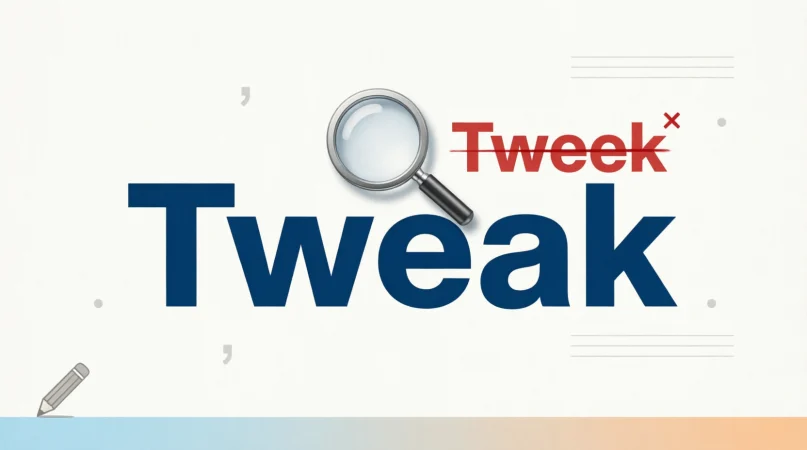
Tweak is the correct spelling.
Tweek is usually a misspelling (except in some names, brands, or informal uses). Tweak means to make a small adjustment or improvement
Tweek or Tweak is a common spelling confusion that occurs because both words look and sound similar. However, in standard English, tweak is the correct and widely accepted spelling. It is used as a verb meaning to make a small change, adjustment, or improvement to something.
The incorrect form tweek is often a simple spelling mistake caused by pronunciation or confusion with similar-looking words. Understanding the difference between tweak and tweek helps you write more accurately and use the right word in professional, academic, and everyday communication
Quick Answer Table
| Feature | Tweak | Tweek |
| Correct Spelling | Yes | No |
| Status | Standard English word | Common misspelling |
| Meaning | To make small adjustments or improvements | No standard meaning |
| Part of Speech | Verb and noun | Misspelling |
| Pronunciation | /twiːk/ | /twiːk/ (same) |
| Dictionary Recognition | All major dictionaries | No dictionary entry |
| Usage Example | “I need to tweak the design slightly.” | Incorrect: “I need to tweek the design.” |
Which One Is Correct?
The definitive answer is tweak. This is the only correct spelling recognized by every major English dictionary, including Merriam Webster, Oxford English Dictionary, Cambridge Dictionary, and Collins Dictionary.
Tweek is simply a misspelling that has gained some visibility through popular culture, particularly the character Tweek Tweak from the animated television show South Park. However, in formal writing, professional contexts, and standard English usage, “tweek” is never acceptable.
The confusion typically arises because “tweak” contains the “ea” vowel combination, which is less common in English words of this type. Our brains often default to the more familiar “ee” pattern found in words like “week,” “seek,” and “sleek.” This is a classic example of how our cognitive shortcuts can lead us astray.
When you’re writing, always choose “tweak.” There’s no situation where “tweek” is considered correct or acceptable in standard English.
Meaning of the Correct Word
Tweak Definition
Tweak functions as both a verb and a noun in English:
As a verb, it means:
- To make small, fine adjustments to something
- To improve something through minor modifications
- To adjust slightly for better performance or appearance
- To pinch, pull, or twist something sharply
As a noun, it refers to:
- A small adjustment or modification
- A slight change made to improve something
- A sharp pinch or twist
Detailed Explanation
The versatility of “tweak” makes it incredibly useful in everyday language. When you tweak something, you’re not making dramatic changes or complete overhauls. Instead, you’re engaging in the art of refinement—making subtle adjustments that collectively produce meaningful improvements.
In creative fields, tweaking is essential. Writers tweak their sentences to achieve the perfect rhythm. Designers tweak colors and layouts until everything feels balanced. Musicians tweak their performances to capture exactly the right emotion. The beauty of a tweak lies in its precision; it’s about making things better through careful, thoughtful adjustment.
Usage and Real World Examples
Everyday Contexts:
- “I just need to tweak the recipe a bit before serving it.”
- “Can you tweak the lighting in this photo? It’s slightly too bright.”
- “She tweaked his nose playfully.”
Professional Settings:
- “We need to tweak our marketing strategy for better results.”
- “The developers will tweak the software based on user feedback.”
- “I’ll tweak the presentation slides before the morning meeting.”
Academic and Technical Usage:
- “Researchers continue to tweak their experimental methodology.”
- “The economist suggested tweaking the model to account for new variables.”
- “We made several tweaks to the algorithm to improve accuracy.”
Metaphorical Usage:
- “Sometimes we need to tweak our mindset to overcome challenges.”
- “His speech was perfect except for a few minor tweaks.”
- “Life often requires us to tweak our plans as circumstances change.”
Meaning of the Incorrect or Alternative Word
Status: Incorrect
Tweek has no recognized meaning in standard English. It is not found in any reputable dictionary as a valid word. While some might argue it’s a variant spelling or regional variation, this is simply not supported by linguistic evidence.
The Tweek Tweak Phenomenon
The only notable appearance of “tweek” in popular culture is the character Tweek Tweak from the adult animated series South Park. This character, known for his anxiety and caffeine addiction, has unfortunately contributed to the confusion between the two spellings. However, it’s essential to recognize that character names in fictional works don’t establish linguistic validity.
Digital Age and Typos
In the digital age, “tweek” appears with surprising frequency. Auto correct and spell check features often flag it as an error, but users sometimes override these suggestions, perpetuating the misspelling. The internet’s informal nature has allowed many spelling errors to circulate widely, but this doesn’t legitimize them in formal usage.
Why It’s Not a Valid Alternative
Several factors confirm that “tweek” isn’t an acceptable alternative:
- Absence from all major dictionaries
- No etymological basis
- No historical usage in English literature
- No regional variation recognition by linguists
- Consistent marking as incorrect by spell check tools
Key Differences Between the Two Words
Spelling
The most obvious difference is the vowel combination. Tweak uses “ea,” while tweek incorrectly uses “ee.” This distinction follows the pattern of other English words where “ea” creates the long “e” sound, such as:
- Peak
- Speak
- Leak
- Weak
Meaning
Tweak has a rich, established meaning that has evolved over centuries. It conveys the idea of making small, precise adjustments to improve something.
Tweek lacks any inherent meaning in standard English. When people use it, they’re always intending to say “tweak.”
Pronunciation
Despite the spelling difference, both are pronounced identically: /twiːk/. This identical pronunciation is precisely why the confusion persists—when you hear someone say “tweek,” it sounds exactly like “tweak,” so your brain doesn’t automatically flag the visual spelling error.
Grammar
Tweak functions as both a verb and a noun, following regular English conjugation patterns:
- Verb forms: tweak, tweaks, tweaked, tweaking
- Noun forms: tweak, tweaks
Tweek has no grammatical function in standard English.
Usage
Tweak appears in countless contexts, from casual conversation to formal writing. It’s used across all English speaking regions and is understood universally.
Tweek appears primarily as a spelling error, occasional social media username, or character name in entertainment media.
Recognition
Tweak is instantly recognized and understood by English speakers worldwide. It’s included in standardized tests, professional writing guides, and educational curricula.
Tweek generates confusion or is immediately flagged as an error by readers who notice the unconventional spelling.
Common Mistakes People Make
Mistake 1: Using “Tweek” in Formal Writing
This is perhaps the most common error. Students, professionals, and even experienced writers occasionally slip up and use “tweek” instead of “tweak” in emails, reports, and other formal documents. Always proofread specifically for this common spelling mistake.
Mistake 2: Assuming “Tweek” Is a Valid Variant
Some writers assume that because “week” is spelled with “ee,” “tweek” must be correct. This false analogy overlooks the specific etymology and spelling patterns of “tweak.”
Mistake 3: Overusing “Tweak” Without Understanding Its Meaning
Some writers use “tweak” when they mean “change” or “alter” in broader, more significant ways. Remember that “tweak” specifically refers to minor, precise adjustments.
Mistake 4: Misspelling the Past Tense
When conjugating “tweak,” some writers incorrectly spell the past tense as “tweeked.” The correct form is “tweaked,” following the pattern of adding ” ed” to the base word.
Mistake 5: Confusion with “Tweaked”
Related to the above, some writers spell “tweaked” as “tweeked” or “tweaked” incorrectly. The correct spelling is always “tweaked.
Correct Usage Examples
Casual Examples
- “I think I’ll tweak the playlist for the party—add a few more upbeat songs.”
- “She tweaked her hair in the mirror before heading out.”
- “Let me tweak the settings on this app; it’s running a bit slowly.”
- “He always tweaks his workout routine every few months.”
- “We tweaked the paint color slightly after seeing it on the walls.”
- “Her grandmother used to tweak her cheeks affectionately.”
Professional Examples
- “The design team will present their latest tweaks to the interface on Monday.”
- “After analyzing the data, we decided to tweak our sales approach.”
- “The engineer suggested tweaking the engine parameters for better fuel efficiency.”
- “Please tweak the wording in the contract’s third paragraph.”
- “Our quarterly report needs a few tweaks before submission.”
- “We’re tweaking the user experience based on customer feedback.”
- “The financial advisor recommended tweaking our investment portfolio.”
Educational Examples
- “Students should learn to tweak their study techniques for different subjects.”
- “The textbook provides examples of how to tweak equations to solve different problems.”
- “Teachers often tweak their lesson plans to accommodate different learning styles.”
- “We need to tweak the experimental setup to control for additional variables.”
- “The assignment requires you to tweak the original code to add new functionality.”
- “When writing essays, always tweak your thesis statement after completing your research.”
Literary and Metaphorical Examples
- “Time has a way of tweaking our memories, smoothing rough edges and brightening highlights.”
- “Fate often tweaks our carefully laid plans in unexpected ways.”
- “His speech was flawless except for one small tweak he’d make to the opening line.”
- “Art is the constant tweaking of reality until it reveals a deeper truth.”
- “Memory is not a recording but a story we continuously tweak and retell.”
- “Every generation tweaks the values it inherits to suit its own time.”
Word Origin / Etymology
Historical Development
The word “tweak” has a fascinating etymological history that traces back to the 15th century. Its roots lie in the Middle English word “twikken,” which meant “to pluck” or “to twitch.” This, in turn, came from the Old English “twiccian,” which meant “to pluck” or “to pinch.”
Linguistic Evolution
Over centuries, the meaning of “tweak” evolved from its original sense of a physical pinch or pull to encompass the broader concept of making small adjustments. This semantic expansion reflects the word’s usefulness in describing the process of refinement and improvement.
The spelling “tweak” has been consistently used since the word entered the English language. The “ea” spelling pattern is historically supported and has remained stable through various periods of English language evolution.
Related Words
The word “tweak” shares its etymological roots with several other English words:
- Twitch: Also derived from Old English “twiccian,” meaning to pull sharply
- Twinkle: Related to quick, small movements
- Twick: An archaic variant meaning the same as tweak
Scandinavian Influence
Some linguists suggest connections to Scandinavian words, such as the Old Norse “tvika,” meaning “to pull.” This influence reflects the complex linguistic heritage that shaped English vocabulary.
Why the Incorrect Version Became Popular
The Analogy Factor
Many people incorrectly spell “tweak” as “tweek” because they apply the pattern of words like “week” and “sleek.” This is a classic example of overgeneralization in spelling. When we see a pattern in language, our brains naturally try to apply it to new situations.
The Role of Popular Culture
As mentioned earlier, the South Park character Tweek Tweak has played a significant role in normalizing this misspelling. For younger generations especially, seeing the name spelled with “ee” can create a mental association that persists even when spelling the verb “tweak.”
Typing and Autocorrect
In our fast paced digital world, typos are inevitable. The letter “e” is very close to “a” on the keyboard, and “ee” can be a natural slip when typing “ea.” Furthermore, autocorrect and text prediction algorithms sometimes fail to catch this specific error, allowing it to spread through informal digital communication.
Lack of Formal Education
Many English speakers never receive explicit instruction on spelling patterns like “ea” versus “ee.” This knowledge gap means they rely on intuition, which can be incorrect.
The Internet Echo Chamber
When misspellings appear repeatedly online, they can seem more acceptable than they actually are. Social media, forums, and comment sections are full of examples of “tweek” used casually, which reinforces the mistake for others.
Easy Memory Tricks
Trick 1: The “Eat” Connection
Remember that “tweak” is spelled like “weak” with a “t” in front. Think: If you make a weak change, you’re just tweaking it. Both “weak” and “tweak” use the “ea” pattern.
Trick 2: The Adjustment Association
Associate “tweak” with “adjustment” and “improvement.” Both of these related words contain the letter “a” (adjastment, improvement—not “e”), helping you remember the correct spelling.
Trick 3: The Week Fallacy Trap
Remember that “tweak” is NOT spelled like “week.” It’s related to words with “ea” like “speak,” “peak,” and “break.” If you can remember this key difference, you’ll avoid the most common mistake.
Trick 4: Visual Mnemonic
Visualize the word “tweak” with the “ea” in the middle. Imagine it as “tiny tiny adjustments”—the “ea” in the word itself reminds you of the “e” and “a” you might adjust slightly.
Trick 5: Write It Repeatedly
Writing the correct spelling multiple times can help create muscle memory. Write “tweak” in different contexts: “tweak the text,” “tweak the design,” “I will tweak this.”
Trick 6: Learn the Etymology
Understanding that “tweak” comes from Old English “twiccian” (which, crucially, has an “i” pattern that evolved into “ea”) can help cement the correct spelling in your mind.
Trick 7: The Spell Check Strategy
Remember that your spell check always flags “tweek.” If it looks wrong, it probably is. Trust the tools and learn the correct form.
Trick 8: Create an Association Chain
Build a chain: “tweak” → “make small changes” → “adjust” → “improve.” This creates multiple mental connections that reinforce both the spelling and the meaning.
FAQs
1. Is “tweek” correct?
No, tweak is the correct spelling. “Tweek” is usually a misspelling.
2. Why do people confuse tweek and tweak?
Because both sound the same and look similar.
3. What does “tweak” mean?
It means to make a small change, adjustment, or improvement.
4. Can tweak be a noun and verb?
Yes, it can mean an adjustment (noun) or to adjust something (verb).
5. What is the past tense of tweak?
The past tense is tweaked.
6. What is the plural of tweak?
The plural form is tweaks.
7. How is tweak pronounced?
It is pronounced tweek (/twiːk/).
8. What are synonyms of tweak?
Adjust, modify, refine, improve, and enhance.
9. How can I remember tweak?
Remember tweak has “ea” like weak.
10. Is tweek ever used?
Only as a name or informal reference, not as a standard word
Conclusion
The difference between tweek and tweak is simple once you understand the correct spelling. Tweak is the standard English word used for making small adjustments or improvements, while tweek is generally considered a misspelling except in specific names or informal uses.
Using the correct spelling shows accuracy and confidence in your writing. Whether you are refining an idea, adjusting a design, or improving a sentence, remember that the right word is always tweak. With this simple rule in mind, you can avoid the common mistake and communicate more clearly.