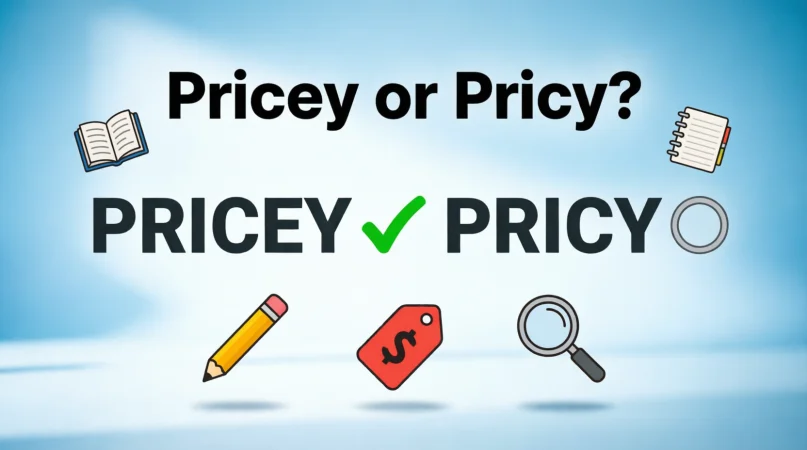
Quick answer: Pricey is the correct and standard spelling. Pricy is also correct, but it is a less common alternative spelling. Use pricey in most writing for broader recognition and consistency.
Pricey and pricy may seem like minor spelling decisions, but using the correct form can improve the clarity and professionalism of your writing. Both words are accepted in modern English and carry the same meaning: something that is expensive or costs more than expected. However, pricey is the more widely recognized and frequently used spelling in dictionaries, published books, newspapers, and online content. Because it is more familiar to readers, it is generally the preferred choice for academic writing and business communication.
Pricy remains a correct alternative, particularly in American English, but it appears less often and may look unusual to some audiences. Understanding the difference helps writers maintain consistency and credibility while matching reader expectations. This guide explains when to use pricey or pricy, compares their usage, and provides examples so you can confidently choose the spelling that best fits your writing style and audience.
Quick Answer Table
| Feature | Pricey | Pricy |
| Correct spelling | Yes | Yes |
| Most common spelling | Yes | No |
| Meaning | Expensive; costing more than expected | Expensive; costing more than expected |
| Formal acceptance | Widely accepted | Accepted but less common |
| Dictionary recognition | Yes | Yes |
| Preferred usage | Strongly preferred | Alternative spelling |
| Example | This restaurant is a bit pricey. | That laptop seems pricy. |
Which One Is Correct?
The short answer is that both pricey and pricy are correct.
However, if you’re writing for:
- Academic purposes
- Business communication
- Professional blogs
- Journalism
- Educational content
You should generally choose pricey.
Most major dictionaries list pricey as the primary spelling, while pricy is usually shown as a variant.
Recommended Usage
✅ Preferred: pricey
✅ Acceptable alternative: pricy
For consistency and broader recognition, most editors and style guides favor pricey.
Meaning of the Correct Word
What Does “Pricey” Mean?
The word pricey is an adjective that means:
More expensive than expected, reasonable, or desired.
It often describes products, services, experiences, or items that cost a significant amount of money.
Definition
Pricey (adjective):
Costing a lot of money; expensive.
Usage in Everyday English
People commonly use pricey when discussing:
- Restaurants
- Cars
- Electronics
- Housing
- Travel
- Education
- Healthcare
- Luxury goods
Real-World Examples
- The hotel was beautiful but extremely pricey.
- Organic groceries can be quite pricey.
- That designer handbag looks pricey.
- Living in major cities is becoming increasingly pricey.
Tone and Connotation
Unlike the word expensive, pricey often carries a conversational tone.
Compare:
- The conference was expensive.
- The conference was pretty pricey.
The second sentence sounds more natural and informal.
Meaning of the Incorrect or Alternative Word
What Does “Pricy” Mean?
Pricy has the same meaning as pricey.
It is not a typo.
It is not slang.
It is not grammatically incorrect.
Instead, it is simply an alternative spelling.
Definition
Pricy (adjective):
Costing a lot of money; expensive.
Examples
- That apartment seems a little pricy.
- New smartphones can be quite pricy.
- The restaurant was excellent but somewhat pricy.
Is It Wrong?
No.
Many respected dictionaries recognize pricy as a valid spelling.
However, it appears less often in published writing and professional content.
For that reason, many grammar experts recommend using pricey whenever possible.
Key Differences Between the Two Words
Although the meanings are identical, there are a few practical differences.
| Feature | Pricey | Pricy |
| Meaning | Expensive | Expensive |
| Grammar | Adjective | Adjective |
| Pronunciation | Same | Same |
| Popularity | More common | Less common |
| Professional writing | Preferred | Less preferred |
| Dictionary acceptance | Yes | Yes |
| Reader familiarity | Higher | Lower |
Spelling Difference
The only visible difference is the extra letter e.
- Price + y = Pricey
- Pric + y = Pricy
Because the root word is price, many writers naturally prefer pricey.
Meaning Difference
There is no meaningful difference.
Both words describe something that costs a lot of money.
Pronunciation Difference
There is no pronunciation difference.
Both are pronounced:
PRICE-ee
Phonetic pronunciation:
/ˈpraɪsi/
Grammar Difference
There is no grammatical difference.
Both function as adjectives.
Examples:
- A pricey vacation.
- A pricy vacation.
Both are grammatically correct.
Recognition Difference
Most readers immediately recognize pricey.
Some readers may view pricy as unusual because they encounter it less often.
Common Mistakes People Make
When deciding between pricey or pricy, writers often make several mistakes.
Assuming Pricy Is Incorrect
Many people think pricy is wrong because it looks unusual.
In reality, it is a legitimate spelling.
Using Both Spellings in One Document
Avoid switching back and forth.
For example:
❌ The car is pricey. The insurance is pricy.
Choose one spelling and remain consistent.
Confusing Pricey With Expensive
Although similar, the words carry slightly different tones.
- Expensive = neutral and formal
- Pricey = conversational and informal
Misspelling Both Versions
Common errors include:
- pricee
- pricie
- priceey
- prycy
Stick to either:
- pricey
- pricy
Correct Usage Examples
Below are examples across different contexts.
Casual Examples
- That coffee shop is a little pricey.
- Concert tickets are getting more pricey every year.
- This smartphone looks pricey.
Professional Examples
- The proposed software solution may be too pricey for small businesses.
- Several vendors offered quality products, but some were excessively pricey.
- The investment appears pricey compared to competing alternatives.
Educational Examples
- University textbooks can be surprisingly pricey.
- Some online certification programs are quite pricey.
- Students often search for cheaper alternatives to pricey academic materials.
Literary and Metaphorical Examples
- Dreams can be pricey when they demand every ounce of your time.
- Success often comes with a pricey commitment to discipline.
- Freedom can be a pricey treasure in difficult times.
Pricey vs Expensive: Is There a Difference?
Many learners also ask whether pricey and expensive are interchangeable.
Similarities
Both words mean:
- High cost
- Significant price
- More money required
Differences
| Pricey | Expensive |
| Informal | Neutral |
| Conversational | Formal |
| Common in speech | Common in writing |
| Slightly opinionated | More objective |
Example
- The watch is expensive. ✅
- The watch is pricey. ✅
The second sentence sounds more personal and conversational.
Synonyms of Pricey
Using synonyms helps improve writing variety and semantic richness.
Common alternatives include:
- Expensive
- Costly
- High-priced
- Premium
- Overpriced
- Luxurious
- Upscale
- Exclusive
- Cost-intensive
- Big-ticket
Example Sentences
- The resort was luxurious but expensive.
- The vehicle is a high-priced model.
- The property market remains costly.
Antonyms of Pricey
Words with opposite meanings include:
- Cheap
- Affordable
- Inexpensive
- Budget-friendly
- Economical
- Low-cost
- Reasonably priced
- Discounted
Examples:
- We found an affordable alternative.
- The restaurant offers inexpensive meals.
- The laptop is surprisingly budget-friendly.
Word Origin / Etymology
The history of pricey reveals why the spelling debate exists.
The root word is:
Price
derived from:
- Middle English pris
- Old French pris
- Latin pretium (meaning value or worth)
As English evolved, speakers added the suffix -y to create an adjective meaning:
Having a high price.
This produced pricey.
Over time, many writers simplified the spelling and began using pricy as an alternative.
Both spellings gradually entered dictionaries and became accepted forms.
However, pricey remained the dominant version because it preserves the original base word more clearly.
Why the Incorrect Version Became Popular
Interestingly, pricy became common for several reasons.
Simpler Spelling
Some writers remove the extra e because it appears unnecessary.
Pronunciation Stays the Same
Unlike many English words, removing the e does not change pronunciation.
Both forms sound identical.
Informal Internet Usage
Online communication often encourages simplified spellings.
Blogs, forums, and social media helped spread pricy.
Dictionary Acceptance
Once major dictionaries recognized the variant, its usage continued to grow.
Even so, pricey remains more widely used in books, newspapers, educational materials, and professional writing.
When Should You Use Pricey?
Use pricey when:
- Writing blog posts
- Creating educational content
- Publishing articles
- Writing essays
- Sending professional emails
- Producing marketing copy
- Creating business reports
Example
“The luxury resort offers exceptional service, but the accommodations can be quite pricey.”
This spelling appears polished and familiar to most readers.
When Can You Use Pricy?
You may use pricy when:
- Following a house style guide that accepts it
- Maintaining consistency with existing content
- Writing informally
- Reflecting personal preference
Example:
“The neighborhood cafés are charming but somewhat pricy.”
Although acceptable, many editors would still change it to pricey.
Easy Memory Tricks
Remembering the preferred spelling is simple.
Trick 1: Keep the Root Word
Think:
Price → Pricey
The base word remains visible.
This makes pricey easier to remember.
Trick 2: The Extra E Equals Extra Cost
Imagine:
Extra E = Extra Expense
Since the item costs more money, it gets an extra letter.
Trick 3: Dictionary Preference
Most dictionaries lead with pricey, making it the safer choice.
Whenever you’re unsure, choose pricey.
SEO-Friendly Comparison Summary
For anyone searching pricey or pricy, here’s the takeaway:
| Question | Answer |
| Is pricey correct? | Yes |
| Is pricy correct? | Yes |
| Which is more common? | Pricey |
| Which should I use? | Pricey |
| Do they mean the same thing? | Yes |
| Are they pronounced differently? | No |
| Is pricy a typo? | No |
| Is pricey preferred in professional writing? | Yes |
FAQs
Is it pricey or pricy?
Both are correct spellings, but pricey is more common and generally preferred.
Is pricy a real word?
Yes. Most major dictionaries recognize pricy as a valid alternative spelling.
Which spelling should I use in formal writing?
Use pricey because it is more widely recognized and preferred by editors.
Do pricey and pricy have different meanings?
No. Both mean expensive or costing more than expected.
How do you pronounce pricey?
It is pronounced:
PRICE-ee
The pronunciation is the same for pricy.
Is pricy considered a typo?
No. It is an accepted spelling variant, not a spelling mistake.
Why is pricey more popular?
Because it retains the original word price and has historically been the dominant spelling in published English.
Can I use pricey in academic writing?
Yes. It is acceptable, though more formal alternatives like expensive or costly may sometimes fit better.
Is it pricey informal?
Yes. It is generally more conversational than the word expensive.
What is the opposite of pricey?
Common opposites include:
- Cheap
- Affordable
- Inexpensive
- Budget-friendly
- Economical
Conclusion
In conclusion, pricey and pricy come down to preference rather than correctness, as both spellings are accepted and mean “expensive.” However, pricey is the dominant spelling in everyday English and is more commonly seen in books, websites, news articles, and professional writing. For consistency, readability, and broader audience recognition, most writers and editors recommend using pricey unless you are following a specific style guide that prefers pricy. By choosing the more familiar spelling, you ensure your message is clear, natural, and aligned with standard English usage.