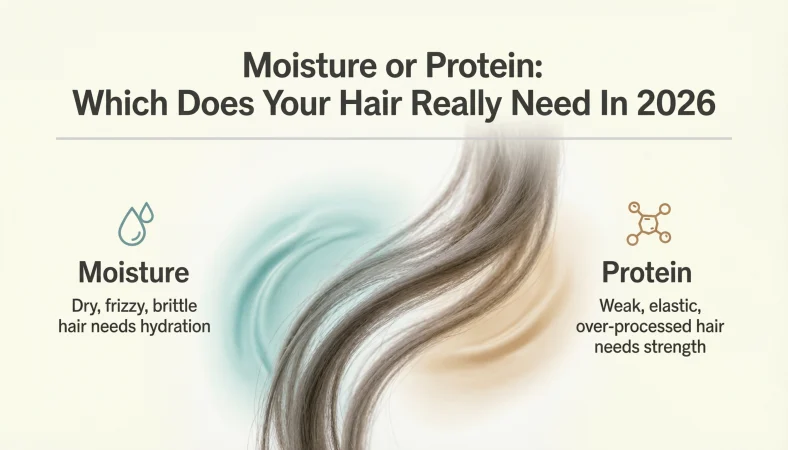
If your hair feels dry, frizzy, brittle, or lifeless, you’ve probably wondered: moisture or protein, which one does my hair actually need?
This is one of the most common hair care questions, especially among people dealing with damage from heat styling, coloring, bleaching, or environmental stress. The confusion exists because both moisture and protein treatments can improve hair health, but they solve very different problems.
Choosing the wrong treatment can sometimes make hair feel worse rather than better. That’s why understanding the difference between moisture and protein is essential for maintaining strong, healthy, and balanced hair.
In this guide, you’ll learn what moisture and protein do, how to tell which one your hair needs, the key differences between them, common mistakes people make, and practical tips for restoring hair balance.
Quick Answer Table
| Feature | Moisture | Protein |
| What It Does | Hydrates and softens hair | Strengthens and repairs hair structure |
| Best For | Dry, rough, frizzy hair | Weak, damaged, stretchy hair |
| Main Ingredients | Humectants, oils, aloe vera, glycerin | Keratin, collagen, amino acids, rice protein |
| Result | Softer, smoother hair | Stronger, more resilient hair |
| Common Sign of Need | Hair feels dry and dull | Hair feels mushy, limp, or overly elastic |
| Example | Deep conditioning mask | Protein treatment mask |
Quick Answer: If your hair is dry and rough, it likely needs moisture. If it stretches excessively, breaks easily, or feels weak, it may need protein.
Which One Is Correct?
Unlike common grammar comparisons where one word is correct and the other is incorrect, both moisture and protein are correct terms. However, they represent two completely different aspects of hair care.
The real question isn’t which word is correct, it’s which treatment is correct for your hair’s current condition.
Understanding the role of each helps you choose the right solution and avoid unnecessary damage.
Meaning of Moisture
Definition
Moisture refers to the water content and hydration level within the hair shaft.
Healthy hair requires adequate moisture to remain:
- Soft
- Flexible
- Smooth
- Manageable
- Less prone to breakage
Without enough moisture, hair becomes dehydrated and loses elasticity.
How Moisture Works
Hair naturally loses water through washing, weather exposure, heat styling, and chemical treatments.
Moisturizing products help replenish hydration using ingredients such as:
- Aloe vera
- Glycerin
- Honey
- Panthenol
- Shea butter
- Coconut oil
- Argan oil
These ingredients attract or lock in water, helping hair stay supple.
Signs Your Hair Needs Moisture
Your hair may need moisture if it:
- Feels rough or straw-like
- Appears dull
- Has excessive frizz
- Tangles easily
- Lacks softness
- Feels dry after washing
Real-World Example
Someone who frequently uses hot tools may notice that their hair becomes dry and difficult to manage. A moisturizing deep conditioner can help restore softness and flexibility.
Meaning of Protein
Definition
Protein in hair care refers to treatments that reinforce the hair’s structure using proteins or amino acids.
Hair is primarily made of a protein called keratin. When hair becomes damaged, some of its protein structure is weakened or lost.
Protein treatments help temporarily fill gaps and strengthen weakened strands.
How Protein Works
Protein treatments commonly contain:
- Keratin
- Silk protein
- Rice protein
- Wheat protein
- Hydrolyzed collagen
- Amino acids
These ingredients attach to damaged areas of the hair shaft, making hair stronger and more resilient.
Signs Your Hair Needs Protein
Your hair may need protein if it:
- Breaks easily
- Feels overly stretchy when wet
- Lacks structure
- Appears limp
- Feels mushy
- Has significant chemical damage
Real-World Example
Someone who frequently bleaches their hair may experience excessive elasticity and breakage. A protein treatment can help strengthen weakened strands.
Is Either One Incorrect?
No.
Neither moisture nor protein is an incorrect term.
However, a common misunderstanding is assuming that every hair problem can be solved with more moisture. In reality, some hair issues stem from structural weakness rather than dehydration.
Likewise, using protein treatments too frequently can make hair stiff and brittle if moisture is lacking.
The goal is balance.
Key Differences Between Moisture and Protein
| Factor | Moisture | Protein |
| Purpose | Hydration | Strength |
| Target Issue | Dryness | Damage |
| Hair Feel After Treatment | Soft and smooth | Strong and firm |
| Main Ingredients | Water-binding agents and oils | Amino acids and proteins |
| Frequency Needed | Often | Occasionally |
| Risk of Overuse | Hair may feel limp | Hair may become brittle |
| Best For | Dry hair | Damaged hair |
Moisture Focuses on Flexibility
Moisture improves:
- Softness
- Elasticity
- Manageability
- Shine
Protein Focuses on Structure
Protein improves:
- Strength
- Resistance to breakage
- Hair integrity
- Durability
Both are important components of healthy hair care.
Pronunciation Differences
Although these are not competing spellings, many people search for them together.
Moisture
Pronunciation: /MOYS-chur/
Protein
Pronunciation: /PRO-teen/
The two words have completely different meanings and sounds.
Common Mistakes People Make
1. Assuming Dry Hair Always Needs More Moisture
Sometimes damaged hair feels dry because the hair structure is compromised.
Adding endless moisture treatments may not solve the underlying weakness.
2. Overusing Protein Treatments
Too much protein can cause:
- Stiffness
- Rough texture
- Increased brittleness
Protein overload is a common issue among people trying to repair damaged hair too aggressively.
3. Ignoring Hair Elasticity
Elasticity is one of the best indicators of hair balance.
Hair that stretches excessively often needs protein.
Hair that snaps immediately may need moisture.
4. Following Generic Hair Advice
Every hair type is different.
Factors include:
- Texture
- Porosity
- Damage level
- Chemical processing
- Environmental exposure
What works for one person may not work for another.
5. Believing Hair Needs Only One Forever
Hair needs change over time.
Seasonal weather, styling habits, and chemical treatments can alter what your hair requires.
Correct Usage Examples
Casual Examples
- My curls feel dry, so they probably need more moisture.
- After bleaching, my hair benefited from a protein treatment.
- I alternate between moisture and protein masks.
Professional Examples
- The stylist recommended additional moisture to improve hair softness.
- Protein treatments can help strengthen chemically processed hair.
- Maintaining a balance between moisture and protein promotes healthier hair.
Educational Examples
- Moisture improves flexibility within the hair shaft.
- Protein helps reinforce damaged areas of the hair cuticle.
- Hair health often depends on balancing hydration and structural support.
Literary or Metaphorical Examples
- Moisture gives hair the softness of silk.
- Protein acts as the framework that keeps hair standing strong.
- Healthy hair thrives when moisture and protein work together in harmony.
Understanding the Moisture-Protein Balance
One of the most important concepts in hair care is the moisture-protein balance.
Think of hair like a building:
- Moisture provides flexibility.
- Protein provides structure.
Too much flexibility without structure causes weakness.
Too much structure without flexibility causes brittleness.
Healthy hair requires both.
Balanced Hair Typically Feels:
- Soft
- Strong
- Elastic
- Shiny
- Easy to manage
Unbalanced Hair May Feel:
| Condition | Possible Need |
| Dry and rough | Moisture |
| Mushy and stretchy | Protein |
| Brittle and stiff | Moisture |
| Weak and breaking | Protein |
| Healthy and resilient | Balanced |
Word Origin / Etymology
Moisture
The word moisture comes from:
- Old French moisteur
- Latin musteus
Historically, it referred to wetness, dampness, or the presence of water.
Protein
The word protein comes from:
- Greek proteios
- Meaning “primary” or “of first importance”
Scientists adopted the term in the 19th century to describe essential biological compounds.
These origins reflect their modern meanings well moisture relates to hydration, while protein relates to fundamental structure.
Why the Moisture vs Protein Debate Became Popular
The rise of natural hair care communities, curly hair education, and social media has made the moisture-protein discussion increasingly popular.
Several factors contributed:
- Increased awareness of hair health
- Growth of curly hair communities
- Popularity of deep conditioning treatments
- Expansion of protein-based repair products
- Education about hair porosity
Many people discovered that traditional hair routines were not addressing their specific hair needs.
As a result, understanding whether hair needs moisture or protein became a central part of modern hair care.
Easy Memory Tricks
Remember these simple associations:
Moisture = Softness
Think:
Moisture = Hydration = Soft Hair
If hair feels dry, moisture is often the first thing to evaluate.
Protein = Strength
Think:
Protein = Structure = Strong Hair
If hair feels weak or stretchy, protein may help.
Simple Rule
Dry = Moisture
Weak = Protein
While not perfect in every situation, this rule helps beginners make better decisions.
How to Determine What Your Hair Needs
A simple strand test can provide clues.
Hair Likely Needs Moisture If:
- It snaps quickly.
- It feels rough.
- It lacks softness.
- It tangles frequently.
Hair Likely Needs Protein If:
- It stretches excessively.
- It feels gummy when wet.
- It lacks strength.
- It breaks after stretching.
Hair Likely Needs Balance If:
- It stretches slightly before returning to shape.
- It feels soft but strong.
- It experiences minimal breakage.
Monitoring your hair regularly can help you adjust treatments as needed.
FAQs
Is moisture better than protein for hair?
Neither is universally better. Moisture hydrates hair, while protein strengthens it. The best choice depends on your hair’s condition.
How do I know if my hair needs moisture or protein?
Dry, rough hair often needs moisture. Weak, stretchy, or overly damaged hair may need protein.
Can hair have too much protein?
Yes. Excessive protein can make hair stiff, brittle, and prone to breakage.
Can hair have too much moisture?
Yes. Over-moisturized hair can become limp, mushy, and overly elastic.
What is protein overload?
Protein overload occurs when hair receives more protein than it can effectively balance with moisture, resulting in stiffness and brittleness.
How often should I use protein treatments?
It depends on hair damage levels. Many people use protein treatments every few weeks rather than every wash day.
Is moisture important for all hair types?
Yes. Straight, wavy, curly, and coily hair all require adequate hydration to remain healthy.
Do curly hair types need more moisture?
Curly and coily hair often benefit from additional moisture because natural scalp oils have a harder time traveling down the hair shaft.
Can I use moisture and protein together?
Yes. Many balanced hair care routines incorporate both moisture and protein treatments.
What is the ideal moisture-protein balance?
The ideal balance varies by hair type and condition, but healthy hair generally feels both soft and strong.
Conclusion
When it comes to moisture or protein, neither is inherently better than the other. They serve different but equally important roles in maintaining healthy hair.
Moisture keeps hair hydrated, flexible, and soft, while protein strengthens the hair structure and helps reduce damage. The key is learning what your hair is telling you.
If your hair feels dry, rough, or frizzy, focus on moisture. If it feels weak, stretchy, or prone to breakage, consider protein. Most importantly, aim for a healthy moisture-protein balance rather than relying too heavily on either one.
The best hair care routine isn’t about choosing moisture or protein forever it’s about giving your hair what it needs at the right time.