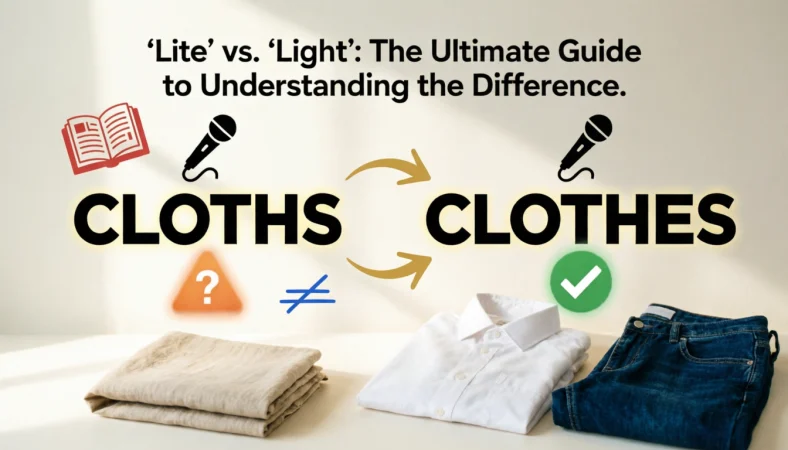
Quick Ans: Clothes are the items you wear (shirts, pants, dresses, etc.). Example: I bought new clothes. Cloths are the pieces of fabric or material, usually used for cleaning or making things. Example: The table was cleaned with soft cloths.
Cloths or Clothes is a common English confusion because these two words look almost identical but have different meanings. Clothes refers to the things people wear, such as shirts, trousers, dresses, and jackets. It is the most common word used when talking about personal clothing.
Cloths, on the other hand, is the plural form of cloth and refers to pieces of fabric or material. It is often used for cleaning, covering, or making items. Understanding the difference between cloths and clothes helps you use the right word and avoid common spelling mistakes
Quick Answer Table
| Feature | Clothes | Cloths |
| Spelling | C L O T H E S | C L O T H S |
| Correct Usage | Always correct for garments | Correct for fabric pieces |
| Primary Meaning | Items worn on the body | Pieces of fabric or material |
| Pronunciation | “klohz” (rhymes with “nose”) | “klawths” (rhymes with “moths”) |
| Example | “I bought new clothes for summer.” | “She wiped the table with cloths.” |
| Plural Form | Always plural | Always plural |
| Singular Form | “Garment” or “item of clothing” | “Cloth” |
| Common Use | Daily conversation about apparel | Cleaning, crafting, specific fabrics |
Which One Is Correct?
The answer is simple: both are correct, but they mean different things. Neither word is incorrect or a typo. However, using one when you mean the other changes your sentence’s meaning entirely.
“Clothes” refers to garments and apparel that people wear. Think shirts, pants, dresses, and jackets. This is the word you will use most frequently in daily conversation.
“Cloths” refers to pieces of fabric or material. Think cleaning rags, polishing cloths, or crafting materials. This word appears less often but remains essential for specific contexts.
The confusion arises because both words share similar spellings and both relate to fabric. Adding to the challenge, the pronunciation differs subtly, making it easy to mix them up in speech.
Meaning of Clothes
Definition
Clothes are items worn to cover the body. This encompasses everything from everyday attire to specialized garments. The term includes all types of apparel regardless of fabric, style, or purpose.
Detailed Explanation
When you say “clothes,” you are referring to wearable items. This covers an enormous range of garments including formal wear, casual outfits, sportswear, sleepwear, and accessories like scarves and gloves. The word functions only as a plural noun in standard English usage.
The term “clothes” encompasses any covering worn on the human body. Whether you are discussing fashion, practicality, or cultural traditions, clothes remain central to human life across all societies.
Usage in Different Contexts
Everyday Conversation:
“I need to do my clothes shopping this weekend.”
“These clothes are too warm for summer.”
“Where did you buy those clothes?”
Professional Context:
“Employee uniforms must be clothes suitable for the workplace.”
“The fashion designer showcased her new clothes collection.”
“Our retail store sells sustainable clothes made from organic materials.”
Educational Context:
“Students learn about different types of clothes in home economics.”
“The history class discussed how clothes reflected social status.”
“Her project examined clothes manufacturing across various cultures.”
Literary and Metaphorical Usage:
“His clothes marked him as a man of wealth and influence.”
“The words draped over the page like expensive clothes on a queen.”
“She shed her old identity like worn out clothes.”
Common Collocations with Clothes
- Clothes shopping
- Clothes closet
- Clothes hanger
- Clothes line
- Clothes dryer
- Casual clothes
- Formal clothes
- Work clothes
- Brand new clothes
- Designer clothes
- Second hand clothes
- Maternity clothes
- Outdoor clothes
- Party clothes
Semantic Variations
The word “clothes” appears in many idiomatic expressions and compound nouns. Native speakers use variations like “work clothes” for professional attire, “playing clothes” for casual wear, and “Sunday best” for formal outfits.
Meaning of Cloths
Definition
Cloths are pieces of fabric or textile material, typically used for cleaning, wiping, polishing, or in specific manufacturing processes. The word represents a countable noun that refers to individual pieces of material.
Detailed Explanation
Unlike clothes, cloths do not refer to wearable items. They are simply pieces of fabric that serve various practical purposes. You might use cloths for household cleaning, industrial applications, or crafting projects.
Each piece of fabric qualifies as a cloth. Multiple pieces become cloths. The singular form is “cloth,” while “cloths” represents the plural. This grammatical distinction helps clarify usage.
Usage in Different Contexts
Everyday Household:
“She grabbed several cloths from the drawer to clean the kitchen.”
“Keep separate cloths for different surfaces to prevent cross contamination.”
“I need new cloths for dusting the furniture.”
Professional Cleaning:
“Commercial cleaning services use color coded cloths for hygiene purposes.”
“The janitor used microfiber cloths to polish the glass surfaces.”
“Industrial facilities require heavy duty cloths for machinery maintenance.”
Crafting and Sewing:
“The quilter prepared various cloths for her latest project.”
“Artists often experiment with different cloths for texture painting.”
“The workshop provided cloths for practicing embroidery techniques.”
Medical and Hygiene Contexts:
“Hospitals use sterile cloths for wound care.”
“Healthcare professionals follow strict protocols for handling contaminated cloths.”
“Disposable cloths help prevent infection spread.”
Common Collocations with Cloths
- Cleaning cloths
- Microfiber cloths
- Dusting cloths
- Polishing cloths
- Disposable cloths
- Bleach cloths
- Cotton cloths
- Linen cloths
- Terry cloths
- Damp cloths
- Dry cloths
- Reusable cloths
- Industrial cloths
- Surgical cloths
Semantic Variations
Different types of cloths serve specialized purposes. “Microfiber cloths” excel at attracting dust particles. “Surgical cloths” maintain sterility in medical settings. “Polishing cloths” produce shine on metal surfaces. The specific type determines the exact application.
Key Differences Between Clothes and Cloths
Spelling
The difference lies in the letter “e.” Clothes contains “c l o t h e s” with an ‘e’ before the ‘s.’ Cloths contains “c l o t h s” without the extra ‘e.’ This single letter changes the pronunciation and meaning completely.
Meaning
Clothes refer to wearable garments. Cloths refer to pieces of fabric. This meaning difference represents the most important distinction between the two words.
Pronunciation
Clothes sounds like “klohz” with a long ‘o’ sound, similar to “nose.” Cloths sounds like “klawths” with a short ‘o’ and a ‘th’ sound, similar to “moths.” The spoken difference remains subtle but important.
Grammar
Clothes functions only as a plural noun. It does not have a singular form in standard usage. Cloths serves as the plural of “cloth.” Both words are always plural, but their grammatical behavior differs slightly.
Usage Frequency
Clothes appears much more frequently in daily conversation. Most native speakers use this word several times per week. Cloths appears less often and in more specific contexts. This frequency difference explains why “clothes” often receives more attention in language learning.
Recognition and Acceptance
Both words are fully recognized in standard English. Neither represents slang, regional variation, or informal usage. You can use both with complete confidence in any context.
Part of Speech
Both words function as plural nouns. However, “clothes” has no singular equivalent, while “cloths” has the singular form “cloth.” This grammatical distinction affects how you use each word.
Cultural Associations
Clothes carry strong cultural, social, and fashion implications. Cloths relate more to practicality, utility, and domestic tasks. This cultural association influences how and when speakers use each term.
Common Mistakes People Make
Confusing Meaning
The most common mistake occurs when people use “cloths” when they mean “clothes.” This error happens frequently when discussing what to wear.
Incorrect: “I need to pack my cloths for vacation.”
Correct: “I need to pack my clothes for vacation.”
Pronunciation Errors
Many language learners pronounce “clothes” as “cloth es” instead of “klohz.” This common mistake makes the word sound awkward and unnatural. The correct pronunciation flows more smoothly.
Spelling Mistakes
The confusion between these homophones creates frequent spelling errors. Writers often omit the ‘e’ in “clothes” or insert an extra ‘e’ in “cloths.” Careful proofreading helps catch these mistakes.
Plural Confusion
Some speakers incorrectly believe “clothes” has a singular form like “cloth” or “clothe.” Actually, “clothes” only appears in plural form. To refer to a single item, use “garment” or “piece of clothing.”
Incorrect: “I need to wash this cloth.” (when meaning a shirt)
Correct: “I need to wash this garment.”
Context Errors
Using the wrong word in professional or formal writing undermines credibility. A resume or business proposal containing this error may create a negative impression. This makes accuracy particularly important in formal contexts.
Overcorrection
Sometimes speakers who know about the difference overcorrect. They might avoid “cloths” entirely, even when it would be appropriate. Remember that both words have valid uses.
Correct Usage Examples
Casual Examples
“I threw my dirty clothes in the washing machine.”
“Do you like my new clothes?”
“We need to buy summer clothes for the children.”
“Her closet overflowed with clothes.”
“His clothes always look freshly pressed.”
“I love shopping for casual clothes.”
“These clothes make me feel confident.”
Professional Examples
“The employee handbook specifies appropriate professional clothes.”
“Our company provides safety clothes for hazardous environments.”
“The fashion buyer selects seasonal clothes for the retail chain.”
“Work clothes must meet OSHA standards in this industry.”
“She updated her interview clothes for the job search.”
“The corporate dress code outlines professional clothes requirements.”
“Sales representatives wear branded clothes at conferences.”
Educational Examples
“The economics class studied global clothes manufacturing.”
“The fashion program teaches clothes design and construction.”
“History students examined how Victorian clothes reflected social hierarchy.”
“The seminar covered sustainable practices in clothes production.”
“Textiles courses differentiate between clothes and cloths.”
“Cultural studies explore traditional clothes around the world.”
“The workshop teaches clothes repair and alteration techniques.”
Cleaning and Practical Examples
“I use microfiber cloths for dusting the shelves.”
“Color coded cloths prevent cross contamination.”
“Keep separate cloths for kitchen and bathroom cleaning.”
“The car detailer uses specialized polishing cloths.”
“Disinfecting cloths make surface cleaning easier.”
“Use damp cloths for wiping countertops.”
“He uses old cloths as rags for messy jobs.”
Crafting and Artistic Examples
“Artists use various cloths for applying oil paints.”
“The pottery studio provides cloths for hand building techniques.”
“Sewing enthusiasts keep multiple cloths for different projects.”
“Creativity often begins with simple cloths and imagination.”
“The workshop supplied cloths for practicing fabric manipulation.”
“Different cloths create different artistic textures.”
Metaphorical Examples
“Her words draped over him like expensive clothes.”
“The country shed its colonial clothes for new identity.”
“His success felt like comfortable clothes on the soul.”
“Truth wears many different clothes in literature.”
“Kindness fits like well worn clothes on the heart.”
Word Origin and Etymology
Understanding the etymology helps clarify why these words look and sound similar. Both words ultimately trace back to Old English and Proto Germanic roots.
Clothes Etymology
“Clothes” comes from the Old English word “clāþas,” which represents the plural of “clāþ” meaning cloth. Over time, the plural form developed a distinct meaning, referring specifically to garments rather than material.
The word evolved through Middle English as “clothes” and “cloþes” before settling into its modern form. The pronunciation shifted gradually, losing the middle vowel sound to become “klohz.”
Cloths Etymology
“Cloths” represents the plural of “cloth,” which comes from Old English “clāþ.” The word has Germanic origins, related to Dutch “kleed” and German “Kleid.”
Interestingly, both “cloth” and “clothes” come from the same root. They represent different grammatical forms that developed separate meanings over centuries of use.
Evolution of Meaning
Originally, “cloth” referred to any woven fabric. The plural “cloths” meant multiple pieces of fabric. Over time, people began using “clothes” specifically for garments. This specialization of meaning emerged gradually through historical usage.
The distinction became clearer during the Middle English period. By the time of Shakespeare, the modern meanings were well established. Today, the difference remains firmly fixed in English grammar.
Why the Confusion Between Cloths and Clothes Happens
Historical Language Evolution
These words share a common ancestor. Their meanings drifted apart naturally over centuries. This historical connection creates confusion for modern speakers who encounter both terms.
The pronunciation shift in “clothes” added to the confusion. Losing the middle vowel sound made it sound different from “cloths,” but the spelling remains close enough to cause mistakes.
Visual Similarity
The words look extremely similar, especially in quick reading. The extra ‘e’ becomes easy to overlook. This visual similarity causes errors even among experienced writers.
Limited Exposure
Many people rarely see “cloths” in writing. Most encounter only “clothes” in daily reading. Limited exposure makes correct spelling of “cloths” more difficult.
Pronunciation Similarity
The sounds are very close, particularly in rapid speech. The ‘th’ sound in both words adds to the confusion. This closeness leads to mixing them up when speaking quickly.
Internet Influence
Social media and casual online writing often contain spelling errors. Seeing the wrong usage reinforces mistakes. The internet’s informal nature normalizes errors that would not appear in formal writing.
Easy Memory Tricks to Remember the Difference
The “E” Technique
Remember that clothes has an ‘e’ because they are what everyone wears. Cloths does not have the ‘e’ because cloths are used for cleaning, which contains no ‘e.’ This simple association helps recall the correct spelling.
Garment vs Fabric
Clothes = garments you wear. Cloths = fabric pieces you use. Associate clothes with your body and cloths with your hands.
Pronunciation Tip
Clothes sounds like “nose” (with a ‘z’ sound). Cloths sounds like “moths” (with a ‘th’ sound). Remember that clothes rhymes with nose, and both are things on or near the body.
Context Association
Think of clothes being in your closet. Both “clothes” and “closet” start with ‘c l o.’ Cloths being in the cleaning cabinet. Both start with ‘c l o t h’ but the ‘e’ makes the difference.
Plurality Trick
Clothes has no singular form. Cloths is the plural of cloth. If you can take away the ‘s’ and have a word, it is cloths. If taking away the ‘s’ creates nonsense, it is clothes.
Visual Cue
Imagine the ‘e’ in clothes as someone wearing a shirt. The ‘e’ is the person inside the clothes. No ‘e’ means no person, just a plain cloth.
FAQs
Is “clothes” singular or plural?
Clothes is always plural. Use piece of clothing for one item.
What is the singular of “clothes”?
There is no singular form. Use garment or item of clothing.
What is the singular of “cloths”?
The singular is cloth (one piece of fabric).
Can I use “cloths” for clothing?
No, use clothes for things you wear.
Why do people confuse these words?
They look and sound similar, which causes confusion.
Are “cloths” and “clothes” pronounced differently?
Yes, clothes sounds like klohz, while cloths has a clearer th sound.
Is “clothes” correct for fabric?
No, use cloths for fabric pieces.
How do I remember the difference?
Things you wear = clothes; fabric pieces = cloths.
What about “clothing” vs “clothes”?
Both mean garments, but clothing can be uncountable while clothes is plural.
Do other languages have similar confusions?
Yes, many languages have similar confusing word pairs
Conclusion
The difference between cloths and clothes is simple once you remember their meanings. Clothes refers to items people wear, while cloths refers to pieces of fabric used for cleaning, covering, or other purposes. Using the correct word makes your writing clearer and more accurate.
A helpful way to remember it is: clothes are worn on your body, and cloths are used around your home or workspace. With this small distinction in mind, you can confidently choose the right word and avoid a common English mistake.