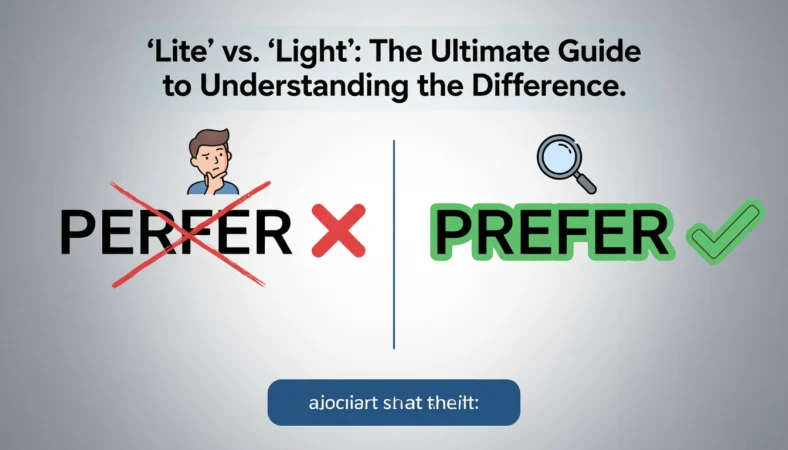
Quick Answer: Prefer is the correct spelling and is the only accepted English word. Perfer is a common misspelling and should not be used in formal or informal writing.
Example: I prefer tea over coffee
Perfer or Prefer is a common spelling confusion in English because the two words look very similar. However, the correct spelling is prefer. The word prefer means to like one thing more than another or to choose something as a better option. Perfer is a common spelling mistake and is not accepted in standard English.
Understanding the difference between prefer and perfer helps you avoid a frequent writing error. The correct form prefer is used in everyday conversations, academic writing, and professional communication. Learning this simple spelling distinction improves accuracy and makes your English clearer.
Quick Answer Table
Here’s a quick reference to help you understand the correct spelling and usage:
| Aspect | Correct Usage | InCorrect Usage |
| Spelling | Prefer | Perfer |
| Meaning | To like one thing more than another; to choose or favor something | None (this is a misspelling) |
| Pronunciation | /prɪˈfɜːr/ (pri FUR) | /pərˈfɜːr/ (per FUR) common mispronunciation |
| Example Sentence | “I prefer coffee over tea in the morning.” | “I perfer coffee over tea.” ❌ |
| Grammatical Role | Verb (transitive) | Not a standard English word |
| Recognition | Recognized in all English dictionaries | Not recognized in standard dictionaries |
Which One Is Correct?
The answer is straightforward: prefer is the only correct spelling. “Perfer” is a common misspelling that has no place in standard English writing.
The confusion between “perfer or prefer” stems from the pronunciation pattern of many English words. When we speak quickly, the first syllable of “prefer” can sound like “per” rather than “pre.” This auditory ambiguity leads many to spell it the way they hear it. However, in written English, “prefer” has been the standard spelling for centuries.
If you’re ever unsure, remember this simple rule: the “pre” in “prefer” means “before” in Latin, indicating priority or favor. When you prefer something, you’re placing it before others in your estimation. The spelling reflects this etymology.
Meaning of the Correct Word: Prefer
The word “prefer” is a transitive verb that carries several related meanings:
Primary Definition
To like, choose, or favor one thing, person, or option more than another. When you prefer something, you’re expressing a comparative preference based on your tastes, values, or needs.
Usage Contexts
Everyday Preferences
“I prefer tea to coffee.” This simple sentence communicates your beverage choice when given options. Perhaps you enjoy the subtle flavors of tea more than the boldness of coffee.
Professional Contexts
“The committee prefers candidates with at least five years of experience.” Here, “prefer” indicates a strong inclination or requirement in a hiring context.
Social Situations
“Would you prefer to meet for lunch or dinner?” This question seeks your preference to accommodate your schedule or comfort.
Legal and Formal Uses
“The court prefers documented evidence over verbal testimony.” In this context, “prefer” indicates what carries more weight or authority.
Real World Examples
Casual Conversation
“I prefer watching movies at home rather than going to the theater. The popcorn is cheaper, and I can pause when I need a break.”
Professional Email
“Dear Team, I prefer we schedule our weekly meeting on Wednesdays to avoid conflicts with other departmental meetings.”
Academic Writing
“Researchers often prefer quantitative methodologies when studying large populations, as they provide statistically significant results.”
Literary Usage
“As the poet wrote, ‘I prefer winter to summer, for the stillness of snow brings peace to my restless mind.'”
Meaning of the Incorrect Word: Perfer
“Perfer” is not a standard English word. It doesn’t appear in authoritative dictionaries like the Oxford English Dictionary or Merriam Webster. When people write “perfer,” they’re almost always making a spelling error for “prefer.”
Why “Perfer” Is Incorrect
Spelling Error
The most common explanation is simple misspelling. Many people hear the word pronounced and spell it phonetically as “perfer.”
Autocorrect Issues
Sometimes, autocorrect or predictive text might suggest “perfer” if you frequently type it incorrectly. This can reinforce the error.
Lack of Exposure
Non native English speakers or those with limited reading exposure might not have seen “prefer” spelled correctly enough times to internalize the spelling.
Rare Exceptions
Is “perfer” ever correct? Outside of being a typo or a deliberate misspelling in creative works, “perfer” has no legitimate usage in standard English. Some might argue it appears as a surname, but this is irrelevant to the word’s standard usage as a verb.
Key Differences Between the Two Words
Understanding the differences between “perfer” and “prefer” goes beyond simple spelling. Let’s examine the distinctions:
Spelling Differences
The primary difference is the second letter: “e” versus “r.” The correct spelling “prefer” starts with “pre,” while the incorrect version starts with “per.”
Correct: P R E F E R
Incorrect: P E R F E R
This tiny difference in spelling leads to completely different recognition in dictionaries and writing software.
Pronunciation Differences
While the correct pronunciation is /prɪˈfɜːr/ (pri FUR), many people mispronounce “prefer” as “perfer,” which sounds like /pərˈfɜːr/. This mispronunciation likely contributes to the spelling confusion.
Proper pronunciation:
- First syllable: “pre” pronounced like “pri” (rhymes with “sigh”)
- Second syllable: “fer” pronounced like “fur”
Common mispronunciation:
- First syllable: “per” pronounced like “purr”
- Second syllable: “fer” pronounced like “fur”
Grammatical Differences
“Prefer” functions as a regular verb with standard conjugations:
- Present: prefer / prefers
- Past: preferred
- Present participle: preferring
- Past participle: preferred
“Perfer” doesn’t function grammatically because it’s not a recognized word. It has no conjugations and serves no grammatical purpose.
Usage Differences
“Prefer” appears in countless contexts, from everyday conversation to formal writing. You’ll find it in:
Dictionaries: Every major dictionary includes “prefer.”
Academic Writing: Scholars use “prefer” in research papers.
Business Communication: Professionals use “prefer” in emails and reports.
Literature: Authors use “prefer” in novels and poetry.
“Perfer” appears only as an error in student essays, quick texts, and social media posts.
Recognition Differences
“Prefer” is recognized by:
- All English spellcheckers
- All grammar checkers
- All standard dictionaries
- All educational institutions
“Perfer” is flagged by:
- Most spellcheckers as an error
- Grammar checkers as a misspelling
- Dictionaries as non existent
- Teachers and editors as an error
Common Mistakes People Make
Understanding the “perfer or prefer” confusion requires examining why this error persists and how people typically make it.
Mistake 1: Phonetic Spelling
The most common mistake is spelling based on how the word sounds rather than how it’s spelled. When speaking, many people pronounce “prefer” in a way that sounds like “perfer.” This leads to the written error.
Example of the Mistake:
“I perfer the blue shirt over the red one.” ❌
Correct:
“I prefer the blue shirt over the red one.” ✅
Mistake 2: Typing Errors
Sometimes, the error is a simple slip of the fingers. When typing quickly, you might accidentally type “perfer” instead of “prefer.” This is especially common on smartphones.
Example of the Mistake:
“Can you tell me which option you perfer?” ❌
Correct:
“Can you tell me which option you prefer?” ✅
Mistake 3: Overcorrection
Occasionally, writers overthink the spelling. They might know that “prefer” starts with “pre” but second guess themselves and change it to “perfer.”
Example of the Mistake:
“I think I would perfer the earlier time slot.” ❌
Correct:
“I think I would prefer the earlier time slot.” ✅
Mistake 4: Confusion with Similar Words
Some people confuse “prefer” with words that genuinely start with “per,” like “perhaps,” “perform,” or “permanent.” This mental association leads to the spelling error.
Example of the Mistake:
“She might perfer to stay home tonight.” ❌
Correct:
“She might prefer to stay home tonight.” ✅
Correct Usage Examples
Let’s explore how to use “prefer” correctly in various contexts. These examples will help you internalize the proper usage.
Casual Examples
In everyday conversations, “prefer” expresses simple choices:
- “I prefer sweet tea over unsweetened tea.”
- “Do you prefer going out for dinner, or staying in?”
- “Personally, I prefer the beach over the mountains.”
- “My cat prefers her food at room temperature.”
- “I prefer jeans to dress pants for casual Fridays.”
Professional Examples
In workplace communication, “prefer” conveys choices in a polite, professional manner:
- “For this project, I prefer we use the new software platform.”
- “Our clients generally prefer to communicate via email.”
- “The marketing team prefers Monday mornings for strategy sessions.”
- “Many employers prefer candidates with bilingual skills.”
- “I prefer to schedule meetings at least a week in advance.”
Academic and Educational Examples
In academic settings, “prefer” expresses scholarly choices and research findings:
- “Students often prefer studying in quiet environments.”
- “The data suggests that consumers prefer sustainable packaging.”
- “Researchers prefer randomized controlled trials for medical studies.”
- “Many professors prefer open book examinations for upper level courses.”
- “Academic journals prefer submissions that follow the APA style guide.”
Literary and Metaphorical Examples
In creative writing, “prefer” adds depth and nuance:
- “The protagonist preferred the solitude of the countryside over the chaos of the city.”
- “She preferred books to people, finding her most meaningful conversations in the pages of novels.”
- “History, it seems, prefers irony over simplicity.”
- “The artist preferred muted colors, believing they better captured the mood of melancholy.”
- “In matters of the heart, he preferred honesty over flattery.”
Comparative Examples with “To” and “Than”
When using “prefer,” you have two common comparative structures:
- “I prefer coffee to tea.” (Noun to noun comparison)
- “I prefer to drive rather than take public transportation.” (Verb to verb comparison)
- “Most people prefer comfort over style when choosing furniture.” (Alternative structure)
Sentence Structure Patterns
“Prefer” follows several patterns:
Prefer + Noun
“I prefer tea.”
“You prefer summer.”
“The chef prefers local ingredients.”
Prefer + Gerund ( ing verb)
“She prefers swimming to running.”
“They prefer studying at the library.”
Prefer + To + Infinitive
“He prefers to work from home.”
“I prefer to arrive early.”
Prefer + Object + Complement
“I prefer my coffee black.”
“She prefers spicy food.”
Prefer That Clause
“The manager prefers that employees arrive on time.”
“I prefer that we meet in person.”
Word Origin / Etymology
Understanding where “prefer” comes from helps solidify its correct spelling in your mind.
Latin Roots
The word “prefer” traces back to the Latin verb “praeferre,” which breaks down into two parts:
- “Prae” meaning “before” or “in front”
- “Ferre” meaning “to carry” or “to bear”
Combined, “praeferre” meant “to carry before,” “to set before,” or “to place in front.” This physical meaning evolved into the metaphorical sense of placing something before others in terms of preference or importance.
Historical Development
14th Century Usage
“Prefer” entered Middle English from Old French “preferer,” which derived from the Latin “praeferre.” During this period, the word meant “to promote” or “to put forward.”
15th 16th Century Evolution
By the Renaissance, “prefer” had broadened its meaning to include “to favor,” “to choose,” and “to like better.” This period saw the word used in religious, political, and literary contexts.
Modern Usage
Today, “prefer” maintains these meanings while also serving as a polite way to express choices and inclinations. Its Latin roots remain visible in the spelling “prefer,” which preserves the “pre” prefix indicating priority.
Related Words
“Prefer” shares its etymology with several English words:
Preference (noun) A greater liking for one alternative over another
Preferential (adjective) Giving or showing preference
Preferably (adverb) Ideally, by preference
Preferment (noun) Advancement or promotion
All these words retain the “pre” spelling, reinforcing the correct pattern.
Why the Incorrect Version Became Popular
The “perfer” misspelling has become increasingly common, and understanding why helps you avoid it.
Phonetic Influence
The primary reason for the “perfer or prefer” confusion is phonetics. In rapid speech, the first vowel sound in “prefer” often reduces to a schwa sound (the “uh” sound) that resembles the “e” in “per.” This is particularly true in American English, where unstressed vowels often become neutral.
When hearing “prefer” pronounced quickly, the “pre” prefix sounds remarkably similar to “pur” or “per.” This auditory ambiguity leads to the written error.
Internet and Social Media Influence
The rise of social media and texting has contributed to “perfer’s” prevalence:
Autocorrect Failure
Many smartphone keyboards learn users’ spelling habits. If you type “perfer” often enough, your phone stops correcting it, perpetuating the error.
Informal Communication
Text messages, social media posts, and informal emails prioritize speed over accuracy. In these contexts, “perfer” appears more frequently, normalizing the error.
Content Creation
Even some content creators and bloggers have published articles containing “perfer,” inadvertently spreading the misspelling.
Second Language Learning Challenges
English learners face unique challenges with “perfer or prefer”:
Inconsistent Pronunciation Rules
English spelling and pronunciation don’t always match, and “prefer” is a prime example.
Direct Translation
Some languages have cognates that resemble “perfer,” leading learners to apply their native language’s pattern to English.
Educational Gaps
Not all ESL programs address common spelling errors, leaving students unaware of their mistakes.
Easy Memory Tricks
Never confuse “perfer or prefer” again with these memorable strategies:
Trick 1: The “Before” Memory Aid
Remember that “prefer” comes from Latin “praeferre,” meaning “to place before.” The “pre” in “prefer” means “before.” Since “before” starts with “pre,” so does “prefer.”
Trick 2: The “Fer” Association
Think of “prefer” as “pre” + “fer.” The “fer” part comes from Latin “ferre” meaning “to carry.” So you’re “carrying something before” others. This helps maintain the “pre” spelling.
Trick 3: Related Words Memory
Associate “prefer” with its related words that all share the “pre” spelling:
- Preference
- Preferential
- Preferably
If you know how to spell these words, you’ll remember “prefer.”
Trick 4: Visual Association
Visualize “prefer” as “pre” + “fer.” Imagine “pre” as “before,” so the word literally means “to put before.” Every time you write it, think, “I’m putting this preference before the other option.”
Trick 5: Pronunciation Practice
Practice pronouncing “prefer” clearly as “pri FUR,” stressing the first syllable like “pri” (rhyming with “sigh”). This reinforces the “pre” spelling in your mind.
Trick 6: The “Purr” Trap
Remember that “per” sounds like “purr” (as in a cat’s purr). You’re not writing about a cat, so don’t write “perfer.” The correct spelling is “prefer.
FAQs
1. Which is correct, perfer or prefer?
Prefer is correct. Perfer is a common misspelling.
2. Why do people spell it as perfer?
Because the pronunciation can sound like perfer, causing spelling confusion.
3. Is perfer a dictionary word?
No, perfer is not accepted in standard English dictionaries.
4. Does perfer have any correct usage?
No, it is only an error or informal typo.
5. How can I remember prefer spelling?
Remember prefer starts with pre, not per.
6. What are synonyms of prefer?
Synonyms include choose, favor, select, and opt for.
7. How do you use prefer in a sentence?
Example: I prefer tea to coffee.
8. Is it prefer to or prefer than?
Use prefer to, not prefer than.
9. Can prefer be used in formal writing?
Yes, prefer is suitable for professional and academic writing.
10. Is prefer a regular verb?
Yes, its forms are prefer, prefers, preferred, preferring.
Conclusion
The difference between “perfer” and “prefer” is simple: “prefer” is the only correct spelling, while “perfer” is a common spelling mistake. The word prefer is used to express a choice, liking, or greater preference for one thing over another.
Although perfer may appear because of pronunciation confusion, it has no accepted meaning in standard English. Using prefer correctly in your writing shows accuracy and a strong understanding of English spelling rules.