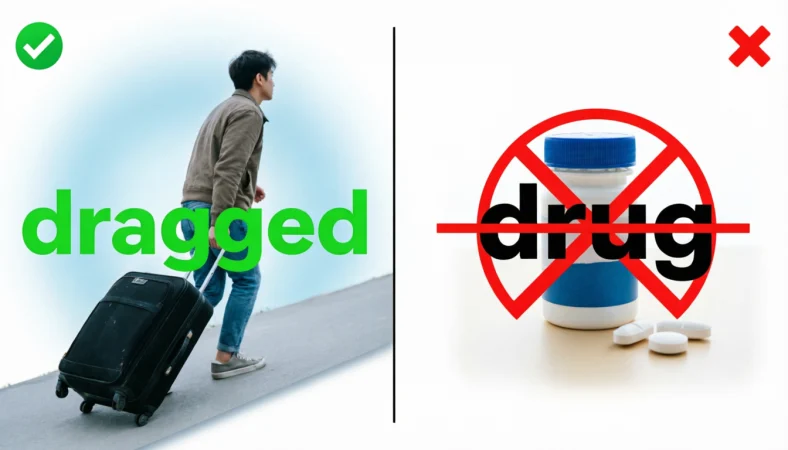
Quick answer: Dragged and drug both can be correct, but they are used differently
Dragged is the standard past tense of drag (to pull something), while drug is a nonstandard/informal past form in some dialects and should usually be avoided in formal English.Example: I dragged the bag across the floor
Have you ever found yourself unsure whether to say “dragged” or “drug”? You’re not alone. This common grammar dilemma trips up native English speakers and language learners alike, largely because regional dialects and everyday speech patterns often blur the lines between correct and incorrect usage.
The difference between dragged and drug stems from a fascinating intersection of grammar rules, regional dialects, and evolving language patterns. While these two words might sound similar in casual conversation, they serve entirely different purposes in the English language, and using them incorrectly can undermine your credibility in professional or academic writing.
In this comprehensive guide, I’ll break down everything you need to know about the dragged or drug debate. You’ll learn which word is grammatically correct, why the confusion exists, and how to confidently choose the right word every time. Whether you’re writing a professional email, crafting a blog post, or simply want to improve your grammar skills, this article will give you the clarity you need.
By the end of this guide, you’ll never second guess yourself when deciding between dragged and drug again.
Quick Answer
| Feature | Dragged | Drug |
| Correct Spelling | Yes | Sometimes (regional slang) |
| Word Type | Past tense of “drag” | Noun (medication) / Slang verb |
| Meaning | Pulled with effort or force | A substance used as medicine / Pulled (slang) |
| Usage | Standard English | Informal, dialectal, or nonstandard |
| Example Sentence | She dragged the suitcase upstairs. | She drug the suitcase upstairs. (Nonstandard) |
Which One Is Correct?
The short answer is that dragged is the grammatically correct past tense and past participle form of the verb drag in Standard English. On the other hand, drug is considered a dialectal variation or nonstandard usage when used as a verb meaning “to pull.
However, things aren’t quite that simple. The word drug does have legitimate uses in English, primarily as a noun referring to medicinal substances or illegal substances. When used as a verb, drug appears frequently in certain regional dialects, particularly in the Southern United States and parts of the Midwest, but it’s not accepted in formal writing or Standard English.
The dragged or drug question primarily arises when people are describing the act of pulling something with effort. In these situations, the correct choice is almost always dragged.
Think of it this way: if you’re writing a school paper, a business report, or any document that requires proper grammar, always choose dragged. If you’re writing dialogue for a character from a region where drug is common in everyday speech, you might use drug to add authenticity to their voice. But even then, it’s important to understand that you’re using nonstandard dialect, not Standard English.
Meaning of Dragged
Definition
Dragged is the past tense and past participle form of the regular verb drag. In Standard English, it means to pull something along the ground or another surface with effort, often with resistance or difficulty. It can also be used metaphorically to describe situations, feelings, or actions that feel heavy, prolonged, or burdensome.
Complete Breakdown of Dragged
As a regular verb, drag follows the standard English pattern of adding ” ed” to form its past tense and past participle. This is why dragged is the grammatically correct choice in formal contexts.
The verb drag has several core meanings:
- Physically pulling something across a surface
- Moving someone or something with effort
- Causing something to move slowly or with difficulty
- Continuing for an unnecessarily long time (metaphorical)
- Mentioning or introducing something irrelevant or unrelated
Usage of Dragged
Dragged appears across all forms of writing and speech, from casual conversations to formal academic papers. It’s a versatile word that works in almost every context.
Real World Examples of Dragged
Here are some examples showing how dragged is used in different contexts:
Casual Examples
- The kids dragged their backpacks through the mud.
- I dragged myself out of bed at 6 AM.
- We dragged the sofa across the room to make space.
Professional Examples
- The legal team dragged the negotiations through multiple court sessions.
- The project manager dragged the team into an unplanned meeting.
- Our data analysis dragged the timeline out by another three days.
Metaphorical Examples
- The boring meeting dragged on for nearly four hours.
- She felt like life was dragging her down.
- His anxiety dragged his confidence into the ground.
Meaning of Drug
When we examine drug in the context of the dragged or drug debate, we need to consider two distinct uses: its proper role as a noun and its nonstandard role as a verb.
Drug as a Noun
As a noun, drug is entirely correct and widely used. It refers to:
- A medicinal substance used in healthcare
- An illegal or recreational substance
- A substance that affects the body’s functions
Drug as a Verb (Nonstandard)
When used as a verb meaning “to pull,” drug is considered nonstandard in formal English. However, it’s important to understand why this usage exists.
The verb drug (in the pulled sense) appears primarily in:
- Southern American English dialects
- Appalachian English
- Midwestern regional speech patterns
- Informal speech in various parts of the United States
In these dialects, drug functions as the past tense of drag, following a pattern similar to irregular verbs like ring rang rung or sing sang sung.
Examples of Drug as a Nonstandard Verb
- He drug the box across the floor. (Regional dialect)
- They drug the boat onto the shore. (Informal speech)
- She drug her feet all the way home. (Regional usage)
While these sentences might sound natural to speakers from certain regions, they would be marked as incorrect in academic writing, professional communication, or Standard English.
Key Differences Between Dragged and Drug
Understanding the differences between these two words will help you avoid grammar mistakes and communicate with confidence. Let’s explore how they compare across several dimensions.
Spelling
The most obvious difference is the spelling. Dragged ends with the standard ” ed” suffix for regular verbs, while drug is a different word entirely that happens to be used as a verb variant in some dialects.
Meaning
When we’re discussing pulling, dragged always means “pulled with effort.” However, drug can mean either “a medicinal substance” or (nonstandard) “pulled,” depending on context.
Pronunciation
Both words have distinct pronunciations:
- Dragged is pronounced as “dragd” with a hard “g” sound
- Drug is pronounced as “druhg” with a softer “g” sound
Grammar
In Standard English grammar:
- Dragged is a regular verb following standard conjugation patterns
- Drug is primarily a noun, though it has dialectal verb usage
Context Appropriateness
- Dragged works in formal writing, professional communication, and casual speech
- Drug (as a verb meaning pull) is limited to informal speech and regional dialects
Recognition
- Dragged is universally recognized as the correct past tense of drag in Standard English
- Drug (as a verb) is recognized in certain American dialects but is not accepted in formal writing
Common Mistakes People Make
The dragged or drug confusion often leads to several common errors. Being aware of these can help you avoid making them yourself.
- Using “drug” as the past tense of “drag” in formal writing
This is the most frequent mistake. While you might hear it in everyday conversation, especially in certain regions, it’s grammatically incorrect in formal contexts. - Incorrectly assuming “drug” is always wrong
Many people learn that drug is incorrect and assume it has no proper usage at all. This isn’t true – drug is perfectly correct when used as a noun referring to medication or substances. - Overcorrection by avoiding “drug” entirely
Some speakers avoid using drug even when they mean a medicinal or illegal substance, choosing awkward alternatives like “medication” or “substance” instead. You can and should use drug correctly as a noun. - Using “dragged” when “drug” would be correct as a noun
For example, saying “I took the dragged” instead of “I took the drug” is a clear error that undermines clarity. - Not recognizing regional dialect differences
While it’s important to use Standard English in formal contexts, it’s equally important to understand that regional dialects are valid forms of communication in their own contexts.
Correct Usage Examples for Dragged
Seeing dragged used in various contexts will help reinforce proper usage. Here are carefully selected examples showing how to use dragged correctly.
Everyday Situations
- My brother dragged me to the gym at 5 AM.
- The dog dragged its leash across the park.
- We dragged the trash cans to the curb.
- She dragged the brush through her tangled hair.
Professional Contexts
- The sales manager dragged the quarterly report into the review meeting.
- Our developers dragged the legacy code into the new system.
- The accountant dragged the numbers into the wrong spreadsheet column.
- The HR representative dragged the hiring process through multiple departments.
Educational Settings
- The professor dragged the lecture past the scheduled time.
- Our biology experiment dragged on for an entire semester.
- The student dragged her research paper through five revisions.
- The teacher dragged the class through the complex math problem.
Literary and Descriptive Uses
- The weight of grief dragged her spirit into darkness.
- Time dragged like a wounded animal through the afternoon.
- The ship dragged its anchor across the ocean floor.
- His reputation dragged behind him like a chain of failures.
Word Origin and Etymology
Understanding where these words come from helps explain why we have this confusion in the first place.
Origin of Dragged
Drag originated from the Old English word dragan, which meant “to draw or pull.” This word has Germanic roots and is related to similar words in other Germanic languages:
- Old Norse draga (to draw, pull)
- German tragen (to carry, wear)
- Dutch dragen (to carry)
The addition of ” ed” to create dragged follows the standard pattern of forming past tense in English. This regular conjugation has been consistent since the word entered the language.
Origin of Drug
Drug comes from the Old French word drogue, which likely originated from the Middle Dutch word droge meaning “dry” (referring to dried medicinal herbs). It entered the English language around the 14th century and has been used as a noun ever since.
The use of drug as a past tense verb for “to pull” is a regional American innovation. It likely developed because drag followed an irregular pattern in certain dialects, similar to verbs like dig dug or hang hung.
Why the Incorrect Version Became Popular
If dragged is the correct form, why do so many people say drug? Several factors contribute to this widespread usage.
The Influence of Regional Dialects
One of the primary reasons is regional dialect. In many parts of the United States, particularly:
- The American South
- The Appalachian region
- Parts of the Midwest
- Rural communities
Using drug as the past tense of drag is perfectly normal in everyday speech. It’s not considered “wrong” in these communities; it’s just how people talk.
The Irregular Verb Pattern
English has many irregular verbs that follow patterns like ring rang rung or sing sang sung. Since drug follows this pattern (drag drug drug), it feels natural to many speakers. This is especially true for people who grew up hearing drug used this way.
Casual Speech
In casual, informal conversations, people often use nonstandard grammar without even realizing it. These “errors” are part of natural language development and don’t necessarily indicate poor education.
Historical Usage
Drug has been used as a past tense of drag for centuries in various English dialects. While it never became standard, its long history means it has deep roots in certain communities.
Social Factors
In some communities, using drug rather than dragged is actually a marker of in group identity. People may consciously or unconsciously adopt regional speech patterns to fit in with their social groups.
Easy Memory Tricks
Here are several memorable ways to remember that dragged is the correct form in Standard English:
Remember ” ed” for “Drag”
Think of this: “Drag” becomes “dragged” – you drag the drag through the * ed* to pull it into the past.
The Three Verbs Test
If you can say ring rang rung and sing sang sung, you might be tempted to say drag drug drug. But remember: drag is a regular verb, not an irregular one!
The Medicine Connection
Drug is what you take for a headache. If you’re not talking about medication, you should probably be using dragged.
The Formal vs. Informal Rule
In formal writing, always choose dragged. In casual speech, you might hear drug, but when in doubt, dragged is always safe.
The ” ed” Rule for Regular Verbs
Most verbs in English form their past tense by adding ” ed.” Since drag is a regular verb, it follows this rule.
Create a Mental Image
Picture someone dragging a heavy object across the floor. The effort is real, and so is the correct spelling – dragged.
FAQs
1. Is “drug” ever correct as the past tense of drag?
No, dragged is the correct past tense in standard English.
2. What is the correct past tense of drag?
The correct form is dragged.
3. Can drug be used as a verb?
Yes, but it means to give medicine or substances, not to pull.
4. Why do people say drug instead of dragged?
It comes from some regional dialects, especially in parts of the US.
5. Is drug acceptable in formal writing?
No, use dragged when you mean “pulled.”
6. How do I remember dragged vs drug?
Remember: drag + ed = dragged for pulling something.
7. What is the difference between dragged and drug?
Dragged means pulled; drug usually means a medicine or substance.
8. Is drug a real word?
Yes, but it has a different meaning from the past tense of drag.
9. Example of dragged?
“She dragged the box across the floor.”
10. Is “drug” used in dialects?
Yes, some dialects use it informally, but it is nonstandard.
Conclusion
The difference between dragged and drug becomes simple once you understand their proper uses. Dragged is the correct past tense of drag when talking about pulling something, while drug has a different meaning related to medicine or substances. Using the correct form helps keep your writing accurate and professional.
Although drug may appear in some regional speech as an informal variant of dragged, dragged remains the standard choice in formal English. By remembering the simple rule—drag + ed = dragged—you can avoid this common mistake and communicate with confidence