Quick answer:Scrapped and Scraped are both correct words, but they have different meanings.
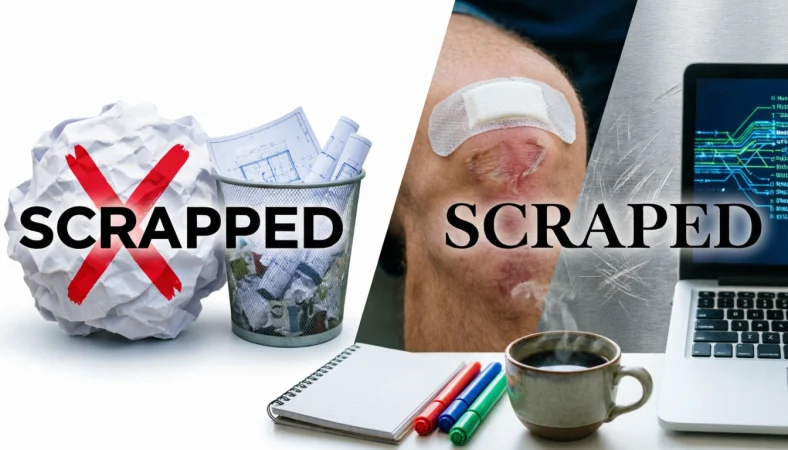
Scraped means to rub or remove something by dragging against a surface, while scrapped means discarded, canceled, or thrown : I scraped my knee. / The old plan was scrapped.
Scrapped or Scraped is a common English wordS both words look and sound similar, but they are used in different situations. Both come from the verb scrap and scrape, which have separate meanings. Understanding this difference helps you choose the right word in writing.
Scraped refers to rubbing, scratching, or removing something from a surface, while scrapped means something has been abandoned, canceled, or discarded. Although the extra “p” changes the meaning, it makes a big difference in correct communication and clear writing
Quick Answer Table
| Aspect | Correct Word Choices |
| Spelling | Scrapped / Scraped (Both are correct, different meanings) |
| Meaning of Scrapped | Discarded, abandoned, or canceled |
| Meaning of Scraped | Rubbed against a rough surface, gathered data |
| When to Use Scrapped | Projects, plans, objects thrown away |
| When to Use Scraped | Injuries, surfaces, web data collection |
| Example of Scrapped | “We scrapped the old furniture.” |
| Example of Scraped | “I scraped my knee on the pavement.” |
Which One Is Correct?
Here is the surprising truth: both “scrapped” and “scraped” are correct spellings. The confusion arises because they sound similar when spoken, but they have distinct meanings and applications.
Scrapped is the past tense of the verb “scrap,” which means to discard, abandon, or cancel something.
Scraped is the past tense of the verb “scrape,” which means to rub against a rough surface or to gather data from digital sources.
The choice between them depends entirely on what you want to say. Neither is wrong, but using them interchangeably would be incorrect because they convey different actions.
Meaning of the Correct Word: Scrapped
Definition and Explanation
Scrapped is the past tense and past participle of the verb “scrap.” The word “scrap” has several related meanings, all revolving around the idea of discarding, abandoning, or breaking down.
When something is scrapped, it has been:
- Thrown away as worthless
- Abandoned or canceled
- Broken down for parts or materials
- Discarded from a plan or schedule
Detailed Usage
The term “scrapped” commonly appears in various contexts:
Business and Project Management
Companies scrap projects that are no longer viable. A product development team might scrap a prototype if testing reveals major flaws. Marketing departments scrap campaigns that are not delivering results.
Everyday Life
People scrap old furniture during home renovations. Someone might scrap their vacation plans due to bad weather. A student might scrap an essay draft and start over.
Manufacturing and Industry
Factories scrap defective products that fail quality control. Scrap metal from demolished buildings is recycled. Automotive shops scrap vehicles that are beyond repair.
Real World Examples
- The construction crew scrapped the original building plans after discovering structural issues.
- We scrapped our dinner reservations and cooked at home instead.
- The company scrapped its expansion plans due to economic uncertainty.
- She scrapped several drafts before settling on the final design.
- The airline scrapped thousands of flights during the pandemic.
- He scrapped his old car and sold the parts individually.
Meaning of the Alternative Word: Scraped
Definition and Explanation
Scraped is the past tense and past participle of the verb “scrape.” Unlike “scrapped,” this word describes physical action involving friction or the collection of digital information.
When something is scraped, it involves:
- Rubbing against a rough surface
- Removing material from a surface
- Gathering data from websites or sources
- Barely managing to achieve something (scraping by)
Detailed Usage
Physical Injuries and Actions
Scraped often describes minor injuries where skin rubs against rough surfaces. A child playing outside might come home with a scraped knee. Someone might scrape their elbow while falling off a bicycle.
Surface Preparation and Maintenance
Painters scrape old paint from walls before repainting. Chefs scrape food residue from cutting boards. Gardeners scrape weeds from pathways.
Digital and Web Contexts
In modern technology, “web scraping” refers to extracting data from websites. Programmers scrape information from online sources for analysis. Data scientists scrape social media for research purposes.
Metaphorical Usage
People can “scrape by” financially, meaning they barely have enough money. Students scrape through exams with minimum passing grades.
Real World Examples
- I scraped my hand on the rough stone wall.
- The chef scraped the burnt bits from the bottom of the pan.
- They scraped the old wallpaper from the bedroom walls.
- The data analyst scraped product prices from competitor websites.
- We scraped together enough money for the down payment.
- She scraped through her final exams with narrow passes.
Key Differences Between Scrapped and Scraped
Spelling Differences
The visual difference is subtle but important. Scrapped” has a double “p,” while “scraped” has only one “p.” This spelling distinction is crucial for correct usage.
Meaning Distinctions
| Aspect | Scrapped | Scraped |
| Core Meaning | Discarded, canceled | Rubbed, abraded |
| Associated Action | Throwing away | Friction or removal |
| Common Contexts | Projects, plans, objects | Injuries, surfaces, data |
| Emotional Tone | Finality, abandonment | Physical sensation, effort |
Pronunciation Guide
Both words are pronounced similarly, which contributes to the confusion.
- Scrapped: /skræpt/ (rhymes with “rapped”)
- Scraped: /skreɪpt/ (rhymes with “taped”)
The main difference lies in the vowel sound. “Scrapped” has a short “a” sound, while “scraped” has a long “a” sound.
Grammatical Usage
Both words function as verbs in their past tense forms. They can also be used as adjectives in past participle form.
Scrapped as Adjective:
The scrapped project documents are in storage.
Scraped as Adjective:
Her scraped elbow needed a bandage.
Recognition and Frequency
Scraped” generally appears more frequently in everyday language because it describes common physical experiences like injuries. “Scrapped” appears more often in business, manufacturing, and project management contexts.
Common Mistakes People Make
The Most Frequent Error
The most common mistake is using “scrapped” when describing a physical injury or surface action. For example, saying “I scrapped my knee” when you actually mean “scraped.” This error stems from the similar pronunciation.
Contextual Confusion
People often confuse the terms when writing quickly or without careful proofreading. Automated spell checkers may not catch the error because both words are correctly spelled.
Overcorrection
Some writers, aware of the confusion, accidentally use “scraped” when they mean “scrapped,” thinking it looks more professional or formal. Overcorrection can be just as problematic.
Data and Technology Contexts
In technical writing about web data extraction, some writers mistakenly use “scrapped” instead of “scraped.” Web scraping is a specific technical term, and using “scrapped” in this context changes the meaning entirely.
Correct Usage Examples
Casual Examples
- I scrapped my plans to go to the beach because of the rain.
- She scraped her knee while rollerblading in the park.
- We scrapped the old couch and bought a new one.
- He scraped the ice off his windshield before driving.
Professional Examples
- The board scrapped the merger after reviewing the financial projections.
- Our IT department scrapes customer reviews from competitor websites for market analysis.
- Management scrapped the software upgrade due to compatibility issues.
- The web scraping tool extracted thousands of data points in just minutes.
Educational Examples
- The student scrapped her original thesis topic after preliminary research.
- Researchers scraped historical weather records from government databases.
- The art class scrapped their ceramics projects that cracked during firing.
- Geology students scraped rock samples for mineral identification.
Literary and Metaphorical Examples
- They scrapped their shared dreams and went their separate ways.
- She scraped together the fragments of her broken heart.
- The company scrapped its traditional values in favor of modern approaches.
- He scraped through life with minimal effort and maximum luck.
Word Origin and Etymology
Origins of Scrap
The word “scrap” traces back to the Old Norse word “skrap,” meaning a small piece or fragment. The verb form developed in English during the 15th century, initially meaning to break into pieces. By the 19th century, it had evolved to mean discarding or abandoning.
The agricultural and manufacturing contexts of “scrap” reflect its historical roots in physical material handling. Iron and metal scraps were collected and recycled long before the modern environmental movement.
Origins of Scrape
“Scrape” comes from the Old English “scrapian,” meaning to scratch or rub. Its roots extend to the Old Norse “skrapa,” which also meant to scrape. The word has maintained a consistent meaning throughout its history in English.
The digital adaptation of “scrape” emerged in the late 20th century with the rise of data collection technology. The visual similarity between manually scraping surfaces and extracting digital data made the metaphor natural.
Historical Usage Patterns
Historically, “scrape” has been the more commonly used word in English literature. “Scrap” gained prominence with industrialization and the rise of recycling and manufacturing waste management.
Why the Incorrect Version Became Popular
Pronunciation Driven Confusion
The confusion between “scrapped” and “scraped” is primarily driven by their similar pronunciation. In casual conversation, listeners often cannot distinguish between them, leading to spelling errors in writing.
Auto Correction Issues
Modern spell checkers sometimes fail to flag incorrect usage because both words exist in the dictionary. This technological gap allows errors to persist, particularly in informal digital communication.
Written Communication Speed
In fast paced writing environments, such as texting, email, or social media, people often type quickly and rely on spell checkers for correction. The similar appearance of the words makes errors more likely.
Regional Speech Patterns
In some English dialects, the pronunciation distinction between the short and long “a” sound is less pronounced, making the words sound even more similar. This regional variation contributes to the confusion.
Easy Memory Tricks
The Double P Trick
Remember that “scrapped” has two P’s, and if you scrap something, you are putting an end to it. The second P stands for “putting a stop” or “pausing” the project or plan.
The Surface Connection
Connect “scraped” with surfaces. When you scrape something, you are rubbing against a surface or removing material from one. Both “scraped” and “surface” contain the letter “A” with a long sound.
The Project Ending Trick
Think of “scrapped” as “scrap + ped” and associate it with throwing things away. If you can imagine something being thrown into a scrap heap, it has been scrapped.
Technology Reminder
For data collection contexts, remember that web scraping involves extracting from digital surfaces. The “A” in “scraped” aligns with “access” and “acquire” data.
Visual Imagery
Picture a piece of paper being crumpled and thrown away for “scrapped.” Picture a knee being rubbed against pavement for “scraped.” The mental image helps reinforce the correct spelling.
FAQs
1. Are scrapped and scraped both real words?
Yes, both are correct words but have different meanings.
2. What does scrapped mean?
Scrapped means canceled, abandoned, or thrown away.
3. What does scraped mean?
Scraped means rubbed, scratched, or removed from a surface.
4. Is it web scraping or web scrapping?
The correct term is web scraping (one p).
5. Can scrapped and scraped be used interchangeably?
No, they have different meanings and cannot replace each other.
6. How do I remember scrapped vs scraped?
Scrapped = stopped/canceled; scraped = surface contact or removal.
7. Which one is for a skin injury?
Use scraped: “I scraped my knee.”
8. Which one is for canceling a project?
Use scrapped: “The project was scrapped.”
9. Why are they confusing?
Because they look and sound very similar.
10. Do scrapped and scraped have different pronunciations?
Yes, scraped has a longer “a” sound; scrapped has a shorter sound.
Conclusion
The difference between scrapped and scraped becomes simple once you understand their meanings. Although they look and sound similar, they are used in completely different situations. Scrapped refers to something canceled, abandoned, or discarded, while scraped means rubbed, scratched, or removed from a surface.
Remember the easy rule: scrapped = stopped or thrown away, and scraped = touched, scratched, or collected. By keeping this small spelling difference in mind, you can avoid confusion and make your writing clearer, more accurate, and more profession.